NetApp ONTAP with Amazon S3 integration transforms how enterprises handle their data storage needs by combining on-premises performance with cloud scalability. This hybrid cloud storage solution lets you keep frequently accessed data close to your applications while automatically moving older files to cost-effective cloud storage.
This guide is designed for IT administrators, storage engineers, and enterprise architects who need to understand how NetApp S3 integration works and whether it fits their organization’s requirements. We’ll break down the technical concepts without the jargon and show you exactly what this technology can do for your business.
You’ll discover the core hybrid storage benefits that make this combination so powerful for modern enterprises, including reduced costs, improved data accessibility, and simplified management across your entire storage infrastructure. We’ll also walk through the complete NetApp cloud deployment process, covering everything from initial planning to security considerations that keep your data protected across both environments.
By the end, you’ll have a clear roadmap for implementing ONTAP cloud tiering and understand whether this enterprise hybrid storage approach aligns with your organization’s data strategy and budget requirements.
Understanding NetApp ONTAP and Amazon S3 Integration

Core components of NetApp ONTAP storage management
NetApp ONTAP serves as the foundation of enterprise storage infrastructure, offering a sophisticated data management platform that handles everything from file systems to block storage. At its heart, ONTAP operates on a clustered architecture that combines multiple storage nodes into a single, scalable system. The platform manages data through Storage Virtual Machines (SVMs), which create isolated environments for different applications or tenants while sharing the underlying physical resources.
The system’s data protection capabilities stand out through features like snapshots, cloning, and replication. ONTAP automatically creates point-in-time copies of data without consuming additional storage space initially, thanks to its copy-on-write technology. The deduplication and compression features work behind the scenes to optimize storage efficiency, often reducing storage requirements by 50% or more.
ONTAP’s Quality of Service (QoS) engine ensures critical workloads get the performance they need while preventing resource-hungry applications from monopolizing system resources. The platform also includes advanced analytics that provide real-time insights into storage performance, capacity trends, and potential issues before they impact operations.
Amazon S3 cloud storage fundamentals
Amazon S3 revolutionized cloud storage by providing virtually unlimited scalability through its object storage architecture. Unlike traditional file systems that organize data hierarchically, S3 stores objects in flat namespaces called buckets. Each object gets a unique identifier, making it accessible from anywhere on the internet through REST APIs.
S3’s durability design targets 99.999999999% (11 9’s) by automatically replicating data across multiple facilities and devices within an AWS region. The service offers multiple storage classes to match different access patterns and cost requirements. S3 Standard provides immediate access for frequently used data, while S3 Glacier and Glacier Deep Archive offer cost-effective solutions for long-term retention.
The platform handles security through multiple layers, including bucket policies, Access Control Lists (ACLs), and integration with AWS Identity and Access Management (IAM). S3 also supports server-side encryption and client-side encryption options to protect data both in transit and at rest.
How ONTAP and S3 work together seamlessly
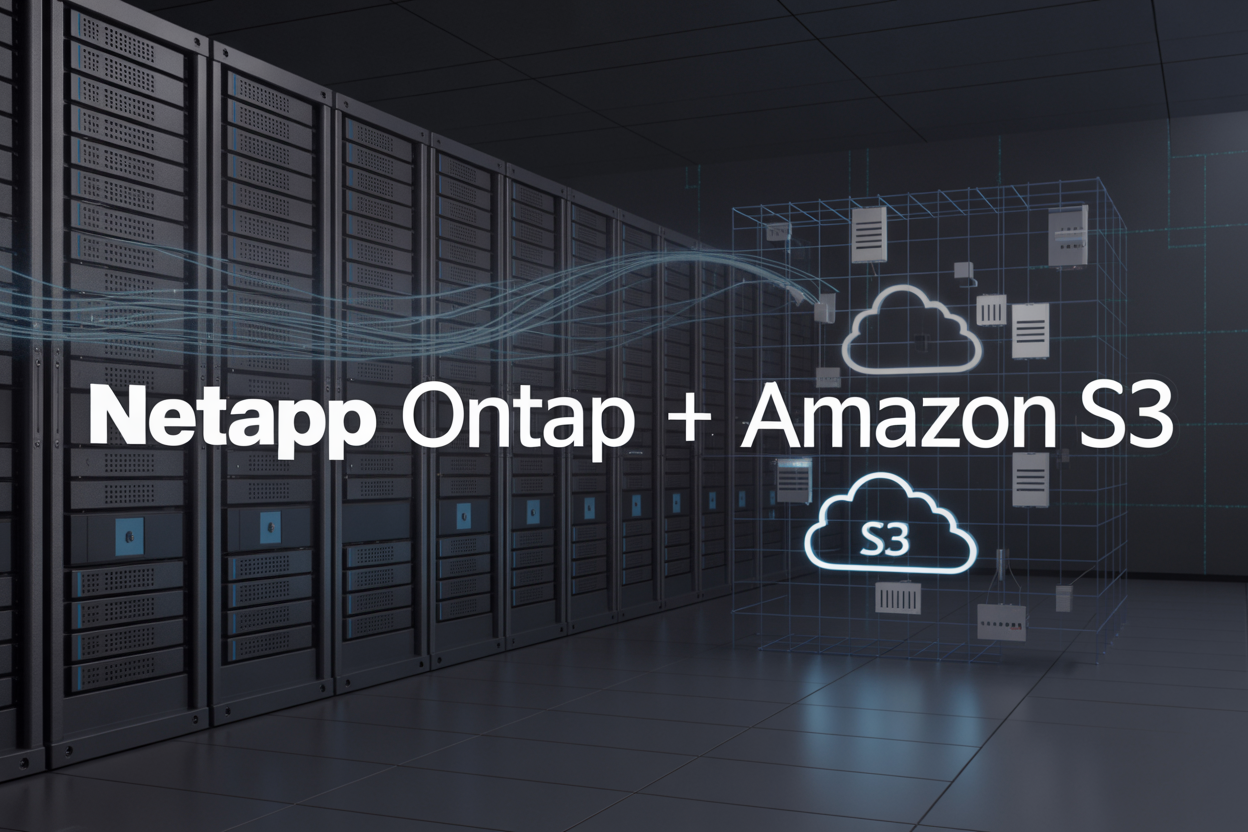
The NetApp ONTAP Amazon S3 integration creates a hybrid storage environment that combines on-premises performance with cloud scalability. ONTAP’s FabricPool technology automatically identifies cold data that hasn’t been accessed recently and moves it to S3 storage tiers. This process happens transparently to applications and users, who continue accessing data as if it remained on local storage.
When applications request data that has been tiered to S3, ONTAP retrieves it automatically and caches frequently accessed blocks locally for optimal performance. The system maintains metadata locally, ensuring fast directory listings and file system operations even when the actual data resides in the cloud.
The integration supports multiple S3 storage classes, allowing organizations to optimize costs based on data access patterns. Recently accessed data might stay in S3 Standard, while older archives can automatically move to Glacier storage classes for long-term retention at lower costs.
Key technical architecture behind the integration
The hybrid storage benefits become possible through ONTAP’s sophisticated data management layer that sits between applications and storage destinations. The system uses intelligent algorithms to analyze data access patterns and make tiering decisions based on configurable policies. Organizations can set thresholds for data age, access frequency, or storage capacity to trigger automatic cloud tiering.
ONTAP maintains a local cache of recently accessed data blocks, ensuring that performance-sensitive workloads don’t experience latency when accessing tiered data. The cache size is configurable and dynamically adjusts based on workload patterns and available local storage capacity.
Security flows through the entire architecture, with data encrypted both in flight to S3 and at rest in cloud storage. ONTAP handles the encryption keys and ensures that data remains protected according to enterprise security policies throughout its lifecycle, whether stored on-premises or in the cloud.
The networking architecture uses efficient data transfer protocols optimized for WAN connections, including compression and bandwidth throttling capabilities to prevent cloud synchronization from impacting production network performance.
Hybrid Storage Benefits for Modern Enterprises

Cost optimization through intelligent data tiering
NetApp ONTAP Amazon S3 integration delivers powerful cost optimization through automated data tiering that adapts to your business needs. The system intelligently moves cold data to Amazon S3 storage classes while keeping hot data on high-performance local storage, creating a perfect balance between performance and cost efficiency.
Automated tiering policies analyze data access patterns and automatically shift infrequently accessed files to S3 Glacier or S3 Intelligent-Tiering. This process happens seamlessly without disrupting user workflows or requiring manual intervention from IT teams. Organizations typically see 30-70% reduction in storage costs within the first year of deployment.
Dynamic storage optimization ensures that your most critical data remains readily accessible on premium NetApp storage while archival data moves to cost-effective cloud tiers. The ONTAP cloud tiering engine continuously monitors data temperatures and makes intelligent decisions about where each dataset should live.
Key cost benefits include:
- Reduced on-premises storage infrastructure requirements
- Lower operational expenses through automation
- Pay-as-you-grow pricing model for cloud storage
- Elimination of manual data migration tasks
- Optimized backup and archival storage costs
Enhanced data protection and disaster recovery capabilities
Hybrid storage benefits extend far beyond cost savings when combining NetApp ONTAP with Amazon S3. The integration creates multiple layers of data protection that traditional single-vendor solutions simply cannot match.
Multi-site data replication becomes effortless with ONTAP’s SnapMirror technology working alongside S3’s geographic distribution. Your data automatically replicates across multiple AWS regions, providing robust protection against site-level disasters while maintaining strict recovery time objectives.
Immutable backup strategies leverage S3 Object Lock capabilities combined with NetApp’s snapshot technology. This creates tamper-proof backup copies that protect against ransomware attacks and accidental deletions. The hybrid approach ensures you always have multiple recovery points across different infrastructure layers.
Granular recovery options give administrators flexibility to restore everything from individual files to entire volumes. The S3 hybrid architecture allows for point-in-time recovery from local snapshots for immediate needs, while cloud-based replicas handle major disaster scenarios.
Protection advantages include:
- 99.999999999% (11 9’s) durability for cloud-stored data
- Cross-region replication for geographic redundancy
- Versioning and lifecycle management automation
- Rapid local recovery combined with comprehensive cloud backup
- Air-gapped protection through cloud isolation
Improved scalability and flexibility for growing businesses
Enterprise hybrid storage solutions built on NetApp ONTAP Amazon S3 integration provide unprecedented scalability that grows with your business demands. Unlike traditional storage architectures that require expensive forklift upgrades, this hybrid approach scales seamlessly from terabytes to exabytes.
Elastic capacity expansion happens automatically as data volumes increase. When local ONTAP systems reach capacity thresholds, the system transparently extends storage into Amazon S3 without service interruptions. This eliminates the need for emergency hardware purchases and complex migration projects.
Multi-protocol support ensures that your hybrid storage infrastructure accommodates diverse application requirements. Whether dealing with NFS, CIFS, iSCSI, or S3 API calls, the integrated platform handles multiple protocols simultaneously while maintaining consistent data management policies.
Global accessibility becomes reality through S3’s worldwide infrastructure combined with ONTAP’s data management capabilities. Remote offices access the same datasets through optimized cloud endpoints while maintaining centralized control and security policies.
Scalability features include:
- Instant capacity scaling without hardware procurement delays
- Support for petabyte-scale data growth
- Global data distribution and access optimization
- Mixed workload consolidation on unified platforms
- Future-proof architecture supporting emerging technologies
- Simplified management across hybrid environments
The NetApp cloud storage solutions integrated with S3 eliminate traditional storage silos and create a unified data fabric that adapts to changing business requirements while maintaining enterprise-grade performance and reliability.
Real-World Use Cases and Performance Advantages

Backup and archival solutions for enterprise data
NetApp ONTAP Amazon S3 integration creates powerful backup and archival capabilities that transform how organizations protect their critical data. Companies can automatically tier cold data from high-performance ONTAP storage to cost-effective S3 storage tiers, reducing on-premises storage costs by up to 70% while maintaining instant accessibility when needed.
The hybrid cloud storage approach allows organizations to implement sophisticated data lifecycle policies. Active data remains on fast ONTAP arrays for immediate access, while older files seamlessly move to S3 Intelligent-Tiering or Glacier storage classes based on predefined rules. This automatic tiering eliminates manual data management overhead and ensures compliance with retention policies.
Financial services companies frequently leverage this setup for regulatory compliance, keeping trading records and transaction logs readily accessible on ONTAP while archiving historical data to S3. The integration maintains data consistency and provides unified management through ONTAP System Manager, simplifying backup operations across hybrid environments.
Data analytics workloads with cloud bursting capabilities
Modern analytics workloads benefit tremendously from NetApp S3 integration through dynamic scaling capabilities. During peak processing periods, organizations can burst compute workloads to AWS while keeping datasets synchronized between ONTAP and S3 storage. This approach prevents expensive over-provisioning of on-premises infrastructure while maintaining performance during demand spikes.
Data science teams particularly value the ability to process large datasets in the cloud without complex data migration procedures. ONTAP cloud tiering automatically places frequently accessed datasets on high-performance storage while keeping complete historical datasets available in S3. Machine learning pipelines can access both hot and cold data seamlessly, accelerating time-to-insight.
Manufacturing companies use this architecture for predictive maintenance analytics, processing sensor data locally on ONTAP while leveraging AWS machine learning services for complex pattern recognition. The hybrid storage benefits include reduced data transfer costs and improved processing speeds compared to traditional cloud-only approaches.
Content distribution and media storage optimization
Media and entertainment organizations find exceptional value in ONTAP Amazon integration for content workflows. High-resolution video files require fast access during editing phases but consume enormous storage capacity when projects complete. The hybrid architecture automatically moves active projects to high-performance ONTAP storage while archiving finished content to S3.
Content distribution networks benefit from this setup by maintaining popular content on ONTAP edge locations while storing the complete content library in S3. This approach reduces content delivery latency for frequently accessed files while maintaining cost-effective storage for the entire catalog.
Broadcast companies often implement this solution for live event coverage, capturing content to ONTAP arrays for immediate editing while simultaneously replicating to S3 for backup and distribution. The enterprise hybrid storage model ensures content availability across multiple locations without manual intervention.
Development and testing environment efficiencies
Development teams gain significant productivity improvements through ONTAP cloud deployment strategies that leverage S3 storage. Test environments can quickly provision from S3-stored golden images while maintaining development databases on high-performance ONTAP storage. This approach reduces environment spin-up times from hours to minutes.
Software companies use this architecture for continuous integration pipelines, storing build artifacts and test data in S3 while keeping active development environments on ONTAP. The NetApp cloud storage solutions provide consistent performance for developers while automatically managing storage costs through intelligent tiering.
Database administrators particularly appreciate the ability to refresh test environments with production-like data stored in S3, while maintaining development databases on ONTAP for optimal performance. This hybrid approach eliminates the traditional trade-off between storage costs and development environment fidelity, enabling more thorough testing cycles without budget constraints.
Step-by-Step Deployment Process

Prerequisites and system requirements assessment
Before diving into NetApp ONTAP Amazon S3 integration, you need to check several technical requirements. Your ONTAP system should be running version 9.2 or later to support FabricPool functionality. Make sure you have sufficient storage space on your primary tier for active data and verify that your network bandwidth can handle data transfers to Amazon S3.
Your AWS account needs proper IAM permissions configured for S3 access, including bucket creation, object read/write operations, and lifecycle management. Create a dedicated S3 bucket in the AWS region closest to your ONTAP cluster to minimize latency and data transfer costs.
Check that your ONTAP cluster has internet connectivity and can reach AWS S3 endpoints. If you’re working in a restricted network environment, configure the necessary firewall rules to allow HTTPS traffic on port 443 to AWS S3 services.
Configuring ONTAP FabricPool for S3 connectivity
Setting up the connection between your ONTAP system and Amazon S3 starts with creating the cloud tier configuration. Access your ONTAP System Manager or use the CLI to add Amazon S3 as an object store.
Navigate to the storage configuration section and select “Add Cloud Tier.” Choose Amazon S3 as your cloud provider and enter your S3 bucket details, including the bucket name, AWS region, and access credentials. Create dedicated AWS access keys specifically for this integration rather than using your root account credentials.
Configure the SSL certificate verification settings to ensure secure communication between ONTAP and S3. Most deployments work well with the default SSL settings, but you can customize certificate validation based on your security requirements.
Test the connection to verify that your ONTAP cluster can successfully communicate with the S3 bucket. The system will perform a connectivity check and confirm that all authentication parameters are working correctly.
Setting up data tiering policies and automation rules
Data tiering policies determine which data moves between your local ONTAP storage and Amazon S3. Create tiering policies based on data access patterns, age, and business requirements. The most common policy is “auto,” which moves cold data to S3 after a specified period of inactivity.
Define the cooling period for your data – typically 31 days for most enterprise workloads, though this can range from 2 to 183 days depending on your needs. Data that hasn’t been accessed within this timeframe automatically moves to the S3 cloud tier.
Set up volume-specific tiering policies through the FabricPool interface. You can apply different policies to different volumes based on their purpose. For example, backup volumes might use aggressive tiering policies, while database volumes might keep more data on the local tier.
Configure space reclamation settings to automatically free up local storage as data moves to S3. This helps maintain optimal performance on your primary storage while maximizing the cost benefits of hybrid storage.
Testing and validating the hybrid storage environment
Start your validation process by creating test volumes and applying your configured tiering policies. Generate sample data with known access patterns to verify that the tiering automation works as expected. Monitor how long it takes for inactive data to move to S3 and ensure the cooling periods align with your policy settings.
Test data retrieval performance by accessing files that have been tiered to S3. Measure the response times for different file sizes and types to establish baseline performance metrics. This helps you understand how the hybrid storage environment will impact user experience.
Perform failover testing to ensure your hybrid storage continues operating if connectivity to S3 is temporarily lost. ONTAP should gracefully handle network interruptions and queue data for tiering once connectivity resumes.
Run capacity planning tests by monitoring storage usage patterns and cloud costs. Track how much data tiers to S3 over time and validate that you’re achieving the expected cost savings from your hybrid cloud storage deployment.
Monitoring and optimization best practices
Implement regular monitoring of your NetApp ONTAP Amazon S3 integration using both ONTAP System Manager and AWS CloudWatch. Set up alerts for unusual tiering activity, connectivity issues, or unexpected storage costs.
Review your tiering policies quarterly to ensure they still match your data access patterns. Business requirements change over time, and your tiering configuration should evolve accordingly. Look for opportunities to adjust cooling periods or modify policies for better cost optimization.
Monitor S3 storage costs closely, especially during the first few months after deployment. Track data transfer charges and storage costs to validate that your hybrid storage architecture delivers the expected financial benefits. Use AWS Cost Explorer to analyze spending patterns and identify optimization opportunities.
Keep your ONTAP software updated to take advantage of new FabricPool features and performance improvements. NetApp regularly releases enhancements that can improve the efficiency of your hybrid storage environment and reduce cloud storage costs.
Security and Compliance Considerations

Data Encryption in Transit and At Rest
NetApp ONTAP Amazon S3 integration provides robust encryption capabilities that protect your data throughout its entire lifecycle. When data moves between your on-premises ONTAP systems and Amazon S3, it travels through encrypted channels using TLS 1.2 or higher protocols. This encryption ensures that even if traffic gets intercepted during transmission, the data remains completely unreadable.
For data at rest, the system offers multiple encryption layers. Your data gets automatically encrypted using AES-256 encryption before it reaches Amazon S3. ONTAP’s native NetApp Storage Encryption (NSE) works seamlessly with AWS Key Management Service (KMS) to manage encryption keys. You can also implement client-side encryption where data gets encrypted at the ONTAP level before any transmission occurs.
The hybrid cloud storage architecture supports both AWS-managed keys and customer-managed keys, giving you complete control over encryption key management. ONTAP cloud tiering automatically handles encryption key rotation and management, reducing the administrative burden on your IT teams while maintaining the highest security standards.
Access Control and Identity Management
Managing access across your NetApp ONTAP Amazon S3 hybrid environment requires a multi-layered approach that integrates with your existing identity management systems. ONTAP supports role-based access control (RBAC) that works alongside AWS Identity and Access Management (IAM) policies to create comprehensive access governance.
Your existing Active Directory or LDAP systems integrate directly with the hybrid storage architecture, allowing users to maintain their current credentials while accessing both on-premises and cloud resources. The system supports multi-factor authentication (MFA) and single sign-on (SSO) capabilities that extend across the entire hybrid infrastructure.
Access controls can be configured at multiple levels:
- Volume-level permissions for ONTAP storage
- Bucket-level policies in Amazon S3
- Object-level access controls for granular security
- Network-level restrictions using security groups and VPCs
The NetApp S3 integration maintains detailed audit logs that track every access attempt, data movement, and configuration change across both environments. These logs integrate with AWS CloudTrail and can feed into your existing security information and event management (SIEM) systems for centralized monitoring.
Regulatory Compliance Requirements and Certifications
Enterprise hybrid storage solutions must meet stringent regulatory requirements, and the NetApp cloud storage solutions architecture addresses these needs comprehensively. The platform maintains compliance with major frameworks including SOC 2 Type II, ISO 27001, HIPAA, PCI DSS, and FedRAMP depending on your deployment configuration.
Data residency requirements get handled through careful configuration of your ONTAP Amazon integration guide settings. You can specify exactly which data gets tiered to specific AWS regions, ensuring compliance with local data protection laws like GDPR or industry-specific regulations. The system maintains detailed data lineage tracking so you always know where your data resides and how it moves through the hybrid environment.
For organizations in highly regulated industries, the platform supports immutable storage configurations that prevent data modification or deletion for specified retention periods. This capability works across both ONTAP and S3, creating a unified compliance posture for your entire data estate.
The hybrid architecture automatically generates compliance reports that document encryption status, access patterns, and data movement activities. These reports can be customized to meet specific auditing requirements and integrate with your existing compliance management tools. Regular third-party security assessments validate the platform’s security controls and provide additional assurance for compliance officers and auditors.

NetApp ONTAP’s integration with Amazon S3 opens up powerful possibilities for businesses looking to modernize their storage infrastructure. The hybrid approach combines the reliability and performance of on-premises ONTAP systems with the scalability and cost-effectiveness of cloud storage. This setup delivers real benefits like improved data tiering, seamless backup operations, and the flexibility to handle both structured and unstructured data across environments.
Getting started with this integration doesn’t have to be complicated when you follow the right deployment steps and keep security best practices in mind. The key is understanding your specific use cases and designing a solution that matches your performance requirements and compliance needs. If you’re dealing with growing data volumes or looking for ways to optimize storage costs while maintaining enterprise-grade features, this hybrid storage approach could be exactly what your organization needs to stay competitive and agile in today’s data-driven landscape.