100 AI Use Cases for State Governments: Real Applications That Are Already Working
State government leaders, agency directors, and public sector technology teams are under constant pressure to do more with less. If you’re looking for practical AI use cases for government that go beyond the buzzwords, you’re in the right place.
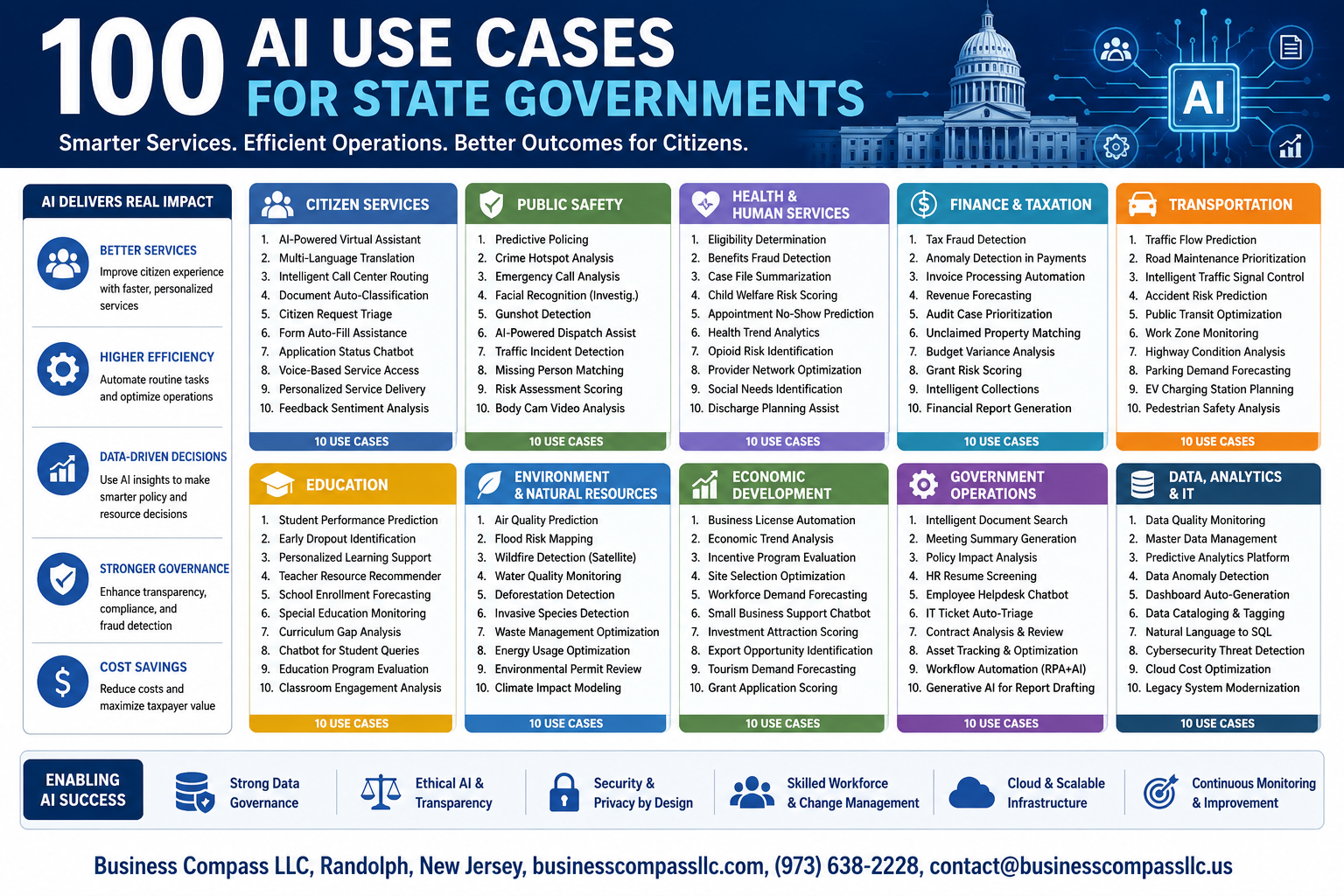
This guide breaks down 100 real-world state government AI applications across ten key areas — from AI for citizen services to AI in public safety and AI-driven policy making. You’ll see exactly how agencies are cutting costs, reducing backlogs, and delivering faster results to residents.
Here’s a quick look at what we’ll cover:
- Transforming citizen services — how artificial intelligence in public administration is slashing wait times and personalizing the resident experience at scale
- Strengthening public safety — the way machine learning for state agencies is helping law enforcement, emergency responders, and disaster management teams stay ahead of crises
- Modernizing healthcare and human services — where AI in healthcare delivery is helping states close coverage gaps and get benefits to people faster
No fluff, no vague promises. Just a practical look at how smart government technology is already changing the way states operate — and what your agency can start doing today.
Transforming Public Administration with AI
Automating Routine Document Processing to Save Staff Hours
State government offices handle mountains of paperwork every single day — applications, forms, reports, compliance documents, you name it. Traditionally, processing all of this has meant teams of staff manually reviewing, sorting, and entering data, which is time-consuming and prone to human error. AI is changing that picture dramatically.
Intelligent Document Processing (IDP) tools powered by machine learning can now read, classify, and extract data from both structured and unstructured documents with remarkable accuracy. Whether it’s a scanned PDF, a handwritten form, or an uploaded image, AI systems can pull the relevant information and route it to the right department automatically.
Here’s what that looks like in practice:
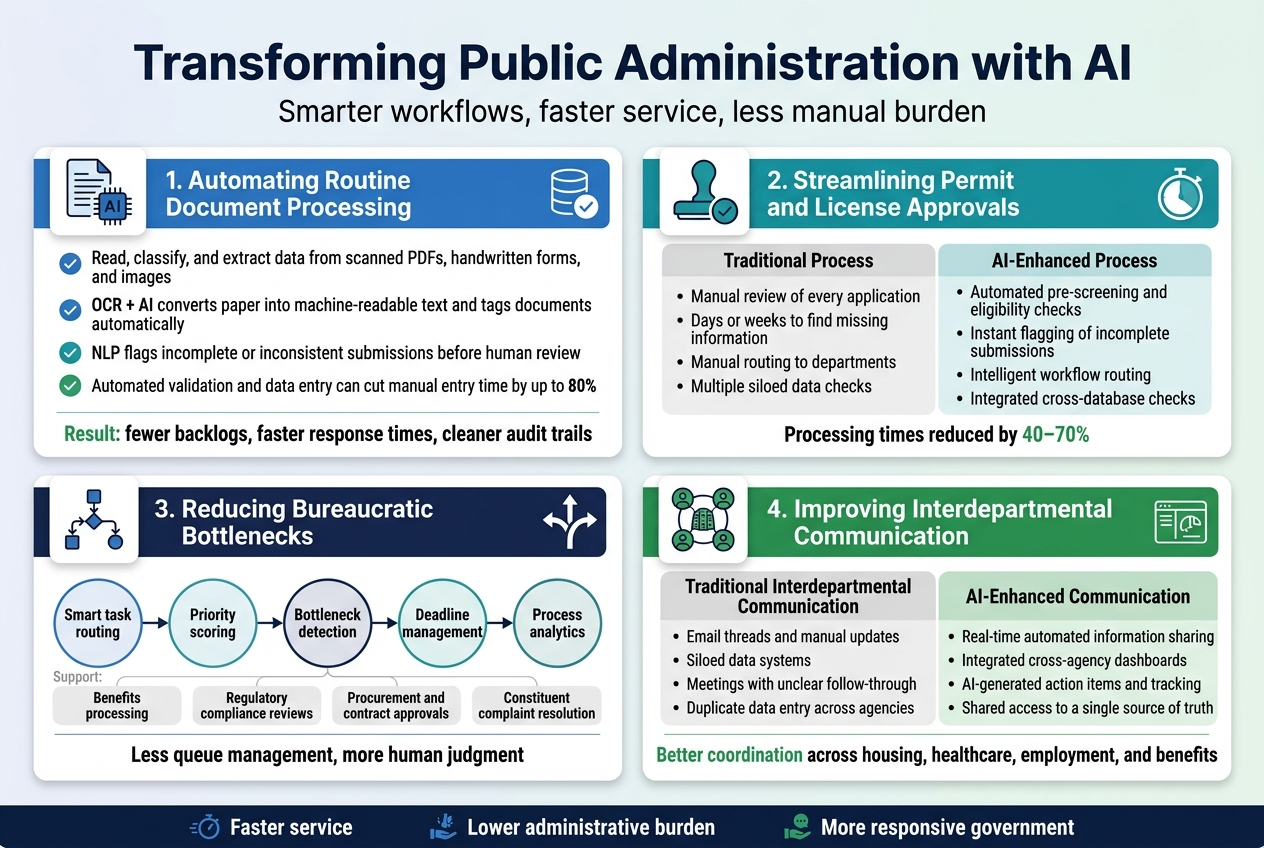
- Optical Character Recognition (OCR) + AI: Converts physical or scanned documents into machine-readable text, then categorizes and tags them without human intervention.
- Natural Language Processing (NLP): Reads and interprets written content to identify key data points, flagging incomplete or inconsistent submissions before they even reach a human reviewer.
- Automated data entry: Pulls extracted information directly into state databases or case management systems, cutting manual entry time by as much as 80%.
- Document validation workflows: Cross-checks submitted documents against existing records or regulatory requirements in seconds.
The payoff for state agencies is significant. Staff who previously spent hours on data entry can redirect their energy toward higher-value work — constituent outreach, policy analysis, and complex case management. For a mid-sized state agency processing thousands of documents monthly, AI-driven automation can recover hundreds of staff hours per week.
Beyond efficiency, automated document processing reduces backlogs, speeds up response times for constituents, and creates a cleaner, more auditable digital paper trail. These are exactly the kinds of wins that make artificial intelligence in public administration a practical priority rather than a distant aspiration.
Streamlining Permit and License Approvals for Faster Service
If you’ve ever tried to get a building permit, a business license, or a professional certification from a state agency, you know the drill. You fill out forms, wait days or weeks for a response, get asked for more documentation, wait again. It’s frustrating for residents and businesses — and it’s largely unnecessary in a world where AI can do much of the heavy lifting.
AI-powered permitting and licensing platforms are giving state governments a way to dramatically cut approval timelines without sacrificing compliance or accuracy.
How AI speeds up permit and license approvals:
| Traditional Process | AI-Enhanced Process |
|---|---|
| Manual review of every application | Automated pre-screening and eligibility checks |
| Days or weeks to identify missing information | Instant flagging of incomplete submissions |
| Human staff routing applications to correct departments | Intelligent workflow routing based on application type |
| Siloed systems requiring multiple data checks | Integrated AI cross-referencing across databases |
| Limited self-service options for applicants | 24/7 AI-guided application portals |
AI systems can screen incoming applications the moment they’re submitted, checking for completeness, verifying supporting documents, and even running background or compliance checks against state databases — all before a human reviewer sees the file. Applications that meet all criteria can be fast-tracked automatically, with approvals issued in hours instead of days.
For more complex applications requiring human judgment, AI handles the groundwork — gathering and organizing relevant data, flagging potential issues, and presenting reviewers with a clean summary rather than a pile of raw documents. This means human staff can focus their attention where it actually matters.
State government AI applications like these are already delivering measurable results. States that have piloted AI-assisted permitting report reductions in processing times of 40–70%, along with notable drops in application error rates. Businesses get faster access to licenses they need to operate. Residents get quicker responses on permits for home renovations, vehicles, and more.
Key benefits for state agencies:
- Shorter approval timelines improve resident and business satisfaction
- Reduced administrative burden on frontline staff
- Fewer errors and omissions in processed applications
- Better compliance tracking and audit readiness
- More consistent application of regulations across all submissions
When state agencies shorten the time it takes to get permits and licenses approved, it sends a strong signal to businesses and residents that the government is responsive, modern, and serious about reducing friction in everyday interactions.
Reducing Bureaucratic Bottlenecks Through Intelligent Workflow Management
Bureaucratic bottlenecks aren’t just annoying — they cost real money and erode public trust. When a case sits in a queue for days because it’s waiting on one approver, or when a request bounces between departments because no one is sure who owns it, the entire system loses credibility. Intelligent workflow management powered by AI is one of the most practical fixes available to state governments today.
At its core, AI-driven workflow management means giving software the ability to understand what needs to happen next in a process, who should handle it, and how to keep things moving without constant human nudging.
What intelligent workflow management actually does:
- Smart task routing: AI analyzes the nature of each incoming request and automatically assigns it to the right team or individual based on workload, expertise, and urgency — no more manual triage.
- Priority scoring: Machine learning models assess the complexity and time-sensitivity of tasks and rank them accordingly, so nothing critical falls through the cracks.
- Bottleneck detection: AI monitors process flows in real time, identifies where work is piling up, and alerts supervisors or automatically redistributes tasks to prevent delays.
- Deadline management: Automated reminders, escalations, and status updates keep processes on track without requiring managers to manually chase down every open item.
- Process analytics: AI tools generate detailed reports on workflow performance, showing where time is being lost and which steps are candidates for further automation.
One of the most powerful things about AI use cases for government workflows is the combination of speed and consistency. Human managers can only oversee so many processes at once. AI systems monitor everything simultaneously, flagging anomalies and inefficiencies the moment they appear.
Real-world workflow scenarios where AI adds immediate value:
- Benefits processing: Applications for state assistance programs often touch multiple agencies. AI routes each step to the right handler and ensures nothing stalls between departments.
- Regulatory compliance reviews: AI tracks review deadlines, sends reminders, and escalates overdue items to supervisors automatically.
- Procurement and contract approvals: Multi-step approval chains are monitored end-to-end, with AI flagging delays and identifying approval stages that consistently slow things down.
- Constituent complaint resolution: Incoming complaints are categorized, prioritized, and routed to the appropriate department without requiring a staff member to read and sort each one manually.
The cultural shift that comes with intelligent workflow management is just as important as the technical one. When staff spend less time managing queues and chasing approvals, they have more bandwidth to focus on work that actually requires human judgment. That’s better for morale, better for productivity, and better for the people the government serves.
Improving Interdepartmental Communication with AI-Powered Platforms
State governments are large, complex organizations where different agencies often operate like separate islands. The Department of Health doesn’t always talk to the Department of Social Services. The Department of Transportation doesn’t always share data with the Department of Environmental Quality. This fragmentation creates blind spots, duplicated work, and missed opportunities to serve residents more effectively.
AI-powered communication and collaboration platforms are helping break down these silos by making it easier for agencies to share information, coordinate on shared goals, and stay aligned without relying on endless email chains and manual reporting.
Where AI-powered platforms make the biggest difference:
- Unified dashboards: AI aggregates data from multiple agency systems into a single view, giving leadership across departments a shared understanding of what’s happening without requiring everyone to log into five different portals.
- Automated cross-agency reporting: Instead of each department manually compiling and sending status updates, AI generates and distributes reports on a scheduled or triggered basis — pulling live data and formatting it for the relevant audience.
- Intelligent meeting assistance: AI tools that summarize meetings, generate action items, and track follow-through mean that cross-departmental conversations actually lead to coordinated action rather than forgotten commitments.
- Shared knowledge bases: AI-powered knowledge management systems learn from documents, policies, and past decisions across agencies and make that information searchable and accessible to staff who need it.
- Proactive alerts and notifications: AI monitors data streams across departments and automatically notifies relevant teams when something requires their attention — for example, alerting social services when health data flags a vulnerable individual who may need additional support.
Smart government technology that connects agencies doesn’t just improve internal operations. It creates better outcomes for residents, who often interact with multiple state services at once. When the departments handling housing, healthcare, employment, and benefits can share relevant information and coordinate their responses, people in need get faster, more comprehensive help.
Comparing communication approaches:
| Traditional Interdepartmental Communication | AI-Enhanced Communication |
|---|---|
| Email threads and manual updates | Real-time, automated information sharing |
| Siloed data systems | Integrated cross-agency dashboards |
| Meetings with unclear follow-through | AI-generated action items and accountability tracking |
| Duplicate data entry across agencies | Single source of truth with shared access |
| Reactive coordination (responding to problems) | Proactive coordination (anticipating needs) |
Getting interdepartmental communication right is one of the most overlooked AI use cases for government. The technology doesn’t need to be flashy or complicated. Even relatively simple AI tools that connect existing systems and reduce the friction of sharing information can have an outsized impact on how effectively a state government operates as a whole.
Enhancing Citizen Services and Engagement
Deploying AI Chatbots for 24/7 Constituent Support
State governments handle thousands of citizen inquiries every single day — questions about driver’s license renewals, tax deadlines, benefit eligibility, permit applications, and much more. Traditional call centers struggle to keep up, leading to long hold times, frustrated residents, and overworked staff. AI-powered chatbots are changing that dynamic in a big way.
Modern AI chatbots built for government portals can handle a wide range of constituent interactions around the clock, without anyone needing to be on the other end of the phone. These aren’t the clunky, scripted bots of a decade ago. Today’s solutions use natural language processing (NLP) to understand how people actually talk and write — including shorthand, typos, and regional phrasing.
What AI Chatbots Can Do for State Agencies
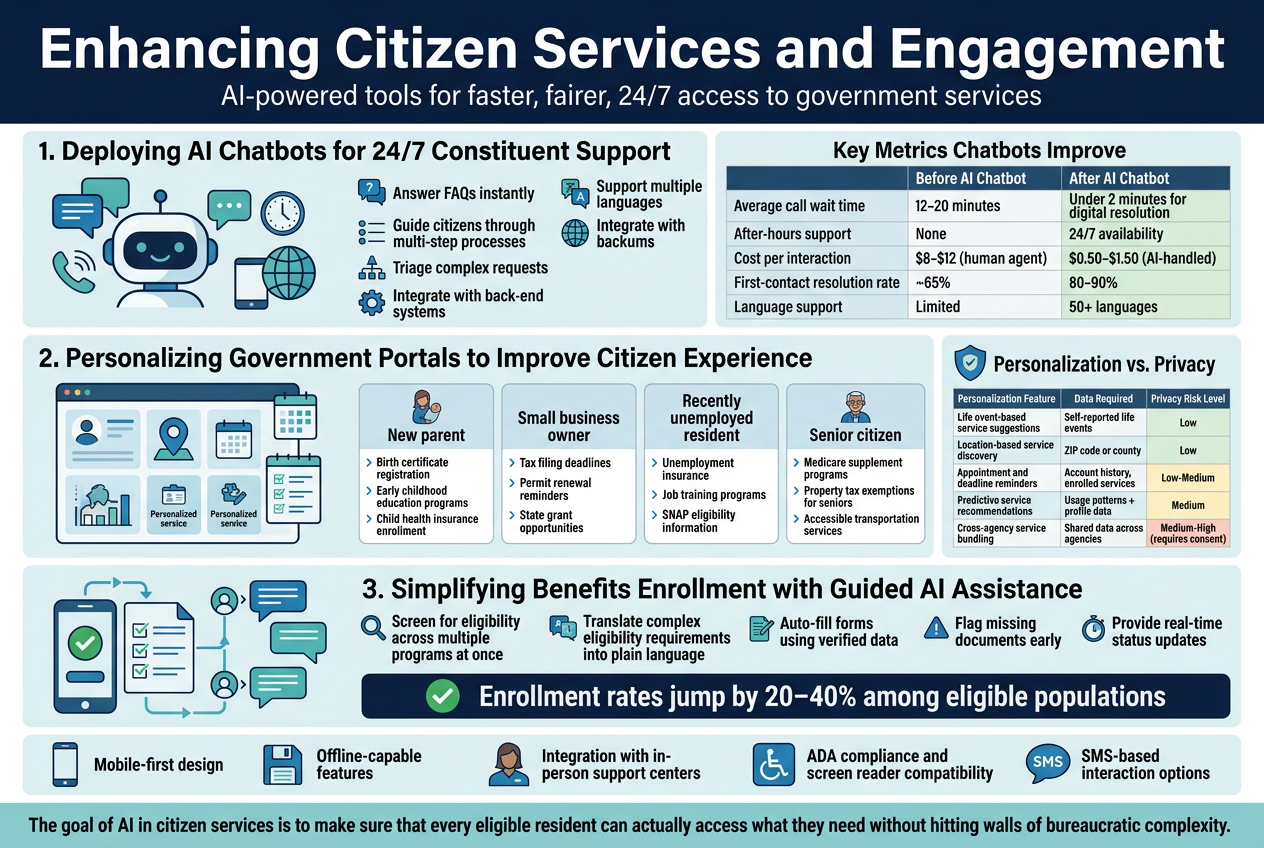
- Answer FAQs instantly — Common questions about business registration, hunting licenses, tax filing, and voting procedures get answered in seconds
- Guide citizens through multi-step processes — Instead of reading through a dense government webpage, residents get step-by-step guidance tailored to their specific situation
- Triage complex requests — When a question is too nuanced for the bot to handle, it can collect relevant details and route the citizen to the right department or human agent, with context already filled in
- Support multiple languages — AI chatbots can communicate in dozens of languages, making government services more accessible to non-English-speaking communities
- Integrate with back-end systems — Connected to state databases, bots can pull real-time information like application status, outstanding balances, or appointment availability
States like California and Georgia have already deployed conversational AI across multiple agencies, reporting significant drops in call center volume and faster resolution times. This is one of the clearest AI use cases for government because the return on investment shows up almost immediately — both in cost savings and in citizen satisfaction scores.
Key Metrics Chatbots Improve
| Metric | Before AI Chatbot | After AI Chatbot |
|---|---|---|
| Average call wait time | 12–20 minutes | Under 2 minutes for digital resolution |
| After-hours support | None | 24/7 availability |
| Cost per interaction | $8–$12 (human agent) | $0.50–$1.50 (AI-handled) |
| First-contact resolution rate | ~65% | 80–90% |
| Language support | Limited | 50+ languages |
The biggest win here isn’t just efficiency — it’s equity. When a working parent can get help with their Medicaid application at 11 PM without waiting on hold, that’s government actually working for people.
Personalizing Government Portals to Improve Citizen Experience
Government websites have historically been designed around how agencies are organized internally, not around how citizens think or what they actually need. Someone trying to start a small business might need to visit five different state portals just to handle licensing, tax registration, and zoning. That’s a broken experience, and AI can fix it.
AI-driven personalization in government portals works similarly to how Netflix or Spotify learns your preferences — but instead of entertainment, the system learns what services a citizen is most likely to need based on their profile, life events, and past interactions.
How Personalized Portals Work in Practice
When a resident logs into a smart government portal, the AI analyzes available data points — location, previously accessed services, declared life events, account type — and surfaces the most relevant information right at the top. No more digging through menus or calling to ask which department handles what.
Examples of personalization in action:
- A new parent logs in and sees links to birth certificate registration, early childhood education programs, and child health insurance enrollment — without having to search for any of it
- A small business owner sees upcoming tax filing deadlines, permit renewal reminders, and relevant state grant opportunities tailored to their industry
- A recently unemployed resident is guided directly to unemployment insurance, job training programs, and SNAP eligibility information
- A senior citizen’s dashboard prioritizes Medicare supplement programs, property tax exemptions for seniors, and accessible transportation services
This kind of smart government technology makes a real difference because it reduces the cognitive load on residents. People shouldn’t need to become experts in government bureaucracy just to access the services they’re entitled to.
Personalization vs. Privacy: Finding the Right Balance
State governments walking this path need to be thoughtful about data use. Personalization must be built on clear consent frameworks, transparent data policies, and strong privacy protections. The good news is that effective personalization doesn’t require invasive data collection — it can be done with the information citizens voluntarily provide during account setup, combined with anonymized usage patterns.
| Personalization Feature | Data Required | Privacy Risk Level |
|---|---|---|
| Life event-based service suggestions | Self-reported life events | Low |
| Location-based service discovery | ZIP code or county | Low |
| Appointment and deadline reminders | Account history, enrolled services | Low-Medium |
| Predictive service recommendations | Usage patterns + profile data | Medium |
| Cross-agency service bundling | Shared data across agencies | Medium-High (requires consent) |
When done right, personalized government portals don’t just improve the citizen experience — they actively increase participation in programs that people qualify for but didn’t know existed. That’s a direct public good.
Simplifying Benefits Enrollment with Guided AI Assistance
Benefits enrollment is one of the most frustrating experiences in the public sector. Whether it’s Medicaid, SNAP, housing assistance, or childcare subsidies, the application processes are often long, confusing, and full of bureaucratic language that feels designed to discourage people. Studies consistently show that a large percentage of eligible residents never complete enrollment — not because they don’t need the help, but because the process is too difficult to navigate alone.
AI-guided enrollment changes that equation.
What Guided AI Assistance Looks Like
Think of it like having a knowledgeable friend walk you through the process step by step. AI enrollment assistants can:
- Screen for eligibility across multiple programs at once — A single set of questions can determine which of dozens of state and federal programs a resident may qualify for, instead of requiring separate applications for each
- Translate complex eligibility requirements into plain language — “Gross household income at or below 130% of the federal poverty level” becomes “You likely qualify if your household earns less than X per month”
- Auto-fill forms using verified data — With permission, AI can pull information from existing state records (like tax filings or DMV records) to pre-populate application fields, cutting completion time dramatically
- Flag missing documents early — Instead of rejecting an application weeks later for a missing piece of documentation, the AI prompts applicants to gather everything needed before submission
- Provide real-time status updates — Once submitted, residents get automated notifications about their application status, required follow-up steps, and approval timelines
The Impact on Enrollment Rates
States that have piloted AI-assisted benefits enrollment have seen enrollment rates jump by 20–40% among eligible populations. That’s not just a better user experience number — it translates to real families getting food, healthcare, and housing support they were already entitled to but couldn’t access on their own.
Common barriers that guided AI assistance removes:
- Confusing legal or bureaucratic language
- Not knowing which programs to apply for
- Difficulty gathering the right documentation
- Applications abandoned mid-way due to complexity
- Long processing times due to incomplete submissions
Equity as a Design Goal
For this to work equitably, AI enrollment tools need to be accessible to residents with limited tech literacy, low-bandwidth internet connections, and disabilities. That means:
- Mobile-first design — Many low-income residents access the internet exclusively through smartphones
- Offline-capable features — Ability to save progress and continue later without losing data
- Integration with in-person support centers — When AI can’t resolve a situation, it should hand off seamlessly to a human caseworker, with all collected information transferred so the resident doesn’t have to start over
- ADA compliance and screen reader compatibility — Non-negotiable for inclusive design
- SMS-based interaction options — For residents without reliable smartphone internet access
The goal of AI in citizen services isn’t to replace the human touch entirely — it’s to make sure that every eligible resident can actually access what they need without hitting walls of bureaucratic complexity. When state government AI applications are built with that mission in mind, the results speak for themselves.
Strengthening Public Safety and Emergency Response
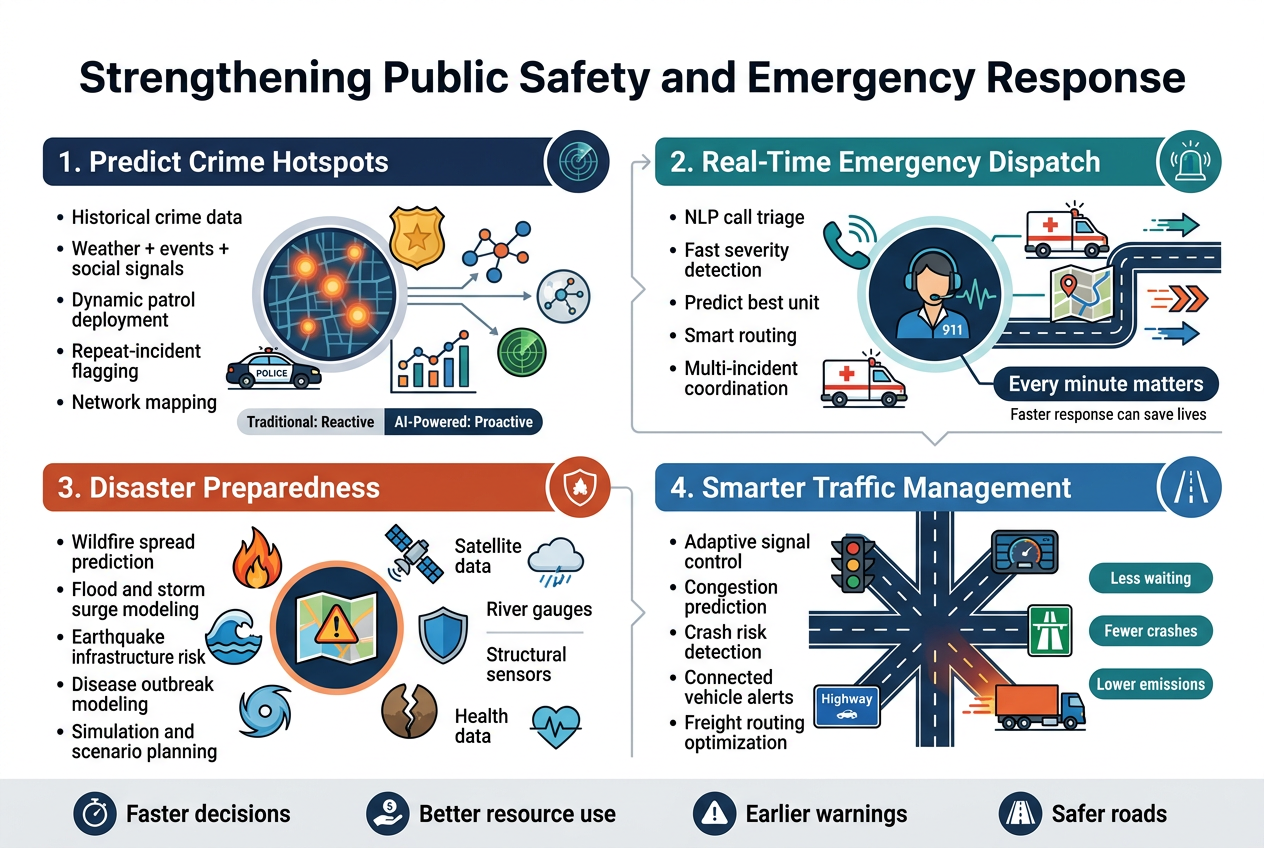
A. Predicting Crime Hotspots to Optimize Law Enforcement Resources
One of the most powerful ways AI is changing public safety is through predictive policing — not the dystopian sci-fi version, but the practical, data-driven kind that helps departments deploy officers where they’re actually needed.
Modern AI systems can analyze years of historical crime data, weather patterns, local event schedules, economic indicators, and even social media activity to identify where and when crimes are most likely to occur. Instead of spreading patrol resources thin across an entire jurisdiction, law enforcement agencies can focus their attention on specific blocks, time windows, and crime types with a much higher degree of precision.
How this plays out in practice:
- Patrol optimization: AI tools like PredPol (now Geolitica) and ShotSpotter have already been deployed in dozens of U.S. cities, generating heat maps that update in real time as new data comes in.
- Resource allocation modeling: Departments can use machine learning to anticipate staffing needs during high-risk periods — holidays, large public gatherings, heat waves — and pre-position units accordingly.
- Repeat victimization prevention: AI can flag addresses or individuals with high repeat-incident histories, prompting proactive outreach or social services intervention before another crime occurs.
- Gang and network analysis: Graph-based AI models can map relationships between known offenders, helping investigators understand criminal networks without manual chart-building.
Key Benefits at a Glance
| Capability | Traditional Approach | AI-Powered Approach |
|---|---|---|
| Crime prediction | Reactive, based on past reports | Proactive, updated in real time |
| Officer deployment | Fixed patrol routes | Dynamic, data-driven positioning |
| Resource planning | Shift-based estimates | Predictive demand modeling |
| Network analysis | Manual detective work | Automated relationship mapping |
States that have adopted AI in public safety have reported measurable reductions in response times and, in some cases, double-digit drops in property crime rates. The key is pairing these tools with strong civil liberties safeguards — clear data governance policies, bias audits, and community transparency — to make sure predictive tools serve everyone fairly.
B. Using AI for Real-Time Emergency Dispatch and Routing
When someone calls 911, every second matters. AI is stepping into the dispatch process to make those seconds count.
Traditional emergency dispatch relies on trained operators manually processing caller information, cross-referencing available units, and making routing decisions under enormous pressure. AI doesn’t replace those dispatchers — it gives them a serious upgrade.
What AI-powered dispatch systems actually do:
- Natural language processing (NLP) for call triage: AI can transcribe and analyze incoming calls in real time, automatically flagging keywords that indicate severity — words like “unconscious,” “not breathing,” or “gunshot” — and pre-categorizing the incident before the dispatcher even finishes the call.
- Predictive unit availability: Machine learning models track unit status, location, and historical response times to recommend which unit gets dispatched, not just the closest one, but the one most likely to arrive fastest given current traffic and workload.
- Smart routing: AI integrates live traffic data, road closures, and incident history to calculate the fastest path for emergency vehicles at any given moment.
- Multi-incident coordination: During large-scale emergencies with simultaneous calls, AI can prioritize and sequence dispatch decisions that would overwhelm even the most experienced human dispatcher working alone.
Real-world examples of AI in emergency dispatch:
- RapidSOS has partnered with hundreds of 911 centers across the country to pull real-time data from smartphones and connected devices directly into dispatch software.
- Carbyne uses AI-enhanced call handling to give dispatchers a fuller picture of what’s happening on the ground before units arrive.
- Some states are piloting text-to-911 AI systems that allow hearing-impaired individuals to communicate emergencies through natural language text, with AI parsing and routing the request just like a voice call.
The downstream effect is significant. Faster dispatch decisions mean faster on-scene arrival. For cardiac arrest patients, each minute without intervention reduces survival odds by roughly 10%. Shaving two or three minutes off an average response time through AI-assisted routing isn’t a small win — it’s a life-or-death difference.
C. Improving Disaster Preparedness with Predictive Risk Modeling
State governments don’t just need to respond to disasters — they need to see them coming. AI gives emergency management agencies a way to do exactly that, turning massive volumes of environmental, meteorological, and infrastructure data into actionable early warnings.
Where predictive modeling makes the biggest difference:
- Wildfire risk forecasting: AI models trained on satellite imagery, vegetation data, humidity levels, wind patterns, and historical fire behavior can predict where wildfires are likely to ignite and spread days before conditions become critical. States like California and Colorado are already using these tools to pre-position firefighting equipment and issue early evacuation orders.
- Flood and storm surge prediction: By combining real-time sensor data from river gauges, ocean buoys, and weather stations with deep learning models, agencies can generate flood maps that are significantly more accurate than traditional hydrological models.
- Earthquake and infrastructure risk: AI can analyze structural sensor data from bridges, dams, and buildings to identify failure risks before a seismic event, enabling preemptive reinforcement or load restrictions.
- Pandemic and disease outbreak modeling: The COVID-19 pandemic showed just how much state governments need better predictive tools for public health emergencies. AI can track disease spread, model healthcare capacity scenarios, and recommend intervention timing.
Disaster Preparedness AI Applications by Hazard Type
| Hazard | AI Application | Data Sources Used |
|---|---|---|
| Wildfire | Spread prediction, evacuation routing | Satellite imagery, weather data, terrain maps |
| Flooding | Inundation modeling, early warning alerts | River gauges, rainfall data, topographic data |
| Hurricanes | Landfall probability, surge forecasting | Ocean temperature, atmospheric pressure, historical tracks |
| Earthquakes | Infrastructure risk scoring | Structural sensor data, geological surveys |
| Extreme heat | Vulnerable population mapping | Census data, energy use, health records |
Beyond prediction — AI in disaster response planning:
AI doesn’t stop at risk modeling. It also helps agencies build better response playbooks by running thousands of simulated disaster scenarios and identifying gaps in current plans. Think of it as a stress test for your emergency management framework, run at a speed and scale no human team could manage alone.
State emergency operations centers can use AI to dynamically reallocate shelter capacity, pre-stage supplies in high-probability impact zones, and optimize evacuation routing based on real-time population movement data pulled from mobile devices.
The result is a smarter, faster, and more coordinated response — one that saves lives not just during a disaster, but in the hours and days before it hits.
D. Enhancing Traffic Management to Reduce Accidents and Congestion
Traffic management might not sound as dramatic as wildfire prediction or emergency dispatch, but the numbers tell a serious story. Traffic congestion costs the U.S. economy over $87 billion annually in lost productivity, and traffic accidents remain one of the leading causes of injury-related death in most states. AI is changing both of those statistics.
Adaptive signal control systems:
Traditional traffic lights run on fixed timers. AI-powered adaptive signal systems read real-time traffic flow — using cameras, sensors, and connected vehicle data — and adjust signal timing on the fly to keep traffic moving. Cities using systems like Surtrac or Intelight’s MAXTIME have reported 25–40% reductions in vehicle wait times at intersections and meaningful drops in fuel consumption and emissions.
Congestion prediction and dynamic routing:
AI systems can predict congestion buildups 20–30 minutes in advance by analyzing historical flow patterns, weather data, event schedules, and incident reports. That predictive window gives transportation agencies time to push dynamic route suggestions to navigation apps, activate variable message signs, and adjust highway on-ramp metering before gridlock sets in.
Crash prediction and prevention:
Machine learning models can identify road segments with high crash probability based on factors like road geometry, speed limits, traffic volume, weather conditions, and near-miss incident history. States can use this information to prioritize road improvements, install targeted safety infrastructure like rumble strips or improved signage, and adjust speed limits dynamically during hazardous conditions.
Connected vehicle integration:
As more vehicles become connected to state infrastructure, AI acts as the backbone of vehicle-to-infrastructure (V2I) communication. Traffic management centers can push real-time hazard alerts, construction zone warnings, and speed advisories directly to vehicle dashboards — reducing reaction time for drivers and cutting accident rates in high-risk zones.
Freight and commercial vehicle management:
State DOTs are also using AI to manage commercial truck routing, weigh-station bypass programs, and port-of-entry scheduling. These tools keep freight moving efficiently while reducing wear on state roads by steering heavy loads away from structurally sensitive corridors.
What states are seeing from AI traffic investments:
- Reduced average commute times in urban corridors
- Lower fuel consumption and vehicle emissions
- Faster emergency vehicle passage through AI-coordinated signal preemption
- More targeted infrastructure spending based on crash risk data
- Improved air quality in dense urban areas due to less idling
Smart government technology in the transportation space isn’t just about convenience — it’s a direct investment in public safety, economic productivity, and environmental health, all in one package.
Optimizing State Budget and Financial Management
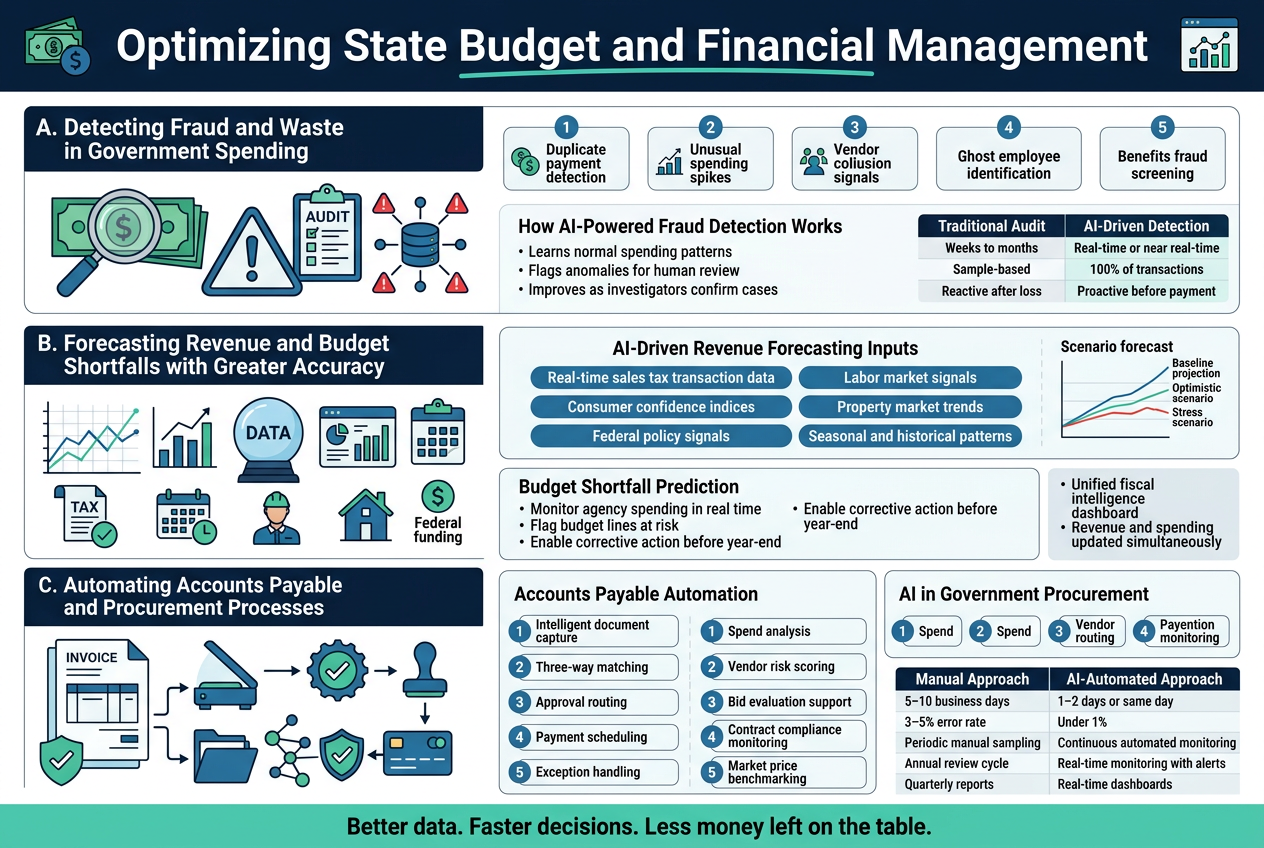
A. Detecting Fraud and Waste in Government Spending
State governments manage billions of dollars every year, and even a small percentage lost to fraud or waste adds up fast. Traditional audit processes catch some of it — but they’re slow, resource-heavy, and often reactive. By the time a problem is flagged, the money is already gone. AI changes that equation dramatically.
Machine learning models can scan massive volumes of transactions in real time, spotting patterns that human auditors would never catch manually. Think about what that means in practice:
- Duplicate payment detection — AI flags when the same invoice gets submitted twice, even with slightly different vendor names or invoice numbers
- Unusual spending spikes — algorithms identify departments or vendors where spending suddenly jumps outside normal ranges without a clear reason
- Vendor collusion signals — models detect when bids from supposedly competing vendors share suspiciously similar pricing structures or submission metadata
- Ghost employee identification — payroll AI flags employees whose records show no activity, no timesheets, and no supervisor approvals over extended periods
- Benefits fraud screening — cross-referencing benefit applications against income databases, death records, and residency data to catch ineligible claims
How AI-Powered Fraud Detection Actually Works in Government
The core approach relies on anomaly detection — training models on historical spending data so they learn what “normal” looks like for a given agency, vendor category, or program. When a transaction falls outside those learned patterns, it gets flagged for human review rather than automatically rejected.
This matters because government spending is complex. A $2 million payment might be perfectly routine for one agency and completely out of place for another. Generic rules-based systems generate too many false positives and exhaust the investigators who have to chase them down. AI-driven systems learn context, which makes the flags far more meaningful.
Some states have already seen serious returns. The State of New York’s Medicaid Inspector General has used data analytics tools to recover hundreds of millions in improper payments. Pennsylvania’s Department of Human Services implemented predictive analytics to identify high-risk Medicaid claims before payment — a “pay and chase” to “prevent and protect” shift that saves both money and administrative headache.
Key Benefits at a Glance
| Capability | Traditional Audit | AI-Driven Detection |
|---|---|---|
| Detection Speed | Weeks to months | Real-time or near real-time |
| Volume Handled | Sample-based | 100% of transactions |
| False Positive Rate | High with rules-based systems | Lower with trained models |
| Cost Recovery | Reactive after loss | Proactive before payment |
| Staff Required | Large audit teams | Smaller, focused investigative staff |
Government AI solutions built for fraud detection also improve over time. As investigators close out cases and mark flags as confirmed fraud or false alarms, the model learns and recalibrates. The system keeps getting smarter without requiring a full rebuild.
B. Forecasting Revenue and Budget Shortfalls with Greater Accuracy
State budgets run on projections — tax revenue estimates, federal funding forecasts, and economic trend assumptions. When those projections miss the mark, the consequences ripple through every agency and program that depends on them. Layoffs, service cuts, emergency borrowing — these are all downstream effects of poor forecasting.
AI doesn’t eliminate uncertainty, but it significantly sharpens the forecast. Machine learning models built for revenue forecasting pull from a much wider data set than traditional econometric models, and they update continuously rather than once a fiscal quarter.
What AI-Driven Revenue Forecasting Looks Like
Instead of relying on a handful of lagging economic indicators, AI forecasting models integrate:
- Real-time sales tax transaction data from point-of-sale systems and e-commerce platforms
- Labor market signals including unemployment claims, job posting volumes, and wage data from workforce agencies
- Consumer confidence indices and credit activity data
- Property market trends affecting property tax collections
- Federal policy signals that may affect grant revenue or matching fund availability
- Seasonal and historical patterns specific to each state’s revenue mix
These inputs feed into ensemble models — combinations of multiple algorithms — that produce probability-weighted forecasts rather than single-point estimates. Budget directors get a range: a baseline projection, an optimistic scenario, and a stress scenario, all with confidence intervals attached.
Handling Budget Shortfall Prediction
Shortfall prediction is a slightly different problem. Here, AI models monitor spending rates across agencies against budget allocations in real time, flagging departments that are on track to exhaust their budgets before fiscal year-end. This gives leadership time to act — redirecting funds, pausing discretionary spending, or making the case to the legislature for a supplemental appropriation — rather than discovering the gap after the fact.
Some smart government technology platforms now combine revenue forecasting and expenditure monitoring into a unified fiscal intelligence dashboard. State finance officers can see both sides of the ledger updating simultaneously, with AI surfacing the specific budget lines or revenue streams showing the most volatility.
Why This Matters for Long-Term Planning
Beyond the current fiscal year, AI supports multi-year capital planning and debt management decisions. Models can simulate how a proposed infrastructure project’s financing costs interact with projected revenue streams over a 10- or 20-year horizon — something that used to require weeks of analyst work and was rarely updated once completed.
States facing structural deficits — where spending commitments consistently outpace revenue growth — can use AI to model the long-term impact of policy changes before committing to them. Should the state expand a tax credit? Adjust pension contribution rates? Shift funding formulas? AI-driven scenario modeling puts real numbers behind those decisions.
C. Automating Accounts Payable and Procurement Processes
Government procurement and accounts payable are notorious for being slow, paper-heavy, and expensive to administer. Processing a single invoice manually can cost state agencies anywhere from $15 to $40 when you factor in staff time, error correction, and approval routing. Multiply that across hundreds of thousands of invoices per year, and the administrative burden is enormous.
AI-powered automation cuts that cost dramatically while also improving accuracy and compliance.
Accounts Payable Automation
Modern AI tools for accounts payable handle the full invoice lifecycle:
- Intelligent document capture — AI extracts data from invoices regardless of format (PDF, scanned paper, EDI files, email attachments) without manual data entry
- Three-way matching — automatically matches invoice data against purchase orders and receiving confirmations, flagging discrepancies for human review
- Approval routing — routes invoices to the correct approvers based on amount, department, and vendor type without manual hand-offs
- Payment scheduling — optimizes payment timing to capture early payment discounts while staying within cash flow parameters
- Exception handling — AI categorizes exceptions by type and urgency, so AP staff focus only on the transactions that genuinely need human judgment
The result is faster vendor payment cycles, fewer late payment penalties, and AP staff freed up for higher-value work like vendor relationship management and spend analysis.
AI in Government Procurement
Procurement is where AI applications for state government agencies are especially powerful. The procurement cycle — from needs identification through contract award and vendor management — involves significant complexity and risk of both inefficiency and misconduct.
AI brings value at multiple stages:
- Spend analysis — clustering historical purchasing data to identify consolidation opportunities, off-contract spending, and maverick buying patterns
- Vendor risk scoring — continuously monitoring vendor financial health, compliance status, and performance history so procurement officers can make informed decisions at contract renewal
- Bid evaluation support — natural language processing tools that read and score vendor proposals against evaluation criteria at scale, reducing the time evaluators spend on initial screening
- Contract compliance monitoring — AI reviews contract terms against actual invoices and deliverables, flagging when vendors bill for services outside the agreed scope
- Market price benchmarking — comparing state contract prices against market data to identify when the state may be overpaying
Procurement Automation Impact: A Practical View
| Process Stage | Manual Approach | AI-Automated Approach |
|---|---|---|
| Invoice Processing Time | 5–10 business days average | 1–2 days or same day |
| Error Rate | 3–5% (industry average) | Under 1% |
| Contract Compliance Review | Periodic manual sampling | Continuous automated monitoring |
| Vendor Risk Assessment | Annual review cycle | Real-time monitoring with alerts |
| Spend Visibility | Quarterly reports | Real-time dashboards |
States that have moved to AI-driven procurement platforms also report better vendor diversity outcomes. When procurement data is fully visible and analyzed, agencies can see clearly where they stand against small business and minority-owned vendor participation goals — and act on gaps rather than discovering them at year-end.
The combination of fraud detection, sharper forecasting, and process automation positions state financial management to operate more like a high-performing enterprise — with better data, faster decisions, and far less money left on the table.
Revolutionizing Healthcare and Human Services Delivery
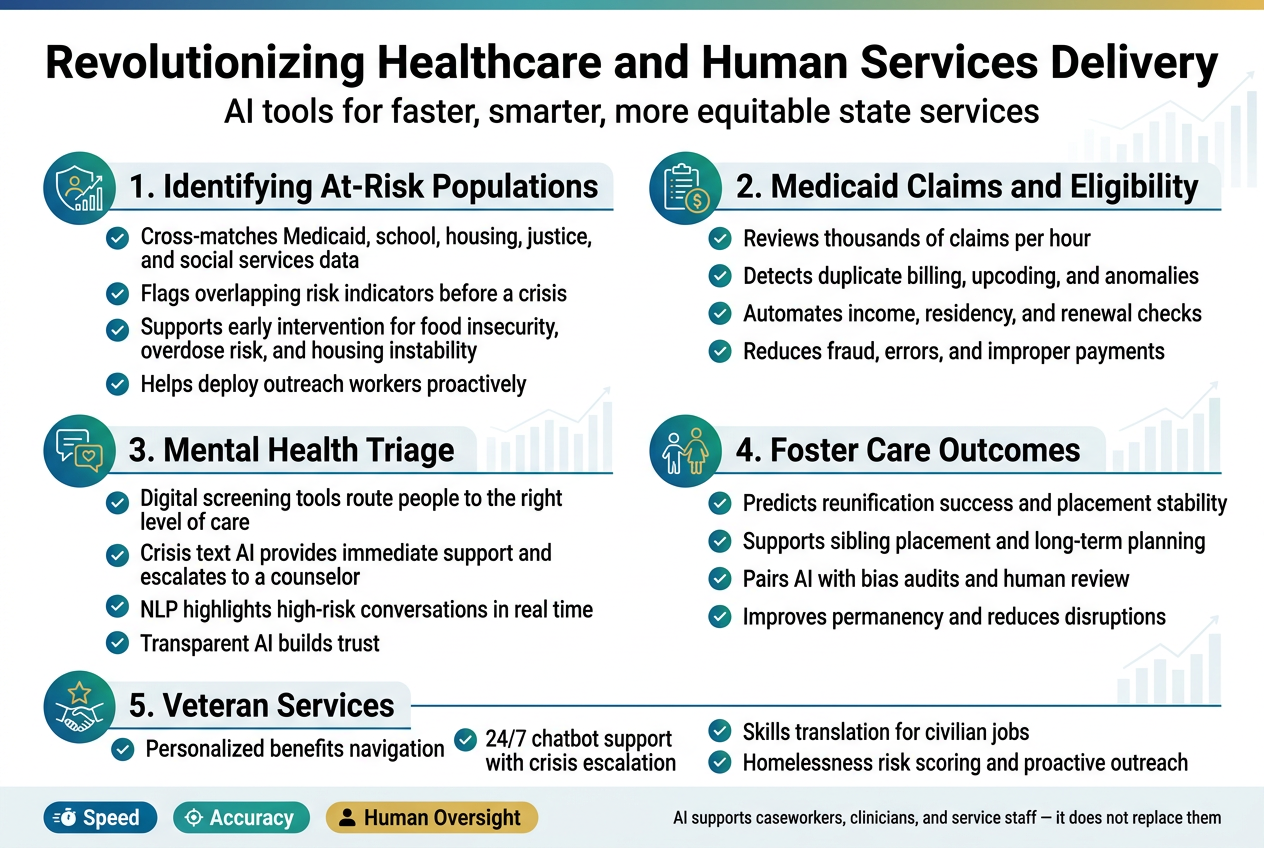
Identifying At-Risk Populations for Early Intervention Programs
State agencies are sitting on mountains of data — Medicaid records, school enrollment figures, housing data, criminal justice information, and social services histories. The challenge has never been collecting that data. It’s knowing what to do with it before a crisis happens.
AI changes that equation dramatically. Machine learning models can scan across multiple datasets simultaneously, flagging individuals and families who show overlapping risk indicators before they reach a breaking point. A child missing school repeatedly, a parent losing a job, and a household with a previous child protective services contact — individually, these might not raise alarms. Together, they paint a very different picture.
Real-world applications include:
- Predictive models that identify children at elevated risk for food insecurity before they enter emergency systems
- AI tools that cross-reference hospital discharge records with social service histories to flag people who may need wraparound support
- Early warning systems for opioid overdose risk, drawing on prescription data, prior emergency room visits, and behavioral health records
- Neighborhood-level risk mapping that helps state agencies decide where to deploy outreach workers proactively
The key advantage here is speed. Human caseworkers are stretched thin, and reviewing every file manually isn’t realistic. AI doesn’t replace those workers — it helps them focus their energy where it matters most.
States like Colorado and Oregon have already piloted data-sharing frameworks that power these kinds of early intervention models, and the results show measurable reductions in the number of people who cycle through emergency services without ever getting to the root of their problems.
Streamlining Medicaid Claims Processing and Eligibility Verification
Medicaid is one of the most administratively complex programs in state government. Billions of dollars flow through it every year, and a significant portion of that money leaks out through fraud, billing errors, and improper payments — not always through bad intent, but because the rules are complicated and the volume is enormous.
AI in healthcare delivery is reshaping how states manage this complexity.
Claims Processing
Traditional claims review is slow, inconsistent, and expensive. AI-powered systems can review thousands of claims per hour, flagging anomalies that human reviewers would never catch in a reasonable timeframe. These systems learn from historical payment data and can spot patterns that suggest:
- Duplicate billing across multiple providers
- Services billed that fall outside a patient’s documented diagnosis
- Provider billing patterns that deviate significantly from peers
- Upcoding — charging for more complex services than were actually delivered
States that have deployed AI-assisted claims review have reported fraud detection rates that are several times higher than those achieved through traditional auditing processes.
Eligibility Verification
Eligibility verification is another area where AI saves enormous time and reduces errors. Determining who qualifies for Medicaid involves checking income, household size, residency, citizenship status, and other variables — often across multiple government databases.
AI-driven eligibility tools can:
| Task | Traditional Approach | AI-Enhanced Approach |
|---|---|---|
| Income verification | Manual document review | Automated cross-check with tax and wage records |
| Residency confirmation | Staff-reviewed utility bills or lease agreements | Real-time address validation against state databases |
| Re-enrollment processing | Paper-based renewal forms | Automated renewal with flagged exceptions only |
| Fraud detection during enrollment | Periodic audits | Continuous background screening with alerts |
The result is faster enrollment for people who qualify, fewer errors that lead to improper payments, and staff who spend their time on genuinely complex cases rather than routine paperwork.
Supporting Mental Health Services Through AI-Driven Triage Tools
Mental health services are chronically underfunded and understaffed in almost every state. Wait times for psychiatric care can stretch into months. Crisis lines are overwhelmed. And people in acute distress often don’t know where to turn or how to get help quickly.
AI-driven triage tools aren’t a replacement for trained mental health professionals — but they’re a powerful bridge between someone reaching out and the right level of care reaching back.
Here’s how states are putting these tools to work:
- Digital screening tools embedded in state health portals that ask structured questions about mood, sleep, substance use, and recent life events, then generate risk scores that help route people to appropriate resources
- Crisis text line AI assistants that can handle initial contact, provide immediate coping resources, and escalate to a live counselor when the situation warrants it
- Natural language processing (NLP) tools that analyze the content of crisis calls to help supervisors identify high-risk conversations in real time and get trained staff on the line faster
- Appointment scheduling optimization that matches people to available providers based on their specific needs, insurance status, language preference, and geographic location
One important distinction worth making: AI triage tools work best when they’re transparent about what they are. People in mental health distress respond better when they know they’re talking to an automated tool initially and that a human will follow up. Trying to pass AI off as a human counselor creates trust issues that undermine the whole system.
States can also use aggregated, anonymized data from AI triage interactions to map mental health need across counties and regions — helping direct resources to areas where demand consistently outpaces supply.
Improving Foster Care Outcomes with Predictive Analytics
The foster care system is one of the most complex and emotionally high-stakes environments in state government. Decisions made by caseworkers have lifelong consequences for children — and those decisions are often made under enormous time pressure with incomplete information.
Predictive analytics is helping states build better decision-support tools for child welfare workers, not to replace their judgment, but to make sure they’re working with the best possible picture of each case.
How Predictive Models Help
AI systems trained on historical child welfare data can identify factors associated with:
- Reunification success — helping caseworkers understand which families are likely to maintain safety and stability after a child is returned home
- Placement stability — predicting which foster placements are at risk of disruption before a breakdown happens, allowing earlier intervention
- Long-term outcomes — identifying children who may need additional support services (educational, therapeutic, vocational) as they age through the system
- Sibling placement opportunities — matching children with foster families who have the capacity and experience to keep sibling groups together
The Ethical Dimension
Predictive analytics in child welfare is an area where ethical guardrails matter enormously. These models are only as good as the data they’re trained on — and if that data reflects historical disparities in how certain communities have been treated by the child welfare system, the models can bake those biases in.
States that are doing this well are pairing AI tools with bias audits, requiring human sign-off on all placement decisions, and training caseworkers to treat model outputs as one input among many — not as verdicts.
Key principles for responsible use:
- Regular auditing of model outputs for racial and socioeconomic bias
- Clear documentation of what factors the model weighs and why
- Mandatory human review before any model recommendation leads to a placement decision
- Ongoing feedback loops where caseworker experience informs model refinement
When done responsibly, predictive analytics in foster care can mean fewer placement disruptions, faster pathways to permanency, and better outcomes for children who’ve already been through enough instability.
Enhancing Veteran Services Through Personalized AI Support
Veterans who need state services often face a frustrating maze. Benefits programs are complicated, eligibility criteria vary widely, and many veterans — especially older ones or those dealing with PTSD or traumatic brain injury — struggle to navigate bureaucratic systems on their own.
AI is helping states build smarter, more responsive veteran services that meet people where they are.
Personalized Benefits Navigation
AI-powered benefits assistants can walk a veteran through their full profile — service dates, discharge status, disabilities, income level, housing situation — and then generate a personalized map of every state and federal benefit they may qualify for. This kind of tool eliminates the guesswork and ensures that veterans don’t miss out on benefits simply because they didn’t know to ask.
These assistants can be deployed through:
- State veteran affairs department websites
- Mobile apps designed for easy access
- Kiosks located at VA medical centers, courthouses, and employment offices
- Integration with state-run veteran call centers
Mental Health and Crisis Support for Veterans
Veterans experience disproportionately high rates of suicide, substance abuse, and housing instability. AI tools can play a meaningful role in the mental health support ecosystem — not as therapists, but as accessible first points of contact.
Specifically:
- AI-powered chatbots trained on veteran-specific language and experiences can provide immediate responses outside of business hours
- Sentiment analysis tools can monitor engagement with veteran portals and flag users who show signs of crisis based on their interactions
- Proactive outreach systems can identify veterans who haven’t engaged with services in a while and trigger check-in communications
Employment and Transition Support
For veterans transitioning out of service, AI tools can translate military occupational specialties into civilian job equivalencies, match veterans with open positions that fit their skills, and connect them with state-funded training programs to close any gaps.
| Veterans Service Area | AI Application | Expected Benefit |
|---|---|---|
| Benefits navigation | Personalized eligibility screening | Fewer missed benefits, faster enrollment |
| Mental health | 24/7 AI chatbot with crisis escalation | Reduced barriers to care |
| Employment | Skills translation and job matching | Faster civilian employment |
| Housing | Risk scoring for homelessness prevention | Earlier intervention |
| Legal support | AI-assisted legal document review | Reduced cost, faster resolution |
State government AI applications in veteran services aren’t about cutting costs by reducing staff — they’re about making services more responsive and accessible for people who’ve earned them. The goal is a veteran experience that feels personal and efficient, not like fighting another system.
Boosting Education Outcomes Across the State
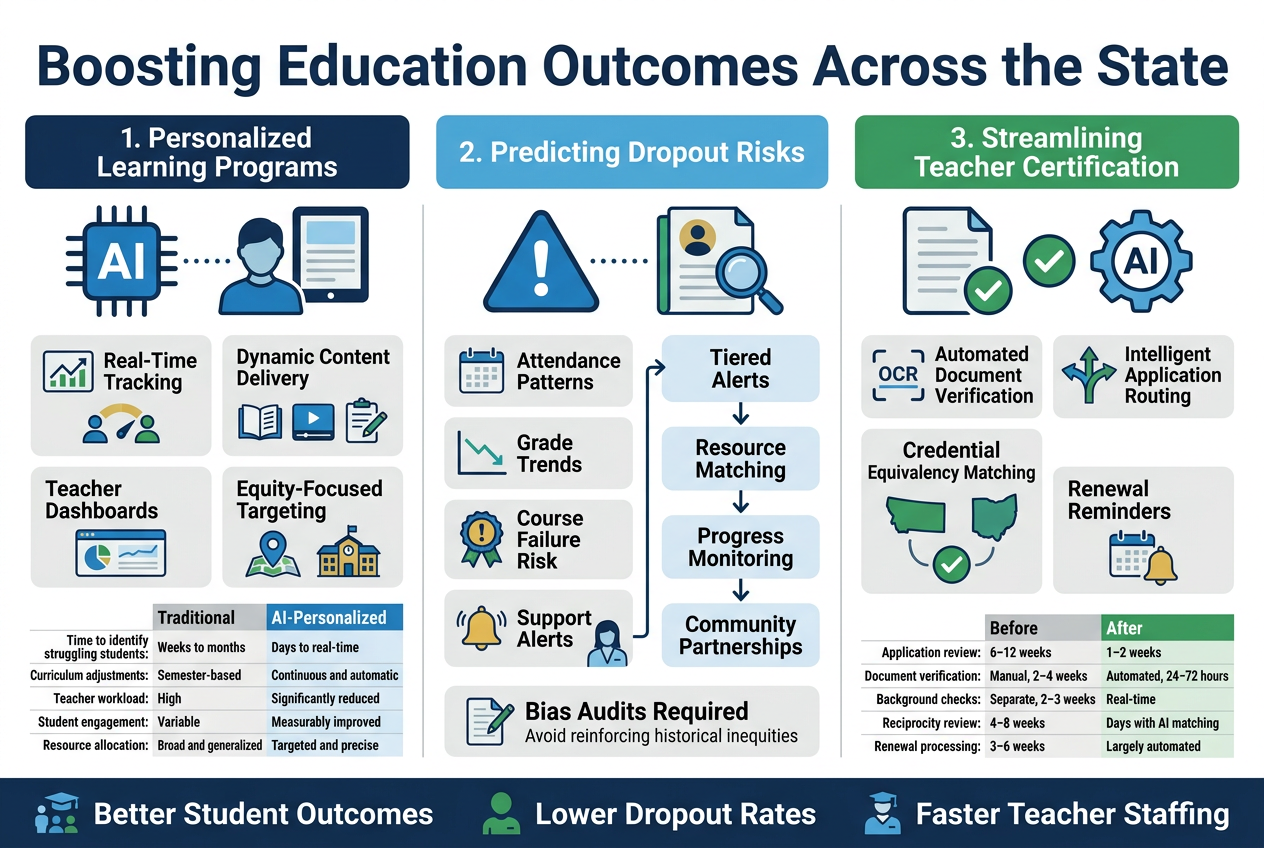
A. Personalizing Learning Programs to Improve Student Performance
One-size-fits-all education has never really worked. Every student learns differently, moves at a different pace, and struggles with different concepts — and yet, for decades, state education systems have largely treated students as a single, uniform group. AI is finally changing that.
State governments are now deploying machine learning for state agencies focused on education to build adaptive learning platforms that adjust to each student’s needs in real time. These systems analyze how a student responds to lessons, where they slow down, which concepts they revisit, and what formats (video, text, interactive quizzes) produce the best retention. From there, the AI tailors future content to close specific gaps rather than just moving the class forward as a group.
How Personalized AI Learning Works in Practice
Here’s what AI-driven personalized learning typically looks like at the state level:
- Real-time performance tracking — AI monitors quiz results, homework completion rates, and time-on-task to spot patterns before teachers even see a grade.
- Dynamic content delivery — If a student is struggling with fractions, the system automatically serves additional practice problems, video explanations, or alternative teaching approaches.
- Teacher dashboards — Educators receive simplified summaries that flag which students need attention and on which specific skills, freeing them to focus on human connection rather than data sorting.
- Equity-focused targeting — State agencies can identify districts or schools where students are consistently underperforming in specific subject areas and direct resources accordingly.
Impact at Scale
| Metric | Traditional Approach | AI-Personalized Approach |
|---|---|---|
| Time to identify struggling students | Weeks to months | Days to real-time |
| Curriculum adjustments | Semester-based | Continuous and automatic |
| Teacher workload for diagnostics | High | Significantly reduced |
| Student engagement rates | Variable | Measurably improved |
| Resource allocation efficiency | Broad and generalized | Targeted and precise |
States like Georgia and Texas have already piloted AI-based adaptive learning tools at the district level with promising results. When scaled statewide, these smart government technology platforms can narrow achievement gaps, improve standardized test outcomes, and increase graduation readiness — all without requiring massive increases in school staffing.
Personalized learning AI also supports students with disabilities or language barriers. Natural language processing tools can translate content, adjust reading levels, or provide audio-based support automatically, removing barriers that previously required expensive one-on-one interventions.
B. Predicting Student Dropout Risks for Timely Intervention
A student doesn’t drop out of school overnight. The warning signs often show up months or even years before someone actually walks away — chronic absences, failing grades, behavioral issues, family instability, food insecurity. The problem has always been that schools collect all of this data but rarely connect the dots in time to actually help.
AI changes the equation. Predictive analytics tools built for state education departments can pull together data from attendance records, academic performance, disciplinary logs, socioeconomic indicators, and even mental health referrals to generate an early warning score for each student. When that score crosses a threshold, counselors and teachers get an alert — early enough to actually make a difference.
Key Risk Indicators AI Models Track
- Attendance patterns (even a 10% chronic absence rate in elementary school is a major predictor)
- Grade trends over time (sudden drops matter more than a single bad semester)
- Course failure rates, especially in gateway subjects like Algebra I or English 9
- Discipline records and suspension frequency
- Transitions between schools or school systems
- Participation in free and reduced lunch programs as a proxy for economic instability
- Engagement with extracurriculars or school-based support programs
What Intervention Actually Looks Like
Predicting risk without having a response plan is just depressing data collection. The real power comes when state governments pair these AI tools with structured intervention workflows:
- Tiered alert systems — Low-risk flags trigger a check-in from an advisor; high-risk flags trigger a full team review including parents, counselors, and administrators.
- Resource matching — AI tools can automatically connect flagged students with available support services — tutoring, mental health counseling, food assistance programs, or after-school activities.
- Progress monitoring — After intervention, the system continues tracking whether the student is responding, adjusting recommendations if the situation worsens.
- Community partnership integration — State agencies can link school-based data with community services like housing assistance or family support programs, creating a more complete picture of what a student needs.
Why This Matters at the State Level
Dropout prevention isn’t just a school problem — it’s a state government AI application with serious long-term economic consequences. High school dropouts are statistically more likely to require public assistance, face unemployment, and end up in the criminal justice system. Keeping one student in school and on track to graduate can save a state tens of thousands of dollars over that individual’s lifetime.
States that have piloted predictive dropout models — including programs in Nevada, Colorado, and California — have reported meaningful reductions in dropout rates when interventions are triggered early and consistently. The key is getting the data infrastructure right at the state level so that schools don’t have to build these systems from scratch on their own.
A quick note on equity: Dropout prediction models need to be carefully designed to avoid reinforcing existing biases. If a model is trained on biased historical data, it may flag certain racial or socioeconomic groups at disproportionate rates. State governments rolling out these tools should require ongoing bias audits and involve community stakeholders in the development process.
C. Streamlining Teacher Certification and Credentialing Processes
Ask any new teacher about the certification process and you’ll probably get a long, exhausted sigh. The paperwork, the wait times, the back-and-forth between state agencies, university registrars, background check vendors, and testing organizations — it can take months before a qualified teacher can step into a classroom. During a teacher shortage, that delay costs states dearly.
AI is making this process dramatically faster, more accurate, and far less painful for everyone involved.
Where AI Cuts Through the Bureaucracy
1. Automated Document Verification
Instead of having a state employee manually review transcripts, test scores, and background check results one by one, AI-powered document processing tools can:
- Extract and verify data from uploaded transcripts using optical character recognition (OCR)
- Cross-check coursework against state licensure requirements automatically
- Flag incomplete applications or missing credentials without human review
- Integrate with third-party background check platforms to pull results directly into the applicant’s file
2. Intelligent Application Routing
Not all certification applications are the same. Some are straightforward renewals; others involve out-of-state reciprocity agreements or alternative licensure pathways. AI can categorize applications at intake and route them to the appropriate review queue — or approve them automatically when all requirements are clearly met — reducing processing backlogs dramatically.
3. Credential Equivalency Matching
For teachers moving between states, determining whether their existing credentials satisfy the new state’s requirements is a notoriously complicated process. AI tools trained on each state’s certification standards can compare an applicant’s credentials against requirements and generate an equivalency report in minutes instead of weeks.
4. Renewal Reminders and Compliance Tracking
Many teachers let their certifications lapse simply because they didn’t realize a renewal deadline was approaching. AI-driven communication tools can send personalized reminders, track continuing education credit completion, and flag upcoming renewal windows — keeping teachers in good standing without them having to manage it manually.
Before and After: AI in Teacher Certification
| Process Step | Traditional Timeline | AI-Assisted Timeline |
|---|---|---|
| Application review | 6–12 weeks | 1–2 weeks |
| Document verification | Manual, 2–4 weeks | Automated, 24–72 hours |
| Background check integration | Separate process, 2–3 weeks | Integrated, real-time |
| Out-of-state reciprocity review | 4–8 weeks | Days with AI matching |
| Renewal processing | 3–6 weeks | Largely automated, days |
The Bigger Picture for State Governments
States are facing a real and growing teacher shortage. Every unnecessary delay in getting a certified, qualified teacher into a classroom is a problem with direct consequences for students. Streamlining this process with AI use cases for government designed specifically for credentialing doesn’t just save administrative time — it gets more teachers working faster, helps fill staffing gaps in high-need subject areas, and reduces the frustration that causes some candidates to abandon the profession before they even start.
When states modernize their credentialing systems with AI, they also get better data. Analytics dashboards can show where bottlenecks exist, which regions have the highest demand for certain certifications, and whether reciprocity pathways are being used effectively. That operational insight helps state education agencies make smarter workforce planning decisions across the board.
Modernizing Infrastructure and Environmental Management
Predicting Infrastructure Failures Before They Become Costly
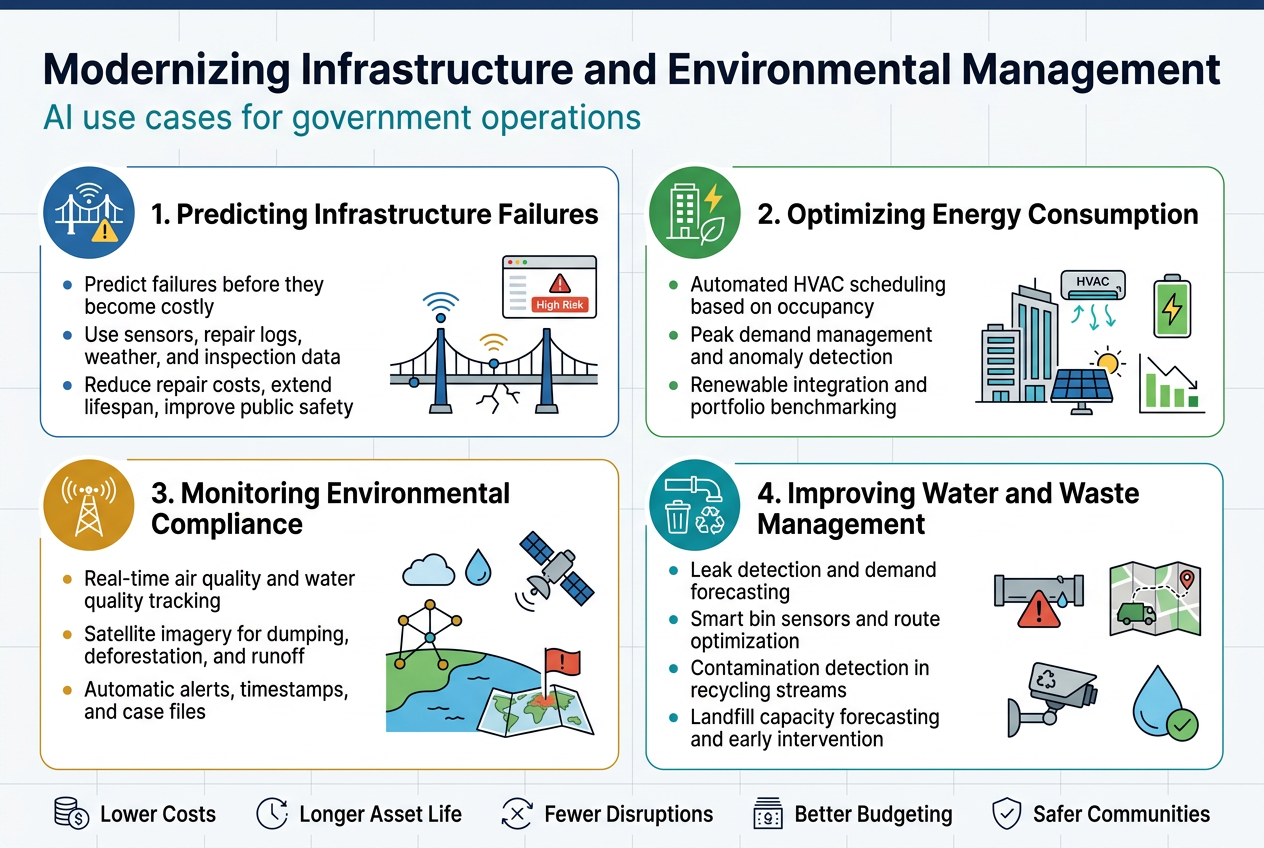
State governments manage thousands of bridges, roads, pipelines, and public buildings — and waiting for something to break before fixing it is an expensive gamble. AI changes that equation completely. By feeding historical maintenance records, sensor readings, weather data, and structural inspection reports into machine learning models, state agencies can now predict which assets are most likely to fail and when.
Think about it this way: a bridge doesn’t just suddenly collapse. There are subtle warning signs — micro-vibrations, hairline cracks, unusual load patterns — that sensors can detect long before a human inspector ever would. AI platforms process this continuous stream of data and flag high-risk assets, giving maintenance crews time to act before a small problem becomes a catastrophic one.
Key Benefits of AI-Driven Predictive Maintenance
- Reduced repair costs — catching issues early is dramatically cheaper than emergency repairs or full replacements
- Longer asset lifespans — proactive maintenance extends the usable life of infrastructure by years, sometimes decades
- Fewer service disruptions — planned maintenance windows cause far less public inconvenience than emergency shutdowns
- Smarter budget allocation — agencies can prioritize spending on the assets that need it most rather than running on fixed schedules
- Improved public safety — failing infrastructure is a direct public safety risk; early warnings save lives
How It Works in Practice
| Data Source | What AI Learns From It |
|---|---|
| IoT sensors on structures | Real-time stress, vibration, and load data |
| Historical repair logs | Patterns that precede failures |
| Weather and climate data | How environmental conditions accelerate wear |
| Traffic and usage data | Stress levels relative to design capacity |
| Inspection reports | Baseline condition benchmarks over time |
Several states have already piloted this approach. Pennsylvania’s bridge monitoring programs and California’s early warning systems for aging infrastructure demonstrate that smart government technology isn’t a future concept — it’s already saving taxpayer dollars today. The predictive models don’t just flag issues; they also rank them by urgency and cost impact, helping agencies decide where to send crews first.
Optimizing Energy Consumption Across State-Owned Facilities
State governments are among the largest property owners in any region. Office buildings, courthouses, correctional facilities, universities, and maintenance depots consume enormous amounts of energy around the clock. That’s both a financial burden and an environmental one — and AI is proving to be one of the most practical tools for tackling both at once.
AI-powered building management systems analyze energy usage patterns in real time. They learn when a building is actually occupied, how heating and cooling loads shift across seasons, and which systems are running inefficiently. Over time, these systems make autonomous adjustments — dimming lights in unused corridors, pre-cooling buildings before peak pricing hours, or shutting down HVAC zones that don’t need conditioning overnight.
What AI-Driven Energy Optimization Looks Like
- Automated HVAC scheduling — systems adjust heating and cooling based on actual occupancy data rather than preset timers
- Peak demand management — AI shifts non-critical energy loads away from expensive peak pricing windows
- Anomaly detection — unusual consumption spikes get flagged immediately, catching equipment faults before utility bills balloon
- Renewable integration — AI coordinates when to draw from solar panels or battery storage versus the grid for maximum cost savings
- Portfolio-wide benchmarking — agencies can compare energy performance across all facilities and pinpoint the worst performers
Potential Energy Savings by Facility Type
| Facility Type | Average Potential Savings | Primary Optimization Area |
|---|---|---|
| Office buildings | 20–30% | HVAC and lighting automation |
| Correctional facilities | 15–25% | Continuous load balancing |
| Courthouses | 18–28% | Occupancy-based scheduling |
| Maintenance depots | 10–20% | Equipment runtime optimization |
| University campuses | 25–35% | Demand response and solar integration |
Beyond the numbers, this kind of AI application directly supports state sustainability goals. Many states have committed to carbon reduction targets, and optimizing energy use in government-owned buildings is one of the fastest and most measurable paths to hitting those benchmarks. It also frees up budget that can go back into core public services.
Monitoring Environmental Compliance with AI-Powered Sensors
Environmental enforcement has historically been a resource-intensive job. State agencies rely on periodic inspections, self-reported data from businesses, and complaint-driven investigations. That approach misses a lot. AI-powered sensor networks and satellite data analysis are shifting the model from reactive enforcement to continuous, real-time environmental monitoring.
Air quality sensors placed near industrial zones, highways, and agricultural areas now generate continuous streams of data. Machine learning models process that data and detect pollution spikes that correlate with specific sources — a factory exceeding emissions limits at 2 AM, for example, or a agricultural operation releasing excessive runoff after a rainstorm. These patterns would be nearly impossible to catch with manual inspections alone.
AI Applications in Environmental Monitoring
- Real-time air quality tracking — sensors detect particulate matter, nitrogen dioxide, ozone, and other pollutants across wide geographic areas
- Emissions source identification — AI cross-references pollution events with known emission sources to pinpoint likely violators
- Satellite imagery analysis — machine learning models scan satellite images to detect illegal dumping, deforestation, or unauthorized land clearing
- Water contamination alerts — continuous water quality monitoring flags contamination events in rivers, lakes, and groundwater sources
- Wildlife and habitat monitoring — AI tracks ecosystem health indicators to support conservation compliance
From Detection to Enforcement
The value here goes beyond detection. When an AI system flags a potential violation, it can automatically generate an alert, timestamp and geolocate the event, and compile supporting data into a ready-to-use case file for enforcement staff. That dramatically shortens the time between a violation occurring and an agency responding.
It also creates a deterrent effect. When businesses know that environmental monitoring is continuous rather than periodic, compliance behavior shifts. The combination of AI use cases for government in this space — from sensor networks to satellite analysis to automated reporting — creates an enforcement ecosystem that’s far more effective than the traditional inspection calendar.
Improving Water and Waste Management Through Smart Analytics
Water and waste management might not grab headlines, but they are foundational to public health, environmental sustainability, and quality of life. State governments oversee complex networks of water treatment plants, distribution systems, landfills, and recycling programs. AI and smart analytics are making these systems dramatically more efficient and responsive.
Smart Water Management
Water systems lose staggering amounts of water to leaks every year — the American Society of Civil Engineers estimates that the U.S. loses roughly 6 billion gallons per day to leaky pipes. AI helps address this by:
- Leak detection and localization — pressure and flow sensors feed AI models that pinpoint leak locations without digging up entire streets
- Demand forecasting — AI predicts daily and seasonal water demand, allowing treatment plants to optimize chemical usage and energy consumption
- Water quality monitoring — sensors detect contamination in real time, triggering automated responses before public health is compromised
- Drought response planning — machine learning models analyze precipitation trends, reservoir levels, and consumption patterns to support early drought interventions
Smart Waste Management
On the waste side, AI is helping states move away from fixed collection schedules toward demand-driven, optimized operations:
- Smart bin sensors — sensors report fill levels in real time, allowing collection routes to skip bins that aren’t full and prioritize those that are
- Route optimization — AI calculates the most efficient collection routes daily, cutting fuel costs and reducing vehicle emissions
- Recycling contamination detection — computer vision systems at sorting facilities identify contaminated recycling streams before they ruin entire batches
- Landfill capacity forecasting — AI models project when landfill capacity will be reached, giving planners time to develop alternatives
Impact Comparison: Traditional vs. AI-Enhanced Management
| Area | Traditional Approach | AI-Enhanced Approach |
|---|---|---|
| Leak detection | Manual inspections, reactive repairs | Continuous sensor monitoring, proactive fixes |
| Waste collection | Fixed schedules regardless of need | Dynamic routing based on real-time fill data |
| Water quality | Periodic lab testing | Continuous automated monitoring with instant alerts |
| Demand planning | Historical averages and seasonal estimates | Real-time data modeling with high accuracy |
| Recycling sorting | Manual or basic mechanical sorting | Computer vision with contamination detection |
State agencies that have deployed smart analytics in this space report meaningful cost reductions, lower environmental impact, and better public health outcomes. These aren’t experimental pilots anymore — they are practical, deployable solutions that represent some of the strongest AI use cases for government at the operational level.
Advancing Transportation and Mobility Solutions
Optimizing Public Transit Routes to Reduce Wait Times
Nobody wants to stand at a bus stop for 20 minutes wondering if the bus forgot about them. That frustration is exactly what AI-powered transit optimization is working to fix — and state governments are increasingly turning to machine learning to make public transportation smarter, faster, and more reliable.
AI systems can process enormous volumes of real-time and historical ridership data, weather patterns, event schedules, and traffic conditions to dynamically adjust transit routes and schedules. Instead of running fixed routes on a rigid timetable regardless of actual demand, transit agencies can shift to demand-responsive models that put more buses where people actually need them, when they need them.
Key ways AI improves public transit efficiency:
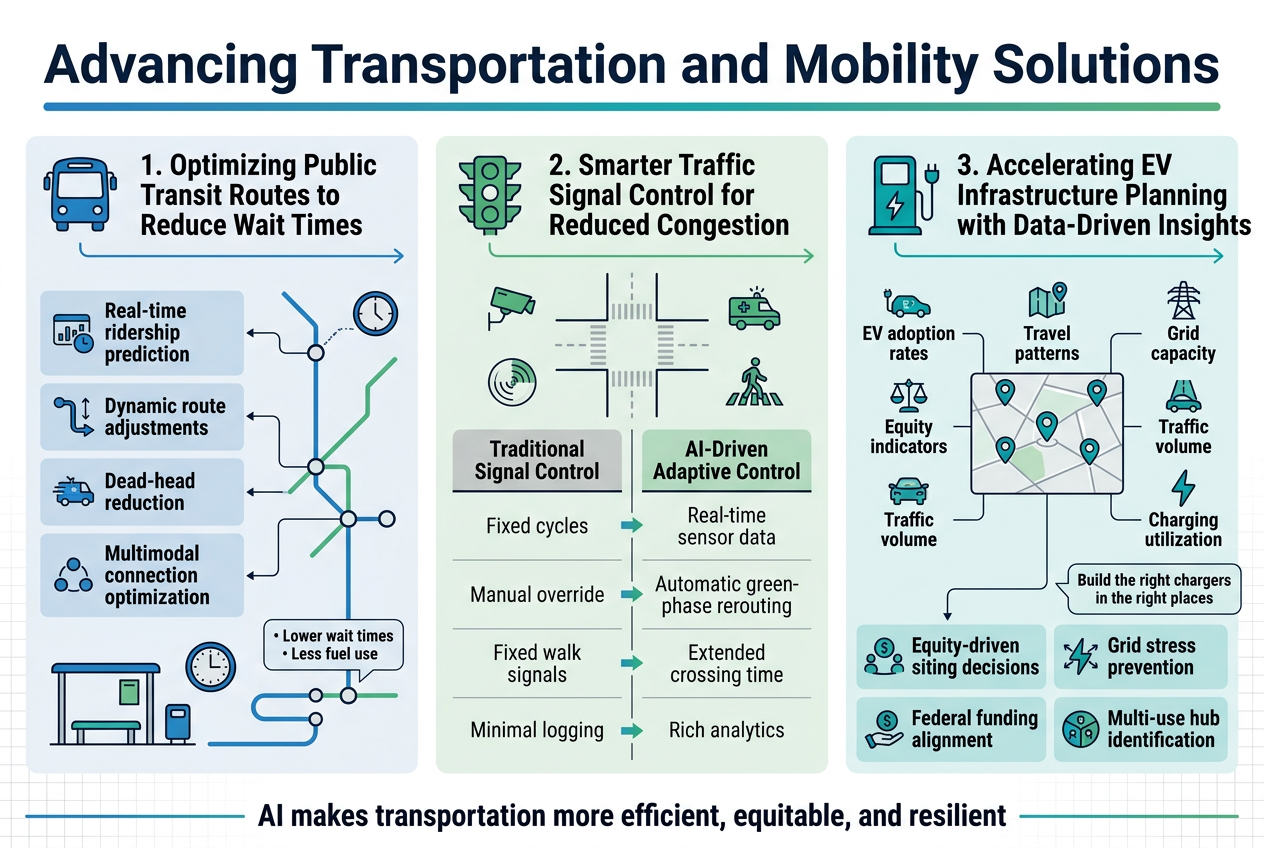
- Real-time ridership prediction — AI models analyze boarding and alighting patterns at each stop to forecast demand spikes before they happen, allowing dispatchers to deploy additional vehicles proactively
- Dynamic route adjustments — When a major event ends or an incident blocks a road, AI can recommend real-time detours and schedule changes without waiting for human operators to notice the problem
- Dead-head reduction — Machine learning identifies patterns where buses run empty between routes and recommends repositioning strategies to cut waste and lower operating costs
- Multimodal connection optimization — AI maps connections between buses, rail, and rideshare services to minimize transfer wait times and keep passengers moving
States like California and Washington have already piloted AI-assisted transit management platforms that have reduced average wait times by measurable margins while also cutting fuel consumption. For state governments managing large transit systems across both urban and rural corridors, these tools offer a path to doing more with existing resources rather than simply adding vehicles or drivers.
The data infrastructure built for transit optimization also creates a foundation for better long-term planning — helping state agencies identify underserved communities, make the case for new routes, and allocate capital budgets more strategically.
Enabling Smarter Traffic Signal Control for Reduced Congestion
Traffic signals still running on fixed 30-year-old timing plans are one of the most overlooked causes of urban congestion. AI-driven adaptive signal control technology (ASCT) is changing how state and local transportation departments manage intersection flow — moving from static, pre-programmed cycles to systems that respond to what’s actually happening on the road.
Traditional traffic signals follow a pre-set timing sequence regardless of traffic volume. A green light runs for 45 seconds whether there are 30 cars waiting or zero. Adaptive AI signal systems use camera feeds, radar sensors, and connected vehicle data to continuously measure queue lengths and adjust signal timing in real time — giving more green time where it’s needed most.
How Adaptive Signal AI Works in Practice
| Feature | Traditional Signal Control | AI-Driven Adaptive Control |
|---|---|---|
| Timing Basis | Pre-programmed fixed cycles | Real-time traffic sensor data |
| Response to Incidents | Manual override required | Automatic rerouting of green phases |
| Emergency Vehicle Preemption | Pre-wired hardware triggers | AI-predicted preemption using GPS data |
| Pedestrian Accommodation | Fixed walk signals | Extended crossing time based on detection |
| Data Output | Minimal logging | Rich analytics for ongoing planning |
Cities and corridors that have deployed adaptive signal systems like SCATS, SCOOT, or more recent deep learning-based platforms have reported congestion reductions ranging from 10% to over 25%, depending on corridor density and intersection complexity.
Why this matters for state governments:
- Emissions reduction — Fewer stop-and-go cycles mean lower vehicle idling time, which directly cuts carbon emissions — a major benefit for states with aggressive climate targets
- Emergency response times — AI systems that detect approaching emergency vehicles and create green corridors in advance can shave critical minutes off response times
- Freight efficiency — Optimized signal timing along commercial corridors keeps delivery trucks moving and reduces logistics costs for businesses operating in the state
- Scalable deployment — Unlike major infrastructure projects, adaptive signal upgrades can often be rolled out incrementally using existing signal hardware with software and sensor upgrades
State DOTs can also use the data generated by these smart signal networks to build better traffic models, informing decisions about where to invest in road capacity expansions or transit alternatives. This kind of state government AI application turns everyday infrastructure into a continuous source of planning intelligence.
Accelerating EV Infrastructure Planning with Data-Driven Insights
Electric vehicle adoption is accelerating fast — but charging infrastructure is struggling to keep up. For state governments managing transportation networks, energy grids, and economic development goals simultaneously, figuring out where to build EV charging stations is a genuinely complex problem. Build them in the wrong places and they sit unused. Neglect key corridors and you leave EV drivers stranded while discouraging further adoption.
AI is proving to be a powerful tool for getting this planning right.
What AI Brings to EV Infrastructure Planning
Machine learning models can combine dozens of data layers that no human planning team could realistically synthesize manually:
- Current and projected EV adoption rates by county or zip code
- Daily travel pattern data from GPS, navigation apps, and traffic studies
- Grid capacity and electrical infrastructure maps
- Demographics and equity indicators to ensure underserved communities aren’t left out
- Commercial corridor traffic volume and stop frequency for freight and rideshare vehicles
- Existing charging station locations and utilization rates
- Real estate availability and land use zoning data
By processing all of this together, AI models can generate optimized siting recommendations that balance coverage, demand, grid feasibility, and equity — all at once. Some platforms even simulate future adoption scenarios so planners can see how charging demand might evolve over 5 or 10 years under different growth assumptions.
Practical Benefits for State Transportation Agencies
Equity-driven siting decisions — AI helps identify neighborhoods with high concentrations of apartment dwellers who can’t charge at home and prioritizes public charging placement in those areas. This is critical for states committed to ensuring EV benefits aren’t limited to homeowners with private garages.
Grid stress prevention — Poorly planned charging clusters can overwhelm local electrical infrastructure. AI models that incorporate utility grid data can flag potential overload points before a station is ever built, saving costly grid upgrades down the line.
Federal funding alignment — With billions in federal EV infrastructure funding flowing through programs like the National Electric Vehicle Infrastructure (NEVI) Formula Program, states need defensible, data-backed siting plans to qualify for grants and demonstrate responsible stewardship of public money. AI-generated planning analyses provide exactly that kind of documentation.
Multi-use hub identification — AI can identify locations like highway rest stops, transit park-and-ride lots, and commercial centers where EV charging can be paired with other services to maximize utilization and return on investment.
States including Colorado, Michigan, and Oregon have begun using AI-assisted tools for EV infrastructure planning, integrating outputs from these models directly into their state EV deployment plans. The goal isn’t just building chargers — it’s building the right chargers in the right places to support a transportation system that actually works for everyone, whether they’re driving an EV through a rural stretch of highway or charging up during a lunch break in a mid-sized city.
Smart government technology applied to EV planning also signals something broader: that transportation investment decisions don’t have to be driven by gut instinct or political pressure alone. When states use AI to ground these decisions in real data, the results tend to be more efficient, more equitable, and more durable over time.
Strengthening Cybersecurity and Data Privacy
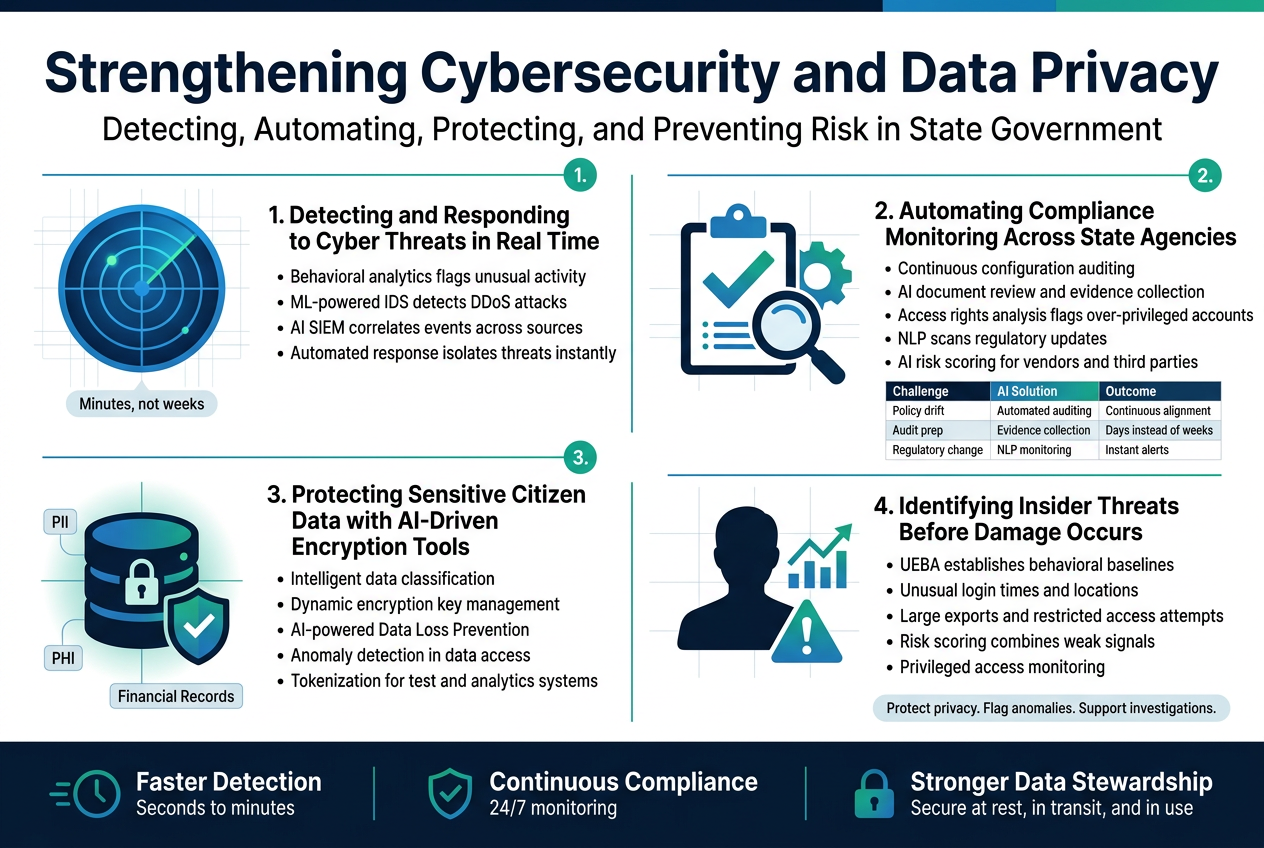
Detecting and Responding to Cyber Threats in Real Time
State government networks are prime targets for cybercriminals. They hold massive amounts of sensitive citizen data, manage critical infrastructure, and often run on aging IT systems that weren’t built with modern threats in mind. That’s a combination that keeps security teams up at night.
AI is changing the game here in a big way. Instead of waiting for a human analyst to spot something suspicious in a sea of log files, AI-powered threat detection systems monitor network traffic around the clock, flagging anomalies the moment they appear.
Here’s what real-time AI threat detection looks like in practice for state agencies:
- Behavioral analytics engines learn what “normal” looks like for every user, device, and system on the network. When something deviates — a user downloading 10x their usual data volume at 2 AM, for example — the system raises an alert immediately.
- Intrusion Detection Systems (IDS) powered by machine learning can distinguish between a legitimate spike in traffic and a distributed denial-of-service (DDoS) attack before it brings down public-facing services.
- AI-driven Security Information and Event Management (SIEM) platforms correlate events across dozens of data sources simultaneously, connecting dots that no human team could connect at that speed.
- Automated incident response playbooks allow the system to isolate compromised endpoints, block malicious IP addresses, and revoke suspicious user sessions without waiting for a human to click “approve.”
The speed advantage alone is worth the investment. The average time to detect a breach in government systems has historically been measured in weeks or months. AI shrinks that window to minutes or even seconds.
State agencies like departments of revenue, motor vehicles, and health services are increasingly deploying Security Operations Centers (SOCs) augmented by AI tools that triage alerts, prioritize the most critical threats, and help small security teams punch well above their weight class.
Automating Compliance Monitoring Across State Agencies
Compliance in state government isn’t optional — it’s woven into every system, process, and data handling practice. Agencies must navigate a complex web of frameworks including NIST, FedRAMP, CJIS, HIPAA (for health agencies), and state-specific data protection laws. Keeping up manually is exhausting, error-prone, and expensive.
AI-driven compliance automation takes the grunt work out of this process and makes continuous compliance a reality rather than a quarterly scramble.
Key AI applications for compliance monitoring include:
| Compliance Challenge | AI Solution | Outcome |
|---|---|---|
| Policy drift across agencies | Automated configuration auditing tools | Continuous alignment with security baselines |
| Manual audit preparation | AI document review and evidence collection | Audit readiness reduced from weeks to days |
| Access control reviews | Machine learning-based access rights analysis | Over-privileged accounts flagged automatically |
| Regulatory change management | NLP tools that scan regulatory updates | Instant alerts when rules change |
| Vendor and third-party risk | AI-powered risk scoring of contractors | Real-time visibility into supply chain risk |
One of the more powerful applications is using natural language processing (NLP) to continuously scan new legislation, executive orders, and agency guidance. When a new data privacy rule is issued, the AI can map it against existing controls and identify gaps before any compliance officer even finishes reading the memo.
Continuous Control Monitoring (CCM) platforms powered by AI run checks 24/7 rather than periodically. If a misconfigured server, an unpatched system, or an unauthorized data transfer occurs, the system logs it, generates a ticket, and notifies the responsible team in real time.
For state government AI applications, this means security and compliance teams can shift from reactive firefighting to proactive governance — a huge operational improvement across departments that historically operated in silos.
Protecting Sensitive Citizen Data with AI-Driven Encryption Tools
Citizens trust state governments with some of their most personal information — Social Security numbers, health records, tax filings, benefit eligibility data, criminal histories, and more. That trust is only as strong as the systems protecting that data.
AI is raising the bar on data protection in ways that traditional encryption methods simply can’t match on their own.
How AI enhances data protection for state agencies:
- Intelligent data classification automatically scans databases, file shares, and cloud storage environments to tag sensitive data (PII, PHI, financial records) so it’s always encrypted and handled appropriately — no manual tagging required.
- Dynamic encryption key management uses AI to monitor how encryption keys are being accessed and rotates them automatically based on risk signals, reducing the window of vulnerability if a key is ever compromised.
- AI-powered Data Loss Prevention (DLP) tools monitor data in motion across email, file transfers, and cloud applications. If an employee accidentally tries to send a spreadsheet containing citizen Social Security numbers to an external address, the system blocks it before it leaves the network.
- Anomaly detection in data access patterns flags when someone is accessing encrypted records they normally never touch — a strong early signal of either an insider threat or a compromised account.
- Tokenization engines with AI optimization replace real data with non-sensitive placeholders in test environments and analytics platforms, so developers and data scientists can work with realistic datasets without ever touching actual citizen information.
State health agencies, for example, deal with Protected Health Information (PHI) that falls under HIPAA. Combining traditional encryption with AI-driven classification and access monitoring creates a layered defense that keeps data secure at rest, in transit, and in use — all three states where breaches most commonly happen.
The goal isn’t just locking data away — it’s making sure the right people can access it quickly when they need it, while keeping everyone else out. That balance is where AI genuinely outperforms rule-based systems that can’t adapt to context.
Identifying Insider Threats Before Damage Occurs
Insider threats are one of the hardest security challenges state governments face. Unlike external attackers, insiders already have legitimate access to systems. They know where the sensitive data lives, how to avoid tripping alarms, and sometimes they’ve been operating undetected for months or years before anyone notices.
The problem isn’t always malicious intent either. Negligent employees who accidentally expose data, fall for phishing attacks, or mishandle records can cause just as much damage as a rogue actor trying to steal information.
AI-powered User and Entity Behavior Analytics (UEBA) platforms are specifically built for this problem. They establish behavioral baselines for every user and then watch for deviations that suggest something has gone wrong.
Common insider threat signals that AI can catch early:
- A state employee accessing records outside their job function or jurisdiction
- Unusual login times — like a benefits worker logging in at 3 AM on a weekend
- Large file downloads or bulk data exports that don’t match historical behavior
- Accessing systems from unusual geographic locations or unfamiliar devices
- Attempting to access restricted areas of the network after multiple failed logins
- Sending sensitive data to personal email addresses or external storage services
- Escalating privileges or attempting to modify audit logs
What makes AI so effective here is the scale. A human analyst reviewing logs manually might catch one suspicious pattern per day, if they’re lucky. A UEBA system can analyze millions of events per hour across thousands of users simultaneously, scoring risk in real time and escalating only the cases that genuinely warrant investigation.
Risk scoring models combine multiple weak signals into a composite picture. One unusual login on its own might mean nothing. But one unusual login, combined with a large data export, followed by an attempt to access a restricted system, adds up to a risk score that demands immediate attention.
State agencies can also layer in privileged access management (PAM) tools enhanced by AI, which monitor what administrators and high-privilege users are doing in real time. Since privileged accounts are the most dangerous when compromised, watching them closely is a high-return investment.
The ethical dimension matters here too. Well-designed insider threat programs don’t turn workplaces into surveillance states. The AI should flag genuine anomalies and support investigations — not become a tool for micromanaging employees. Setting clear policies about how the data is used, who reviews alerts, and how investigations are handled protects both citizens and employees while maintaining the integrity of the security program.
Smart government technology in this space is ultimately about building systems where threats surface quickly, responses happen before damage spreads, and public trust in government data stewardship is actually earned rather than just assumed.
Driving Economic Development and Workforce Growth
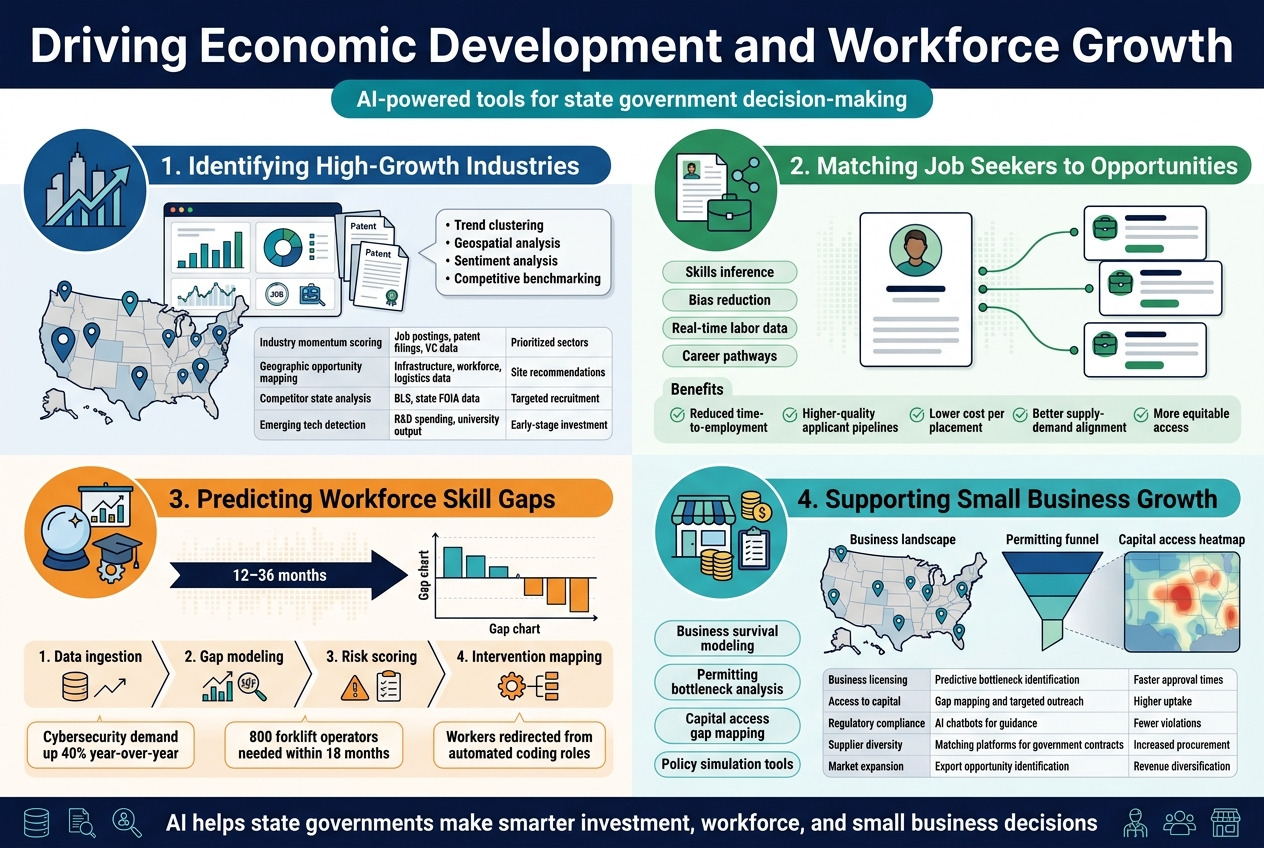
Identifying High-Growth Industries to Target Investment
State governments are sitting on enormous amounts of economic data — labor market reports, tax revenue trends, business registration records, patent filings, and federal grant allocations — but most of it goes underused when it comes to strategic investment decisions. AI changes that entirely.
By feeding this data into machine learning models, state economic development agencies can spot which industries are gaining momentum before they hit mainstream awareness. Instead of chasing yesterday’s headlines, policymakers get a forward-looking picture of where jobs, capital, and innovation are headed.
What AI-Powered Industry Analysis Looks Like in Practice
- Trend clustering algorithms scan startup formation rates, VC investment flows, and job posting volumes to identify emerging sectors in real time
- Geospatial analysis tools overlay demographic, infrastructure, and logistics data to find the most viable locations within a state for targeted industry clusters
- Sentiment analysis on business surveys picks up early signals from employers about expansion plans or relocation risks
- Competitive benchmarking models compare a state’s industry mix against peer states to identify gaps and opportunities
| Analysis Type | Data Sources Used | Outcome for Policymakers |
|---|---|---|
| Industry momentum scoring | Job postings, patent filings, VC data | Prioritized list of sectors for incentive programs |
| Geographic opportunity mapping | Infrastructure, workforce, logistics data | Site recommendations for enterprise zones |
| Competitor state analysis | Bureau of Labor Statistics, state FOIA data | Targeted recruitment strategies |
| Emerging tech detection | R&D spending, university output | Early-stage innovation investment decisions |
Smart government technology applied to economic development isn’t about replacing human judgment — it’s about making sure the people making decisions have the clearest possible picture of what’s happening in the marketplace.
Matching Job Seekers to Opportunities with AI-Powered Platforms
State workforce agencies have long struggled with a frustrating mismatch: thousands of open jobs on one side, thousands of unemployed or underemployed residents on the other, and no efficient way to connect them. Traditional job boards rely on keyword searches and self-reported résumé data, which leaves enormous value on the table.
AI-powered job matching platforms go much deeper. They analyze a job seeker’s full skills profile — including transferable skills that the person may not even know how to describe — and match it against open positions based on actual competency requirements rather than just job titles or degree requirements.
Key Capabilities of AI Job Matching for State Workforce Agencies
- Skills inference engines that extract capabilities from work history, education, and even volunteer experience, even when applicants don’t know how to articulate them
- Bias-reduction filters that flag job postings with unnecessarily restrictive credential requirements and suggest alternatives that expand the candidate pool
- Real-time labor market data integration so that job seekers are matched with roles that are genuinely in demand, not just posted positions that have already been filled
- Personalized career pathway recommendations that show a job seeker not just one job, but a logical sequence of roles that could lead to better pay and stability over time
This approach directly supports AI use cases for government that improve quality of life for residents. When a laid-off manufacturing worker can quickly see that their skills align well with roles in logistics technology or technical sales — jobs they may never have searched for on their own — the platform creates economic mobility that traditional systems simply can’t deliver at scale.
Benefits at a Glance
- Reduced time-to-employment for job seekers
- Higher-quality applicant pipelines for employers
- Lower cost per placement for state workforce programs
- Better alignment between workforce supply and employer demand
- More equitable access to opportunity for underserved populations
Predicting Workforce Skill Gaps to Guide Training Programs
One of the most persistent frustrations in workforce development is timing. By the time a state identifies a skill shortage, designs a training program, secures funding, and enrolls participants, the labor market may have already shifted. People finish programs only to find the jobs they trained for have changed or the positions were filled months ago.
AI-driven policy making flips this timeline. Predictive models built on employer hiring data, industry growth projections, and education pipeline information can give workforce agencies a 12-to-36-month forward view of where skill gaps are likely to emerge. That lead time is the difference between reactive and proactive workforce strategy.
How Skill Gap Prediction Models Work
- Data ingestion: Pull from job postings, LinkedIn activity, employer surveys, community college enrollment data, and layoff notices
- Gap modeling: Compare current training output by occupational category against projected employer demand
- Risk scoring: Flag occupations where the gap between supply and demand is widening fastest
- Intervention mapping: Recommend which training providers, program formats, and funding mechanisms are best positioned to close each gap
Real-World Applications
- A state notices that cybersecurity job postings are growing 40% year-over-year but community college enrollment in related programs has stayed flat — AI flags this as a high-priority gap requiring immediate curriculum investment
- Models identify that a major logistics company expanding in the region will need 800 forklift operators and warehouse management system operators within 18 months — the state pre-positions apprenticeship programs before the need becomes a crisis
- Analysis reveals that healthcare coding and billing roles are being automated, and residents currently in those training tracks are redirected toward roles with stronger long-term demand
Machine learning for state agencies transforms workforce planning from a reactive, gut-feel exercise into a data-driven discipline with measurable outcomes. States that build this capability see better employment rates, higher program completion, and stronger return on investment for every dollar spent on workforce development.
Supporting Small Business Growth Through Data-Driven Policy Insights
Small businesses represent the backbone of most state economies, generating the majority of net new jobs and driving community-level economic activity. Yet many state policies that affect small businesses — tax structures, permitting timelines, access to capital programs — are designed based on incomplete information or political instinct rather than hard evidence.
AI changes that by giving state economic development agencies the ability to analyze the full landscape of small business activity and identify exactly which policy levers have the greatest impact on growth and survival rates.
What Data-Driven Small Business Policy Looks Like
- Business survival modeling that identifies the combination of factors — industry, location, access to capital, owner demographics, regulatory burden — most associated with long-term business success
- Permitting bottleneck analysis that pinpoints where in the licensing and permitting process small businesses are most likely to abandon applications, allowing agencies to streamline those specific steps
- Capital access gap mapping that overlays SBA loan data, state grant disbursements, and business density maps to show which communities are most underserved by existing programs
- Policy simulation tools that let analysts model the likely impact of proposed changes — like reducing a registration fee or shortening an inspection timeline — on business formation rates before the policy is enacted
Categories of Small Business Support Enhanced by AI
| Policy Area | AI Application | Expected Outcome |
|---|---|---|
| Business licensing | Predictive bottleneck identification | Faster approval times, fewer abandonments |
| Access to capital | Gap mapping and targeted outreach | Higher uptake of grant and loan programs |
| Regulatory compliance | AI chatbots for guidance | Fewer violations, lower compliance costs |
| Supplier diversity | Matching platforms for government contracts | Increased procurement from small businesses |
| Market expansion | Export opportunity identification | Revenue diversification for established SMBs |
State government AI applications in the small business space don’t require replacing human case workers or business development specialists. The best implementations use AI to make those specialists dramatically more effective — giving them clear, actionable intelligence about which businesses are at risk, which policy changes would have the broadest impact, and where state resources are most needed.
When a small business owner can get clear answers about licensing requirements from an AI-powered assistant at 10pm instead of waiting on hold for two days, that’s a real, tangible improvement in the relationship between government and the people it serves. And when a state can design its capital access programs around actual gap data rather than assumptions, more businesses get the resources they need to survive and grow.
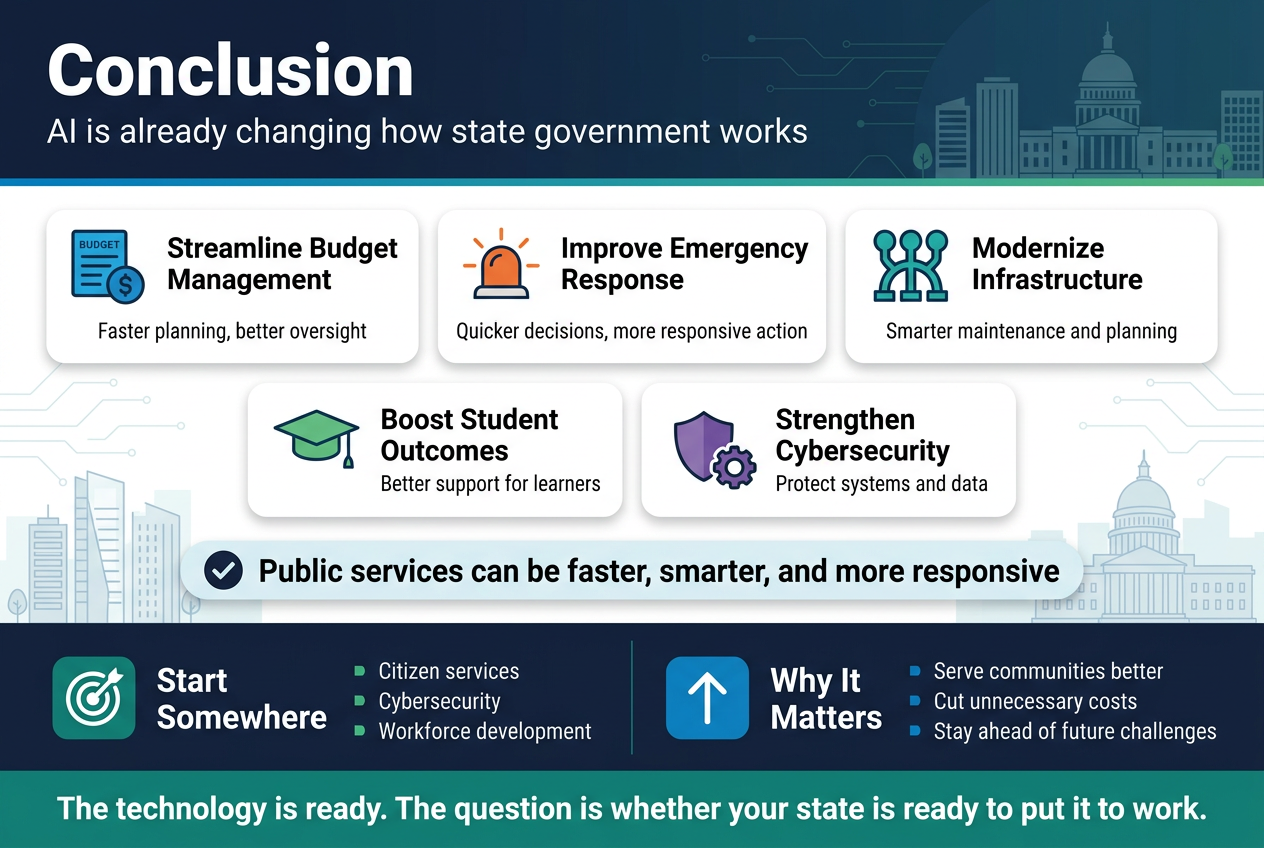
AI is no longer a futuristic concept for government — it’s a practical tool that’s already changing how states operate, serve residents, and plan for the future. From streamlining budget management and improving emergency response to modernizing infrastructure and boosting student outcomes, the possibilities stretch across every corner of state government. The use cases covered here show that AI can make public services faster, smarter, and more responsive to the people who rely on them every day.
The real opportunity for state governments is to start somewhere. Pick a few high-impact areas — whether that’s improving citizen services, tightening cybersecurity, or supporting workforce development — and build from there. States that take action now will be better positioned to serve their communities, cut unnecessary costs, and stay ahead of the challenges that are coming. The technology is ready. The question is whether your state is ready to put it to work.