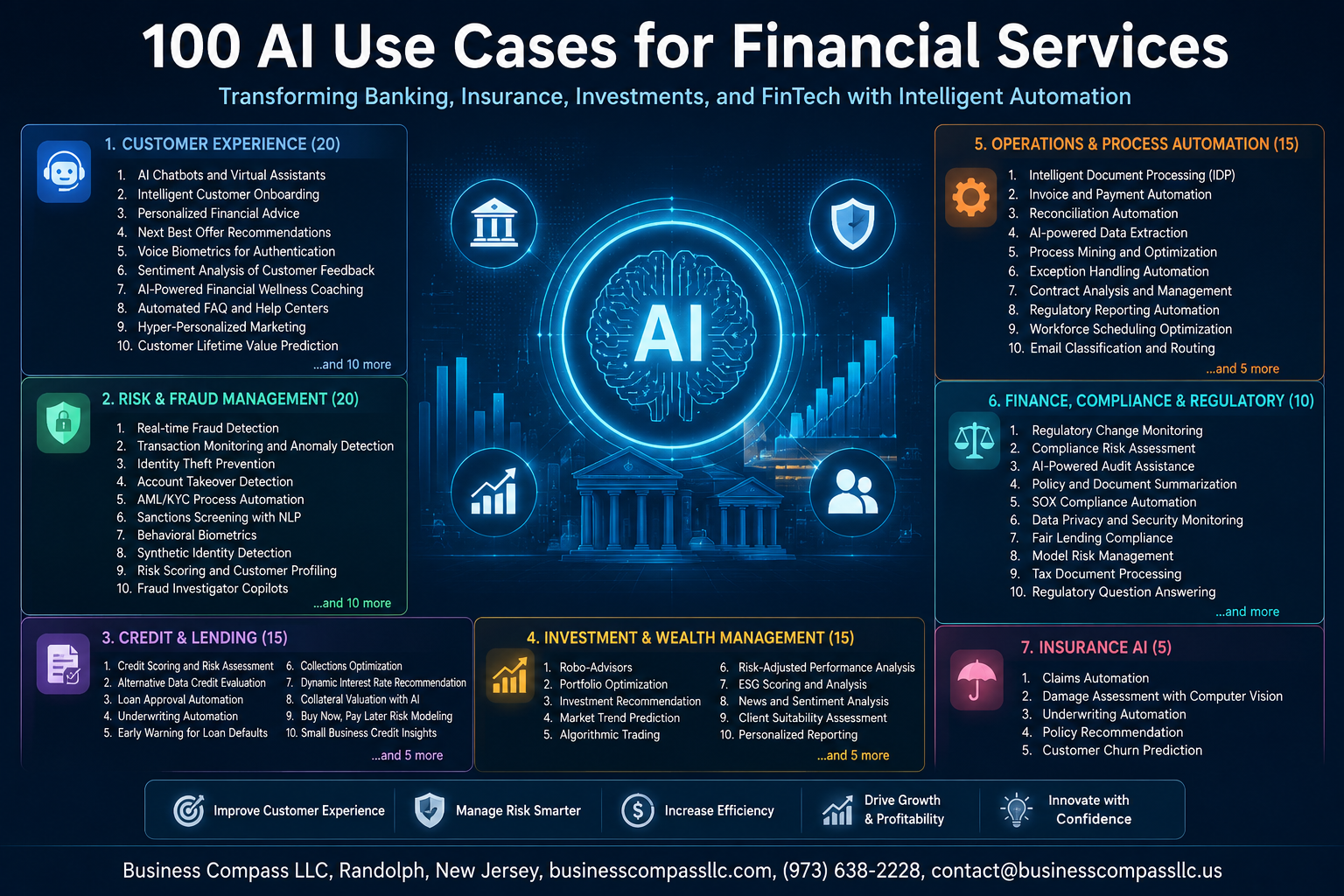
100 AI Use Cases for Financial Services: Real Applications Changing the Industry
AI in financial services has moved way past the buzzword stage. Banks, lenders, insurers, and fintech companies are now using artificial intelligence to do things faster, smarter, and with far fewer errors than traditional methods ever allowed.
This guide is for financial services professionals, fintech founders, bank executives, and anyone building or evaluating AI-powered products in the finance space. If you work in banking, insurance, wealth management, or lending — you’ll find something directly relevant here.
We’ll walk through 100 concrete AI use cases in finance, organized by function. You’ll see how machine learning credit scoring is reshaping lending decisions, how AI fraud detection in finance is stopping bad actors before damage happens, and how AI-powered wealth management is making personalized financial advice scalable for everyday investors — not just high-net-worth clients.
No fluff. Just real applications you can actually learn from.
AI-Powered Fraud Detection and Security
Real-Time Transaction Monitoring to Stop Fraud Instantly
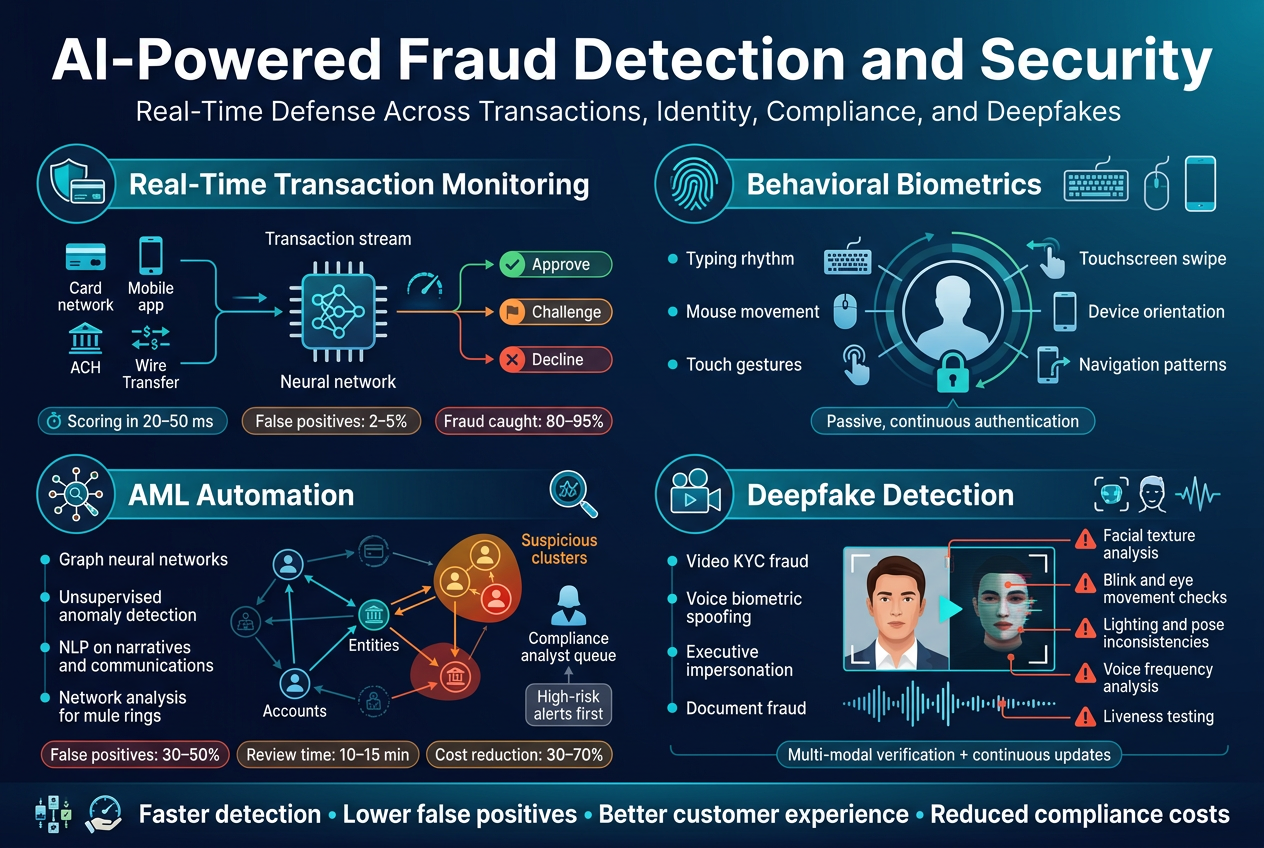
Every second counts when fraud is happening. Traditional rule-based systems that flag transactions after the fact are no longer enough — by the time a human analyst reviews an alert, the money is already gone. AI in financial services changes this equation completely by processing thousands of transactions per second and making risk decisions in milliseconds.
Modern AI fraud detection systems use machine learning models trained on hundreds of millions of historical transactions. These models learn what “normal” looks like for each individual customer — their typical spending amounts, geographic locations, merchant categories, time of day, and even device fingerprints. When something deviates from that baseline, the system doesn’t just throw up a generic alert. It calculates a precise risk score and decides whether to approve, flag, or block the transaction outright.
How Real-Time AI Transaction Monitoring Works
The pipeline typically looks like this:
- Data ingestion — Transaction data streams in from card networks, mobile apps, ACH systems, and wire transfers simultaneously
- Feature engineering — The model extracts dozens of signals: transaction velocity, location anomaly score, merchant risk rating, time-since-last-transaction, and more
- Scoring — A gradient boosting or deep learning model assigns a fraud probability score (0–100) within 20–50 milliseconds
- Decision engine — Based on the score, the system approves, challenges (triggers a one-time password), or declines the transaction
- Feedback loop — Confirmed fraud cases and false positives get fed back into training data, continuously improving accuracy
Real-World Impact
| Metric | Rule-Based Systems | AI-Powered Systems |
|---|---|---|
| False positive rate | 15–30% | 2–5% |
| Detection speed | Minutes to hours | Milliseconds |
| Fraud caught before completion | ~40% | 80–95% |
| Analyst review volume | High (many false alerts) | Low (targeted alerts only) |
| Adaptive learning | No | Yes |
Banks like JPMorgan Chase, Mastercard, and Visa have publicly credited AI fraud detection with saving hundreds of millions of dollars annually. Mastercard’s Decision Intelligence platform alone reportedly reduces false declines by up to 50% while catching more actual fraud.
The real payoff isn’t just catching more fraud — it’s doing so without annoying legitimate customers. Nothing frustrates a good customer more than having their card declined while traveling or making an unusual purchase. AI models that understand individual spending context dramatically reduce these false positives, which means fewer abandoned transactions, fewer angry calls to customer service, and higher cardholder satisfaction.
Behavioral Biometrics for Stronger Identity Verification
Passwords and PINs are broken. They get phished, guessed, reused, and leaked in data breaches. Even two-factor authentication via SMS can be bypassed through SIM-swapping attacks. Behavioral biometrics takes a completely different approach — instead of asking “what do you know?”, it asks “how do you behave?”
Behavioral biometrics captures and analyzes patterns in the way a person interacts with their device:
- Typing rhythm — The speed, pressure, and cadence of keystrokes
- Mouse movement patterns — How a user moves the cursor, the path they take, acceleration and deceleration
- Touchscreen gestures — Swipe speed, finger pressure, angle of touch, scrolling behavior
- Device orientation — How a person typically holds their phone while banking
- Navigation patterns — The sequence of pages visited, time spent on each screen
These behavioral signals are captured passively in the background while the user goes about their session. Machine learning models build a unique behavioral profile for each user and continuously compare live session data against that profile.
Why This Matters for Financial Services
A stolen username and password gives a fraudster the keys to an account. But they can’t replicate the way the real account holder types. A fraudster who purchases credentials on the dark web will naturally behave differently — they might copy-paste information rather than type it, navigate pages in unfamiliar sequences, or hold a mobile device at a different angle.
AI-powered behavioral biometric systems can detect account takeover attempts in real time, even when the attacker has valid credentials. This is a massive leap forward in identity verification for banking applications.
Key Use Cases in Banking
- Continuous authentication — Instead of a one-time login check, the system monitors every action throughout the session and can trigger re-authentication if behavioral anomalies spike
- Account takeover detection — Flags sessions where behavior doesn’t match the established profile
- New account fraud prevention — Detects synthetic identity patterns during onboarding by analyzing how application forms are filled out
- High-value transaction protection — Applies extra scrutiny when large wire transfers or beneficiary changes are attempted
Companies like BioCatch, NuData Security (acquired by Mastercard), and ThreatMetrix have built entire platforms around this technology, and major global banks have quietly deployed them at scale. The technology is invisible to legitimate users but creates a behavioral wall that fraudsters can’t easily climb over.
Anti-Money Laundering Automation to Cut Compliance Costs
Anti-money laundering (AML) compliance is one of the most expensive burdens in financial services. Global banks collectively spend an estimated $274 billion annually on financial crime compliance, and a huge chunk of that goes toward AML programs that are still shockingly inefficient.
The problem? Traditional AML systems generate enormous volumes of alerts — and the vast majority are false positives. Industry estimates suggest that somewhere between 90–95% of AML alerts are false positives, meaning compliance teams spend most of their time chasing dead ends instead of real criminal activity. It’s exhausting, expensive, and largely ineffective.
AI fraud detection in finance and AML automation are changing this from the ground up.
What AI Does Differently in AML
Traditional rule-based transaction monitoring watches for simple patterns: cash deposits just under reporting thresholds, transactions to high-risk geographies, unusual wire transfer volumes. These rules are static and easy for sophisticated money launderers to work around.
AI-powered AML systems use:
- Graph neural networks — Map relationships between accounts, entities, and transactions to surface hidden networks and shell company structures
- Unsupervised anomaly detection — Identifies unusual behavior patterns without needing labeled examples of specific money laundering schemes
- Natural language processing (NLP) — Scans transaction narratives, customer communications, and news feeds for red flags
- Network analysis — Detects money mule networks by identifying clusters of accounts that funnel funds through a chain of intermediaries
The Numbers That Make the Business Case
| Area | Before AI | After AI Implementation |
|---|---|---|
| False positive rate | 90–95% | 30–50% |
| Alert review time | 45–60 minutes per alert | 10–15 minutes (with AI triage) |
| SAR filing accuracy | Moderate | Significantly improved |
| Cost per investigation | High | Reduced by 30–70% |
| Money laundering detection | Low (sophisticated schemes missed) | Improved (network patterns caught) |
HSBC partnered with Google Cloud to deploy AI for AML transaction monitoring and reported a significant reduction in false positive alerts while simultaneously catching more suspicious activity. Danske Bank, after suffering one of Europe’s largest money laundering scandals, turned to AI to overhaul its AML program entirely.
Alert Management and Prioritization
One of the most practical AI applications here is intelligent alert prioritization. Instead of analysts working through a flat queue of alerts, AI models rank alerts by risk severity, considering:
- Customer risk profile
- Relationship history
- Geographic risk factors
- Transaction network connections
- Prior suspicious activity history
This means the most genuinely suspicious cases rise to the top of the queue, and analysts spend their limited time where it actually matters. The result is fewer burned-out compliance officers, lower operational costs, and better regulatory outcomes — a rare win-win-win in financial services.
Deepfake Detection to Protect Against Identity Theft
Deepfakes are no longer a distant sci-fi concern. They’re a clear and present threat to financial institutions right now. Criminals are already using AI-generated synthetic video and audio to impersonate bank customers during video KYC (Know Your Customer) verification calls, trick voice authentication systems, and even impersonate executives to authorize fraudulent wire transfers.
In 2024, a finance employee at a multinational firm was deceived into transferring $25 million after attending a video conference call populated almost entirely by deepfake versions of company executives. This is the real-world stakes financial services firms are dealing with.
The Attack Vectors AI Deepfakes Enable
- Video KYC fraud — Attackers use real-time deepfake tools to present a fake face during video identity verification, bypassing onboarding controls
- Voice biometric spoofing — AI voice cloning tools can replicate a customer’s voice accurately enough to fool voice authentication systems used by call centers
- Executive impersonation for wire fraud — Fake audio or video of CFOs and CEOs authorizing large transfers
- Document fraud augmentation — Deepfake-generated supporting documents that look real alongside stolen identities
How AI Detects Deepfakes
Fighting fire with fire, AI deepfake detection models analyze video and audio streams for artifacts and inconsistencies that are invisible to the human eye:
- Facial texture analysis — Real skin has micro-textures and imperfections; deepfake renders often show subtle smoothing or blurring
- Blinking and eye movement patterns — Early deepfakes didn’t blink naturally; newer detection models look at saccadic eye movements and pupil dilation
- Head pose and lighting inconsistencies — Lighting direction on a deepfake face may not match the background environment
- Frequency domain analysis — Examining the underlying signal structure of video frames can reveal compression artifacts characteristic of synthetic generation
- Liveness detection — Challenges that require real-time responses (turning head, reading random words, reacting to prompts) that deepfake systems struggle to handle in real time
- Voice frequency analysis — AI-cloned voices often have subtle artifacts in frequencies above 8kHz that are detectable by specialized models
Building a Deepfake Defense Strategy for Banks
A layered approach works best:
- Multi-modal verification — Combine video, voice, document, and behavioral signals rather than relying on any single channel
- Liveness testing at onboarding — Deploy certified liveness detection that meets ISO 30107-3 PAD (Presentation Attack Detection) standards
- Continuous model updates — Deepfake generation technology evolves quickly; detection models need frequent retraining against new generation techniques
- Employee training — Technology alone isn’t enough; staff should know the warning signs of social engineering combined with deepfake attacks
- Out-of-band verification — For high-value transactions, confirm through a separate, pre-established communication channel
Companies like Onfido, iProov, and Pindrop have built deepfake and liveness detection capabilities specifically for financial services, and regulatory bodies in multiple jurisdictions are beginning to require robust liveness detection as part of eKYC compliance frameworks.
The threat will only grow as deepfake generation tools become cheaper and more accessible. Financial institutions that invest in AI-powered detection now will be significantly better positioned than those scrambling to catch up after a major incident.
Smarter Credit Scoring and Loan Underwriting
A. Alternative Data Analysis for More Accurate Risk Assessment
Traditional credit scoring has always had a blind spot. Someone who pays rent on time every month, keeps their phone bill current, and manages a tight budget responsibly can still get flagged as “high risk” simply because they don’t have a long credit history. That gap has locked millions of people out of fair lending — and it’s a problem machine learning credit scoring is actively solving.
AI-powered credit assessment pulls in a much wider range of data points to build a fuller picture of who a borrower actually is. Instead of relying almost entirely on payment history and debt-to-income ratios, AI models can weigh:
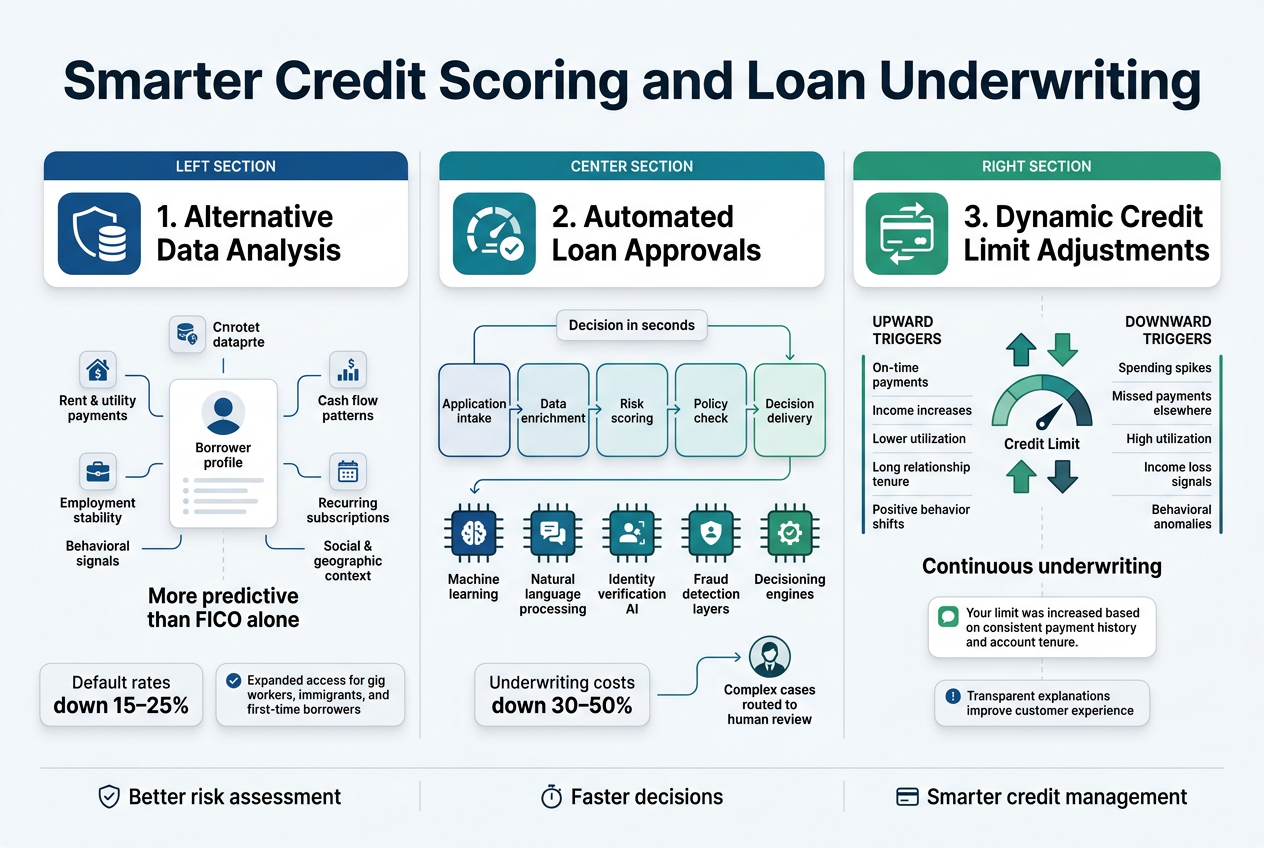
- Rent and utility payment history — consistent on-time payments signal financial discipline even outside traditional credit
- Cash flow patterns — how money moves in and out of a bank account over time
- Employment stability data — job tenure, income consistency, and career trajectory
- Subscription and recurring payment behavior — how reliably someone manages ongoing financial commitments
- Psychographic and behavioral signals — in some models, how someone interacts with a financial app can indicate responsibility levels
- Social and geographic data — carefully applied within regulatory limits, this can reveal economic context
The result is a credit profile that’s genuinely more predictive than a FICO score alone. Studies have shown that alternative data models can reduce default rates by 15-25% while simultaneously expanding credit access to underserved populations, including gig workers, recent immigrants, and young adults entering the credit market for the first time.
Why This Matters for Financial Inclusion
AI in financial services has opened a real door for people who were previously invisible to traditional lenders. When models are trained on diverse, multi-dimensional datasets, they stop penalizing people for simply being outside the conventional financial system. This isn’t just good ethics — it’s good business. Lenders who adopt alternative data analysis are tapping into a previously underserved market of creditworthy borrowers who just didn’t fit the old mold.
That said, model governance matters enormously here. Bias can creep into alternative data just as easily as it can into traditional methods if the training data reflects historical inequalities. Leading institutions are pairing AI with explainability tools (like SHAP values) to ensure credit decisions can be audited, understood, and defended under regulatory scrutiny.
B. Automated Loan Approvals to Speed Up Customer Decisions
Getting a loan used to mean paperwork, waiting days for a decision, and sometimes hearing nothing at all. For borrowers, that experience was frustrating. For lenders, it was expensive and slow. Artificial intelligence banking applications have fundamentally changed what that process looks like.
Today, AI-driven loan origination platforms can run a full credit assessment, verify income and identity, check for fraud signals, and return a lending decision — in seconds. The technology stack behind this typically includes:
| Component | Function |
|---|---|
| Machine learning models | Assess creditworthiness using structured and unstructured data |
| Natural language processing | Extract and verify information from documents like pay stubs and tax returns |
| Identity verification AI | Cross-check government IDs and selfies using biometric matching |
| Fraud detection layers | Flag anomalies in application data before approval |
| Decisioning engines | Apply lending policy rules alongside model outputs to generate a final decision |
This end-to-end automation doesn’t just make things faster — it makes them more consistent. Human loan officers, no matter how skilled, are subject to fatigue, bias, and variability. An automated system applies the same logic to every single application, every time.
What Automated Approval Looks Like in Practice
Here’s how a typical AI-powered loan approval flow works:
- Application intake — The borrower submits details through a mobile app or web portal
- Data enrichment — The system pulls credit bureau data, bank transaction history, and employment verification in real time
- Risk scoring — The AI model generates a probability of default score and a recommended decision
- Policy check — Automated rules verify the application meets regulatory and internal lending policy requirements
- Decision delivery — Approval, denial, or a request for more information is delivered instantly to the borrower
For straightforward applications, this entire process can happen without any human involvement. For more complex cases — larger loan amounts, borderline credit profiles, unusual income structures — the system routes the file to a human underwriter with a pre-populated summary, so the underwriter spends their time making the final call rather than gathering data.
Lenders adopting this model have reported underwriting cost reductions of 30-50% and significant improvements in customer satisfaction scores. Faster decisions mean less drop-off in the application funnel, which directly improves conversion rates.
C. Dynamic Credit Limit Adjustments Based on Spending Behavior
Static credit limits are a pretty blunt tool. A credit card issued to someone two years ago with a $5,000 limit doesn’t automatically reflect how that person’s financial situation has changed — whether they’ve earned more, spent more responsibly, or hit a rough patch that should trigger some caution on the lender’s side. AI changes that entirely by making credit limits a living, breathing number.
Dynamic credit limit adjustment systems monitor cardholder behavior on an ongoing basis and recalibrate limits in response to real signals. These adjustments can move in both directions:
Upward adjustments triggered by:
- Consistent on-time payments over a sustained period
- Income increases detected through connected bank account data
- Reduced utilization suggesting the borrower has more financial bandwidth
- Long-term relationship tenure with the institution
- Positive behavioral shifts after a period of higher utilization
Downward adjustments or limit freezes triggered by:
- Sudden spikes in spending that deviate from established patterns
- Signs of financial stress, such as missed payments elsewhere
- High utilization across multiple credit products simultaneously
- Income loss signals from connected financial data sources
- Behavioral anomalies that correlate with pre-default patterns
The Business Case for Real-Time Credit Management
From a lender’s perspective, dynamic credit limits are a direct tool for managing portfolio risk without having to wait for a borrower to miss a payment before acting. The AI system is essentially doing continuous underwriting — running the same risk logic that happened at origination against fresh, current data every day.
For borrowers, the experience can feel genuinely rewarding. Getting a surprise credit limit increase after six months of responsible spending sends a clear signal that the institution is paying attention and appreciates the behavior. It builds loyalty in a way that generic marketing campaigns never could.
The key to making this work well is transparency. Borrowers should receive clear communication when limits change and, ideally, understand why. AI systems that generate human-readable explanations for limit decisions (“Your limit was increased based on your consistent payment history and account tenure”) create a far better customer experience than silent changes that leave people confused.
Financial services automation at this level also enables more sophisticated product design — institutions can create credit products that automatically graduate customers through limit tiers as they build their credit profile, turning a basic credit card into a long-term relationship-deepening tool.
Personalized Customer Experience and Engagement
AI Chatbots That Resolve Customer Queries Around the Clock
Gone are the days when customers had to wait on hold for 45 minutes just to check their account balance or dispute a transaction. AI-powered chatbots in financial services have completely changed that dynamic — and banks, credit unions, and fintech companies that have deployed them are seeing the difference in both customer satisfaction scores and operational costs.
Modern financial chatbots go way beyond scripted FAQ responses. They use natural language processing (NLP) to understand context, intent, and even emotional tone, which means they can handle genuinely complex conversations — not just “What’s my balance?” but “Why did my payment fail?” or “Can you help me understand why my credit score dropped?”
What These Chatbots Actually Do
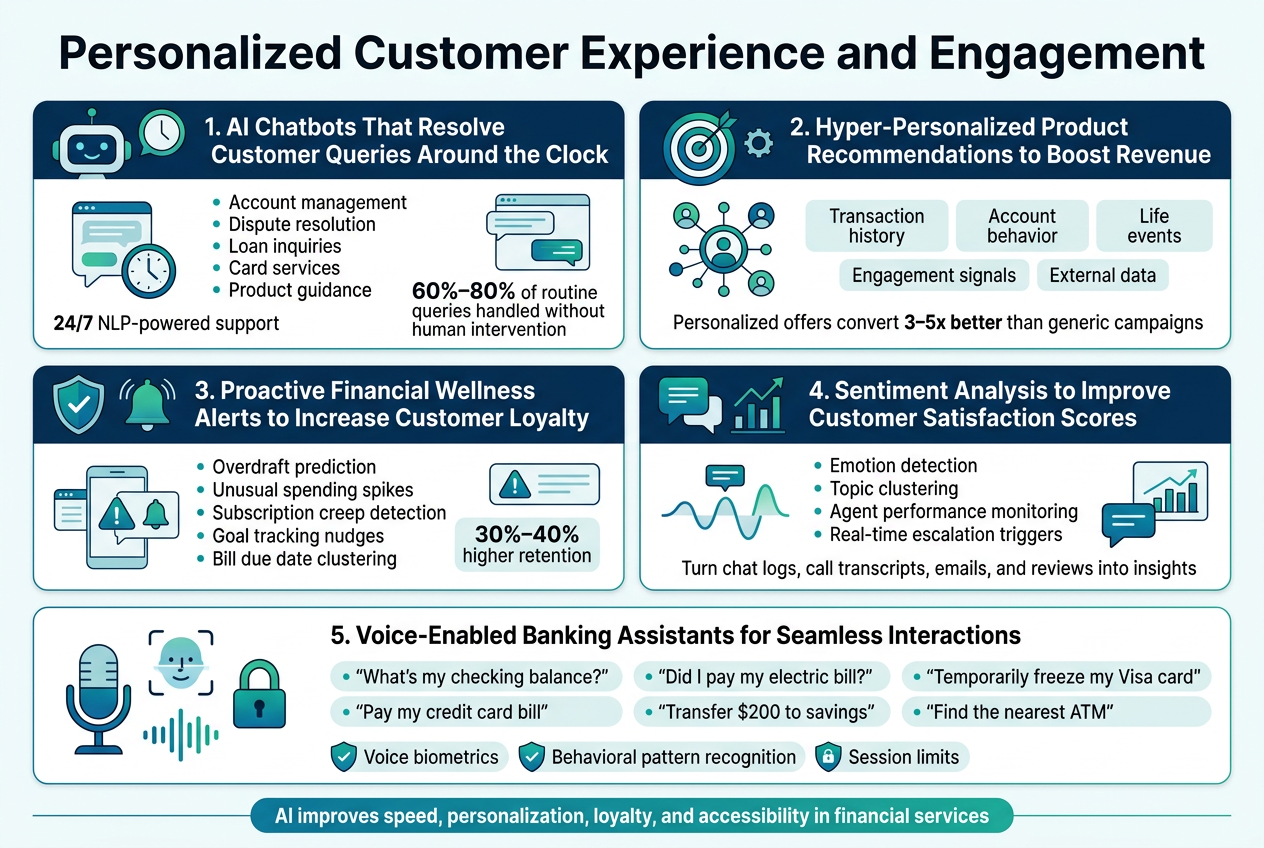
- Account management: Check balances, review recent transactions, update contact information, and set up alerts
- Dispute resolution: Guide customers through the process of flagging unauthorized transactions and collecting the necessary documentation
- Loan inquiries: Walk customers through eligibility requirements, current rates, and next steps without ever transferring to a human agent
- Card services: Block a lost card, request a replacement, or change spending limits — all within the chat window
- Product guidance: Explain the difference between a money market account and a high-yield savings account in plain language
One of the biggest wins here is availability. A well-trained AI chatbot handles the same volume at 3 AM on a Sunday as it does during peak hours on a Monday morning. For global banks serving customers across multiple time zones, that’s not a nice-to-have — it’s a competitive necessity.
The numbers back this up. Banks that have deployed AI chatbots report handling anywhere from 60% to 80% of routine customer queries without human intervention. That translates directly to lower cost-per-interaction and faster resolution times.
The Handoff Problem — And How AI Solves It
One thing that used to frustrate customers about early chatbots was the clunky handoff to a human agent. The customer would explain their problem, get transferred, and then have to explain everything all over again. Newer systems solve this elegantly. When the AI recognizes a query that needs a human touch — a sensitive complaint, a complex mortgage question, an escalating emotional conversation — it packages the entire chat history, account context, and a summary of the issue before routing to a live agent. The human agent walks in already knowing the full picture. No awkward re-introductions needed.
This is a big part of why AI in financial services isn’t replacing customer service teams — it’s making them significantly more effective.
Hyper-Personalized Product Recommendations to Boost Revenue
Think about the last time Netflix recommended a show you ended up loving. Now imagine your bank doing the same thing — but instead of a TV series, it’s recommending a savings product that perfectly matches your spending behavior, life stage, and financial goals. That’s what hyper-personalization in financial services looks like in practice.
Traditional cross-selling in banking was almost embarrassingly blunt. A 22-year-old college student would get the same home equity loan offer as a 55-year-old approaching retirement, because the segmentation wasn’t sophisticated enough to know the difference. AI changes that completely.
How AI Builds Personalization at Scale
Machine learning models in financial services pull from a rich set of data points to build a highly accurate picture of each customer:
| Data Source | What It Reveals |
|---|---|
| Transaction history | Spending patterns, lifestyle habits, recurring expenses |
| Account behavior | Savings rate, overdraft frequency, balance trends |
| Life events | New direct deposits, increased spending in baby categories, large one-time payments |
| Engagement signals | Which emails were opened, which offers were clicked, which features are used most |
| External data | Credit bureau data, property records, publicly available demographic signals |
By combining these signals, AI models can predict — with surprising accuracy — which customers are likely to be in the market for a mortgage refinance, a personal loan, or a new credit card product within the next 90 days.
Real-World Impact
A regional bank might identify that a segment of customers recently started making large home improvement purchases at stores like Home Depot and Lowe’s. That’s a strong behavioral signal that they might be open to a home equity line of credit. Instead of blasting the entire customer base with that offer, the AI targets only those customers — at exactly the right moment — with a message that feels relevant rather than random.
The results are measurable:
- Higher conversion rates: Personalized offers convert at 3–5x the rate of generic campaigns
- Better customer lifetime value: Customers who hold multiple products are significantly less likely to churn
- Reduced marketing spend: You’re not wasting budget on irrelevant outreach
For fintech apps in particular, AI-powered personalization is one of the core revenue levers. Apps like Mint, Credit Karma, and Chime have built entire business models around surfacing the right financial product to the right user at exactly the right moment.
The Ethical Side of Personalization
It’s worth spending a moment on the guardrails here. Hyper-personalization has to be built on a foundation of transparency and genuine customer benefit. Using AI to steer vulnerable customers toward high-interest products or inappropriate financial instruments isn’t personalization — it’s predatory targeting, and regulators are paying close attention. The best-in-class implementations in financial services are the ones where the recommendation engine is genuinely optimizing for customer outcomes, not just short-term revenue.
Proactive Financial Wellness Alerts to Increase Customer Loyalty
Most banks are reactive by design. Something happens — you overdraft, you miss a payment, your credit score drops — and then the bank sends you a notification. The damage is already done.
AI flips that model on its head. Instead of responding to financial events after the fact, AI systems can monitor patterns in real time and flag potential problems before they happen. That shift from reactive to proactive is one of the most powerful ways artificial intelligence banking applications are reshaping the customer relationship.
What Proactive Financial Wellness Actually Looks Like
Here are some concrete examples of what these AI systems can do:
- Overdraft prediction: The system detects that a customer’s recurring utilities, subscriptions, and rent will likely exceed their current balance before their next paycheck arrives — and sends an alert with options like a small advance or a transfer from savings
- Unusual spending spikes: A customer who typically spends $400/month on dining suddenly spends $900 — the AI flags this and asks if everything is okay, or whether they’d like to set a budget alert
- Subscription creep detection: The system identifies 14 recurring subscriptions and surfaces them in one dashboard, asking whether the customer is aware of all of them
- Goal tracking nudges: A customer set a savings goal for a vacation six months ago. The AI notices they’re behind pace and sends a gentle nudge with a specific suggestion — “Transfer $120 now to stay on track”
- Bill due date clustering: The system recognizes that four major bills are all due in the same three-day window and suggests spreading payment dates to avoid cash flow stress
Why This Drives Loyalty
The psychology behind this is straightforward. When your bank proactively helps you avoid a $35 overdraft fee, you don’t just feel like a customer — you feel like the bank is actually on your side. That emotional connection is something no interest rate promotion can replicate.
Data from banks that have deployed proactive wellness features shows real impact on retention:
- Customers who engage with financial wellness alerts have 30–40% higher retention rates than those who don’t
- Net Promoter Scores (NPS) tend to rise meaningfully when customers feel their bank is looking out for them
- Cross-sell acceptance rates are higher among customers who are actively engaged with wellness features — because trust is already established
For younger customers especially — millennials and Gen Z — this kind of proactive, digital-first engagement isn’t just appreciated. It’s expected. Banks that can deliver it at scale will have a serious competitive edge.
Sentiment Analysis to Improve Customer Satisfaction Scores
Customer satisfaction surveys have a fundamental problem: most customers don’t fill them out. The ones who do are typically either very happy or very angry, which means the data you’re collecting represents the extreme ends of the experience — not the messy middle where most customers actually live.
AI-powered sentiment analysis fixes this by extracting signal from interactions that are already happening — chat logs, call transcripts, email threads, social media posts, and app reviews — rather than relying on customers to voluntarily report how they feel.
How Sentiment Analysis Works in Financial Services
At a basic level, sentiment analysis uses NLP to classify text as positive, negative, or neutral. But modern systems go much deeper than that:
- Emotion detection: Beyond positive/negative, AI can identify frustration, confusion, urgency, satisfaction, or anxiety — which tells you a lot more about what kind of intervention is needed
- Topic clustering: The system automatically groups negative sentiment around specific themes — “long wait times,” “confusing fee structure,” “mobile app crashes” — so you can identify systemic problems rather than isolated incidents
- Agent performance monitoring: In call center environments, AI analyzes every call to identify which agents consistently leave customers feeling resolved vs. frustrated, creating targeted coaching opportunities
- Real-time escalation triggers: If a customer’s sentiment during a live chat suddenly shifts from neutral to strongly negative, the system can automatically flag the conversation for supervisor review or trigger a proactive outreach from a senior agent
Turning Insights Into Action
The real value of sentiment analysis isn’t the data itself — it’s what you do with it. Banks that use AI-driven sentiment data well are doing things like:
- Redesigning IVR menus after analysis reveals that a specific phone menu path is generating consistent frustration signals
- Updating product disclosures when sentiment data shows customers feel misled about fee structures
- Identifying at-risk customers before they churn — a pattern of declining engagement combined with negative sentiment in support interactions is a strong early warning signal
- Measuring the real impact of product changes by tracking sentiment before and after a new feature rolls out, rather than waiting for formal survey cycles
The Competitive Angle
In a world where most financial products are commoditized — the interest rates and fee structures aren’t wildly different from one bank to the next — customer experience is often the deciding factor. Banks that systematically listen to the emotional signals their customers are broadcasting, and actually act on them, are the ones building lasting loyalty rather than just transactional relationships.
Voice-Enabled Banking Assistants for Seamless Interactions
Voice interfaces have moved from novelty to genuine utility faster than most people expected. Amazon Alexa, Google Assistant, and Siri have trained hundreds of millions of people to speak naturally to their devices — and that comfort with voice interaction is now flowing into financial services in a meaningful way.
AI-powered voice banking assistants allow customers to manage their finances using natural speech, either through smart speakers, mobile apps, or in-branch kiosks. And with improvements in speech recognition accuracy and NLP sophistication, these systems are handling increasingly complex requests.
What Voice-Enabled Banking Can Handle Today
- Balance inquiries: “Hey [bank name], what’s my checking account balance?”
- Payment initiation: “Pay my credit card bill with $500 from checking”
- Transaction search: “Did I pay my electric bill this month?”
- Spending summaries: “How much did I spend on groceries last month?”
- Transfers: “Transfer $200 to my savings account”
- Card management: “Temporarily freeze my Visa card”
- Branch and ATM locators: “Find the nearest ATM that accepts cash deposits”
This isn’t just about convenience — though that’s a major part of it. Voice interfaces also represent a meaningful accessibility improvement for customers with visual impairments or motor disabilities who find traditional app navigation challenging.
Where Voice Banking Gets More Interesting
Beyond the basics, some forward-thinking banks are deploying voice assistants that can handle genuinely conversational queries:
- “I’m thinking about buying a car. What loan options do I have?”
- “I’m worried I’m spending too much. Can you give me a breakdown?”
- “What would happen to my monthly payment if I paid down $5,000 on my mortgage?”
These questions require the AI to pull real account data, run calculations, and respond in a way that’s both accurate and understandable in spoken format — no tables, no links, just a clear verbal explanation.
The Security Piece
One of the biggest concerns people raise about voice banking is security — and it’s a legitimate one. Leading implementations handle this through:
- Voice biometrics: The system analyzes the unique acoustic characteristics of a customer’s voice to authenticate their identity, similar to how fingerprint sensors work
- Behavioral pattern recognition: Requests that deviate from a customer’s typical voice banking behavior (time of day, types of transactions, amounts) trigger additional verification steps
- Session limits: High-value transactions like large transfers or new payee additions require secondary authentication through the mobile app or a PIN
The combination of voice biometrics and behavioral AI creates an authentication layer that’s both frictionless for legitimate users and genuinely difficult for bad actors to defeat.
Why Financial Services Companies Are Investing Here
The user adoption numbers for voice interfaces are compelling. Customers who use voice banking features tend to engage with their bank more frequently than those who don’t, which translates to higher lifetime value and more opportunities for meaningful product conversations. For banks looking to stay relevant to a generation that grew up talking to their devices, building capable voice banking experiences isn’t optional anymore — it’s a core part of the digital strategy.
Algorithmic Trading and Investment Management
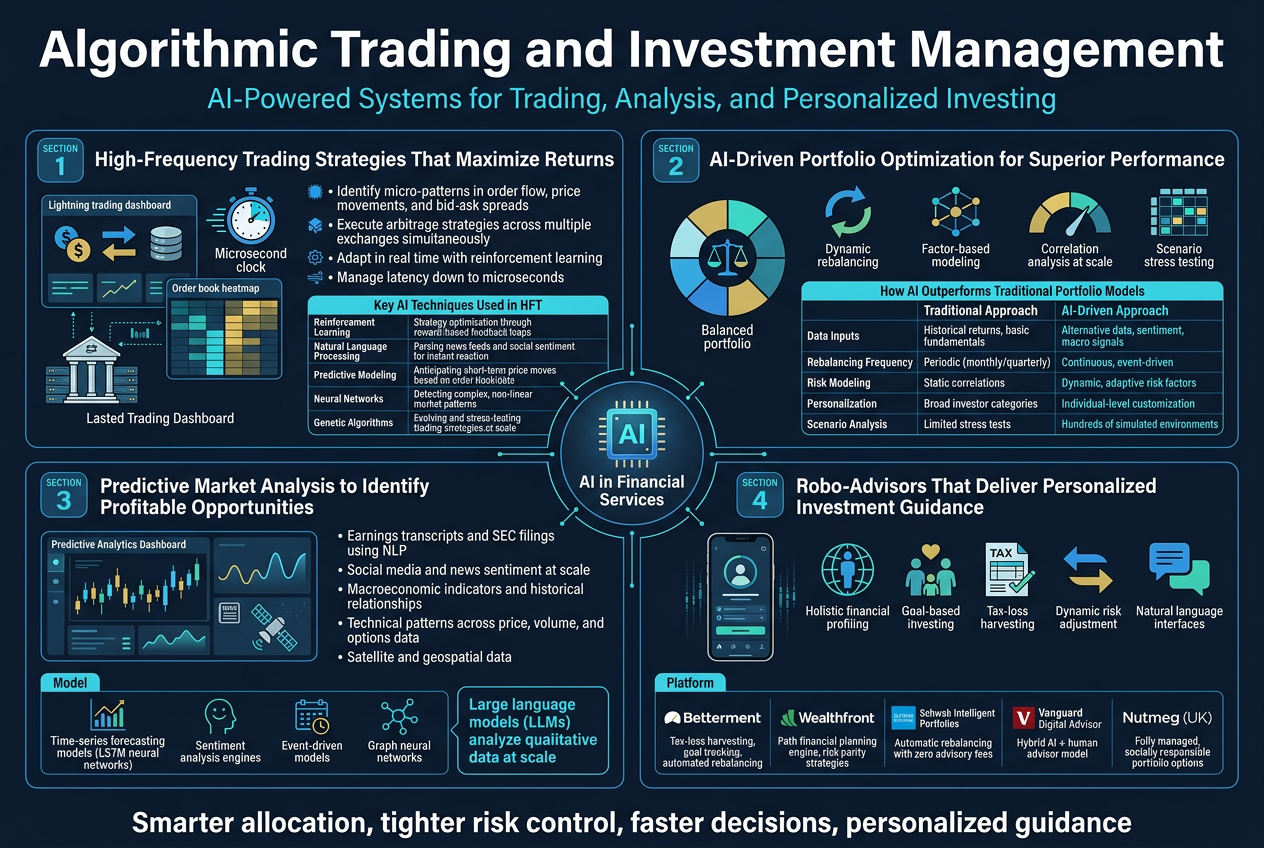
High-Frequency Trading Strategies That Maximize Returns
Speed is everything in high-frequency trading (HFT), and AI has become the engine that makes it possible. Traditional trading strategies relied on human decision-making, which—no matter how sharp the trader—simply can’t compete with machines executing thousands of trades per second.
Modern AI-driven HFT systems do far more than just act fast. They:
- Identify micro-patterns in order flow, price movements, and bid-ask spreads that are invisible to the human eye
- Execute arbitrage strategies across multiple exchanges simultaneously, capturing tiny price discrepancies before they vanish
- Adapt in real time to shifting market conditions using reinforcement learning, continuously refining their own strategies without human input
- Manage latency down to microseconds, co-locating servers near exchange data centers to shave off every possible millisecond
The role of machine learning here is particularly compelling. Reinforcement learning models “learn” by trial and error—rewarded for profitable trades and penalized for losses—essentially training themselves to become better traders over time. This is a massive leap beyond rule-based algorithms that execute the same logic regardless of market context.
Key AI Techniques Used in HFT
| Technique | Application in HFT |
|---|---|
| Reinforcement Learning | Strategy optimization through reward-based feedback loops |
| Natural Language Processing | Parsing news feeds and social sentiment for instant reaction |
| Predictive Modeling | Anticipating short-term price moves based on order book data |
| Neural Networks | Detecting complex, non-linear market patterns |
| Genetic Algorithms | Evolving and stress-testing trading strategies at scale |
One thing that separates today’s AI-powered HFT from older systems is the ability to ingest and process alternative data sources—satellite imagery of retail parking lots, shipping container tracking, credit card transaction aggregates—and factor them into split-second trading decisions. That kind of multi-layered intelligence gives firms running AI a genuine edge over those still relying on traditional quantitative models.
AI-Driven Portfolio Optimization for Superior Performance
Building a high-performing portfolio has always involved a balancing act between risk and reward. Classic approaches like Modern Portfolio Theory gave us a mathematical framework, but they came with significant limitations—static assumptions, reliance on historical correlations, and an inability to adapt to rapidly changing conditions.
AI-powered portfolio optimization throws those limitations out the window.
What AI does differently:
- Dynamic rebalancing: Instead of reviewing a portfolio quarterly or annually, AI monitors positions continuously and rebalances in response to real-time market signals, economic shifts, or changes in a client’s financial goals
- Factor-based modeling: Machine learning identifies which risk factors—momentum, value, quality, volatility—are driving returns at any given point in the market cycle and tilts the portfolio accordingly
- Correlation analysis at scale: AI can track correlations across thousands of assets simultaneously, identifying hidden dependencies that traditional models miss
- Scenario stress testing: Deep learning models simulate hundreds of macroeconomic scenarios (rate hikes, recessions, geopolitical shocks) and assess how a portfolio would hold up under each one
How AI Outperforms Traditional Portfolio Models
| Dimension | Traditional Approach | AI-Driven Approach |
|---|---|---|
| Data Inputs | Historical returns, basic fundamentals | Alternative data, sentiment, macro signals |
| Rebalancing Frequency | Periodic (monthly/quarterly) | Continuous, event-driven |
| Risk Modeling | Static correlations | Dynamic, adaptive risk factors |
| Personalization | Broad investor categories | Individual-level customization |
| Scenario Analysis | Limited stress tests | Hundreds of simulated environments |
Firms like BlackRock have already embedded AI deeply into their Aladdin platform, which manages risk analytics for trillions in assets. Quantitative hedge funds—think Two Sigma and Renaissance Technologies—have long operated on the principle that better data processing leads to better returns. That philosophy is now filtering down into mainstream asset management.
The result is a new standard for portfolio management: smarter allocation, tighter risk control, and performance that’s no longer dependent on a single portfolio manager’s judgment calls.
Predictive Market Analysis to Identify Profitable Opportunities
Predicting market movements has been the holy grail of finance for as long as markets have existed. AI hasn’t cracked the code on certainty—no model ever will—but it has dramatically improved the odds of identifying where opportunity is likely to emerge before the crowd catches on.
The data advantage is enormous. AI models can simultaneously process:
- Earnings transcripts and SEC filings using NLP to detect subtle shifts in management tone
- Social media and news sentiment at scale, flagging spikes in discussion around specific stocks or sectors
- Macroeconomic indicators (inflation, employment, PMI data) and their historical relationship to asset class performance
- Technical patterns across price, volume, and options market data
- Satellite and geospatial data—tracking supply chain disruptions, crop yields, energy production, and foot traffic
Types of Predictive Models Used in Market Analysis
- Time-series forecasting models (LSTM neural networks) that identify temporal patterns in price data
- Sentiment analysis engines that score news articles, earnings calls, and social media for bullish or bearish signals
- Event-driven models that predict how markets typically react to specific catalysts—Fed announcements, earnings beats, geopolitical events
- Graph neural networks that map relationships between companies, sectors, and macroeconomic variables to understand how shocks propagate through markets
One of the most exciting developments is the use of large language models (LLMs) to analyze qualitative data at a depth that wasn’t possible before. When a CEO’s language in an earnings call shifts from confident to hedging, or when regulatory filings contain unusual legal disclaimers, an LLM picks that up immediately—giving analysts an early signal that something may be changing beneath the surface.
The firms winning in this space aren’t necessarily those with the most capital. They’re the ones with the best data pipelines, the sharpest models, and the discipline to act on signals before they become consensus.
Robo-Advisors That Deliver Personalized Investment Guidance
Robo-advisors have moved well beyond the basic “fill out a risk questionnaire and get a generic ETF portfolio” experience that defined the first generation of these platforms. Today’s AI-powered robo-advisors are genuinely sophisticated—and they’re making professional-grade investment guidance accessible to people who would never have been able to afford a traditional wealth manager.
What modern robo-advisors actually do:
- Holistic financial profiling: They pull in data from bank accounts, tax records, spending habits, and life events to build a real picture of a client’s financial situation—not just their stated risk tolerance
- Goal-based investing: Rather than managing to a benchmark, they align every investment decision to a client’s specific goals—retirement at 60, a child’s college fund, buying a home in five years
- Tax-loss harvesting: Sophisticated platforms like Betterment and Wealthfront automatically harvest tax losses daily, a service that used to require a dedicated tax advisor
- Dynamic risk adjustment: As markets shift or life circumstances change, the portfolio rebalances automatically without the client needing to do anything
- Natural language interfaces: Clients can ask questions in plain English—”How am I tracking toward retirement?”—and get clear, data-backed answers
Leading Robo-Advisor Platforms and Their AI Features
| Platform | Key AI Capability |
|---|---|
| Betterment | Tax-loss harvesting, goal tracking, automated rebalancing |
| Wealthfront | Path financial planning engine, risk parity strategies |
| Schwab Intelligent Portfolios | Automatic rebalancing with zero advisory fees |
| Vanguard Digital Advisor | Hybrid AI + human advisor model |
| Nutmeg (UK) | Fully managed, socially responsible portfolio options |
The democratization angle here is genuinely significant. A 25-year-old with $1,000 to invest now gets access to the same quality of portfolio management that a $5 million client received at a private bank ten years ago. That’s not an exaggeration—it’s the practical outcome of applying AI in financial services to investment management.
What’s coming next is even more interesting. Robo-advisors are starting to integrate with broader financial planning ecosystems, connecting investment management with insurance needs, estate planning, and tax strategy into a single, AI-coordinated picture. The era of fragmented financial advice is ending, replaced by a unified, continuously optimized financial plan that adapts to your life as it changes.
Regulatory Compliance and Risk Management
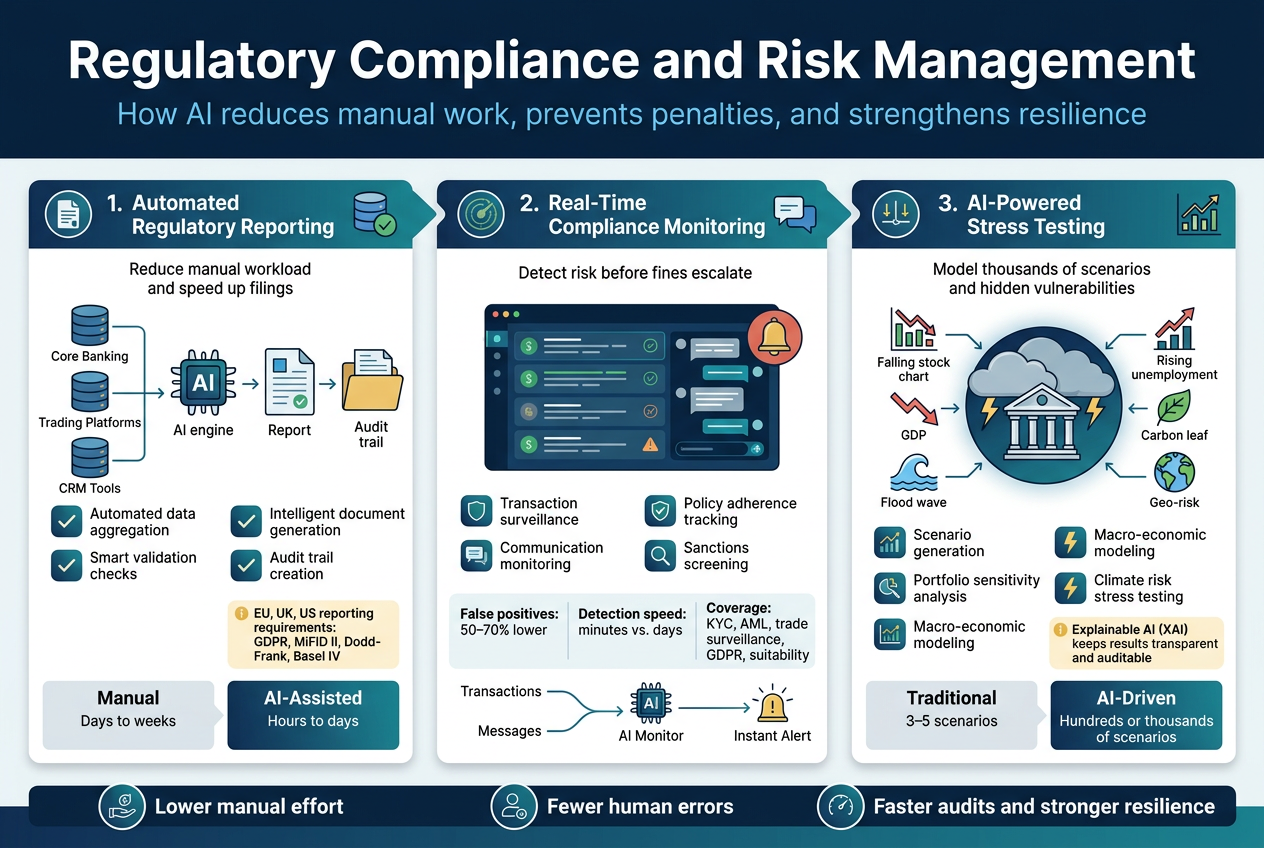
Automated Regulatory Reporting to Reduce Manual Workload
Keeping up with regulatory reporting is one of the most resource-draining tasks in financial services. Teams spend countless hours collecting data from siloed systems, reconciling figures, formatting reports, and chasing deadlines — only to repeat the entire process next quarter. AI is changing that in a meaningful way.
How AI streamlines regulatory reporting:
- Automated data aggregation — AI systems pull data from multiple internal sources (core banking systems, trading platforms, CRM tools) and consolidate it without manual intervention
- Intelligent document generation — Natural language generation (NLG) tools can auto-draft regulatory filings, from Basel III capital adequacy reports to FINRA submissions, formatted to the exact specifications required by each regulator
- Smart validation checks — Before a report is submitted, AI runs integrity checks to flag inconsistencies, missing fields, or figures that fall outside expected thresholds
- Audit trail creation — Every data point used in a report is logged with its source, timestamp, and transformation history, making it easy to respond to regulatory inquiries
Banks and financial institutions operating across multiple jurisdictions have an especially hard time managing the volume and variety of reporting requirements. A bank active in the EU, UK, and US might need to satisfy GDPR, MiFID II, Dodd-Frank, and Basel IV requirements simultaneously — each with different data formats, timelines, and submission portals.
AI-powered regulatory reporting platforms like Axiom SL, Wolters Kluwer OneSumX, and MSCI’s regulatory tools are already helping large institutions cut reporting cycles from weeks to days. Some firms have reported reducing reporting-related labor costs by 40–60% after deployment.
Typical manual vs. AI-assisted reporting comparison:
| Task | Manual Process | AI-Assisted Process |
|---|---|---|
| Data collection | 3–5 days across teams | Hours (automated ingestion) |
| Data validation | Manual spot-checks | Automated rule-based validation |
| Report drafting | Template-filling by analysts | Auto-generated drafts |
| Submission | Manual portal entry | API-driven direct submission |
| Audit preparation | Weeks of document retrieval | Instant audit trail access |
The shift isn’t just about saving time. Fewer manual steps mean fewer human errors, which directly lowers the risk of filing inaccurate reports and attracting unwanted regulatory scrutiny.
Real-Time Compliance Monitoring to Minimize Penalties
Regulatory penalties in financial services are not small numbers. Between 2008 and 2023, global banks paid over $380 billion in fines related to compliance failures — everything from anti-money laundering (AML) violations to market manipulation and data privacy breaches. Many of those fines came down because institutions weren’t catching problems fast enough.
Traditional compliance models are reactive. Something goes wrong, an investigation happens, a fine is issued. AI flips that model on its head by enabling continuous, real-time monitoring across transactions, communications, and employee activity.
What real-time compliance monitoring with AI actually looks like:
- Transaction surveillance — AI scans millions of transactions per day looking for patterns that suggest insider trading, wash trading, layering, or spoofing in capital markets
- Communication monitoring — Natural language processing (NLP) tools analyze trader emails, chat messages, and call transcripts to flag language that might signal market abuse or policy violations
- Policy adherence tracking — AI checks whether client-facing staff are recommending suitable products based on customer risk profiles (particularly important under MiFID II’s suitability requirements)
- Sanctions screening — Real-time cross-referencing of counterparties against OFAC, UN, and EU sanctions lists, with instant alerts when a match is detected
Key compliance areas where AI is deployed:
- Know Your Customer (KYC) and Customer Due Diligence (CDD)
- Anti-Money Laundering (AML) transaction monitoring
- Trade surveillance (market manipulation detection)
- GDPR and data privacy compliance
- Suitability and conduct monitoring
One of the biggest wins here is the reduction in false positives. Legacy rule-based systems are notorious for generating huge volumes of alerts, most of which turn out to be nothing. Compliance teams waste enormous time chasing ghost alerts. Machine learning models trained on historical case outcomes get significantly better at separating real risks from noise — some banks have seen false positive rates drop by 50–70% after switching to AI-driven monitoring.
AI in regulatory compliance for fintech and banking environments also helps with dynamic regulatory change management. When a regulation is updated, AI systems can be retrained or reprogrammed to reflect the new rules far faster than updating a legacy rule engine maintained by an IT team.
Benefits at a glance:
- Faster detection of compliance breaches (minutes vs. days)
- Reduced cost of compliance operations
- Lower false positive rates = less analyst burnout
- Proactive alerts before issues escalate into regulatory action
- Better documentation for examinations and audits
AI-Powered Stress Testing to Strengthen Financial Resilience
Stress testing has been a core regulatory requirement for banks since the 2008 financial crisis. Regulators like the Federal Reserve (through DFAST and CCAR), the European Banking Authority (EBA), and the Bank of England run annual exercises where banks must demonstrate they can survive severe economic shocks — like a 10% GDP contraction, a 50% drop in equity markets, or a sudden spike in unemployment.
The problem with traditional stress testing is that it’s slow, expensive, and based on a limited set of pre-defined scenarios. AI is making the entire process dramatically more powerful.
Where AI adds value in stress testing:
- Scenario generation — Generative AI and simulation models can produce thousands of stress scenarios, including historically novel ones, by combining economic variables in ways human analysts wouldn’t think to explore
- Portfolio-level sensitivity analysis — Machine learning models can assess how individual assets, loan portfolios, or trading books respond to stress conditions, factoring in non-linear relationships and second-order effects that traditional models miss
- Macro-economic modeling — AI can process a much wider range of macroeconomic inputs (interest rate shifts, geopolitical events, commodity price changes, credit spreads) and model how they ripple through a bank’s balance sheet
- Climate risk stress testing — As climate-related financial risk becomes a regulatory priority under frameworks like the TCFD, AI is being used to model physical risks (flood damage to collateral) and transition risks (carbon pricing impacts on loan books)
Traditional vs. AI-driven stress testing:
| Dimension | Traditional Approach | AI-Driven Approach |
|---|---|---|
| Scenarios tested | 3–5 regulatory scenarios | Hundreds or thousands of scenarios |
| Time to complete | Weeks to months | Days |
| Variable relationships | Linear assumptions | Non-linear, dynamic modeling |
| Data sources | Historical financial data | Alternative data, macro feeds, satellite data |
| Climate risk modeling | Limited or manual | Integrated physical and transition risk models |
| Model explainability | Straightforward | Requires explainable AI (XAI) techniques |
One area getting serious attention is reverse stress testing — working backwards from a failure scenario to identify what combination of events would break the bank. AI is particularly well-suited for this because it can explore a massive combinatorial space of risk factors simultaneously.
Financial services automation of the stress testing process also helps institutions run ad hoc tests outside of the regulatory calendar. When COVID-19 hit in March 2020, institutions that had AI-powered risk systems were able to run emergency stress scenarios within days to understand their exposure. Those relying on manual processes took weeks.
Explainability remains a real challenge. Regulators don’t just want a number — they want to understand how the model got there. This is why financial institutions are investing in explainable AI (XAI) frameworks alongside their stress testing tools, so they can present results to regulators in a transparent, auditable way.
Key outcomes institutions are targeting through AI-driven stress testing:
- Stronger capital planning tied to realistic, dynamic risk scenarios
- Faster regulatory submission cycles
- Identification of hidden portfolio vulnerabilities before they become crises
- Better integration of emerging risks (climate, geopolitical, cyber) into financial resilience frameworks
- Board-level dashboards that translate complex stress test outputs into clear risk narratives
Operational Efficiency and Cost Reduction
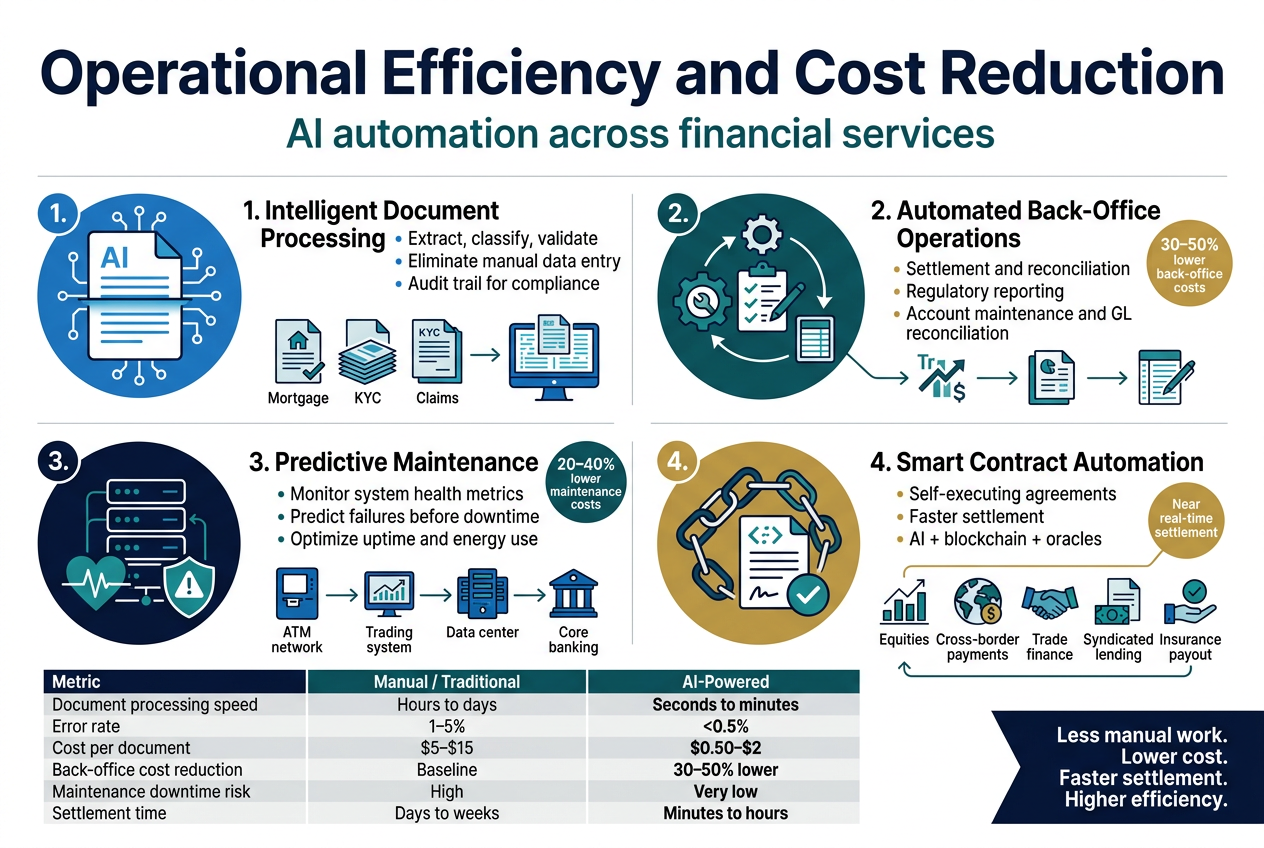
Intelligent Document Processing to Eliminate Manual Data Entry
Anyone who has worked in financial services knows the pain of drowning in paperwork. Loan applications, KYC forms, trade confirmations, account opening documents — the volume is staggering, and the traditional approach of having humans key in data is slow, expensive, and riddled with errors.
AI-powered Intelligent Document Processing (IDP) changes all of that. By combining optical character recognition (OCR), natural language processing (NLP), and machine learning, IDP systems can extract, classify, and validate data from virtually any document type — structured or unstructured — at a speed no human team can match.
Here’s what that looks like in practice:
- A mortgage lender receives hundreds of applications daily, each with pay stubs, tax returns, and bank statements. IDP reads every document, pulls the relevant figures, cross-checks them for consistency, and feeds clean data directly into the underwriting system — all within seconds.
- A bank’s compliance team no longer manually reviews passports and utility bills for KYC checks. The IDP system extracts data, flags anomalies, and routes only exceptions to human reviewers.
- Insurance companies process claim forms, medical reports, and repair estimates automatically, cutting claims handling time from days to hours.
The business case is clear:
| Metric | Manual Processing | AI-Powered IDP |
|---|---|---|
| Processing speed | Hours to days | Seconds to minutes |
| Error rate | 1–5% (human average) | <0.5% |
| Cost per document | $5–$15 | $0.50–$2 |
| Scalability | Requires hiring | Scales instantly |
Beyond raw speed, IDP creates an auditable data trail, which matters enormously in a regulated industry. Every extraction decision is logged, making it easier to demonstrate compliance during audits.
Financial services automation at this level isn’t just about cutting costs. It’s about freeing up skilled employees to do work that actually requires human judgment — relationship management, complex negotiations, strategic analysis — rather than copy-pasting numbers from PDFs.
Automated Back-Office Operations to Lower Overhead Costs
Back-office functions are the engine room of any financial institution. Settlement, reconciliation, reporting, account maintenance, regulatory filings — none of it is glamorous, but all of it is critical. And traditionally, it has consumed enormous amounts of time, headcount, and budget.
AI-driven automation is reshaping this entire landscape. Robotic Process Automation (RPA) combined with machine learning handles high-volume, rule-based tasks without breaks, errors, or complaints. When you layer in more sophisticated AI — like anomaly detection and predictive analytics — you get systems that don’t just execute tasks but also catch problems before they escalate.
Key back-office areas being transformed by AI:
- Trade settlement and reconciliation: AI systems match trade records across multiple counterparties and ledgers in real time, automatically flagging breaks and resolving the majority without human intervention. This dramatically reduces the cost and risk associated with failed trades.
- Regulatory reporting: AI tools pull data from multiple systems, validate it against regulatory requirements, and generate reports automatically — reducing both the time burden and the risk of submission errors.
- Account maintenance: Address changes, beneficiary updates, dividend reinvestment instructions — AI handles these routine requests instantly, without routing them through a service queue.
- General ledger management: Automated reconciliation tools cross-reference thousands of entries, identify discrepancies, and assign them to the right resolution workflow without a human having to review each one manually.
What this means for the bottom line:
A large retail bank processing millions of transactions daily can see back-office costs reduced by 30–50% after full AI implementation. That’s not a speculative number — several tier-one banks have publicly reported savings in this range following large-scale automation programs.
The real competitive advantage isn’t just cost reduction, though. Faster back-office processing means faster settlement, which reduces counterparty risk and improves capital efficiency. In a business where capital efficiency directly translates to profitability, that matters enormously.
AI in financial services is increasingly positioning automation not as a way to simply do existing things cheaper, but as a way to do things that were previously impossible at scale — like real-time reconciliation across complex multi-leg transactions.
Predictive Maintenance for Critical Financial Infrastructure
When people think about predictive maintenance and AI, they typically imagine factory floors and wind turbines. But financial institutions run on infrastructure just as complex and just as vulnerable — trading systems, payment networks, data centers, ATM fleets, and core banking platforms.
Downtime in any of these systems isn’t just an operational inconvenience. It’s a compliance risk, a reputational crisis, and a direct revenue loss event. A payment network outage during peak hours can cost millions of dollars per minute.
How AI-powered predictive maintenance works in financial infrastructure:
AI models continuously monitor system health metrics — CPU load, memory usage, error rates, latency spikes, hardware sensor data — and learn the patterns that precede failures. Rather than waiting for something to break (reactive maintenance) or servicing it on a fixed schedule regardless of condition (preventive maintenance), the system flags components that are showing early warning signs of degradation and schedules intervention before failure occurs.
Real-world applications in financial services:
- ATM networks: AI analyzes cash dispenser mechanisms, card reader performance, and connectivity data to predict which machines are likely to go offline — allowing technicians to service them before customers experience downtime. Banks with large ATM fleets have cut unplanned downtime by up to 30% using this approach.
- Trading infrastructure: Low-latency trading systems are extraordinarily sensitive. AI monitoring tools detect micro-level performance degradation in network switches, co-location servers, and order routing systems before they impact trade execution.
- Data center operations: AI manages cooling systems, power distribution, and server loads dynamically, predicting hardware failures days in advance and optimizing energy consumption simultaneously.
- Core banking systems: Legacy core banking platforms — still running at the heart of many institutions — are monitored by AI tools that track transaction processing speeds, batch job completion rates, and database query performance, flagging deterioration that might indicate an impending failure.
The ROI of predictive maintenance in financial infrastructure:
| Maintenance Approach | Cost Profile | Downtime Risk | Efficiency |
|---|---|---|---|
| Reactive | Low upfront, high incident cost | High | Low |
| Preventive (scheduled) | Moderate, often wasteful | Medium | Medium |
| AI Predictive | Higher upfront investment | Very low | High |
The shift to predictive approaches typically delivers a 20–40% reduction in total maintenance costs and a significant reduction in unplanned outages. For institutions where even minutes of downtime carries regulatory and financial consequences, that’s a compelling business case.
Smart Contract Automation to Accelerate Transaction Settlement
Traditional financial transaction settlement is, by any modern standard, painfully slow. Equity trades take two business days to settle (T+2). Cross-border payments can take three to five days. Trade finance transactions — letters of credit, bills of lading — can take weeks of back-and-forth between multiple parties, each checking the same documents independently.
The friction isn’t arbitrary. It exists because settlement requires verification, reconciliation, and trust between counterparties who don’t necessarily trust each other. Smart contracts, powered by blockchain and increasingly enhanced by AI, directly address this trust problem.
What smart contracts actually do:
A smart contract is a self-executing agreement where the terms are written directly into code on a blockchain. When predefined conditions are met — payment received, delivery confirmed, credit check passed — the contract executes automatically. No intermediary needed. No waiting for a back-office team to verify and release funds.
Where AI amplifies smart contract capabilities:
Smart contracts alone are rules-based. AI adds intelligence. Combining the two creates systems that can:
- Assess and adapt in real time: AI can evaluate incoming data — market prices, credit ratings, counterparty risk scores — and adjust contract execution parameters dynamically. For example, a trade finance smart contract might automatically adjust collateral requirements based on real-time credit risk assessments.
- Monitor for exceptions: AI identifies situations where contract conditions are ambiguous or where external data inputs are unreliable, escalating to human review only when genuinely needed.
- Integrate with off-chain data: AI-powered oracles feed verified real-world data into smart contracts — commodity prices, interest rate benchmarks, exchange rates — enabling contracts that respond accurately to external conditions.
Industries and use cases being transformed:
- Derivatives and structured products: Smart contracts can handle the complex, multi-leg settlement logic of derivatives trades — calculating net payments, applying netting agreements, and executing simultaneously across counterparties — dramatically reducing settlement risk and operational cost.
- Syndicated lending: Loan participation and payment distribution among multiple lenders, historically a manual nightmare, can be fully automated through smart contracts that distribute principal and interest payments instantly based on each lender’s share.
- Trade finance: Letters of credit backed by smart contracts can verify shipping documents through AI-powered document recognition and automatically release payment upon confirmed delivery — cutting trade finance cycle times from weeks to hours.
- Insurance payouts: Parametric insurance products (where payouts trigger automatically when defined conditions occur — a hurricane of a certain wind speed, a flight delayed beyond a certain threshold) are natural candidates for smart contract execution.
The settlement speed transformation:
| Asset Class | Current Settlement Time | Smart Contract Target |
|---|---|---|
| Equities | T+2 days | Near real-time |
| Cross-border payments | 3–5 days | Minutes to hours |
| Trade finance (letters of credit) | 7–14 days | Same day |
| Syndicated loan payments | 1–3 days | Instant |
| OTC derivatives | 2–3 days | Same day |
The financial services industry processes trillions of dollars in transactions annually. Compressing settlement cycles doesn’t just speed things up — it frees up enormous amounts of capital that would otherwise be tied up during settlement periods. That capital can be redeployed, generating additional returns. The aggregate economic value of faster settlement across global markets runs into hundreds of billions of dollars.
Regulatory frameworks around smart contracts and blockchain settlement are still evolving, and widespread adoption requires coordination across institutions and market infrastructure providers. But pilot programs at major exchanges, central banks exploring central bank digital currencies (CBDCs), and growing enterprise blockchain adoption all point in the same direction: smart contract automation is moving from experimental to essential in financial services.
Insurance Underwriting and Claims Processing
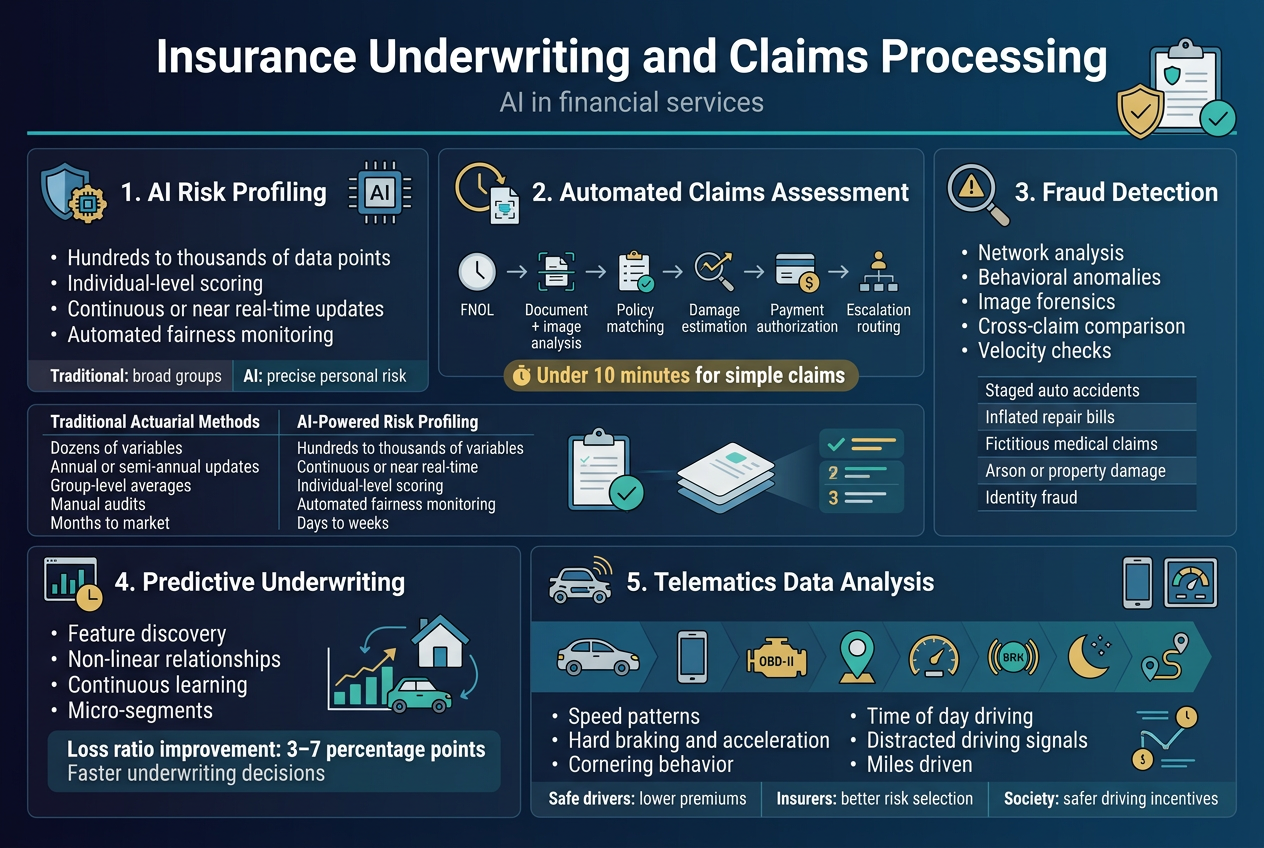
AI Risk Profiling to Price Policies More Accurately
Traditional insurance pricing leaned heavily on broad demographic categories — age, location, occupation — and historical loss tables that treated everyone in a group as roughly the same risk. AI changes that entirely. Machine learning models can now pull together hundreds of data points per applicant, from driving records and credit behavior to health wearable data and property sensor readings, and build a risk profile that’s genuinely specific to that individual.
The practical payoff is significant:
- Fairer premiums — lower-risk customers stop subsidizing higher-risk ones, which reduces churn among profitable policyholders
- Better portfolio balance — insurers can select risks more deliberately rather than accepting whatever walks through the door
- Real-time repricing — as new data comes in, models can adjust risk scores dynamically rather than waiting for annual renewal cycles
Here’s a quick look at how AI-driven risk profiling stacks up against traditional actuarial approaches:
| Factor | Traditional Actuarial Methods | AI-Powered Risk Profiling |
|---|---|---|
| Data inputs | Dozens of variables | Hundreds to thousands of variables |
| Update frequency | Annual or semi-annual | Continuous or near real-time |
| Granularity | Group-level averages | Individual-level scoring |
| Bias detection | Manual audits | Automated fairness monitoring |
| Speed to market | Months | Days to weeks |
Insurers using AI risk profiling for underwriting have reported meaningful improvements in their loss ratios, which is ultimately what separates a profitable book of business from one that slowly bleeds money.
Automated Claims Assessment to Reduce Processing Time
Claims processing has historically been one of the most labor-intensive parts of the insurance business. Adjusters manually reviewing documents, scheduling inspections, cross-referencing policy details — the whole thing could take days or even weeks for a straightforward claim. That’s frustrating for customers and expensive for insurers.
AI-powered claims automation collapses that timeline dramatically. Here’s how the modern AI claims workflow actually operates:
- First Notice of Loss (FNOL) — Customers submit claims via app or web portal; AI immediately extracts key details and classifies the claim type
- Document and image analysis — Computer vision models assess photos of damaged property, vehicles, or medical records in seconds
- Policy matching — Natural language processing cross-references claim details against policy terms to determine coverage eligibility automatically
- Damage estimation — AI models trained on repair cost databases generate repair or replacement estimates without human input
- Payment authorization — For straightforward, low-complexity claims below a defined threshold, payments are approved and initiated automatically
- Escalation routing — Complex or ambiguous claims get flagged and routed to human adjusters with an AI-generated summary already attached
Some insurers have brought simple auto and property claims from submission to payment in under 10 minutes using this kind of end-to-end automation. That’s a customer experience transformation as much as it is an operational one.
Key Benefits of Automated Claims Processing
- Reduced cost per claim — automating routine decisions significantly cuts labor costs
- Faster cycle times — customers get resolutions faster, which drives satisfaction and loyalty
- Consistency — AI applies the same rules every time, reducing variability in outcomes
- Scalability — during catastrophic events like hurricanes or wildfires, automated systems can handle massive claim volumes without hiring surge staff
Fraud Detection in Claims to Protect Insurer Profitability
Insurance fraud costs the industry tens of billions of dollars every year, and a meaningful portion of every premium dollar goes toward covering fraudulent payouts. AI fraud detection in claims is one of the clearest, most direct applications of AI in financial services because the ROI is so easy to quantify — every fraudulent claim caught is money saved.
AI systems detect fraud in ways that rule-based systems simply can’t. Rather than relying on a fixed list of red flags, machine learning models identify unusual patterns across thousands of variables simultaneously:
- Network analysis — detecting rings of connected claimants, providers, and repair shops that are coordinating fraud
- Behavioral anomalies — identifying claims where the timing, sequence, or nature of events doesn’t match typical patterns
- Image forensics — spotting manipulated photos submitted as evidence (metadata analysis, pixel-level inconsistencies)
- Cross-claim comparison — flagging claimants who have filed suspiciously similar claims with multiple insurers
- Velocity checks — catching unusual claim frequency from a single individual, address, or provider
Types of Fraud AI Is Particularly Good at Catching
| Fraud Type | AI Detection Method |
|---|---|
| Staged auto accidents | Network graph analysis + telematics data |
| Inflated repair bills | Price benchmarking models |
| Fictitious medical claims | Provider pattern analysis + record cross-referencing |
| Arson/deliberate property damage | Satellite imagery + historical risk data |
| Identity fraud | Biometric verification + behavioral analytics |
Critically, AI doesn’t just flag suspicious claims after the fact — the best systems score claims for fraud probability at the moment of submission, so high-risk claims get extra scrutiny from the start rather than being paid out and investigated later.
Predictive Underwriting Models That Improve Loss Ratios
Loss ratio — the percentage of premiums paid out in claims — is the single most important measure of underwriting quality. A loss ratio that’s too high means the insurer is pricing risk wrong. AI underwriting models attack this problem at the source.
Predictive underwriting goes beyond standard risk scoring. These models are trained on years of historical claims data, and they learn the subtle combinations of factors that actually predict future losses — not just the obvious ones. An AI model might discover, for example, that a particular combination of home construction type, local weather patterns, proximity to emergency services, and homeowner behavior predicts claims far better than any individual variable alone.
What makes predictive underwriting models effective:
- Feature discovery — AI finds predictive signals that human underwriters wouldn’t think to look for
- Non-linear relationships — models capture complex interactions between variables that linear actuarial models miss
- Continuous learning — as new claims data flows in, models retrain and improve their predictions
- Segment precision — instead of broad buckets, AI creates micro-segments with genuinely differentiated risk levels
Practical Outcomes Insurers Have Seen
- Reductions in loss ratios of 3–7 percentage points in commercial lines
- Improved selection of preferred risks, reducing adverse selection
- More competitive pricing on lower-risk accounts, helping win business worth keeping
- Faster underwriting decisions, reducing time-to-bind for brokers and agents
The interaction between AI insurance underwriting and loss ratio improvement is one of the most compelling business cases in the industry. For every point of improvement in loss ratio on a large book of business, the financial impact runs into millions of dollars.
Telematics Data Analysis for Usage-Based Insurance Products
Usage-based insurance (UBI) is where AI and real-world behavioral data come together in a genuinely new way. Rather than pricing auto insurance based on historical statistics about people who are similar to you, telematics captures how you actually drive — and prices your premium accordingly.
Telematics data typically flows from:
- In-vehicle OBD-II dongles — small devices that plug into a car’s diagnostic port
- Smartphone apps — GPS and accelerometer data from the driver’s phone
- Factory-embedded telematics — built into newer vehicles directly by manufacturers
- Connected car platforms — integrations with automaker data feeds
AI models analyze this raw data stream and extract meaningful signals:
- Speed patterns — frequency and severity of speeding events
- Hard braking and acceleration — indicators of aggressive driving style
- Cornering behavior — lateral G-force events that suggest risky maneuvers
- Time of day driving — nighttime driving, particularly late night, correlates with higher risk
- Distracted driving signals — phone handling detected via accelerometer patterns
- Miles driven — raw exposure measurement
How AI Turns Telematics Into Pricing
The raw telematics data by itself isn’t a price. AI models aggregate thousands of individual events into a composite driving score, then map that score to expected loss probability. Gradient boosting and neural network models are particularly effective here because the relationship between driving behavior and crash probability is non-linear and complex.
UBI benefits by stakeholder:
| Stakeholder | Benefit |
|---|---|
| Safe drivers | Lower premiums that reflect actual risk |
| Insurers | Better risk selection and loss prediction |
| Regulators | More transparent, behavior-based pricing |
| Society | Financial incentives that encourage safer driving |
Beyond personal auto, the same principles apply to commercial fleet insurance. AI analysis of fleet telematics data allows insurers to price large commercial accounts with extraordinary precision, and gives fleet managers real-time visibility into driver behavior that helps them reduce risk proactively.
The data volumes involved are genuinely massive — a single vehicle generates hundreds of data points per trip — and AI is the only realistic way to extract actionable pricing signals from that volume at scale. This is a space where financial services automation and behavioral science are genuinely reshaping what insurance products can look like and who they work best for.
Wealth Management and Financial Planning
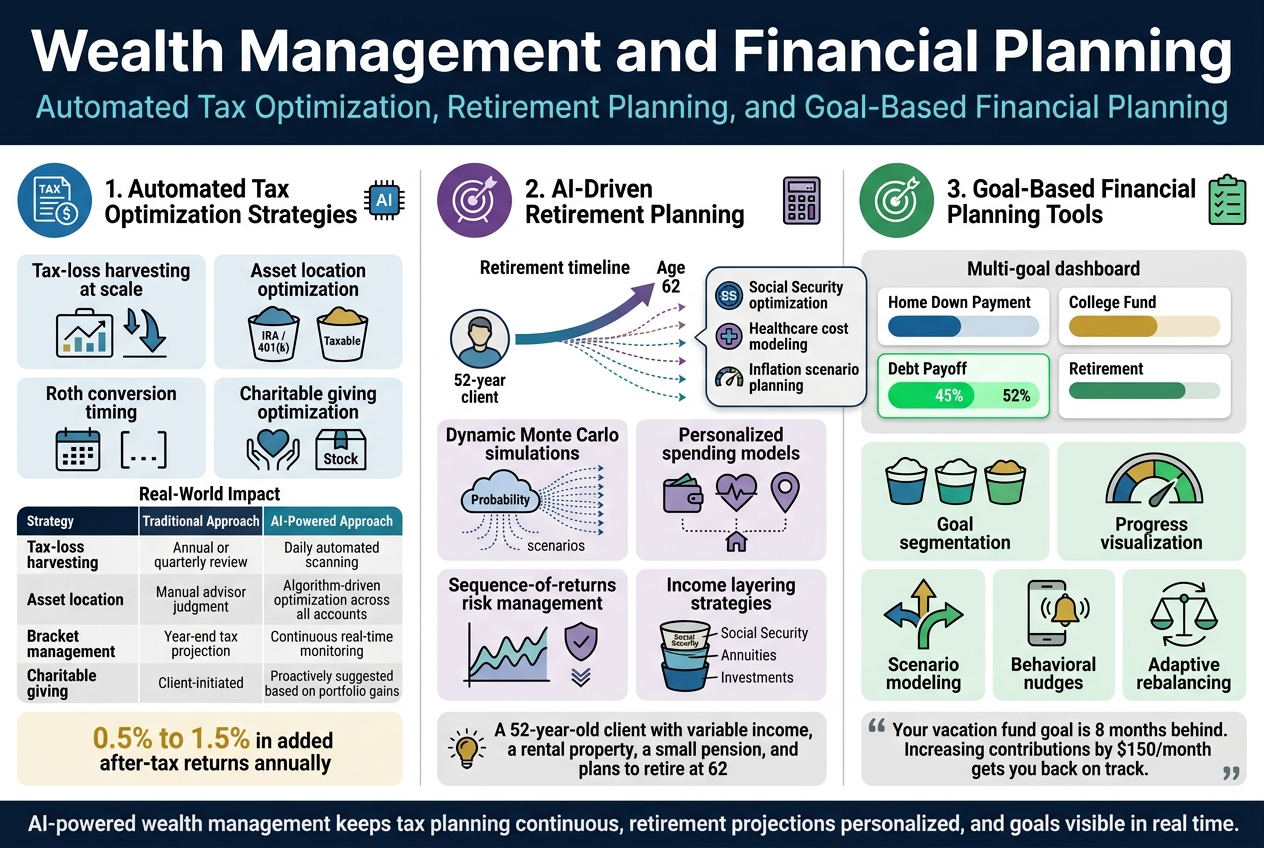
Automated Tax Optimization Strategies to Maximize Client Returns
Tax season used to mean scrambling through receipts and hoping your accountant caught everything. AI-powered wealth management platforms are changing that game entirely — and clients are seeing real money stay in their pockets because of it.
AI-driven tax optimization works year-round, not just in April. These systems continuously scan client portfolios, income patterns, and changing tax laws to surface opportunities that even experienced advisors might miss.
What AI Does That Traditional Methods Can’t
- Tax-loss harvesting at scale: AI monitors portfolios daily (sometimes hourly) and automatically identifies losing positions that can be sold to offset capital gains — without triggering wash-sale violations or disrupting the client’s overall investment strategy.
- Asset location optimization: The system figures out which investments belong in tax-advantaged accounts (like IRAs or 401(k)s) versus taxable accounts — a surprisingly powerful strategy that most people never fully take advantage of.
- Roth conversion timing: AI models can predict the optimal years for Roth conversions by analyzing projected income, marginal tax brackets, and anticipated future tax rate changes.
- Charitable giving optimization: Platforms can identify whether donating appreciated stock, using donor-advised funds, or bunching charitable deductions makes the most sense for a specific client’s tax picture.
Real-World Impact
| Strategy | Traditional Approach | AI-Powered Approach |
|---|---|---|
| Tax-loss harvesting | Annual or quarterly review | Daily automated scanning |
| Asset location | Manual advisor judgment | Algorithm-driven optimization across all accounts |
| Bracket management | Year-end tax projection | Continuous real-time monitoring |
| Charitable giving | Client-initiated | Proactively suggested based on portfolio gains |
Platforms like Betterment, Wealthfront, and Vanguard Digital Advisor have demonstrated that automated tax-loss harvesting alone can add between 0.5% and 1.5% in after-tax returns annually. Over a 30-year investment horizon, that difference compounds into significant wealth.
The real advantage isn’t just the tactics — it’s the consistency. AI never forgets to check, never gets too busy, and never misses a window because of a long weekend.
AI-Driven Retirement Planning for Long-Term Financial Security
Retirement planning has historically been built on broad assumptions: pick a target date, contribute a fixed percentage, and hope the market cooperates. That approach ignores the messy reality of how people actually live — career gaps, unexpected medical expenses, inheritance, divorce, and lifestyle changes that no static spreadsheet can anticipate.
AI in financial services is rewriting how retirement planning works, shifting it from a one-size-fits-all exercise into something that actually reflects each person’s life.
How AI Makes Retirement Planning Smarter
Dynamic Monte Carlo Simulations
AI-powered retirement tools run thousands — sometimes millions — of simulated market scenarios to give clients a realistic probability range for hitting their goals. Unlike traditional Monte Carlo tools that use fixed assumptions, modern AI models update in real time as market conditions shift, interest rates change, or a client’s financial situation evolves.
Personalized Spending Models
Instead of assuming a client will spend 80% of their pre-retirement income (a common but often inaccurate rule of thumb), AI analyzes actual spending behavior, health data, lifestyle preferences, and even geographic location to build personalized retirement spending projections.
Sequence-of-Returns Risk Management
One of the most underappreciated retirement risks is getting unlucky with market timing early in retirement. AI systems can dynamically adjust withdrawal strategies — shifting between portfolios, delaying Social Security claims, or tapping different account types — based on current market conditions to protect long-term retirement sustainability.
Key Areas Where AI Adds Real Value
- Social Security optimization: AI calculates the ideal claiming age based on life expectancy, spousal benefits, and the client’s overall retirement income picture — a decision worth tens of thousands of dollars for many retirees.
- Healthcare cost modeling: AI integrates projected healthcare inflation, Medicare premium estimates, and long-term care probability into retirement projections — costs that traditional plans wildly underestimate.
- Inflation scenario planning: Rather than using a fixed 3% inflation assumption, AI models test portfolios against a range of inflationary environments, including stagflation scenarios.
- Income layering strategies: AI helps design income “buckets” — pairing guaranteed income sources like Social Security and annuities with growth-oriented investments to cover different time horizons.
What This Looks Like in Practice
A 52-year-old client with a variable income, a rental property, a small pension, and plans to retire at 62 would have been nearly impossible to model accurately with traditional tools. An AI-driven platform can pull all those income sources together, run them through thousands of scenarios, and surface a clear picture of what’s achievable — along with specific action steps to close any gaps.
This kind of planning used to be reserved for ultra-high-net-worth clients who could afford expensive financial planning teams. AI-powered wealth management platforms are making it accessible to anyone.
Goal-Based Financial Planning Tools That Improve Client Outcomes
Goal-based financial planning sounds simple in concept — set a goal, build a plan to reach it. But in practice, people have multiple goals running simultaneously, often with competing timelines and priorities. They want to pay off debt, save for a house, fund college for two kids, and retire comfortably — all at once.
AI-powered goal-based planning tools are uniquely suited to handle that complexity in a way that genuinely connects with how people think about money.
The Shift From Portfolio-Centric to Goal-Centric Planning
Traditional wealth management centered on building the best portfolio possible and measuring success by investment returns. Goal-based planning flips that entirely — success is measured by whether the client actually achieves what matters to them, not whether the portfolio beat a benchmark.
AI makes this work because it can:
- Track multiple goals simultaneously with different time horizons, risk tolerances, and funding strategies.
- Prioritize dynamically — if a client gets a raise, has a child, or faces a financial setback, the AI recalibrates which goals to accelerate and which to adjust.
- Connect emotional context to financial decisions — some platforms now incorporate behavioral data and client preferences to understand not just what someone wants, but why, which leads to better plan adherence.
How Goal-Based AI Tools Are Built
| Feature | What It Does | Why It Matters |
|---|---|---|
| Goal segmentation | Splits finances into buckets by goal | Prevents emotional mixing of short and long-term money |
| Progress visualization | Shows real-time goal health | Keeps clients engaged and on track |
| Scenario modeling | Tests “what-if” situations | Helps clients make confident decisions |
| Behavioral nudges | Sends timely alerts and suggestions | Drives action at the right moments |
| Adaptive rebalancing | Adjusts allocations as goals evolve | Keeps the plan aligned without manual intervention |
The Behavioral Finance Connection
One of the biggest reasons financial plans fail isn’t math — it’s human behavior. People panic during downturns, overspend in good times, and lose sight of long-term goals when short-term pressures mount.
AI-driven goal-based tools tackle this directly:
- Gamification elements make progress feel tangible and rewarding — seeing a “Home Down Payment” goal bar move from 45% to 52% is motivating in a way that a portfolio return figure simply isn’t.
- Automated contributions aligned to specific goals remove the temptation to redirect money elsewhere.
- Smart alerts flag when a goal is at risk — not in intimidating financial jargon, but in plain, actionable language: “Your vacation fund goal is 8 months behind. Increasing contributions by $150/month gets you back on track.”
Who Benefits Most
- Millennials and Gen Z clients who think about money in terms of life milestones rather than investment returns respond particularly well to goal-based interfaces.
- Families with complex financial pictures — multiple income earners, business ownership, inheritance planning — benefit from AI’s ability to model competing priorities without losing sight of any of them.
- Advisors managing large client books can use AI goal-tracking tools to stay on top of client progress at scale, getting alerted when a client’s plan needs attention rather than waiting for an annual review.
The best goal-based AI platforms close the gap between a beautifully designed financial plan and actually following it — and that’s where the real client outcomes improvement happens.
Lending and Mortgage Innovation
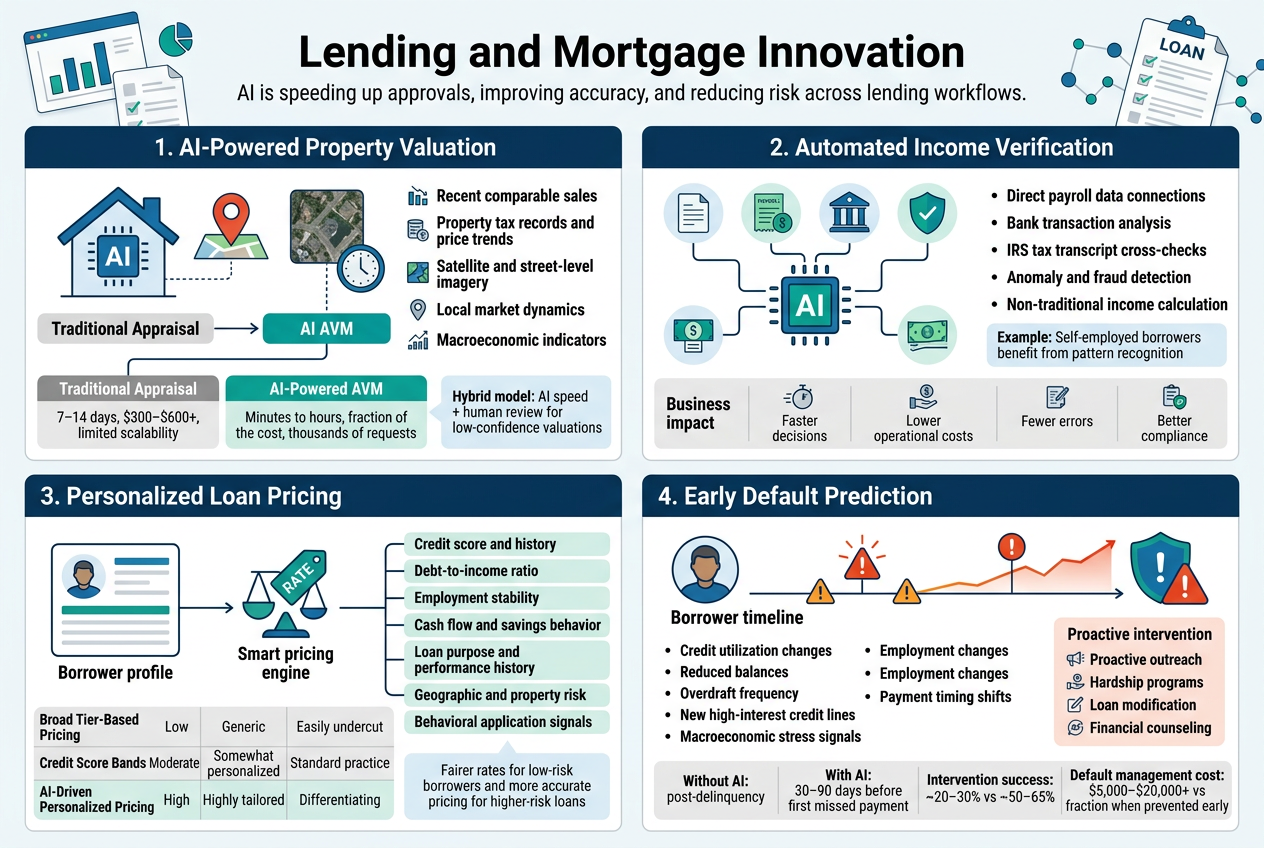
AI-Powered Property Valuation for Faster Mortgage Approvals
Traditional property appraisals have always been a bottleneck in the mortgage process. A buyer finds their dream home, submits an application, and then waits — sometimes weeks — for a licensed appraiser to schedule a visit, conduct an inspection, and file a report. AI is changing that completely.
Modern AI-powered Automated Valuation Models (AVMs) analyze massive datasets in seconds, including:
- Recent comparable sales in the neighborhood
- Property tax records and historical price trends
- Satellite and street-level imagery to assess condition
- Local market dynamics such as school ratings, walkability scores, and proximity to amenities
- Macroeconomic indicators like interest rate movements and regional employment data
What used to take 7–10 days can now be completed in minutes with a high degree of accuracy. Lenders like Rocket Mortgage and United Wholesale Mortgage have already embedded AI valuation tools into their pipelines, dramatically cutting time-to-close.
How AVMs Compare to Traditional Appraisals
| Feature | Traditional Appraisal | AI-Powered AVM |
|---|---|---|
| Turnaround Time | 7–14 days | Minutes to hours |
| Cost | $300–$600+ | Fraction of the cost |
| Scalability | Limited by appraiser availability | Handles thousands of requests simultaneously |
| Consistency | Varies by appraiser | Standardized algorithm |
| Coverage in Rural Areas | Often difficult | Dependent on data availability |
That said, AI valuations work best in data-rich urban and suburban markets. Rural properties or unique homes with fewer comparable sales still benefit from human appraisers. The smartest approach blends AI speed with human oversight — a hybrid model that flags low-confidence valuations for manual review while fully automating the straightforward cases.
This kind of AI in financial services doesn’t just speed things up. It also reduces bias that can creep into human appraisals, a problem that has historically disadvantaged minority homebuyers in certain neighborhoods. Algorithm-driven valuations, when built on clean and representative training data, can deliver more consistent outcomes across different communities.
Automated Income Verification to Streamline Loan Processing
Income verification has traditionally been one of the most paper-heavy, frustrating parts of applying for any loan. Borrowers gather pay stubs, tax returns, W-2s, and bank statements. Loan officers manually review each document. Processors follow up on discrepancies. The whole thing drags on.
AI-powered income verification cuts through that friction by directly connecting to authoritative data sources and doing the heavy lifting automatically.
Here’s what modern AI verification systems can do:
- Pull payroll data directly from employers through integrations with platforms like Truework, Argyle, or Equifax’s The Work Number
- Analyze bank transaction history to identify recurring income deposits, even for gig workers and freelancers
- Cross-reference IRS data through Form 4506-C tax transcript services
- Detect anomalies in submitted documents that might indicate fraud or inconsistency
- Calculate income from non-traditional sources like rental income, alimony, or side businesses
This matters a lot for self-employed borrowers, who have historically faced an uphill battle getting approved simply because their income is harder to document. A freelance designer earning $150,000 a year might see 12 different client deposits every month — a human processor finds that messy, but an AI model trained on income pattern recognition handles it cleanly.
The Business Impact for Lenders
- Faster decisions: Automated verification can reduce processing time from days to hours
- Lower operational costs: Less manual document review means smaller back-office teams
- Fewer errors: Automated systems don’t misread numbers or transpose figures
- Better compliance: A consistent, documented verification process is easier to audit
- Higher borrower satisfaction: Nobody likes hunting for tax returns from three years ago
Machine learning credit scoring and income verification are converging into a single, seamless workflow. The result is a lending experience that feels less like a bureaucratic ordeal and more like a straightforward digital transaction.
Personalized Loan Pricing to Attract and Retain Borrowers
For a long time, loan pricing was relatively blunt. A borrower with a 720 credit score got a certain rate, and that was more or less it. The nuance stopped there. AI is making pricing far more precise — and far more competitive.
Personalized loan pricing uses machine learning to analyze dozens or even hundreds of variables beyond the credit score to determine the true risk profile of a borrower. This lets lenders offer rates that genuinely reflect individual risk rather than applying a broad category average.
Variables that AI pricing models might consider:
- Credit score and full credit history
- Debt-to-income ratio
- Employment stability and tenure
- Industry and job type
- Cash flow patterns and savings behavior
- Loan purpose and how similar loans have performed historically
- Geographic and property-level risk factors (for mortgage products)
- Behavioral data from the application process itself
When pricing gets this granular, a few interesting things happen. First, lenders can confidently offer better rates to borrowers who are genuinely low-risk but might have a slightly imperfect credit score due to a single past event. Second, they can price higher-risk loans more accurately rather than just declining them outright — expanding access to credit responsibly.
Why This Is a Competitive Advantage
In a crowded market where borrowers can shop rates in minutes across dozens of lenders, personalized pricing can be the difference between winning and losing a loan application. Consider the comparison:
| Pricing Approach | Rate Accuracy | Borrower Appeal | Competitive Position |
|---|---|---|---|
| Broad Tier-Based Pricing | Low — same rate for wide range of risk | Generic | Easily undercut |
| Credit Score Bands | Moderate | Somewhat personalized | Standard practice |
| AI-Driven Personalized Pricing | High — individual risk assessment | Highly tailored | Differentiating |
Fintech lenders like SoFi, LendingClub, and Upstart have built their entire value propositions around this kind of personalized AI pricing, often attracting borrowers who felt underserved by traditional banks. Established banks are now adopting similar approaches to stay relevant.
There’s also a retention angle. When a borrower knows their lender has genuinely analyzed their financial profile and offered a fair rate, they’re more likely to return for their next loan rather than defaulting to whoever runs the best ad on Google.
Early Default Prediction to Reduce Non-Performing Loans
Non-performing loans (NPLs) are expensive — for lenders, for investors, and ultimately for borrowers too. The traditional approach to managing loan portfolios has been largely reactive: a borrower misses a payment, a collection process starts, and by the time a workout plan is in place, the damage is often already done.
AI flips that model on its head by identifying borrowers who are showing early signs of financial stress — often weeks or months before they miss their first payment.
Signals that AI default prediction models monitor:
- Changes in credit utilization patterns
- Reduced account balance trends over time
- Increased overdraft frequency
- New inquiries or recently opened high-interest credit lines
- Changes in employment status (if accessible through payroll data integrations)
- Payment timing shifts — paying on the last possible day instead of early
- Macroeconomic indicators tied to the borrower’s industry or geography
The sophistication here is real. A borrower who was comfortably employed in tech, took out a mortgage, and now suddenly has a sharp uptick in credit card usage and two new payday loan inquiries is sending distress signals — even if they haven’t missed a single payment yet. An AI model trained on historical default patterns can spot that combination and flag it for proactive outreach.
What Lenders Can Do With Early Warning Signals
Once a borrower is flagged as elevated risk, lenders have a range of options that are far better for everyone involved than letting a loan slide into default:
- Proactive outreach: A simple check-in call or message asking if the borrower needs support
- Hardship programs: Offering temporary payment deferrals or interest-only periods
- Loan modification: Restructuring the loan terms to make payments more manageable
- Financial counseling: Connecting borrowers with resources that help them stabilize
This approach benefits lenders through lower NPL ratios, reduced provisioning costs, and better portfolio performance. For borrowers, early intervention can be the difference between a temporary rough patch and a full-blown default that damages their credit for years.
The Numbers Behind the Value
| Metric | Without AI Early Warning | With AI Early Warning |
|---|---|---|
| Average time to identify at-risk borrower | Post-delinquency | 30–90 days before first missed payment |
| Intervention success rate | ~20–30% | ~50–65% (industry estimates) |
| Cost of managing a default | $5,000–$20,000+ per loan | Fraction of cost when prevented early |
| Borrower relationship preserved | Rarely | Often, with goodwill intact |
Financial services automation at this level isn’t just about cutting costs — it’s about fundamentally improving outcomes for everyone in the lending relationship. Banks and credit unions that deploy these models see meaningful reductions in NPL ratios while building stronger borrower loyalty, since customers remember lenders who helped them through a tough moment rather than just handing them over to collections.
Financial Crime Prevention and Cybersecurity
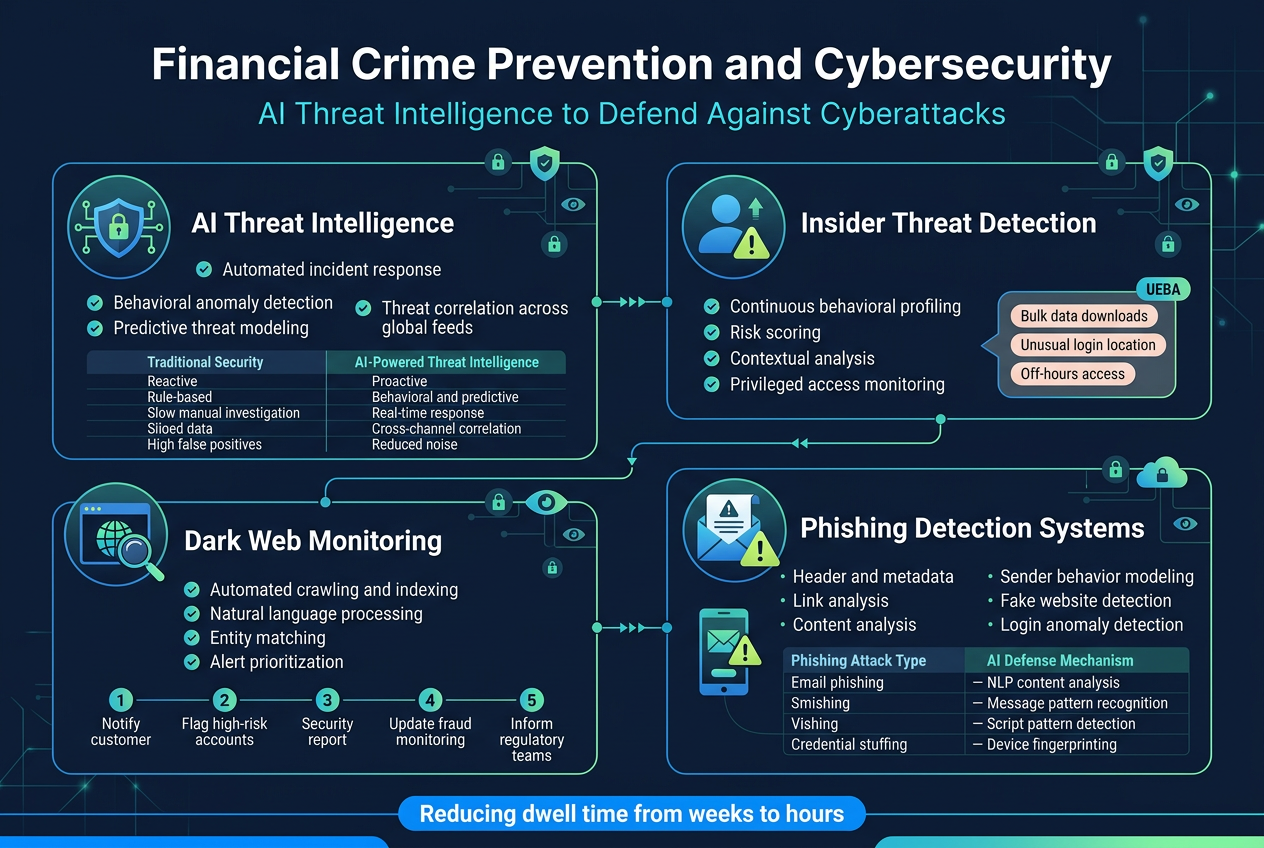
AI Threat Intelligence to Defend Against Cyberattacks
Financial institutions are among the most targeted organizations on the planet. Banks, insurers, and fintech platforms collectively hold trillions of dollars in assets and billions of sensitive customer records — making them irresistible targets for cybercriminals. Traditional security tools that rely on static rule sets and signature-based detection simply can’t keep pace with the speed and sophistication of modern cyberattacks. That’s exactly where AI-powered threat intelligence steps in.
AI systems designed for cyber threat intelligence do something humans and legacy tools struggle with: they process enormous volumes of data in real time and spot anomalies that would otherwise go unnoticed for weeks or even months. These systems continuously monitor network traffic, user behavior, endpoint activity, and external threat feeds all at once.
Key capabilities AI brings to cyber threat intelligence in financial services:
- Behavioral anomaly detection — AI builds a baseline of normal activity for every user, device, and system. When something deviates from that baseline — like an employee accessing systems at 3 AM from an unfamiliar location — the system flags it immediately.
- Predictive threat modeling — Machine learning models analyze historical attack patterns to predict where the next threat is likely to come from and what form it might take.
- Automated incident response — Rather than waiting for a human analyst to review an alert, AI can automatically isolate compromised endpoints, block suspicious IP addresses, or revoke access credentials in real time.
- Threat correlation across global feeds — AI aggregates intelligence from thousands of global sources — government advisories, security vendor feeds, dark web forums — and cross-references that data against an institution’s own environment.
| Traditional Security Approach | AI-Powered Threat Intelligence |
|---|---|
| Reactive — responds after breach | Proactive — detects threats before they escalate |
| Rule-based detection | Behavioral and predictive modeling |
| Slow manual investigation | Automated real-time response |
| Siloed data analysis | Cross-platform, cross-channel correlation |
| High false positive rates | Context-aware, reduced noise |
The financial services sector has seen AI threat intelligence dramatically cut the average time to detect and contain a breach — the industry calls this “dwell time.” The longer an attacker sits inside a network undetected, the more damage they can do. AI tools from vendors like Darktrace, CrowdStrike, and Microsoft Sentinel have helped major banks reduce dwell time from weeks down to hours.
Insider Threat Detection to Safeguard Sensitive Financial Data
Not every threat comes from outside the organization. Some of the most damaging security incidents in banking history were caused by employees — either acting maliciously for personal gain or accidentally mishandling sensitive data. Insider threats are notoriously hard to detect because, by definition, the person involved has legitimate access to the systems and data they’re misusing.
AI changes the game here by applying a discipline called User and Entity Behavior Analytics (UEBA). Instead of monitoring what people are allowed to do, AI monitors what they actually do — and flags when that behavior starts looking unusual.
How AI-powered insider threat detection works in practice:
- Continuous behavioral profiling — The system learns each employee’s typical work patterns: what systems they access, what hours they work, how much data they typically download, who they communicate with.
- Risk scoring — Each user is assigned a dynamic risk score that updates in real time. A sudden spike in data downloads, accessing files outside of normal job responsibilities, or logging in from unusual locations pushes that score higher.
- Contextual analysis — AI doesn’t just look at one signal in isolation. It combines multiple weak signals into a stronger picture. An employee who recently received a poor performance review, started downloading bulk client records, and connected a USB drive to their workstation is a very different situation from someone who only did one of those things.
- Privileged access monitoring — Finance employees with elevated system access — IT admins, database administrators, senior traders — receive extra scrutiny because the potential damage from their accounts being misused is disproportionately high.
Real-world examples of insider threat scenarios AI can catch:
- A back-office employee slowly exfiltrating customer account data over several weeks to sell to competitors
- A trader placing unauthorized positions and then attempting to cover their tracks by manipulating transaction logs
- A contractor accessing systems they have no business reason to touch during off-hours
- An employee about to leave the company downloading entire customer databases before their last day
The legal and reputational stakes are enormous. Data protection regulations like GDPR and CCPA impose heavy fines for data breaches — regardless of whether they come from external hackers or internal employees. AI-powered insider threat detection gives compliance teams the visibility they need to act before a breach becomes a headline.
Dark Web Monitoring to Identify Stolen Customer Credentials
Millions of stolen usernames, passwords, credit card numbers, and Social Security numbers are bought and sold on dark web marketplaces every day. By the time a customer realizes their credentials have been compromised, the damage is often already done — their account has been drained, their identity has been used for loan applications, or their data has been bundled and resold dozens of times.
AI-driven dark web monitoring flips that timeline on its head. Instead of waiting for customers to report fraud, financial institutions can proactively scan dark web forums, marketplaces, and data dump sites to identify stolen credentials before they’re used.
What AI does in dark web monitoring:
- Automated crawling and indexing — AI bots continuously crawl dark web sites, paste sites, hacker forums, and encrypted messaging channels where stolen data gets traded. This is something no human team could realistically do at scale.
- Natural language processing (NLP) — Dark web content is messy, coded, and multi-lingual. NLP models can parse slang, obfuscated text, and coded language to extract meaningful intelligence about what data is being sold and who’s selling it.
- Entity matching — AI cross-references discovered data against the institution’s own customer database to identify which specific customers have been affected.
- Alert prioritization — Not all credential leaks carry the same risk. AI ranks alerts by severity — a leaked password to a high-net-worth account with no MFA enabled is far more urgent than a low-balance account that already has strong authentication controls.
Typical response workflow once a match is identified:
- Customer is automatically notified of the potential compromise
- High-risk accounts are flagged for enhanced authentication or temporary holds
- Security team receives detailed intelligence report on the source of the breach
- Fraud prevention systems are updated to watch for suspicious activity on the affected accounts
- Regulatory teams are informed if breach disclosure obligations are triggered
Banks that deploy dark web monitoring as part of their AI in financial services stack have been able to get ahead of large-scale credential stuffing attacks — where criminals take leaked username/password combinations and systematically try them across banking platforms hoping customers reused passwords from other breached sites.
Phishing Detection Systems That Protect Customers and Employees
Phishing remains one of the most effective and persistent attack vectors targeting the financial sector. Despite years of security awareness training, people still click on malicious links, enter credentials on fake banking portals, and fall for convincing impersonation emails. Modern phishing attacks are increasingly difficult to spot — AI-generated emails can perfectly mimic a bank’s branding, tone, and even replicate the writing style of a specific executive.
Fighting AI-powered phishing requires AI-powered defenses.
On the employee side, financial institutions deploy AI email security tools that go well beyond basic spam filters:
- Header and metadata analysis — AI examines email headers for spoofing indicators that look legitimate to the naked eye but reveal inconsistencies when analyzed algorithmically.
- Link analysis — Every URL in an email is checked against threat intelligence feeds and analyzed for redirect chains, domain age, SSL certificate details, and visual similarity to legitimate banking domains.
- Content analysis — NLP models analyze email body text for urgency cues, impersonation patterns, and request types that commonly appear in phishing campaigns (“your account will be suspended unless you verify immediately”).
- Sender behavior modeling — AI learns what normal communication patterns look like for each internal sender. An email that appears to come from the CFO but was sent at an unusual time, to an unusual recipient list, with an unusual request pattern gets flagged even if the email address looks correct.
On the customer side, AI protection extends to:**
- Fake website detection — AI-powered tools identify fraudulent websites cloned from legitimate banking portals and can trigger takedowns before significant customer damage occurs.
- SMS and voice phishing (smishing and vishing) detection — Modern phishing doesn’t stop at email. AI models trained on telecommunications data can identify fraudulent SMS messages and even flag suspicious call center interactions that match known social engineering scripts.
- Real-time login anomaly detection — If a customer’s credentials are entered on a phishing site and then immediately used to attempt a login on the real banking platform, AI can flag the suspicious sequence and block the fraudulent login attempt before money moves.
| Phishing Attack Type | AI Defense Mechanism |
|---|---|
| Email phishing | NLP content analysis, header inspection, link scanning |
| Spear phishing (targeted) | Sender behavioral modeling, executive impersonation detection |
| Smishing (SMS) | Telecom data analysis, message pattern recognition |
| Vishing (voice calls) | Call center AI, script pattern detection |
| Clone phishing websites | Domain similarity analysis, real-time site takedowns |
| Credential stuffing post-phishing | Login anomaly detection, device fingerprinting |
The business case for investing in AI-powered phishing detection is straightforward. The average cost of a successful phishing attack on a financial institution runs into the millions when you account for fraud losses, regulatory fines, customer remediation costs, and reputational damage. AI systems that catch phishing attempts at scale — processing hundreds of thousands of emails and web interactions per day — deliver a return on investment that traditional security teams simply can’t match at equivalent cost.
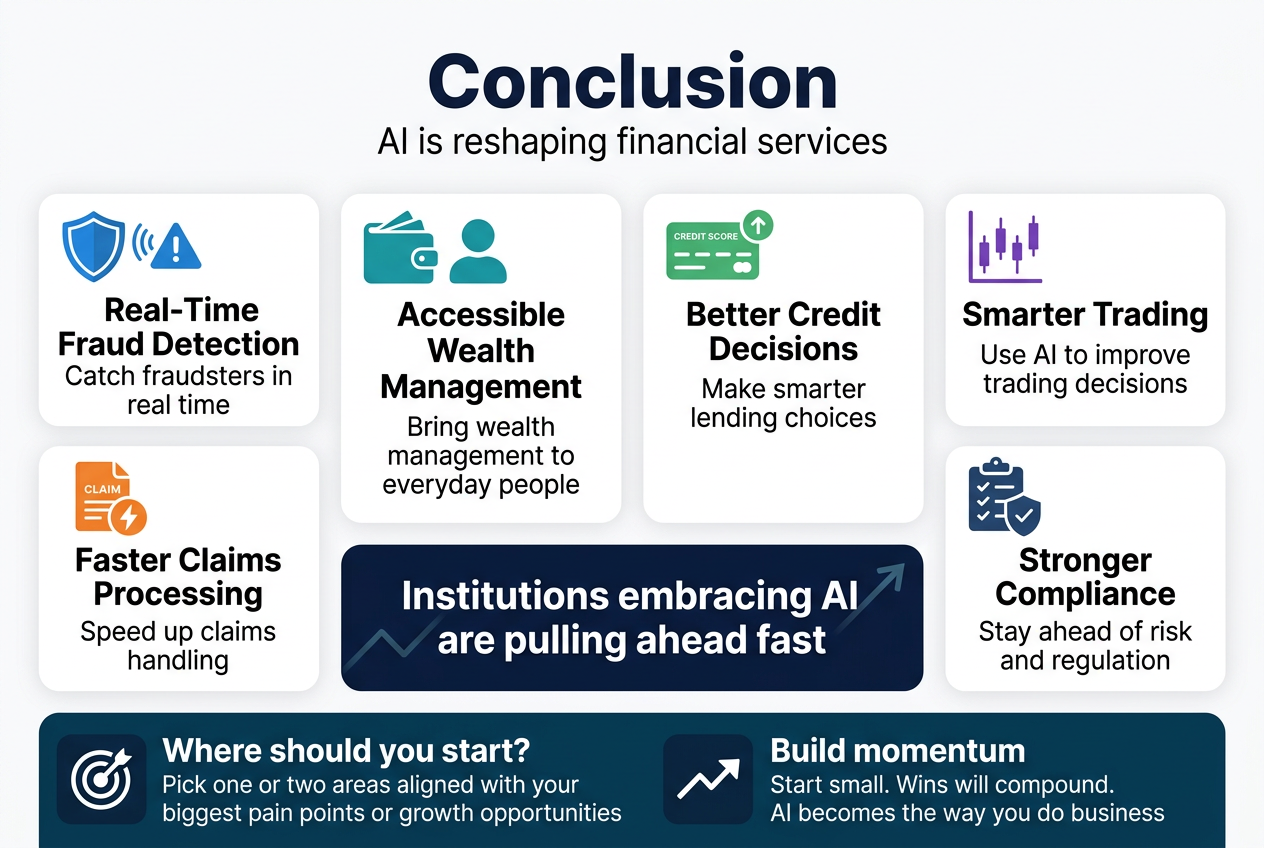
AI is reshaping financial services in ways that would have seemed impossible just a few years ago. From catching fraudsters in real time to making wealth management accessible to everyday people, the technology is touching every corner of the industry. Better credit decisions, smarter trading, faster claims processing, and stronger compliance are no longer future goals — they’re happening right now, and the financial institutions embracing these tools are pulling ahead fast.
If you work in financial services, the question is no longer whether AI belongs in your business — it’s where to start. Pick one or two areas from this list that align with your biggest pain points or growth opportunities, and start there. The wins will build momentum, and before long, AI won’t feel like a bold move — it’ll just be how you do business.