Enterprise Agentic AI Architecture: The Two Layers Every Organization Needs
If you’re an enterprise tech leader trying to figure out how agentic AI actually fits into your organization, you’ve landed in the right place.
Most companies are past the “should we explore AI?” phase. The real question now is how to build something that works at scale — not just a chatbot or a single automation, but a full enterprise agentic AI architecture that makes decisions and acts on them without constant human hand-holding.
This guide breaks down exactly that. You’ll walk away understanding:
- What agentic AI for enterprises actually means and why the timing matters right now
- The AI orchestration layer — the brain that handles intelligent decision-making AI across complex workflows
- The AI execution layer — where decisions stop being decisions and start being results
These two layers are the backbone of any serious enterprise AI automation strategy. Get them right, and you have a system that scales. Get them wrong, and you have expensive chaos.
Let’s dig in.
Understanding Agentic AI and Why Enterprises Need It Now

How Agentic AI Differs from Traditional Automation Tools
Traditional automation tools follow rigid, pre-defined rules — they do exactly what you tell them, nothing more. Agentic AI for enterprises thinks, plans, and adapts. Instead of waiting for human input at every decision point, agentic AI systems:
- Reason through ambiguous situations without needing a rule for every scenario
- Chain together multiple actions to complete complex, multi-step goals autonomously
- Learn from outcomes and adjust their approach in real time
- Collaborate with other AI agents to divide and conquer large-scale tasks
Think of traditional automation as a vending machine — put in the right input, get the expected output. Agentic AI is closer to a skilled employee who can figure out how to get something done, even when the path isn’t perfectly clear.
The Business Costs of Delaying Agentic AI Adoption
Every quarter an organization waits on agentic AI implementation is a quarter competitors are pulling ahead. The costs aren’t just hypothetical:
- Operational drag — human teams continue spending hours on tasks that AI agents can handle in minutes
- Slower decision cycles — without intelligent decision-making AI, approvals and analysis bottlenecks pile up
- Talent strain — skilled employees stay buried in repetitive work instead of driving strategy
- Missed revenue windows — agentic systems can identify and act on opportunities faster than any manual process
Early adopters aren’t just saving money — they’re building compounding advantages in speed, data fluency, and customer experience that become harder to close over time.
Why a Layered Architecture Prevents Costly Mistakes
Jumping straight into enterprise AI automation without a structured architecture is where most costly failures happen. A layered approach creates clear boundaries between thinking and doing — which matters enormously at enterprise scale.
Without this separation:
- Agents can take actions without proper reasoning or context
- There’s no clean way to audit what happened or why
- Scaling becomes chaotic because responsibilities are tangled
- A single failure point can cascade across the entire system
A well-designed enterprise agentic AI architecture keeps the decision-making logic isolated from execution, so you can upgrade, audit, or constrain either layer independently. It’s the difference between a system you can trust and one that eventually surprises you in the worst way.
Key Capabilities That Define Enterprise-Grade Agentic AI
Not every agentic AI system is ready for enterprise demands. The ones that are share a specific set of capabilities:
- Goal decomposition — breaking a high-level objective into actionable, sequenced subtasks
- Memory and context retention — maintaining relevant information across long, multi-session workflows
- Tool use and API integration — connecting seamlessly to existing enterprise systems and data sources
- Human-in-the-loop controls — knowing when to escalate and when to act autonomously
- Explainability — providing clear reasoning trails so compliance and leadership teams can verify decisions
- Multi-agent coordination — orchestrating specialized agents across the AI orchestration layer without conflicts or redundancy
These aren’t nice-to-haves — they’re the baseline for any organization serious about deploying agentic AI for enterprises at scale without introducing new risks.
Layer One: The Orchestration Layer That Drives Intelligent Decision-Making

What the Orchestration Layer Does and Why It Matters
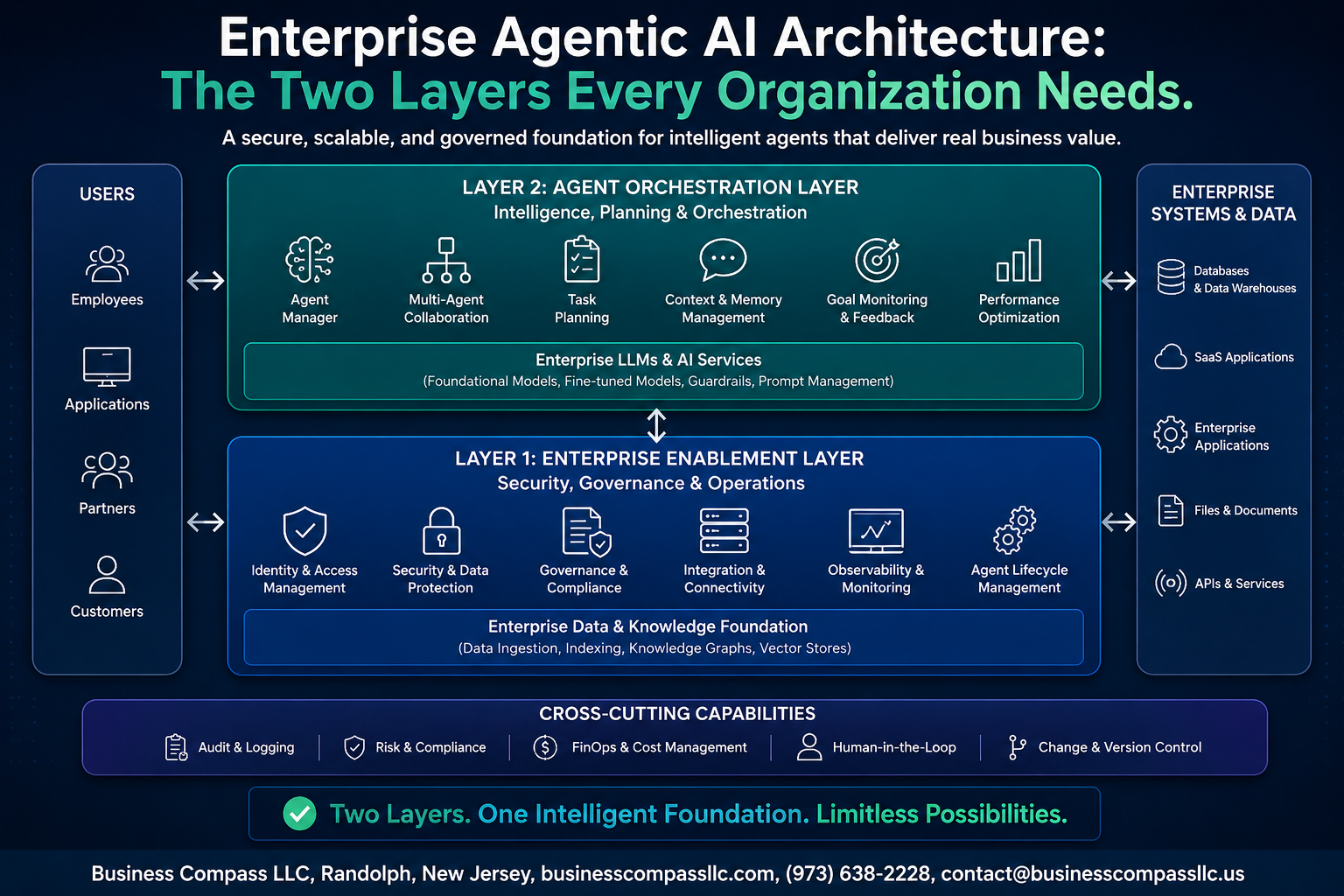
The orchestration layer is essentially the brain of your enterprise agentic AI architecture. It handles planning, prioritization, and decision-making across multiple systems and agents. Instead of waiting for a human to connect the dots between a customer complaint, an inventory shortfall, and a shipping delay, the orchestration layer reads the full picture and decides what needs to happen next — and in what order.
Think of it less like a workflow engine and more like a senior manager who never sleeps, never loses context, and can juggle dozens of active decisions simultaneously without dropping the ball.
Core Components That Enable Cross-System Coordination
A well-built orchestration layer in agentic AI for enterprises typically includes several tightly integrated components:
- Goal Management Module – Breaks high-level business objectives into smaller, executable tasks that downstream agents can act on
- Context Memory – Retains short-term and long-term context so agents aren’t starting from scratch on every interaction
- Task Router – Assigns work to the right execution agents based on skill mapping, availability, and priority
- State Tracker – Monitors the live status of every active task so the system can course-correct without human intervention
- Conflict Resolver – Handles situations where two agents receive competing or contradictory instructions and need a tiebreaker
These components work as a team, not in isolation. If the task router hands off a job but the state tracker flags an error mid-execution, the conflict resolver steps in automatically. That tight feedback loop is what separates a functional orchestration layer from a messy pile of disconnected automations.
How Orchestration Reduces Human Bottlenecks in Complex Workflows
Most enterprise workflows stall not because of missing data or slow systems — they stall because a human needs to review something, approve something, or manually pass information from one team to another. The AI orchestration layer attacks that problem directly.
Here’s what changes when orchestration is working properly:
- Approval handoffs get automated for decisions that fall within predefined confidence thresholds, so humans only touch the genuinely ambiguous cases
- Cross-department coordination happens in real time instead of waiting for a weekly sync or an email chain that goes cold
- Errors get caught and rerouted mid-process, not after the fact when the damage is already done
- Parallel workstreams run simultaneously, so a procurement process doesn’t have to wait for legal review to finish before finance modeling begins
The result is that intelligent decision-making AI stops being a tool your team uses and starts being a system that runs entire process chains on its own — only looping in humans when the stakes or complexity genuinely require it.
Common Pitfalls When Building the Orchestration Layer
Getting the orchestration layer wrong is easy, especially if your team is coming from a traditional automation background. A few traps that show up repeatedly:
- Over-centralizing control – Routing every single decision through one master orchestrator creates a bottleneck that mirrors the human problem you were trying to solve
- Ignoring context drift – If your memory management is weak, agents start making decisions based on stale or incomplete context, which quietly degrades output quality over time
- Skipping failure handling – Assuming that agents will always succeed means one hiccup can cascade into a system-wide failure with no recovery path built in
- Treating orchestration like a flowchart – Static workflow diagrams don’t adapt. A real orchestration layer needs dynamic replanning capabilities so it can respond to conditions that weren’t anticipated at build time
- Underinvesting in observability – If you can’t see what the orchestration layer is deciding and why, debugging problems or auditing decisions becomes nearly impossible
Enterprise AI automation built on a shaky orchestration layer will hit a ceiling fast. The architecture has to be designed for resilience and adaptability from day one, not retrofitted after problems start surfacing in production.
Layer Two: The Execution Layer That Turns Decisions Into Results

How the Execution Layer Interfaces With Enterprise Systems
The AI execution layer is where decisions actually get done. It connects directly to your existing enterprise systems — CRMs, ERPs, databases, and communication platforms — acting as the hands of your agentic AI architecture. Instead of just recommending actions, it reaches into those systems and carries them out, whether that means updating a customer record, triggering a workflow, or sending an alert.
Tools, APIs, and Connectors That Power Reliable Task Completion
Reliable enterprise AI automation depends heavily on the quality of its integrations. The execution layer leans on:
- Pre-built API connectors for platforms like Salesforce, SAP, and ServiceNow
- Custom API wrappers built around internal tools or legacy systems
- RPA (Robotic Process Automation) bridges for systems that lack modern APIs
- Event-driven triggers that kick off tasks the moment certain conditions are met
These connectors are what give agentic AI for enterprises its real teeth — turning high-level decisions into low-level, system-specific actions without human hand-holding at every step.
Ensuring Accuracy and Accountability at the Execution Level
Mistakes at the execution level can be costly, so guardrails matter. Strong enterprise agentic AI architecture builds in:
- Action logging that tracks every task the AI carries out
- Confidence thresholds that pause execution when uncertainty is too high
- Human-in-the-loop checkpoints for high-stakes or irreversible actions
- Rollback mechanisms to undo actions when something goes wrong
Accountability isn’t just a compliance checkbox — it’s what makes teams actually trust and adopt AI execution at scale.
How the Two Layers Work Together to Deliver Enterprise Value

The Communication Flow Between Orchestration and Execution
The orchestration layer sends structured task instructions to execution agents, which return status updates, outputs, and error flags in real time. This two-way communication keeps the AI orchestration layer fully informed, letting it reroute tasks, adjust priorities, or escalate decisions without human intervention slowing everything down.
Real-World Use Cases Where the Dual-Layer Model Excels
- Finance: The orchestration layer detects an anomaly in transaction data, dispatches an execution agent to freeze the account, notifies compliance, and logs the event — all within seconds.
- Supply Chain: When a supplier misses a shipment window, the system automatically sources alternatives, updates procurement records, and alerts operations teams.
- Customer Support: Orchestration routes complex queries to specialized execution agents trained on product-specific data, cutting resolution times dramatically.
- HR Onboarding: New hire workflows trigger document generation, system access provisioning, and training scheduling without anyone manually coordinating steps.
How the Architecture Scales Across Departments and Regions
Enterprise agentic AI architecture scales by adding execution agents without rebuilding the orchestration layer. A regional team in Southeast Asia can run localized agents operating under the same central decision logic used in North America, with regional compliance rules baked in at the execution level.
Measuring ROI From a Two-Layer Agentic AI System
Track these metrics to get a clear picture of return:
- Task cycle time reduction — how much faster workflows complete end-to-end
- Human intervention rate — fewer escalations means the system is maturing
- Error rate per workflow — execution accuracy directly tied to orchestration quality
- Cost per automated decision — drops sharply as the system handles more volume
- Employee hours recaptured — teams redirected from repetitive tasks to higher-value work
Building a Future-Proof Agentic AI Architecture for Your Organization

Assessing Your Current Infrastructure for Compatibility
Before adding any new AI layer, take a hard look at what you already have. Legacy systems, data silos, and outdated APIs can quietly kill an agentic AI rollout before it gains momentum. Run an honest audit of your:
- Data pipelines – Are they clean, accessible, and structured enough for AI agents to act on?
- Integration points – Can your existing tools talk to each other through APIs or webhooks?
- Compute resources – Do you have the cloud or on-prem capacity to support real-time AI orchestration?
- Latency tolerances – Some workflows need near-instant responses; others can afford a few seconds of processing time
Map your current stack against the demands of both the orchestration and execution layers. Gaps you find here become your first priority list.
Prioritizing Security, Governance, and Compliance by Design
Security cannot be bolted on after the fact with enterprise agentic AI architecture. Agents that make decisions and take actions autonomously need clear guardrails from day one. Think about:
- Role-based access controls – Agents should only touch the data and systems they absolutely need
- Audit trails – Every decision an agent makes should be logged, timestamped, and reviewable
- Compliance alignment – Whether you’re working under GDPR, HIPAA, SOC 2, or industry-specific regulations, your architecture needs to reflect those requirements at the model and execution layer
- Human-in-the-loop checkpoints – High-stakes decisions should always have a human approval step baked in
Governance is not a blocker — it’s what lets leadership actually trust the system enough to scale it.
Choosing the Right Vendors and Platforms for Each Layer
Not every AI platform does both layers well. Some vendors excel at orchestration — think LangChain, AutoGen, or enterprise-grade options like Microsoft Copilot Studio and Salesforce Agentforce. Others are built for the execution side, specializing in robotic process automation, API management, or tool integrations.
When evaluating platforms, ask:
- Does this vendor support multi-agent workflows, or is it limited to single-task automation?
- How well does it connect to our existing enterprise systems (ERP, CRM, data warehouses)?
- What’s the model flexibility — can we swap LLMs as the space evolves?
- What does the pricing model look like at scale?
Avoid locking your entire agentic AI for enterprises strategy into one vendor’s ecosystem too early. A modular approach gives you room to swap components as the technology matures.
Creating a Phased Rollout Plan That Minimizes Disruption
A big-bang deployment of agentic AI across the enterprise is a recipe for chaos. Start narrow, prove value, then expand. A practical phased approach looks like this:
Phase 1 – Pilot (0–3 months)
- Pick one high-impact, low-risk use case (e.g., internal IT support automation or invoice processing)
- Deploy a minimal viable architecture with both layers connected
- Measure latency, accuracy, and user satisfaction
Phase 2 – Expand (3–9 months)
- Roll out to two or three additional departments based on pilot learnings
- Harden the orchestration layer with better routing logic and error handling
- Start building reusable agent templates and tool connectors
Phase 3 – Scale (9–18 months)
- Push enterprise AI automation across core business functions
- Integrate cross-departmental agents that share data and coordinate tasks
- Establish a center of excellence to manage ongoing development and governance
Each phase should have a clear success metric — not just technical performance, but actual business outcomes like time saved, error rates reduced, or revenue impacted.
Upskilling Teams to Maximize the Value of Agentic AI
The architecture only works if the people running it know what they’re doing. Agentic AI implementation shifts roles — IT teams need to understand agent orchestration, business analysts need to know how to design agent workflows, and leadership needs enough literacy to make smart investment decisions.
Focus training in three areas:
- Technical teams – Prompt engineering, agent debugging, API integration, and model evaluation
- Business users – How to define tasks for agents, how to interpret agent outputs, and when to escalate to human review
- Leaders and managers – How to read AI performance dashboards, how to set governance policies, and how to identify new automation opportunities
Pair formal training with hands-on experimentation. Teams that get to build small agents themselves develop intuition that no course can fully replicate. Create internal communities of practice where early adopters share wins, failures, and shortcuts with the rest of the organization.

Getting agentic AI right comes down to having these two layers working in sync. The orchestration layer handles the thinking — breaking down goals, making decisions, and coordinating the right agents for the job. The execution layer handles the doing — taking those decisions and turning them into real, measurable actions across your business systems. When both layers are built well and connected properly, you stop just automating tasks and start running an AI-powered operation that can actually think and act at scale.
The good news is that you don’t need to overhaul everything overnight. Start by identifying where intelligent decision-making and automated execution would make the biggest difference in your organization, then build from there. The enterprises that will pull ahead are the ones that treat agentic AI as a core part of how they operate — not just another tool to bolt on. Now is the time to lay that foundation.