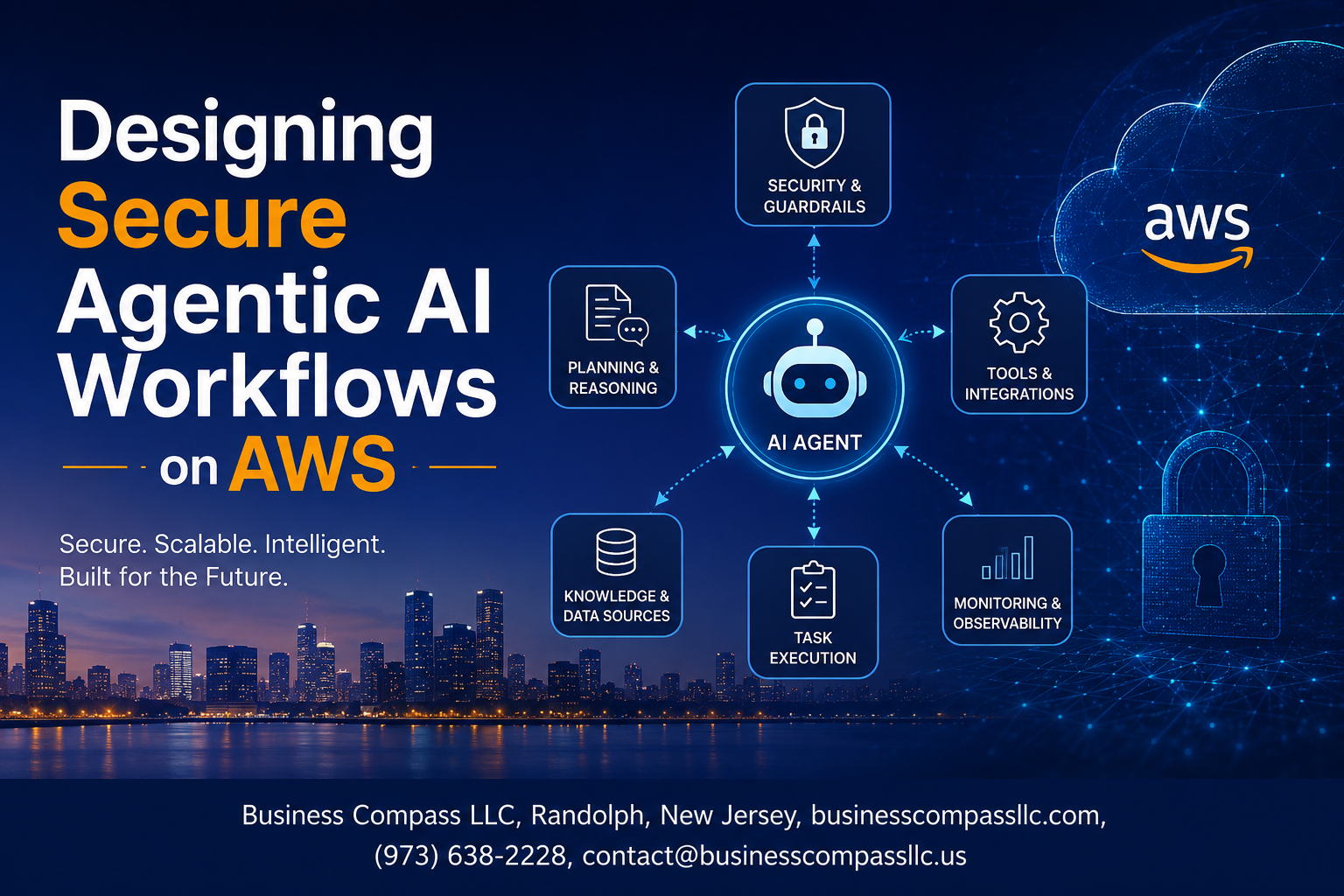
Designing Secure Agentic AI Workflows on AWS
AI agents are no longer just running simple tasks — they’re making decisions, calling APIs, reading databases, and taking actions with real consequences. That shift from passive tools to autonomous systems creates security gaps that traditional cloud security frameworks weren’t built to handle.
This guide is for cloud architects, security engineers, and ML platform teams who are building or hardening agentic AI on AWS. If you’re responsible for keeping autonomous AI pipelines safe in production, this is written for you.
Here’s what we’ll cover:
- Why agentic AI security is different — and what makes these workflows harder to lock down than standard applications
- Identity and access control for AI agents — how to apply least-privilege principles to non-human identities operating inside AWS
- Runtime controls and threat detection — how to set guardrails on agent behavior and catch anomalies before they become incidents
AWS gives you a solid foundation for secure AI design, but the tools only work if you know how to wire them together for autonomous workloads. By the end of this, you’ll have a clear picture of how to build AI agent pipelines that are both powerful and safe.
Understanding Agentic AI Workflows and Their Unique Security Challenges
What Makes Agentic AI Different from Traditional AI Systems
Traditional AI systems are largely reactive — you send an input, they return an output, and that’s the end of the interaction. Agentic AI flips that model entirely. These systems can plan across multiple steps, call external tools, spin up sub-agents, read and write data, and make decisions in a loop without a human approving every move. That autonomy is exactly what makes them powerful, and exactly what makes agentic AI security a completely different beast compared to securing a standard ML inference endpoint.
Key differences worth understanding:
- Multi-step reasoning loops — agents don’t just respond once; they iterate, which means a single compromised step can cascade into a much larger failure
- Tool and API access — agents can browse the web, query databases, execute code, or call third-party services, dramatically expanding the blast radius of any security gap
- Dynamic decision-making — unlike static pipelines, agents pick their own paths, making it hard to predict or audit behavior in advance
- Chained sub-agents — one orchestrator agent can spawn others, each with its own permissions and context, creating deeply nested trust relationships that are tricky to trace
Key Security Risks Introduced by Autonomous AI Agents
The more autonomy you hand to an AI agent, the more ways things can go wrong. These aren’t theoretical concerns — they’re practical risks that teams are already running into as they build production agentic systems.
Prompt injection is one of the nastiest threats. A malicious payload embedded in external content — a web page, a document, an email — can hijack an agent’s instructions and redirect it to do something harmful, all while the system looks like it’s operating normally. Because agents process text from so many sources, the attack surface is wide open.
Other risks that regularly come up:
- Privilege escalation — an agent operating with broad permissions can be manipulated into accessing data or systems it was never meant to touch
- Tool misuse — agents might call APIs in unintended ways, either due to adversarial inputs or flawed planning logic
- Data exfiltration — an agent with memory and external communication capabilities can be tricked into leaking sensitive information across session boundaries
- Runaway loops — without proper runtime controls for AI agents, an agent can burn through API quota, incur massive costs, or cause downstream system damage before anyone notices
- Identity spoofing — in multi-agent setups, a rogue agent or external service could impersonate a trusted system component
Why AWS Is a Strong Foundation for Secure Agentic Deployments
AWS gives you a mature set of tools that map well to the specific demands of secure AI workflows on AWS. Rather than bolting security on after the fact, you can build it into the fabric of how your agents are deployed, how they access resources, and how their behavior gets monitored.
A few reasons AWS stands out here:
- Granular IAM controls — you can scope agent permissions tightly using roles, policies, and permission boundaries, which is the backbone of solid AI agent access control
- Amazon Bedrock Agents — provides a managed orchestration layer with built-in guardrails, session isolation, and integration hooks that reduce the amount of custom security logic you need to build
- AWS PrivateLink and VPC controls — keep agent traffic off the public internet and tightly routed through private networks
- AWS CloudTrail and Amazon CloudWatch — every API call an agent makes can be logged, monitored, and alerted on, which is critical for maintaining visibility in agentic AI identity management
- AWS Secrets Manager and KMS — agents that need credentials or encryption keys can access them without those secrets ever being hardcoded or exposed in memory longer than needed
The combination of identity, networking, observability, and data protection tooling means you’re not starting from scratch when you need to enforce AWS secure AI design principles.
Common Attack Surfaces in Multi-Agent Architectures
When you move from a single agent to a multi-agent setup, the complexity jumps fast. Each new agent, tool connection, memory store, and communication channel is another potential entry point for something to go wrong.
Here are the attack surfaces that get the most attention in real-world deployments:
- Inter-agent communication channels — agents passing context to each other can carry injected instructions or corrupted data if that channel isn’t validated and authenticated
- Shared memory and vector stores — if multiple agents read from the same knowledge base, a poisoned embedding or document can influence all of them simultaneously
- Tool call interfaces — API endpoints and external services that agents invoke are often implicitly trusted; that trust needs to be earned and verified, not assumed
- Agent orchestrator layer — the top-level planner that breaks tasks into sub-tasks is a high-value target; compromise here means full control over the entire workflow
- Session and context boundaries — agents that persist context across user sessions can accidentally (or intentionally) bleed information from one user into another’s interaction
- Third-party plugin and tool integrations — any external tool an agent can call introduces supply chain risk; a malicious or compromised plugin can take control of the agent’s next action
Understanding these surfaces is the first step toward building AWS AI pipeline security that actually holds up in production.
Building a Secure Identity and Access Foundation for AI Agents

Applying Least Privilege Principles to Agent IAM Roles
Every AI agent in your AWS environment should carry only the permissions it actually needs — nothing more. Create dedicated IAM roles per agent function rather than sharing broad roles across multiple agents. Scope policies to specific resources, actions, and conditions using IAM condition keys like aws:SourceVpc or aws:RequestedRegion to tighten boundaries even further.
- Avoid wildcard (
*) actions in agent policies - Pin permissions to exact resource ARNs where possible
- Set permission boundaries to cap the maximum effective permissions an agent role can ever assume
- Rotate credentials regularly using short-lived tokens via AWS STS
Using AWS IAM Identity Center to Manage Agent Permissions
AWS IAM Identity Center gives you a centralized place to manage who — and what — gets access across your multi-account AWS environment. For agentic AI identity management, map agent service roles to permission sets defined in Identity Center, so access policies stay consistent and auditable across every pipeline stage.
- Group agents by function and assign permission sets accordingly
- Leverage attribute-based access control (ABAC) to dynamically scope permissions using agent tags
- Audit access through AWS CloudTrail integrated with Identity Center activity logs
Preventing Privilege Escalation Across Agent Chains
In multi-agent architectures, one compromised or misconfigured agent can hand elevated permissions to the next in the chain — a classic privilege escalation risk. Break that chain by enforcing strict role boundaries at each handoff point.
- Never allow agent roles to call
iam:PassRoleon roles with broader permissions than their own - Use AWS Organizations Service Control Policies (SCPs) to enforce hard ceilings across accounts
- Validate trust policies so agents can only assume roles explicitly scoped to their task
- Regularly run AWS IAM Access Analyzer to catch unintended cross-agent permission paths before they become exploitable gaps in your secure AI workflows on AWS
Protecting Data Integrity and Confidentiality in Agent Pipelines

Encrypting Data in Transit and at Rest with AWS KMS
Keeping your data locked down at every stage of an agentic AI pipeline is non-negotiable. AWS Key Management Service (KMS) lets you create, rotate, and control encryption keys across services like S3, DynamoDB, and Amazon Bedrock — so whether your agent is reading a knowledge base or writing outputs to storage, the data stays protected end-to-end.
- Use customer-managed keys (CMKs) instead of AWS-managed defaults for tighter control
- Enable automatic key rotation to reduce exposure from long-lived credentials
- Apply key policies and grants to restrict which agents or roles can decrypt specific datasets
- Pair KMS with TLS enforcement on all API calls to eliminate plaintext data in transit
Securing Knowledge Bases and Vector Stores Used by Agents
Agents backed by retrieval-augmented generation (RAG) pipelines pull from vector stores and knowledge bases constantly. If those sources are compromised, the agent’s responses are too — and that’s a serious problem for AWS AI pipeline security.
- Restrict access to Amazon OpenSearch Serverless or Pinecone vector stores using fine-grained IAM policies
- Apply resource-based policies to prevent unauthorized agents from querying sensitive document collections
- Audit all retrieval activity through AWS CloudTrail to catch unusual access patterns
- Segment knowledge bases by data sensitivity level, keeping PII-heavy sources isolated from general-purpose retrieval
Preventing Sensitive Data Leakage Through Agent Outputs
One of the sneakiest risks in agentic AI security is the agent itself becoming a data exfiltration channel. An agent might pull in a confidential document and then echo that content straight into a user-facing response or downstream API.
- Use Amazon Bedrock Guardrails to scan and filter agent outputs before they reach end users
- Define sensitive content categories — SSNs, financial records, internal system paths — and block their inclusion in responses
- Log all agent outputs to a centralized store and run pattern-matching rules to catch accidental leakage
- Build a human review layer for high-stakes workflows where the cost of a data leak is significant
Enforcing Data Boundary Controls with AWS Macie and Lake Formation
Knowing where your sensitive data lives is half the battle. AWS Macie continuously scans S3 buckets to discover and classify sensitive data, giving you a clear picture of what your agents can potentially touch — and what they absolutely shouldn’t.
- Configure Macie findings to trigger automated alerts or even revoke agent access when sensitive data is detected in unexpected locations
- Use AWS Lake Formation to define column- and row-level permissions on data lakes that agents query
- Set up data filters in Lake Formation to ensure agents only see the rows and columns their role explicitly permits
- Combine Macie and Lake Formation with AWS Config rules to continuously validate that data boundary policies haven’t drifted out of compliance
Implementing Runtime Controls to Govern Agent Behavior

Defining and Enforcing Agent Action Boundaries with Guardrails
Runtime controls are your safety net when AI agents start making autonomous decisions at scale. Without clear action boundaries, an agent can drift into unintended territory — calling APIs it shouldn’t, accessing data outside its scope, or triggering irreversible actions. The key is defining explicit permission boundaries upfront:
- Allowlists over denylists — specify exactly what actions an agent can take rather than trying to block everything bad
- Scope-limited tool access — each agent gets only the tools required for its specific task, nothing extra
- Action confirmation gates — for high-stakes operations like deletions or financial transactions, require an explicit approval step before execution
- Rate limiting on agent actions — cap how many tool calls an agent can make per session to prevent runaway loops
Using Amazon Bedrock Guardrails to Restrict Harmful Outputs
Amazon Bedrock Guardrails gives you direct control over what your AI agents can say and do. You can configure content filters, topic denials, and sensitive data redaction that apply consistently across every agent interaction — no custom filtering logic needed on your end. For example, you can block an agent from discussing competitor products, prevent it from returning PII in responses, or stop it from generating content that falls outside your defined topic scope. These guardrails run at the model layer, which means they catch problems before outputs ever reach downstream systems in your AWS AI pipeline.
Monitoring Agent Decision Chains with AWS CloudTrail and X-Ray
Knowing what an agent did is only half the story — you also need to know why it made each decision. AWS CloudTrail captures every API call your agents make, giving you a full audit trail across services like Lambda, S3, and Bedrock. AWS X-Ray goes deeper, tracing the complete decision chain across distributed components so you can see exactly how an agent moved from input to action. Together, they help you:
- Spot unusual agent behavior patterns before they become real problems
- Reconstruct the full sequence of events during a security incident
- Validate that runtime controls for AI agents are actually working as expected
- Feed trace data into anomaly detection for continuous agentic AI security monitoring
Detecting and Responding to Threats in Real Time

Leveraging Amazon GuardDuty to Identify Anomalous Agent Activity
Amazon GuardDuty continuously monitors API calls, network traffic, and data access patterns across your AWS environment, making it a natural fit for catching weird behavior from AI agents before it spirals into a real incident. When an agent suddenly starts calling APIs it has never touched before, or begins pulling data from S3 buckets outside its normal scope, GuardDuty flags those deviations fast. You can tune threat findings specifically around the IAM roles your agents run under, so alerts stay relevant and actionable rather than drowning your team in noise.
- Enable GuardDuty findings for IAM role activity tied to agent execution environments
- Watch for unexpected cross-region API calls from agent workloads
- Tag agent-specific roles clearly so GuardDuty findings map back to the right workflow instantly
Setting Up Automated Incident Response with AWS Security Hub
AWS Security Hub pulls GuardDuty findings, AWS Config violations, and other signals into one place, giving you a single pane of glass for agentic AI security events. The real power comes from wiring Security Hub to EventBridge rules that kick off Lambda functions automatically — isolating a compromised agent role, revoking temporary credentials, or snapshotting a container for forensic review without waiting for a human to notice.
- Create EventBridge rules that trigger on high-severity Security Hub findings tied to agent roles
- Use Step Functions to orchestrate multi-step response playbooks that contain and investigate incidents
- Test your automated responses in a staging environment regularly so they actually work when things go sideways
Building Audit Trails That Support Compliance and Forensics
Every action an AI agent takes should leave a clear trail. AWS CloudTrail logs every API call with timestamps, caller identity, and request parameters, which becomes gold when you need to reconstruct what an agent did during an incident. Pair CloudTrail with CloudWatch Logs Insights to run fast queries across large volumes of agent activity data without exporting anything manually.
- Enable CloudTrail in all regions where agent workloads run and ship logs to a dedicated, write-protected S3 bucket
- Log agent-specific metadata — session IDs, task IDs, prompt hashes — as custom fields in application logs
- Store logs with object lock enabled to prevent tampering, supporting compliance requirements for threat detection in AI workflows
Continuously Testing Agent Workflows for Security Vulnerabilities
Static security reviews miss the dynamic, emergent risks that show up in autonomous AI security pipelines. Regular red-team exercises that simulate prompt injection attacks, privilege escalation attempts, and data exfiltration paths give you a realistic picture of your actual exposure. AWS Fault Injection Service can also simulate dependency failures that push agents into edge-case behavior, revealing gaps that normal testing never surfaces.
- Schedule recurring penetration tests focused specifically on agent tool-use boundaries and API permission scopes
- Test what happens when an agent receives malicious or malformed inputs from external sources
- Review agent decision logs after each test to spot patterns that suggest the workflow is making unsafe choices
Establishing a Feedback Loop to Strengthen Security Posture Over Time
Security for AWS AI pipeline security is not a one-time setup. Agent capabilities change, new tools get added, and threat landscapes shift, so the controls you put in place today need regular revisiting. Build a rhythm where security findings from GuardDuty and Security Hub feed back into sprint planning, prompt and policy reviews happen on a defined schedule, and lessons from incidents actually get written into runbooks rather than forgotten.
- Hold monthly reviews of agent IAM permissions and remove anything that has not been used recently
- Track mean time to detect and mean time to respond for agent-related incidents as key metrics
- Share learnings from near-misses across teams building different agent workflows to raise the overall security bar

Building secure agentic AI workflows on AWS comes down to a few core principles: giving your AI agents only the access they truly need, keeping data protected as it moves through your pipelines, and putting the right guardrails in place so agents behave the way you expect them to. Layer on top of that a solid plan for spotting and responding to threats as they happen, and you have a foundation that lets your AI systems do their job without opening the door to unnecessary risk.
Security in agentic AI is not a one-time setup — it’s an ongoing commitment. As your workflows grow and evolve, revisit your access policies, audit your agent behavior, and stay sharp on emerging threats. Start small, lock things down tight from the beginning, and build from there. The time you invest in getting the security right early will save you a whole lot of headaches down the road.