How Amazon S3 Processes API Requests: A Cloud Architect’s Guide
If you’ve ever wondered what actually happens the moment your application fires off a request to Amazon S3, you’re not alone. Most engineers interact with S3 daily but rarely stop to think about what’s happening under the hood — and that gap in understanding can lead to real problems like unexpected latency, failed requests, or consistency issues that are a nightmare to debug.
This guide is for cloud architects, backend engineers, and DevOps folks who want to go beyond the basics and build systems that work reliably at scale.
Here’s what we’ll walk through together:
- How Amazon S3 fits into your broader cloud architecture — where it sits, how requests reach it, and why that path matters
- Authentication and authorization in S3 request handling — how S3 validates who you are and whether you’re allowed to do what you’re asking, before a single byte moves
- Performance optimization for high-volume S3 API workloads — practical strategies to keep things fast and stable when request volume climbs
By the end, you’ll have a solid mental model of S3 request processing — one you can actually apply when designing systems, chasing down bugs, or making the case for architectural decisions to your team.
Let’s get into it.
How Amazon S3 Fits Into Cloud Architecture

Core Role of S3 in Distributed Cloud Systems
Amazon S3 acts as the backbone for storing and retrieving massive data volumes across distributed systems. It handles Amazon S3 API requests through a globally redundant infrastructure, making it a go-to choice for backups, data lakes, and static assets — all while staying virtually invisible to end users.
The Journey of an API Request Through S3

How Clients Initiate Requests to S3 Endpoints
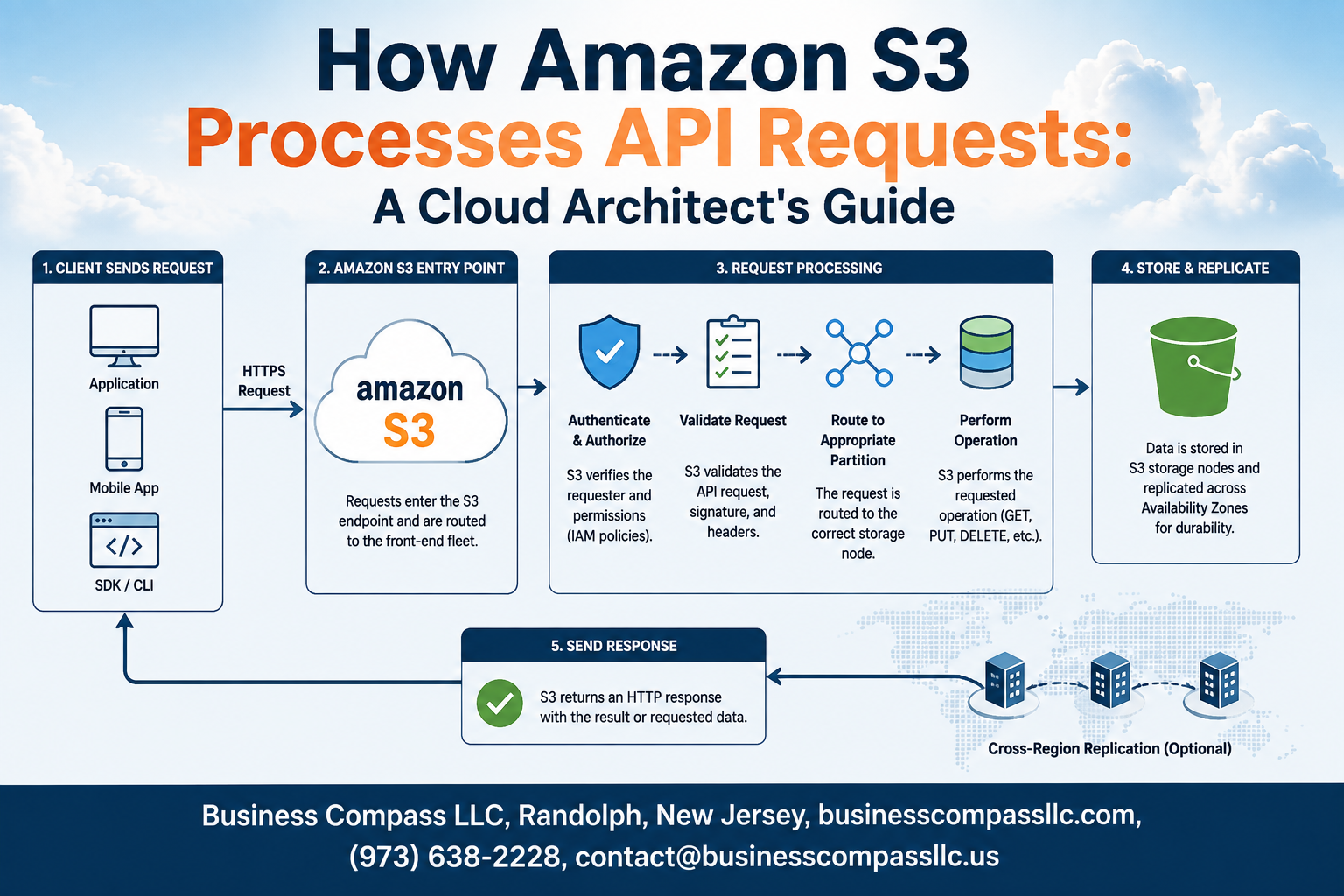
When your app calls S3, it sends an HTTPS request to an endpoint like s3.amazonaws.com. AWS DNS resolves this to the nearest edge, routes traffic through load balancers, and internally maps your bucket/key to a specific storage node — all within milliseconds, transparently handling petabytes across distributed infrastructure.
Authentication and Authorization in S3 Request Handling

How AWS Signature Version 4 Validates Every Request
Every S3 API request gets cryptographically signed using AWS Signature Version 4, binding your credentials, timestamp, and payload into a tamper-proof hash.
IAM Policies and Bucket Policies Work Together
- Identity-based IAM policies control who can act
- Bucket policies control what can be accessed
How S3 Enforces Access Control Before Processing Data
S3 evaluates both policy types simultaneously, denying access if either blocks the request.
Data Consistency and Durability During Request Processing

How S3 Achieves Strong Read-After-Write Consistency
After December 2020, S3 delivers strong consistency automatically — no extra configuration needed. Every successful write is immediately readable.
- Concurrent requests use internal locking to prevent conflicts
- Checksums validate data at every transfer stage
- Cross-AZ replication ensures 99.999999999% durability
Performance Optimization for High-Volume API Workloads

Partitioning Strategies That Maximize Request Throughput
Spread prefixes across your S3 keys to avoid hot partitions. Random hashing at the start of key names distributes load evenly.
Multipart Uploads for Faster Large Object Transfers
- Split files above 100MB into parallel chunks
Byte-Range Fetches to Reduce Latency
- Download only needed file segments simultaneously
Using S3 Transfer Acceleration for Global Workloads
Routes traffic through CloudFront edge locations, cutting latency dramatically for distributed teams.
Monitoring and Troubleshooting S3 API Request Flows

Leveraging S3 Server Access Logs for Deep Visibility
Enable server access logging to capture every request hitting your bucket — requester, IP, timestamp, and HTTP status codes included.
Using AWS CloudTrail to Audit Every API Call
CloudTrail records all S3 control-plane actions, perfect for troubleshooting Amazon S3 permission issues.
Key Metrics in Amazon CloudWatch to Track Request Health
Watch 5xxErrors and TotalRequestLatency closely when monitoring S3 API requests at scale.

Amazon S3 is a powerhouse when it comes to handling API requests at scale, and understanding how it works under the hood can make a real difference in how you design and optimize your cloud architecture. From the moment a request hits S3 to the point where data is stored or retrieved, every step — authentication, authorization, consistency checks, and durability mechanisms — plays a role in keeping things running smoothly and securely.
As a cloud architect, knowing these details gives you an edge. You can make smarter decisions about performance tuning, catch issues faster when troubleshooting, and build systems that hold up even under heavy API workloads. Take what you’ve learned here and start looking at your current S3 setup with fresh eyes — there’s a good chance there are optimizations waiting to be made or monitoring gaps worth closing. The more you understand S3’s inner workings, the better equipped you’ll be to build cloud solutions that are fast, reliable, and built to last.