Stop Forcing Your AI Stack to Work Around Your Database
If you’re building AI applications at scale, you’ve probably hit the same wall: your database wasn’t designed for the way modern AI systems actually work. Embeddings live in one place, structured data in another, and your retrieval pipeline is basically duct tape holding it all together.
This guide is for data engineers, ML engineers, and enterprise architects who want to build clean, production-ready AI systems without managing five different tools just to answer one query.
Here’s what we’ll walk through:
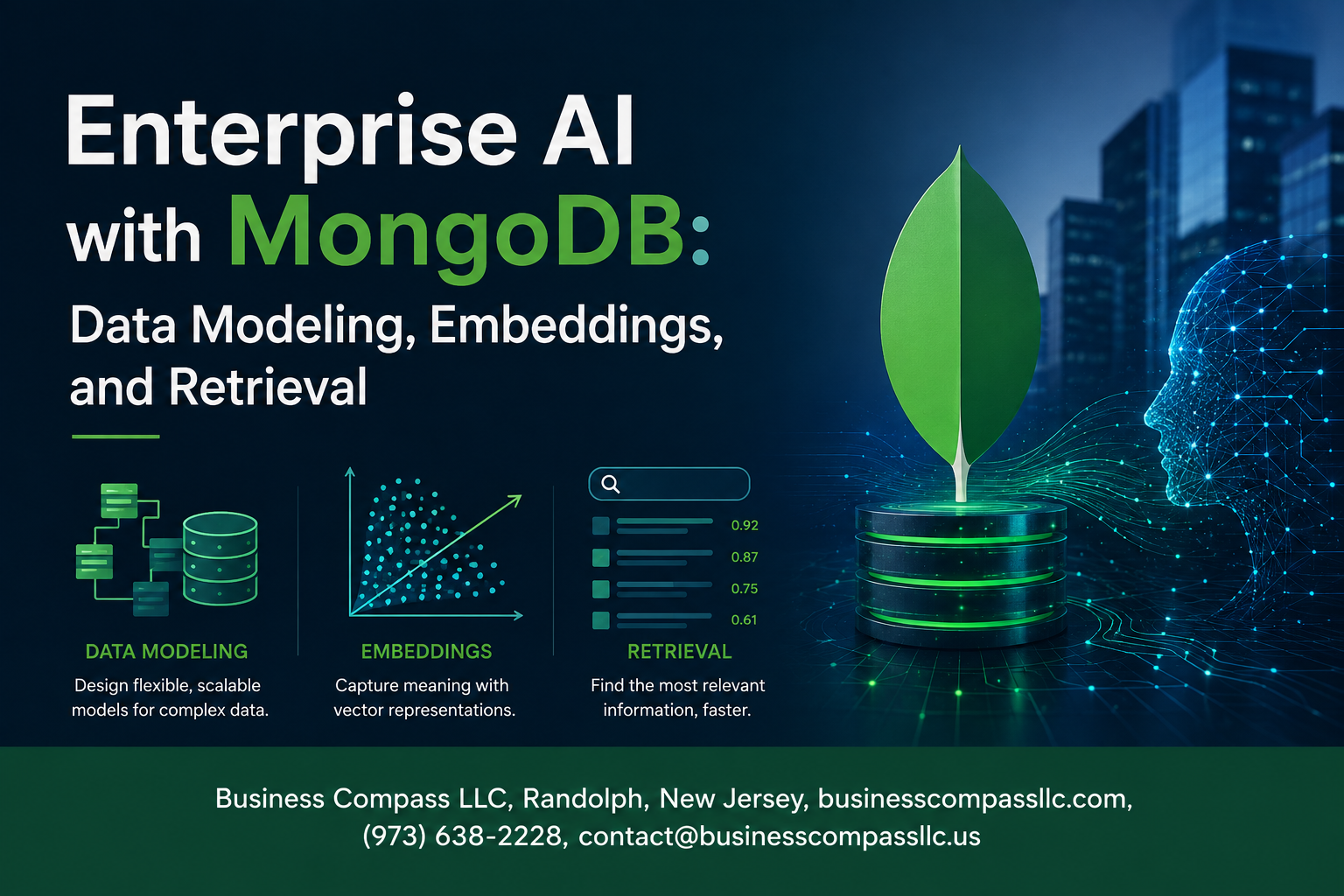
- How to design data models that actually support AI-driven applications, not just store data for them
- How storing embeddings in MongoDB alongside your operational data simplifies your entire pipeline
- How MongoDB Atlas Vector Search powers RAG pipelines that are fast, governable, and ready for enterprise security requirements
By the end, you’ll have a clear picture of how MongoDB AI integration fits into a real production workflow — from raw data to retrieval-augmented generation MongoDB deployments that your security and compliance teams won’t push back on.
Let’s get into it.
Why MongoDB Is Built for Enterprise AI Workloads
Handle Diverse Data Types with a Flexible Document Model
MongoDB’s document model stores text, images, metadata, and vectors together — no rigid schemas holding you back.
Scale AI Applications Without Compromising Performance
Horizontal scaling keeps AI apps fast under heavy loads.
Unify Operational and AI Data in a Single Platform
MongoDB AI integration eliminates data silos, combining operational and AI data seamlessly.
Designing Effective Data Models for AI-Driven Applications
Structure Documents to Support Fast and Accurate AI Queries
Effective enterprise AI data modeling in MongoDB means co-locating related data—embeddings, metadata, and source content—within single documents, slashing query latency. Embed vectors alongside their parent records, reference large shared datasets separately, and denormalize aggressively for read-heavy RAG workloads. Keep schemas flexible so evolving AI requirements never demand painful migrations.
Generating and Storing Embeddings Directly in MongoDB

What Embeddings Are and Why They Power Modern AI
Embeddings convert text, images, or documents into numerical vectors machines can compare.
Integrate Leading Embedding Models with MongoDB Collections
- OpenAI, Cohere, and Hugging Face models generate vectors via API
- Store outputs directly in MongoDB documents
Store Vector Embeddings Alongside Operational Data
Keeping storing embeddings MongoDB native eliminates pipeline complexity, giving AI apps fast, unified access.
Accelerating Retrieval with MongoDB Vector Search

Set Up Atlas Vector Search Indexes for High-Speed Similarity Queries
MongoDB Atlas Vector Search lets you index high-dimensional embeddings and run fast approximate nearest-neighbor queries natively. Combine semantic search with metadata filters, tune numCandidates for relevance-speed tradeoffs, and benchmark across millions of documents — all without separate vector infrastructure, cutting latency and costs significantly.
Building Retrieval-Augmented Generation Pipelines on MongoDB

Connect MongoDB Retrieval Layers to Large Language Models Seamlessly
A RAG pipeline MongoDB setup pairs Atlas Vector Search with LLM APIs, pulling contextually relevant documents before generation. Ground responses in live business data, keeping answers accurate. Manage context windows by ranking retrieved chunks smartly, sending only the most relevant content, preventing token overflow during enterprise-scale interactions.
Securing and Governing AI Data in Enterprise Environments

Enforce Role-Based Access Controls Across AI Data Collections
MongoDB’s built-in RBAC lets you lock down who touches your AI collections, embeddings, and vector indexes — keeping sensitive data away from unauthorized users while your RAG pipeline MongoDB workflows run smoothly.
- Assign granular read/write roles per collection
- Restrict embedding access by team or service account
- Encrypt sensitive documents at rest and in transit

MongoDB brings together everything enterprise AI needs in one place — flexible data modeling, native embedding storage, fast vector search, and RAG pipeline support, all wrapped in enterprise-grade security and governance. Instead of stitching together a patchwork of tools, teams can build smarter, more scalable AI applications without the overhead of managing multiple systems.
If you’re ready to take your AI workloads to the next level, MongoDB gives you a solid foundation to move fast without sacrificing control or reliability. Start by rethinking your data models with AI in mind, get your embeddings living alongside your operational data, and let vector search do the heavy lifting when it comes to retrieval. The pieces are all there — it’s just a matter of putting them together.