Stop Losing Time and Money to Infrastructure That Can’t Keep Up
If your engineering team spends more time fixing broken deployments than shipping features, you’re not alone. Most growing businesses hit the same wall — the tools that worked at 10 employees start crumbling at 100. That’s exactly where Terraform, Kubernetes, and CI/CD integration comes in.
This guide is for engineering leads, DevOps engineers, and technical founders who know their infrastructure needs work but aren’t sure where to start — or how these tools connect to actual business outcomes.
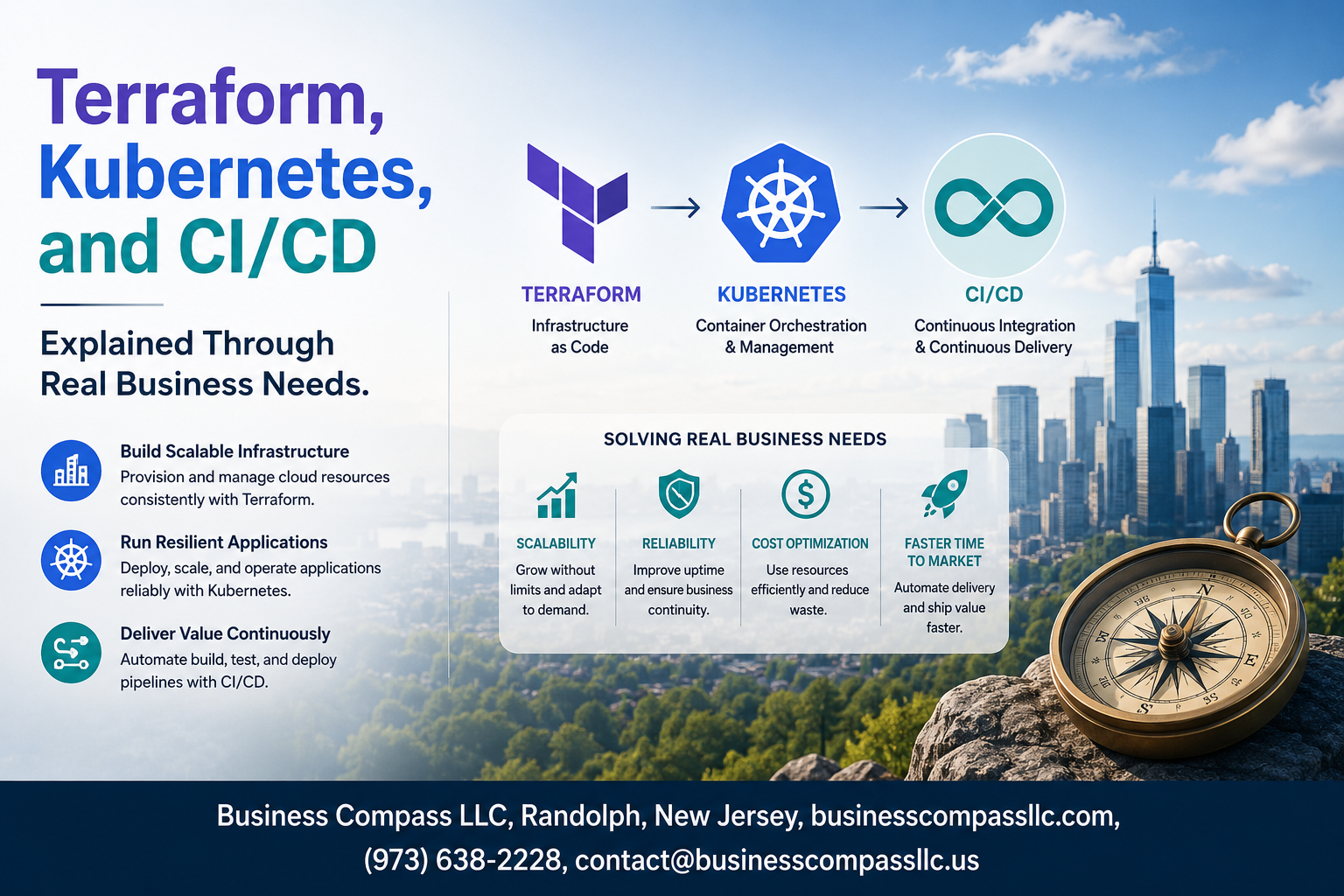
Here’s what we’ll walk through:
- Why Terraform infrastructure as code removes the guesswork from spinning up and managing cloud environments
- How Kubernetes container orchestration benefits your apps by keeping them running reliably, even when traffic spikes or something breaks
- Why CI/CD pipeline best practices let your team ship faster without crossing their fingers every time code hits production
No fluff, no theory for the sake of it. Every section ties back to a real problem businesses face and shows how DevOps tools for business growth actually solve it. By the end, you’ll see why running Terraform and Kubernetes together inside a solid CI/CD workflow isn’t just a technical upgrade — it’s a competitive advantage.
Why Modern Businesses Struggle Without the Right Infrastructure Tools

The Hidden Cost of Manual Infrastructure Management
Manual infrastructure management quietly drains resources in ways most businesses don’t notice until it’s too late. Engineers spend hours clicking through cloud consoles, writing one-off scripts, and fixing mistakes that never should have happened. Without infrastructure automation for businesses, every server spun up manually becomes a liability — inconsistent, undocumented, and nearly impossible to reproduce reliably.
How Slow Deployments Hurt Revenue and Team Morale
- Slow releases mean competitors ship features first
- Developers lose motivation waiting days for approvals and environment setups
- Customers churn when bugs sit unfixed because deployment pipelines are too fragile to push updates confidently
- Downtime during manual deployments directly translates to lost sales and damaged trust
Without CI/CD pipeline best practices in place, even small updates become high-stakes events that teams dread rather than celebrate.
The Risk of Inconsistent Environments Across Teams
When your dev environment doesn’t match staging, and staging doesn’t match production, bugs slip through that nobody can explain. Developers say “it works on my machine” while customers report crashes. This is where Terraform infrastructure as code becomes critical — it ensures every environment is built from the same blueprint, removing the guesswork that costs teams hours of painful debugging every single week.
Terraform Solves the Problem of Unpredictable Infrastructure

Provision Cloud Resources the Same Way Every Time
Terraform infrastructure as code means your team stops guessing what got deployed where. Every cloud resource — servers, databases, networking rules — gets defined in plain config files, so spinning up a new environment looks identical whether it’s your tenth time or your first.
Reduce Human Error With Infrastructure as Code
Manual cloud setup is where costly mistakes happen. Someone forgets a security rule, misnames a resource, or skips a step under deadline pressure. With Terraform, the configuration file is the process, and it runs the same way every single time — no memory required.
Scale Up or Down Based on Real Business Demand
Infrastructure automation for businesses means you’re not paying for idle servers during slow periods or scrambling during traffic spikes. Terraform lets you adjust capacity by changing a number in a file and running one command, keeping costs tight and performance solid.
Manage Multiple Cloud Providers From a Single Workflow
Running AWS alongside Google Cloud or Azure? Terraform handles all of them through one consistent workflow. Your team learns one tool instead of three, and your infrastructure stays visible, version-controlled, and easy to audit — no matter how many cloud accounts are in play.
Kubernetes Gives Your Applications the Reliability Customers Expect

Keep Applications Running During Traffic Spikes
Kubernetes container orchestration benefits shine brightest when your traffic suddenly doubles overnight. Instead of manually spinning up servers in a panic, Kubernetes automatically scales your application pods up or down based on real demand, keeping response times fast without you lifting a finger.
- Horizontal Pod Autoscaler (HPA) monitors CPU and memory usage and adds pods when thresholds are crossed
- Cluster Autoscaler provisions additional nodes when existing ones run out of capacity
- Resource requests and limits prevent one noisy application from stealing resources from another
Eliminate Downtime With Self-Healing Container Orchestration
When a container crashes at 2 AM, nobody wants to wake up and restart it manually. Kubernetes watches every container and restarts failed ones automatically, reschedules workloads away from unhealthy nodes, and replaces unresponsive pods without requiring human intervention.
- Liveness probes detect when a container is stuck and trigger automatic restarts
- Readiness probes keep traffic away from pods that aren’t ready to serve requests
- ReplicaSets guarantee that your specified number of healthy pods always stays running
Deploy Updates Without Disrupting the User Experience
Rolling updates in Kubernetes let you ship new code while keeping the old version running just long enough to hand traffic off smoothly. If something breaks, rollback takes seconds.
- Rolling deployment strategy gradually replaces old pods with new ones
- Blue-green deployments run two environments simultaneously for instant traffic switching
- Canary releases route a small percentage of users to the new version before a full rollout
CI/CD Turns Code Changes Into Business Value Faster

Ship Features to Market Before Your Competitors
When your development team pushes a new feature, every hour it sits waiting for manual approval or deployment is an hour your competitor could beat you to market. A solid CI/CD pipeline best practices setup means code goes from a developer’s laptop to production in minutes, not days.
- Automated build triggers kick off the moment code hits the repository
- Deployment pipelines handle environment promotion without human bottlenecks
- Release schedules shift from “whenever IT has time” to “whenever the business needs it”
Catch Bugs Early Before They Reach Real Customers
The earlier you catch a bug, the cheaper it is to fix. A bug found in development costs a fraction of what it costs when a real customer hits it on a Friday night.
- Unit tests run automatically on every commit
- Integration tests flag issues before code merges into the main branch
- Staging environments mirror production so surprises stay rare
Automate Repetitive Tasks So Developers Focus on What Matters
Developers are expensive, skilled people. Having them manually package builds, click through deployment steps, or copy configuration files is like hiring a chef to wash dishes.
- Infrastructure automation for businesses handles environment setup without developer input
- Scripts replace manual checklists that people forget or skip under pressure
- Teams reclaim hours each week that go straight back into building features
Build Confidence in Every Release With Automated Testing
Continuous integration and deployment explained simply means this: every change gets verified automatically before it touches production. Teams stop dreading release day because the pipeline already did the hard checking work.
- Automated test suites run across multiple environments simultaneously
- Failed tests block deployments automatically, removing the risk of human error
- Green pipelines give product, engineering, and leadership a shared signal that a release is genuinely ready
How Terraform, Kubernetes, and CI/CD Work Better Together
Use Terraform to Prepare the Infrastructure Kubernetes Runs On
Before Kubernetes can do anything useful, the underlying infrastructure needs to exist — and that’s exactly where Terraform steps in. With Terraform infrastructure as code, teams can spin up cloud networking, compute resources, storage, and security configurations in a repeatable, version-controlled way. No more clicking through cloud consoles or hoping someone remembers what settings they used last time.
- Define your VPCs, subnets, and node pools once, then reuse them across environments
- Store infrastructure definitions in Git, so every change is tracked and reversible
- Avoid environment drift by ensuring dev, staging, and production are built from the same templates
Trigger Automated Pipelines That Deploy Directly to Kubernetes Clusters
Once Terraform has the infrastructure ready, CI/CD pipeline best practices take over — automatically building, testing, and deploying application updates straight to your Kubernetes clusters. A developer pushes code, the pipeline kicks off, and within minutes the change is running in production. No manual handoffs, no forgotten steps.
- Pipeline stages handle linting, unit tests, container builds, and security scans automatically
- Kubernetes deployment manifests get applied only after all checks pass
- Rollback triggers fire instantly if health checks fail post-deployment
Maintain Consistency From Development to Production Across Every Team
One of the biggest hidden costs in engineering is environment inconsistency — something works locally but breaks in production. When Terraform and Kubernetes work together inside a shared CI/CD workflow, every team builds against the same infrastructure definitions and the same container images.
- Developers write code against environments that mirror production exactly
- Shared Terraform modules prevent teams from creating snowflake infrastructure setups
- Kubernetes namespaces keep teams isolated without sacrificing standardization
Reduce Operational Overhead With a Fully Integrated Toolchain
Running Terraform, Kubernetes, and CI/CD as separate, disconnected tools creates more work, not less. When they’re wired together, the infrastructure automation for businesses becomes self-sustaining — infrastructure provisions itself, applications deploy themselves, and alerts surface problems before customers notice them.
- On-call burden drops when deployments are predictable and automated
- Teams stop spending weekends on manual releases and environment fixes
- Fewer humans touching production directly means fewer human-caused outages
Align Engineering Workflows With Measurable Business Outcomes
The whole point of Terraform Kubernetes CI/CD integration isn’t to collect impressive-sounding tools — it’s to ship better software faster, with less risk. When engineering workflows are automated and consistent, businesses can move quicker on product decisions, respond to market changes, and scale without hiring an army of operations staff.
- Deployment frequency goes up, meaning customers get improvements sooner
- Mean time to recovery drops because broken releases get caught and rolled back automatically
- Infrastructure costs become predictable because capacity scales with actual demand, not guesswork
Real Business Use Cases That Prove the Value of This Stack

E-Commerce Platform Handles Peak Season Without Outages
A major online retailer used Terraform and Kubernetes together to auto-scale infrastructure during Black Friday, handling 10x normal traffic without a single crash. Terraform provisioned cloud resources in minutes, while Kubernetes shifted workloads dynamically across nodes, keeping checkout pages fast and reliable exactly when customers needed it most.
SaaS Startup Cuts Release Cycles From Weeks to Hours
By building a solid CI/CD pipeline connected to Kubernetes deployments, one SaaS team went from shipping updates every three weeks to pushing multiple releases daily. Every code commit triggered automated testing, container builds, and zero-downtime rollouts, meaning new features reached paying customers faster without breaking anything already working.
Enterprise Team Achieves Compliance Through Automated Infrastructure Audits
A financial services company used Terraform infrastructure as code to enforce security policies across every environment automatically. Instead of manual audits that took weeks, their compliance checks ran inside the CI/CD pipeline on every change, flagging misconfigurations instantly and creating a complete audit trail regulators could review without drama.
Getting your infrastructure right isn’t just a technical checkbox — it directly affects how your business grows, how your customers experience your product, and how fast your team can move. Terraform takes the guesswork out of managing infrastructure, Kubernetes keeps your applications running smoothly even when demand spikes, and CI/CD makes sure your team’s work reaches customers quickly and reliably. When these three work together, you stop fighting fires and start shipping with confidence.
If your team is still dealing with inconsistent environments, slow deployments, or applications that feel fragile under pressure, this stack is worth a serious look. Start small — even adopting one of these tools can create a noticeable shift. But the real magic happens when all three come together, giving your business the kind of reliable, scalable foundation that lets you focus on building great products instead of managing chaos.