The Competitive Landscape of Modern Cloud Computing Platforms
The cloud computing market has never been more crowded — or more competitive. AWS, Azure, and Google Cloud are each pouring billions into infrastructure, AI capabilities, and pricing wars, making the cloud computing platforms comparison harder than ever for businesses trying to pick the right fit.
This guide is for IT decision-makers, tech leads, and business owners who need a clear, no-fluff breakdown of where the major players actually stand in 2024.
Here’s what we’ll dig into:
- How AWS vs Azure vs Google Cloud stack up on core services and real-world performance benchmarks
- Cloud pricing comparison — because sticker price and actual cost are rarely the same thing
- Multi-cloud and hybrid cloud strategies — why more enterprises are refusing to put all their eggs in one basket, and what that means for your next infrastructure decision
By the end, you’ll have a solid read on the current cloud computing market trends and enough context to make smarter calls about your own cloud setup.
Understanding the Current Cloud Computing Market

Key Players Driving Industry Growth
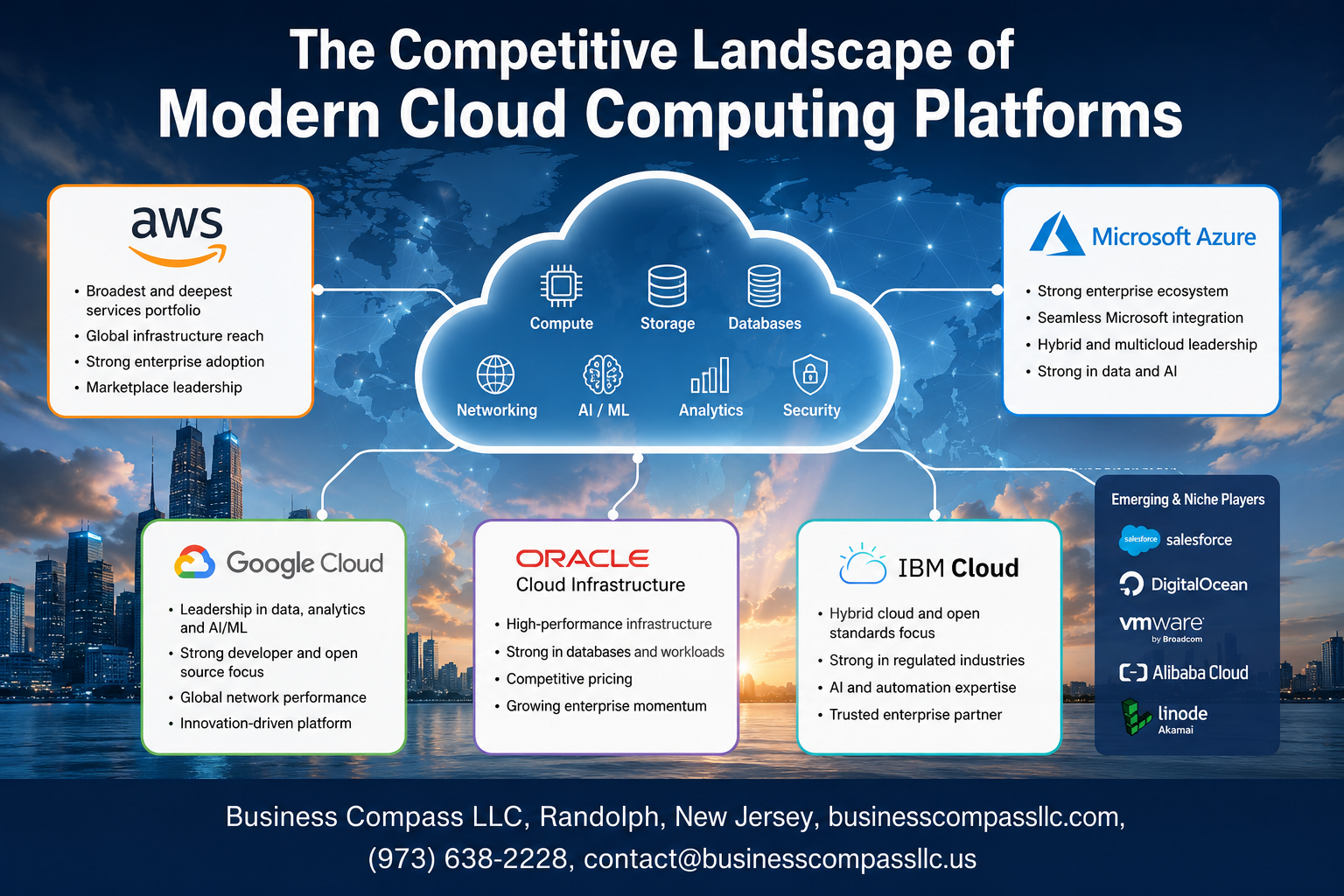
The cloud computing market is dominated by a handful of powerhouses that keep pushing boundaries. Amazon Web Services (AWS), Microsoft Azure, and Google Cloud sit at the top, each bringing something different to the table:
- AWS leads with the widest service catalog and deepest global infrastructure
- Microsoft Azure wins enterprise deals through seamless integration with existing Microsoft tools
- Google Cloud punches hard on AI, machine learning, and data analytics capabilities
Market Share Breakdown Among Top Providers
When doing a cloud computing platforms comparison, the numbers tell a clear story. AWS holds roughly 31% of the market, Azure sits around 25%, and Google Cloud claims approximately 11%. That still leaves a sizeable chunk of the market open for competition, which is exactly where things get interesting.
Emerging Challengers Disrupting the Status Quo
The best cloud providers in 2024 aren’t limited to the big three anymore. A new wave of players is shaking things up:
- Oracle Cloud aggressively targets database-heavy enterprises
- IBM Cloud focuses on regulated industries like finance and healthcare
- Alibaba Cloud dominates Asia-Pacific markets with competitive pricing
- Cloudflare and Fastly chip away at edge computing use cases
These challengers are forcing AWS vs Azure vs Google Cloud conversations to expand, making the cloud computing market trends far more dynamic than they were even two years ago.
Core Services That Separate the Leaders

Compute and Storage Capabilities Compared
When you stack up AWS, Azure, and Google Cloud head-to-head, the differences in compute and storage become pretty clear fast. AWS leads with the widest instance variety, Azure plugs seamlessly into Windows workloads, and Google Cloud punches hard with sustained-use discounts and custom machine types.
- AWS EC2 offers 600+ instance types, covering everything from memory-heavy workloads to GPU-intensive tasks
- Azure Virtual Machines shine brightest for enterprises already running Microsoft ecosystems
- Google Compute Engine delivers automatic sustained-use discounts without requiring upfront commitments
AI and Machine Learning Offerings
This is honestly where the cloud computing platforms comparison gets exciting. Google Cloud holds a natural edge — their TPUs and Vertex AI platform are battle-tested since Google trains its own models on them. AWS SageMaker remains the go-to for production ML pipelines, while Azure AI integrates tightly with OpenAI’s models.
- Google Cloud: TPU access, AutoML, and BigQuery ML built right in
- AWS: SageMaker Studio, Bedrock for foundation models, and Rekognition for vision tasks
- Azure: OpenAI Service, Cognitive Services, and strong enterprise AI governance tools
Networking and Security Features
All three best cloud providers in 2024 offer global backbone networks, but their security stacks have real differences worth knowing:
- AWS has the most mature compliance portfolio with 143+ security standards covered
- Azure Sentinel leads in SIEM capabilities for enterprise cloud services
- Google Cloud’s BeyondCorp zero-trust model sets the bar for identity-based access
Developer Tools That Boost Productivity
Developers consistently vote with their feet, and the tooling ecosystems across platforms reflect that. AWS CloudFormation, Azure DevOps, and Google Cloud Build each handle CI/CD pipelines differently, but all three now deeply support Kubernetes, Terraform, and GitHub Actions integrations, making multi-cloud development smoother than ever.
Pricing Strategies and Cost Competitiveness

How Major Platforms Structure Their Pricing
When doing a cloud pricing comparison across the big three — AWS, Azure, and Google Cloud — you’ll notice each takes a slightly different approach. AWS leans heavily on its pay-as-you-go model with Reserved Instances for predictable workloads. Azure bundles discounts for existing Microsoft customers through its Hybrid Benefit program. Google Cloud offers sustained-use discounts automatically, without requiring upfront commitment.
Key pricing models across platforms include:
- On-demand pricing — pay only for what you consume, hour by hour or second by second
- Reserved/committed use — lock in capacity for 1–3 years and save up to 72%
- Spot/preemptible instances — deeply discounted compute for fault-tolerant workloads
- Free tiers — limited but useful for testing and small-scale development
Hidden Costs to Watch Out For
The sticker price is rarely the full story. Many businesses get caught off guard by charges that aren’t obvious upfront.
Watch out for:
- Egress fees — moving data out of the cloud can get expensive fast, especially at scale
- API call charges — high-frequency applications can rack up unexpected bills
- Support plan costs — enterprise-grade support on AWS or Azure isn’t cheap
- Storage retrieval fees — particularly relevant with archival storage tiers like AWS Glacier
- Licensing costs — running certain software on cloud VMs may carry separate licensing fees
Finding the Best Value for Your Business Needs
The “cheapest” option on paper rarely ends up being the most cost-effective. Picking the right platform from the best cloud providers in 2024 really comes down to matching pricing structure to your workload patterns.
A few practical tips:
- Audit your actual usage before committing to any reserved capacity
- Use cloud cost calculators — AWS, Azure, and Google Cloud all offer free tools
- Negotiate enterprise agreements if you’re spending over $100K/year — discounts are very much on the table
- Consider multi-cloud strategies to avoid vendor lock-in and leverage competitive pricing across providers
- Right-size your instances regularly, since most organizations are overprovisioned by 30–40%
Performance and Reliability Benchmarks

Uptime Guarantees and SLA Comparisons
When picking a cloud provider, uptime guarantees are often the first thing teams check. AWS, Azure, and Google Cloud all promise 99.9% to 99.99% uptime depending on the service tier, but the real difference shows up in how they handle downtime credits and support response times.
- AWS offers tiered SLAs per service, with EC2 promising 99.99% monthly uptime
- Azure matches this with strong SLAs across compute, storage, and networking services
- Google Cloud has been aggressive with its SLA offerings, particularly for GKE and BigQuery
Global Infrastructure and Data Center Reach
Cloud performance benchmarks heavily depend on how close a provider’s data centers are to your end users. More regions mean lower latency and better redundancy.
- AWS leads with 33 geographic regions and 105 availability zones
- Azure has the broadest country coverage, spanning 60+ regions worldwide
- Google Cloud has been rapidly expanding, with strong fiber backbone advantages
Speed and Scalability Under Real-World Conditions
Raw numbers rarely tell the whole story. In real-world cloud computing platforms comparison testing, Google Cloud’s premium networking tier consistently delivers faster data transfer speeds. AWS shines with auto-scaling during traffic spikes, while Azure integrates smoothly with Windows-based enterprise workloads, reducing latency for Microsoft-heavy stacks.
Disaster Recovery and Redundancy Strengths
Each major provider handles disaster recovery differently:
- AWS offers multi-AZ deployments and AWS Backup for automated, policy-driven recovery
- Azure Site Recovery makes geo-redundant failover straightforward for enterprise cloud services
- Google Cloud uses live migration technology to move workloads without downtime during maintenance
Industry-Specific Cloud Solutions

Tailored Platforms for Healthcare and Finance
When it comes to heavily regulated industries, the best cloud providers in 2024 have gone far beyond generic storage and computing. AWS, Azure, and Google Cloud each offer dedicated compliance frameworks:
- AWS for Healthcare: HIPAA-eligible services, Amazon HealthLake for patient data analytics, and purpose-built medical imaging tools
- Azure for Finance: Built-in support for PCI DSS, SOC 2, and real-time fraud detection through Azure Synapse Analytics
- Google Cloud for Both: Strong de-identification APIs and financial services risk modeling tools
These enterprise cloud services aren’t just checkbox compliance plays — they actively cut the time teams spend on regulatory paperwork, freeing up engineers to build actual products.
E-Commerce and Retail Cloud Advantages
Retail businesses live and die by traffic spikes — think Black Friday or a viral product drop. Cloud computing platforms handle this brilliantly through auto-scaling that traditional on-premise servers simply can’t match:
- AWS powers many top retail brands with its vast global edge network and DynamoDB for lightning-fast catalog queries
- Google Cloud brings unmatched personalization through its AI recommendation engines
- Azure connects smoothly with Microsoft Dynamics for inventory and supply chain management
How Startups Benefit From Specialized Offerings
Startups punching above their weight lean hard on specialized cloud tiers:
- Free credits and startup programs (AWS Activate, Google for Startups, Azure Founders Hub) give early-stage companies runway without burning cash
- Pay-as-you-go cloud pricing comparison clearly favors startups over rigid enterprise contracts
- Pre-built ML models and APIs mean a two-person team can ship features that previously required entire data science departments
Multi-Cloud and Hybrid Cloud Strategies

Why Businesses Are Avoiding Vendor Lock-In
Getting stuck with a single cloud provider can feel like being trapped in a bad contract with no exit. Companies are actively building multi-cloud solutions to keep their options open, negotiate better pricing, and avoid situations where one provider’s outage takes down their entire operation.
- Spreading workloads across AWS, Azure, and Google Cloud reduces single points of failure
- Negotiating power increases significantly when vendors know you’re not exclusively committed
- Regulatory requirements in certain industries demand data residency options that one provider alone might not cover
Managing Multiple Platforms Efficiently
Running workloads across several cloud platforms sounds messy, and honestly, it can be without the right approach. The key is treating each platform’s strengths intentionally rather than randomly distributing workloads.
- AWS typically wins for raw breadth of services and global reach
- Azure shines in enterprises already running Microsoft ecosystems
- Google Cloud stands out for data analytics and machine learning workloads
- Centralizing visibility through a single monitoring dashboard prevents cost surprises across platforms
Tools That Simplify Hybrid Cloud Integration
A solid hybrid cloud strategy depends heavily on the right tooling stitching everything together seamlessly.
- HashiCorp Terraform lets teams provision infrastructure across multiple providers using the same codebase
- Kubernetes has become the universal language for deploying containerized apps regardless of where they run
- Anthos (Google), Azure Arc, and AWS Outposts each offer native solutions for extending cloud capabilities into on-premise environments
- Platforms like Datadog and Dynatrace give teams unified observability regardless of which cloud hosts the workload
Future Trends Reshaping Cloud Competition

Edge Computing as the Next Battleground
The race to the edge is heating up fast. AWS, Azure, and Google Cloud are all pushing computing power closer to end users, slashing latency for real-time applications like autonomous vehicles, smart factories, and AR/VR experiences. Whoever wins the edge game likely dominates the next decade of cloud competition.
- AWS Outposts and Wavelength bring cloud infrastructure directly into telecom networks and on-premises data centers
- Azure Edge Zones target ultra-low-latency workloads in partnership with major carriers
- Google Distributed Cloud extends Google’s infrastructure to the network edge and even air-gapped environments
Sustainability Initiatives Influencing Provider Choice
Green credentials are becoming a real differentiator when companies pick their cloud provider. Enterprises with serious ESG commitments are actively choosing platforms based on carbon neutrality pledges, renewable energy usage, and sustainability reporting transparency. Google already claims 24/7 carbon-free energy matching in several regions, while Microsoft targets carbon negativity by 2030.
- Buyers now request sustainability scorecards during procurement
- Cloud providers publish real-time carbon dashboards to win environmentally conscious enterprise deals
- Data center water usage and cooling efficiency are increasingly scrutinized
Quantum Computing and Its Impact on Cloud Services
Quantum computing is shifting from a research curiosity to an actual cloud service offering, and it’s changing how providers compete on raw computational power.
- AWS Braket, Azure Quantum, and Google Quantum AI all offer cloud-based quantum access today
- Early adopters in pharma, finance, and logistics are testing quantum algorithms for optimization problems that classical computers struggle with
- As quantum hardware matures, providers offering the best quantum-classical hybrid workflows will pull ahead in highly specialized enterprise segments
How Regulation Will Shape Platform Development
Data sovereignty laws, AI governance rules, and antitrust scrutiny are quietly becoming some of the biggest forces shaping the future of cloud computing platforms comparison decisions.
- GDPR, DORA, and emerging AI Acts in Europe are forcing providers to build region-specific infrastructure and compliance tooling
- The US and China tech decoupling is splitting the global cloud market, pushing providers like Alibaba and Huawei out of Western enterprise deals
- Regulatory pressure around data portability could eventually make switching between providers easier, intensifying competition across AWS vs Azure vs Google Cloud

The cloud computing market is anything but simple, with major players constantly pushing each other to deliver better services, smarter pricing, and stronger performance. From the core offerings that set the leaders apart to the industry-specific solutions carving out new niches, the competition is driving real innovation that businesses can take advantage of right now. Hybrid and multi-cloud strategies have become the smart move for organizations that want flexibility without getting locked into a single provider, and the pricing wars between platforms mean there’s more room to negotiate than ever before.
The future of cloud computing is going to look very different from what we see today, with AI integration, edge computing, and sustainability efforts changing the game for every major provider. If you’re evaluating your cloud strategy, now is the perfect time to take a hard look at what each platform actually delivers for your specific needs rather than just going with the biggest name. Do your homework, run the benchmarks that matter to your workloads, and don’t be afraid to mix and match platforms to get the best of what’s out there.