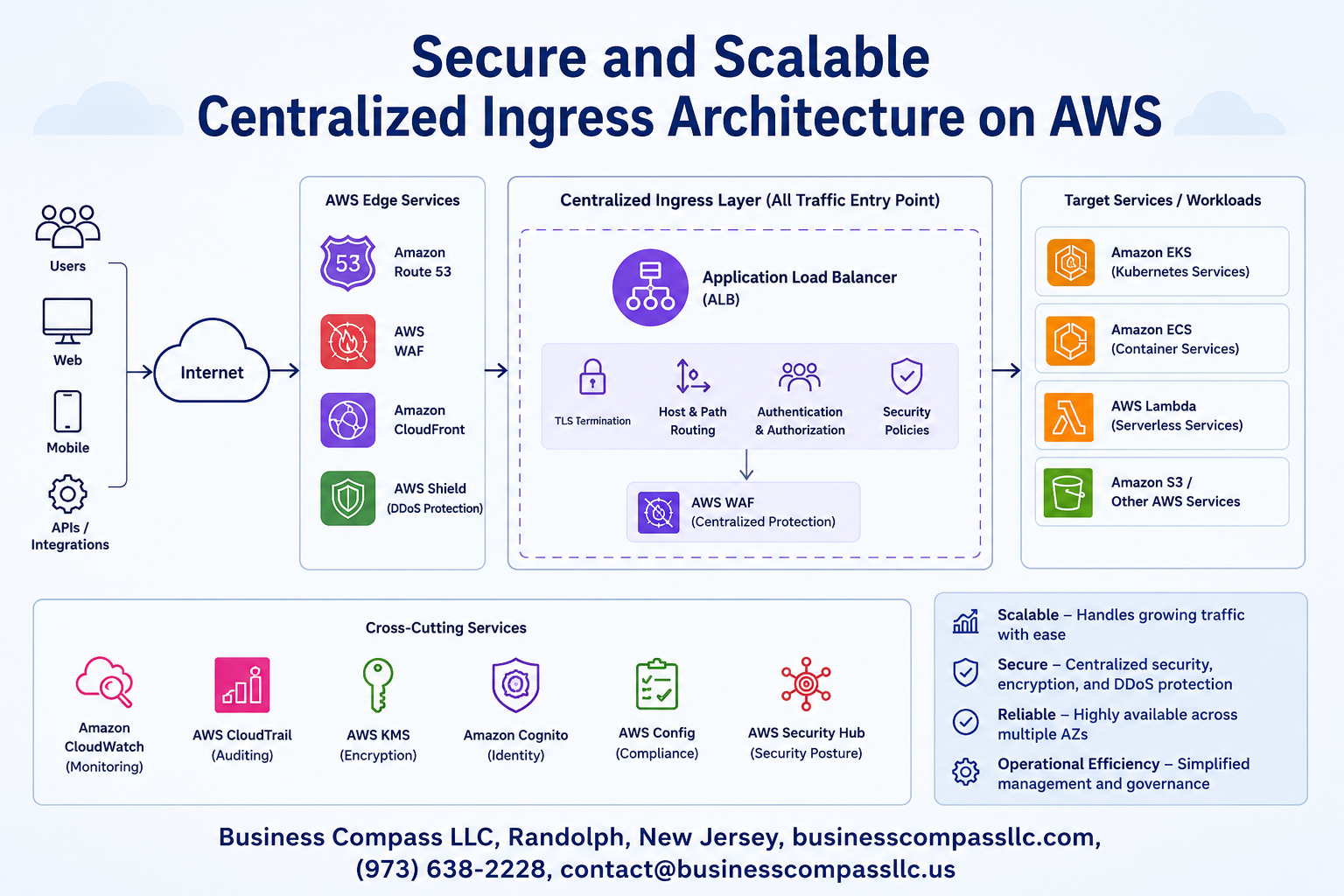
Managing traffic flow into your AWS applications just got complicated. Your organization is growing, security threats are evolving, and users expect lightning-fast responses from multiple regions. Sound familiar?
This guide walks DevOps engineers, cloud architects, and platform teams through building a secure and scalable centralized ingress architecture on AWS that handles real-world complexity without breaking your budget or sanity.
You’ll learn how to design scalable cloud ingress design patterns that grow with your business, implement multi-layer security AWS architecture controls that actually stop attacks, and set up cloud ingress monitoring observability systems that catch problems before users notice them.
We’ll cover the essential AWS services for building robust ingress solutions, show you proven high availability ingress patterns that keep your apps running during outages, and share AWS ingress controller best practices from teams managing thousands of requests per second.
Understanding Centralized Ingress Architecture Benefits

Simplified traffic management across multiple services
AWS centralized ingress architecture transforms how organizations handle traffic routing across distributed microservices. Instead of managing individual load balancers for each service, teams can route all external traffic through a single entry point using AWS Application Load Balancer or API Gateway. This approach eliminates the complexity of maintaining multiple ingress points while providing intelligent traffic distribution based on URL paths, headers, or host-based routing rules. Development teams gain unified control over request routing, enabling seamless service discovery and simplified deployment workflows across their entire application ecosystem.
Enhanced security through single entry point control
Centralizing ingress creates a powerful security chokepoint where all external traffic passes through controlled access points. Organizations can implement comprehensive security policies using AWS WAF to filter malicious requests, rate limiting to prevent abuse, and SSL/TLS termination for encrypted communications. This single-point security model dramatically reduces attack surface area compared to distributed ingress patterns. Security teams can enforce consistent authentication, authorization, and threat detection rules across all services without duplicating security configurations. The centralized approach also simplifies compliance auditing and security monitoring workflows.
Cost reduction via shared infrastructure resources
Shared ingress infrastructure delivers significant cost savings by eliminating redundant load balancers and networking components. Instead of provisioning separate Application Load Balancers for each microservice, teams can leverage a single ALB to handle traffic distribution across multiple backend services. This consolidation reduces AWS resource costs while maintaining high performance and availability. Organizations also benefit from simplified infrastructure management, reduced operational overhead, and better resource utilization across their cloud environment. The shared model scales more efficiently as new services are added without proportional infrastructure cost increases.
Streamlined SSL certificate management
Centralized ingress simplifies SSL certificate lifecycle management by consolidating certificate storage and rotation processes. AWS Certificate Manager integration allows automatic certificate provisioning, renewal, and deployment across all services through the central ingress point. Teams no longer need to manage individual certificates for each service endpoint, reducing administrative burden and security risks associated with expired certificates. This approach supports wildcard certificates and domain validation workflows while maintaining end-to-end encryption. Certificate updates propagate automatically across all routed services without service-specific configuration changes.
AWS Services for Building Robust Ingress Solutions
Application Load Balancer for intelligent traffic distribution
Application Load Balancer serves as the foundation of AWS centralized ingress architecture, delivering intelligent layer-7 traffic routing based on content, headers, and HTTP methods. It automatically distributes incoming requests across multiple availability zones while performing real-time health checks to ensure traffic flows only to healthy targets. The service integrates seamlessly with Auto Scaling groups, enabling dynamic scaling based on demand patterns. Advanced features include SSL termination, sticky sessions, and WebSocket support, making it ideal for modern microservices architectures. ALB’s path-based and host-based routing capabilities allow teams to implement sophisticated traffic management strategies without complex infrastructure overhead.
AWS WAF for application-layer protection
AWS WAF provides comprehensive application-layer security through customizable web access control lists that filter malicious traffic before it reaches your applications. The service includes managed rule sets covering OWASP Top 10 vulnerabilities, SQL injection attempts, and cross-site scripting attacks. Real-time threat intelligence feeds continuously update protection rules to address emerging security threats. Rate limiting capabilities prevent DDoS attacks and API abuse by controlling request frequencies from specific IP addresses or geographic regions. Integration with CloudFront and Application Load Balancer ensures consistent security policies across all entry points while maintaining low latency for legitimate traffic.
Amazon CloudFront for global content delivery
CloudFront accelerates content delivery through a global network of edge locations that cache static and dynamic content closer to end users. The CDN service integrates with AWS origins including S3, ALB, and EC2 instances while supporting custom origins for hybrid architectures. Advanced caching behaviors allow fine-grained control over content delivery policies based on file types, query parameters, and request headers. Built-in DDoS protection through AWS Shield Standard safeguards against network-layer attacks. Real-time logs and metrics provide visibility into cache performance and user behavior patterns across geographic regions.
Route 53 for DNS management and health checks
Route 53 delivers highly available DNS services with advanced routing policies including weighted, latency-based, and geolocation routing for optimal user experiences. Health check capabilities monitor endpoint availability across multiple protocols and automatically route traffic away from failed resources. The service supports complex DNS scenarios through alias records that seamlessly integrate with other AWS services without additional charges. Failover routing ensures business continuity by automatically switching traffic to backup resources when primary endpoints become unavailable. Route 53’s programmable DNS enables infrastructure automation through APIs and CloudFormation templates.
Implementing Multi-Layer Security Controls

WAF Rules for Blocking Malicious Traffic Patterns
AWS WAF provides comprehensive protection by filtering HTTP/HTTPS requests at the application layer before they reach your backend services. Configure rate-limiting rules to prevent brute force attacks, geo-blocking to restrict traffic from high-risk regions, and SQL injection protection to safeguard database queries. Set up managed rule groups for OWASP Top 10 vulnerabilities, custom string matching patterns for blocking specific attack signatures, and reputation-based filtering to automatically block known malicious IP addresses. Regular rule updates and monitoring ensure your WAF adapts to evolving threat landscapes.
Security Groups and NACLs for Network-Level Protection
Security groups act as virtual firewalls controlling inbound and outbound traffic at the instance level, while Network ACLs provide subnet-level filtering for additional defense layers. Design security groups with least-privilege principles, allowing only necessary ports and protocols from specific source ranges. Configure NACLs to block suspicious traffic patterns and create network segmentation boundaries. Layer both controls strategically – use NACLs for broad traffic filtering and security groups for granular application-specific rules. This dual approach creates redundant protection that significantly reduces attack surface exposure.
AWS Shield for DDoS Attack Mitigation
AWS Shield Standard provides automatic protection against common network and transport layer DDoS attacks for all AWS resources at no additional cost. Shield Advanced offers enhanced DDoS protection with 24/7 access to the DDoS Response Team, real-time attack notifications, and cost protection against scaling charges during attacks. Enable Shield Advanced for critical applications handling high-value traffic, configure health checks for automatic failover during attacks, and integrate with CloudWatch for comprehensive attack visibility. The service automatically scales protection based on attack patterns and traffic volume.
Designing for High Availability and Fault Tolerance

Multi-AZ deployment strategies for zero downtime
Distributing your centralized ingress architecture across multiple Availability Zones creates automatic redundancy that keeps your applications running even when entire data centers go offline. Deploy Application Load Balancers with targets spread across at least three AZs, ensuring traffic automatically reroutes when failures occur. This high availability ingress pattern eliminates single points of failure and maintains continuous service delivery without manual intervention.
Health check configuration for automatic failover
Configure health checks with aggressive timeouts and failure thresholds to detect problems quickly and trigger automatic failover mechanisms. Set health check intervals to 30 seconds with unhealthy thresholds of 2-3 consecutive failures for rapid detection. Include both basic connectivity checks and application-specific validation endpoints that verify your services are actually processing requests correctly, not just responding to pings.
Cross-region backup and disaster recovery planning
Establish cross-region replication for your ingress configuration and traffic routing rules to protect against regional outages. Use Route 53 health checks with failover routing policies that automatically redirect traffic to backup regions when primary regions become unavailable. Maintain synchronized copies of your WAF rules, SSL certificates, and load balancer configurations across regions to enable seamless disaster recovery activation.
Auto-scaling policies for handling traffic spikes
Design auto-scaling policies that respond to both predictable and unexpected traffic patterns by monitoring key metrics like request count, CPU utilization, and response times. Configure target tracking policies that maintain optimal performance levels while implementing step scaling for rapid response to sudden traffic surges. Set up scheduled scaling for known traffic patterns and establish minimum capacity thresholds that prevent your scalable cloud ingress design from scaling down too aggressively during quiet periods.
Monitoring and Observability Best Practices

CloudWatch metrics for performance tracking
CloudWatch serves as the foundation for monitoring your AWS centralized ingress architecture, providing essential metrics like request count, latency, and error rates. Set up custom metrics for Application Load Balancer target health, connection counts, and response times. Monitor CPU and memory usage across your ingress infrastructure to identify bottlenecks before they impact users. Configure metric filters to track specific patterns in your logs, enabling proactive performance optimization and capacity planning.
AWS X-Ray for distributed tracing capabilities
X-Ray provides end-to-end visibility across your centralized traffic management AWS infrastructure, tracing requests from the load balancer through microservices. Enable X-Ray tracing on your Application Load Balancer and downstream services to visualize request flows and identify latency hotspots. The service map shows dependencies between components, making it easier to pinpoint where delays occur. Analyze trace data to optimize routing decisions and improve overall system performance.
VPC Flow Logs for network traffic analysis
VPC Flow Logs capture detailed information about network traffic flowing through your secure AWS ingress solutions, including source and destination IPs, ports, and protocols. Enable flow logs at the VPC, subnet, and network interface levels to gain comprehensive visibility into traffic patterns. Use this data to identify unusual traffic spikes, potential security threats, and optimization opportunities. Flow logs help validate that your security groups and network ACLs are working as expected.
Real-time alerting for proactive issue resolution
Configure CloudWatch alarms with appropriate thresholds for critical metrics like error rates, latency percentiles, and target health checks. Set up SNS topics to send notifications to your operations team via email, SMS, or Slack integration. Create escalation policies that trigger different alert levels based on severity and duration. Use composite alarms to reduce noise by combining multiple metrics into intelligent alerting rules that prevent false positives.
Custom dashboards for operational visibility
Build comprehensive CloudWatch dashboards that display key performance indicators for your scalable cloud ingress design across multiple AWS regions and availability zones. Include widgets for load balancer metrics, target group health, WAF blocked requests, and certificate expiration dates. Create role-based dashboards for different teams – operations staff need detailed technical metrics while executives prefer high-level business impact views. Use dashboard variables to filter data by environment, region, or service for focused troubleshooting.

Building a secure and scalable centralized ingress architecture on AWS doesn’t have to be overwhelming when you break it down into manageable components. By leveraging AWS’s native services and following the principles we’ve covered – from implementing robust security controls to designing for high availability – you can create an ingress solution that grows with your business while keeping threats at bay. The key is starting with a solid foundation that includes proper monitoring and observability from day one.
Your organization’s success depends on having reliable, secure entry points for your applications. Take the time to plan your architecture carefully, test your failover scenarios, and establish clear monitoring practices. The investment you make in building this infrastructure properly will pay dividends as your traffic grows and security requirements become more complex. Start implementing these practices today, and you’ll have the peace of mind that comes with knowing your ingress layer can handle whatever comes its way.