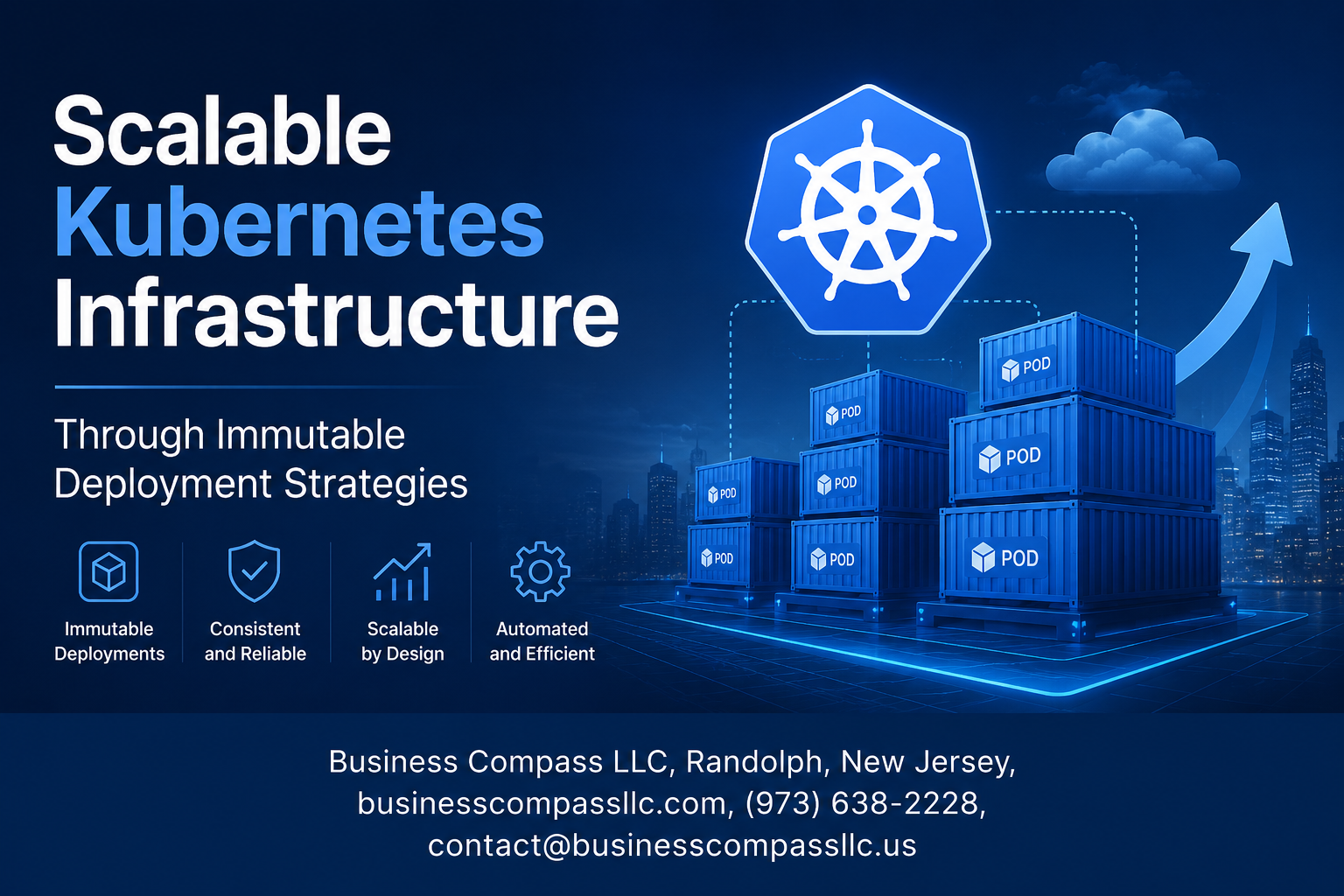
Managing complex Kubernetes environments at scale becomes a nightmare when deployments fail unpredictably, rollbacks take forever, and infrastructure drift creates mysterious bugs. Scalable Kubernetes infrastructure built on immutable deployment strategies solves these problems by treating your infrastructure and applications as unchangeable artifacts that get replaced rather than modified.
This guide targets DevOps engineers, platform teams, and cloud architects who need to build reliable, scalable container orchestration systems that can handle production workloads without breaking under pressure.
You’ll learn how to implement blue-green deployment Kubernetes patterns that eliminate downtime during releases, master canary release Kubernetes techniques that catch issues before they affect all users, and set up GitOps Kubernetes workflows that make infrastructure changes predictable and auditable. We’ll also cover container image immutability best practices and Kubernetes observability monitoring approaches that give you confidence in your deployments.
By the end, you’ll have a complete playbook for building Kubernetes infrastructure that scales smoothly and deploys safely, every single time.
Understanding Immutable Infrastructure Fundamentals

Core principles of immutable deployments
Immutable infrastructure treats servers and applications as disposable units that never change after creation. When updates are needed, you replace entire components rather than modifying existing ones. This approach eliminates configuration drift and ensures consistent environments across development, staging, and production. The fundamental principle revolves around building once, deploying anywhere, maintaining identical states throughout the deployment pipeline.
Key differences from traditional mutable infrastructure
Traditional infrastructure allows in-place modifications, patches, and configuration changes that accumulate over time, creating unique server configurations known as “snowflake servers.” Immutable deployment strategies prevent these variations by rebuilding complete environments for each change. Instead of updating packages or modifying files on running systems, you create fresh instances from version-controlled blueprints. This eliminates the “it works on my machine” problem that plagues mutable environments.
Benefits for scalability and reliability
Kubernetes immutable infrastructure delivers predictable scaling behavior since every instance starts from identical base images. Rolling back problematic deployments becomes instantaneous – simply redirect traffic to previous versions instead of troubleshooting corrupted configurations. Automated testing becomes more reliable because test environments perfectly mirror production. Security improves as compromised instances are replaced rather than patched, eliminating persistent threats. Horizontal scaling accelerates since new pods boot from known-good states without lengthy configuration processes.
Essential prerequisites for implementation
Successful immutable deployment strategies require robust CI/CD pipelines that automate image building and testing. Container registries must store versioned artifacts with proper tagging strategies. Infrastructure as code tools like Terraform or Helm manage environment provisioning declaratively. Comprehensive logging and monitoring capture application state since you can’t SSH into containers for debugging. Development teams need mindset shifts toward treating infrastructure as cattle, not pets, embracing automated processes over manual interventions.
Building Immutable Container Images for Kubernetes

Dockerfile best practices for immutability
Building truly immutable container images requires careful attention to Dockerfile structure and layer optimization. Start with minimal base images like Alpine Linux or distroless variants to reduce attack surface and image size. Avoid package manager caches by combining RUN commands with cleanup operations in single layers. Pin specific package versions rather than using “latest” tags to guarantee reproducible builds. Copy application code last to maximize Docker layer caching efficiency. Use non-root users for security and avoid installing unnecessary development tools in production images.
Multi-stage builds for optimized image layers
Multi-stage builds revolutionize container image immutability by separating build dependencies from runtime requirements. Create dedicated build stages for compiling applications, installing dependencies, and generating artifacts. Copy only essential binaries and configuration files to the final production stage, dramatically reducing image size and eliminating build tools from the runtime environment. This approach ensures cleaner, more secure images while maintaining fast build times through intelligent caching strategies across different build stages.
Security hardening techniques
Implementing robust security measures strengthens container image immutability and protects Kubernetes workloads. Scan images regularly using tools like Trivy or Clair to identify vulnerabilities before deployment. Remove shell access by using scratch or distroless base images when possible. Apply principle of least privilege by running containers with read-only filesystems and dropping unnecessary Linux capabilities. Configure proper resource limits and use security contexts to enforce runtime restrictions. Implement image signing with tools like Cosign to verify image integrity throughout the deployment pipeline.
Version control strategies for container images
Effective versioning ensures reliable immutable deployment strategies across Kubernetes environments. Use semantic versioning for application releases combined with Git commit hashes for precise traceability. Implement consistent tagging strategies that include environment identifiers and build numbers. Store images in secure registries with vulnerability scanning and access controls enabled. Create immutable tags that prevent accidental overwrites and maintain audit trails. Automate image promotion between environments using GitOps workflows that track version history and enable quick rollbacks when needed.
Implementing Blue-Green Deployment Patterns

Setting up parallel production environments
Blue-green deployment patterns create two identical production environments running simultaneously, allowing instant traffic switching between stable releases. Configure separate Kubernetes namespaces or clusters for blue and green environments, ensuring identical resource allocations, networking configurations, and persistent storage volumes. Use Infrastructure as Code tools like Helm charts or Kustomize to maintain environment parity and automate provisioning processes.
Traffic routing strategies with Kubernetes services
Kubernetes services provide flexible traffic routing mechanisms for blue-green deployments through label selectors and service mesh integration. Configure a primary service that switches between blue and green deployments by updating selector labels, enabling instant traffic redirection. Implement ingress controllers with weighted routing capabilities to gradually shift traffic percentages, or use service mesh solutions like Istio for advanced traffic management and circuit breaker patterns.
Automated rollback mechanisms
Automated rollback systems monitor deployment health through readiness probes, liveness checks, and custom metrics to trigger instant reversions when issues arise. Deploy monitoring agents that track application performance, error rates, and business metrics, automatically switching traffic back to the previous stable environment when thresholds breach. Configure automated alerts and webhook integrations to notify teams immediately when rollbacks occur, maintaining detailed audit logs for post-incident analysis.
Zero-downtime deployment workflows
Zero-downtime workflows orchestrate seamless transitions between blue and green environments through coordinated deployment pipelines and health validation gates. Implement pre-deployment validation steps including database migrations, configuration updates, and smoke tests before traffic switching occurs. Use Kubernetes rolling updates with proper resource requests, graceful shutdown periods, and connection draining to ensure active sessions complete successfully during environment transitions.
Advanced Canary Release Strategies

Progressive traffic splitting configurations
Canary release Kubernetes implementations rely heavily on sophisticated traffic splitting mechanisms that gradually shift user requests from stable versions to new deployments. Service mesh technologies like Istio and Linkerd provide granular control over traffic distribution, allowing teams to start with minimal exposure (1-5%) and progressively increase traffic based on performance metrics. Kubernetes ingress controllers such as NGINX and Traefik offer weighted routing capabilities that complement immutable deployment strategies by maintaining separate backend services while controlling traffic flow. Advanced configurations support header-based routing, geographic distribution, and user cohort targeting to minimize blast radius during releases.
Monitoring and metrics collection during canary phases
Real-time observability becomes critical during canary deployments, where teams must track both technical metrics and business KPIs to validate new releases. Prometheus integration with Kubernetes monitoring provides detailed insights into response times, error rates, CPU usage, and memory consumption across different deployment versions. Custom metrics collectors capture application-specific data points like conversion rates, user engagement, and feature adoption to ensure business objectives align with technical performance. Alert configurations trigger notifications when canary versions deviate from baseline performance thresholds, enabling rapid response to potential issues.
Automated promotion and rollback triggers
Smart automation frameworks evaluate predefined success criteria to determine whether canary releases should progress to full deployment or trigger immediate rollbacks. GitOps Kubernetes workflows integrate with monitoring systems to create decision trees based on error rates, latency percentiles, and custom business metrics collected during canary phases. Flagger and Argo Rollouts provide native Kubernetes operators that automatically promote successful canaries while maintaining immutable infrastructure principles. Rollback mechanisms preserve previous deployment states, allowing instant reversion to stable versions when automated triggers detect performance degradation or increased error rates exceeding acceptable thresholds.
GitOps Integration for Infrastructure Management

Infrastructure as Code with Kubernetes manifests
Kubernetes manifests serve as the foundation for GitOps infrastructure management, enabling teams to define cluster resources through declarative YAML configurations. These manifests capture everything from deployments and services to ingress rules and custom resources, creating a complete infrastructure blueprint. Version-controlled manifest repositories become the single source of truth, allowing infrastructure changes through standard Git workflows. Tools like Kustomize and Helm enhance manifest management by providing templating and overlay capabilities for different environments.
Continuous deployment pipelines
GitOps pipelines automatically sync Kubernetes clusters with Git repository states, eliminating manual deployment steps and reducing human error. Popular operators like ArgoCD and Flux continuously monitor Git repositories for changes, triggering automatic deployments when manifest updates are detected. These pipelines support multi-environment workflows, promoting changes from development through staging to production environments. Pipeline configurations can include automated testing, security scanning, and approval gates before applying changes to production clusters.
Git-based approval workflows
Pull request workflows provide natural approval mechanisms for infrastructure changes, leveraging Git’s built-in review capabilities. Teams can implement branch protection rules requiring code reviews, automated tests, and specific approver permissions before merging infrastructure modifications. This approach creates audit trails for all infrastructure changes, showing who made changes, when they occurred, and what approval process was followed. Integration with external systems like Slack or Microsoft Teams can notify relevant stakeholders about pending infrastructure changes requiring approval.
Configuration drift detection and remediation
GitOps operators continuously compare actual cluster state with desired Git repository state, detecting and correcting configuration drift automatically. When manual changes are made directly to the cluster, GitOps tools can either alert operations teams or automatically revert unauthorized modifications. This ensures clusters maintain consistency with their declared configurations, preventing the “snowflake server” problem common in traditional infrastructure management. Advanced drift detection includes resource-level comparisons, identifying specific fields that have diverged from their intended values and providing detailed remediation reports.
Scaling Challenges and Solutions

Resource allocation optimization techniques
Scaling scalable Kubernetes infrastructure with immutable deployment strategies requires careful resource planning. Traditional resource allocation models break down when dealing with immutable workloads that can’t be modified in-place. Setting appropriate CPU and memory limits becomes critical since containers can’t be patched or adjusted after deployment. Resource quotas at the namespace level help prevent resource hogging, while vertical pod autoscaling recommendations guide right-sizing for future deployments. Node affinity rules ensure workloads land on appropriately sized instances, and resource requests should reflect actual usage patterns rather than peak theoretical needs.
Horizontal pod autoscaling with immutable workloads
Horizontal pod autoscaling faces unique challenges with immutable container images since scaling decisions must account for the complete replacement of pods rather than incremental updates. Custom metrics beyond CPU and memory—such as queue depth or request latency—provide better scaling triggers for immutable workloads. The HPA controller needs sufficient time to warm up new immutable pods, requiring careful tuning of scale-up and scale-down delays. Predictive autoscaling using historical data helps anticipate traffic patterns, while pod disruption budgets ensure scaling operations don’t compromise application availability during blue-green transitions.
Cluster-level scaling considerations
Managing cluster-level scaling with Kubernetes immutable infrastructure demands coordination between multiple autoscaling mechanisms. Cluster autoscaler must account for the resource overhead of maintaining multiple deployment versions during blue-green deployments. Node pools should be sized to handle both current workloads and the temporary doubling of resources during immutable deployments. Multi-zone deployment strategies become essential for maintaining availability while scaling, and network policies must accommodate the dynamic nature of pod IP addresses in scaled environments. Storage considerations include ensuring persistent volumes can handle the concurrent access patterns that emerge during scaled immutable deployments.
Monitoring and Observability Best Practices

Health Check Strategies for Immutable Deployments
Kubernetes immutable infrastructure demands robust health checks that account for the stateless nature of containers. Readiness probes ensure pods receive traffic only when fully operational, while liveness probes restart unhealthy containers automatically. Configure startup probes for applications with longer initialization times to prevent premature restarts. Custom health endpoints should validate critical dependencies like databases and external APIs. Use multi-layered health checks combining HTTP endpoints, TCP socket checks, and exec commands to catch different failure modes in your scalable Kubernetes infrastructure.
Logging and Tracing Implementation
Centralized logging becomes critical when managing immutable deployment strategies across multiple environments. Deploy log aggregators like Fluentd or Fluent Bit as DaemonSets to collect container logs from all nodes. Structured logging with JSON format enables better parsing and searching capabilities. Implement distributed tracing using OpenTelemetry to track requests across microservices in blue-green and canary deployments. Correlation IDs help connect logs from different services handling the same user request. Store logs in persistent storage like Elasticsearch or cloud-native solutions to survive pod restarts and maintain audit trails for compliance.
Performance Metrics and Alerting Systems
Comprehensive metrics collection powers effective Kubernetes observability monitoring for immutable deployments. Prometheus scrapes metrics from application endpoints, node exporters, and kube-state-metrics to provide cluster-wide visibility. Key metrics include CPU and memory utilization, request rates, error percentages, and response times. Set up alerting rules for resource exhaustion, pod crash loops, and deployment failures. Grafana dashboards visualize trends and patterns across your infrastructure. Custom metrics specific to your application business logic help identify performance bottlenecks before they impact users. Alert fatigue reduction requires thoughtful threshold tuning and escalation policies.
Debugging Techniques for Containerized Applications
Debugging containerized applications requires specialized approaches due to their ephemeral nature. Use kubectl exec to access running containers for real-time troubleshooting without breaking immutability principles. Debug containers provide additional tools without modifying production images. Container image scanning during build pipelines catches vulnerabilities early. Ephemeral containers in newer Kubernetes versions allow attaching debugging tools to running pods temporarily. Log analysis tools help identify patterns in application behavior across multiple pod instances. Network policies and service mesh observability reveal communication issues between services. Performance profiling tools like pprof integrate with containerized applications to identify CPU and memory bottlenecks.

Adopting immutable deployment strategies transforms how teams manage Kubernetes infrastructure at scale. By treating infrastructure as code and containers as unchangeable artifacts, organizations can eliminate configuration drift, reduce deployment risks, and achieve faster recovery times. The combination of blue-green deployments, canary releases, and GitOps workflows creates a robust foundation for managing complex applications across multiple environments.
The real power comes from integrating these practices into a cohesive system where monitoring and observability guide decision-making. Start with building reproducible container images, then gradually introduce automated deployment patterns that match your risk tolerance. Your infrastructure becomes more reliable, your deployments more predictable, and your team more confident in pushing changes to production. The investment in these practices pays off quickly when you can deploy with confidence and scale without fear.