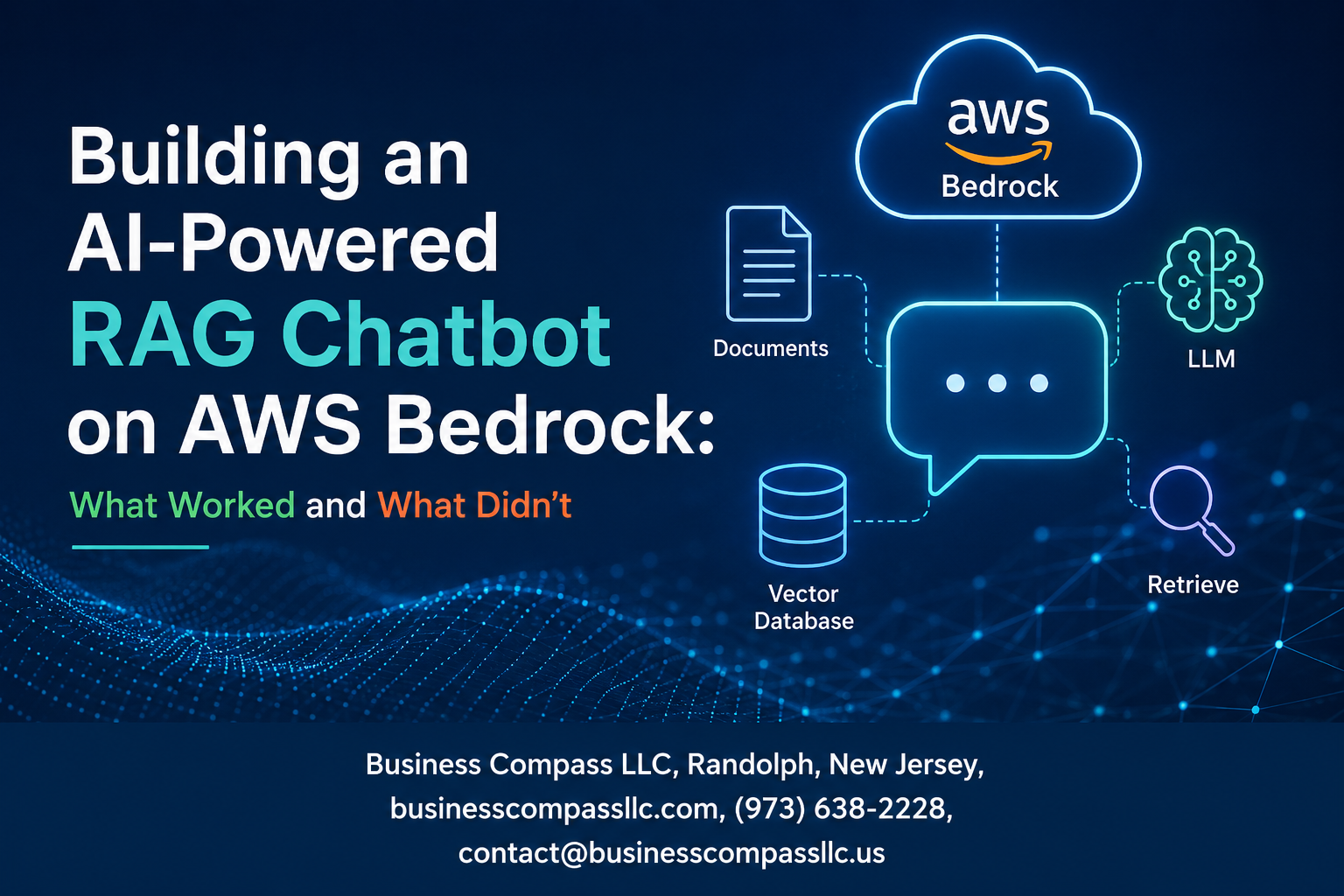
Building an AI-powered RAG chatbot on AWS Bedrock sounds straightforward until you hit the real-world challenges that separate working prototypes from production-ready systems. This comprehensive AWS Bedrock implementation guide walks developers, AI engineers, and technical teams through the practical lessons learned from deploying retrieval augmented generation AWS solutions in live environments.
You’ll discover the specific document ingestion strategies that actually scale, plus the retrieval optimization techniques that transform sluggish responses into snappy conversations. We’ll also cover the common pitfalls that can derail your AWS Bedrock RAG chatbot project and share proven performance monitoring approaches that keep your conversational AI AWS system running smoothly.
Whether you’re building your first RAG chatbot architecture or optimizing an existing implementation, this guide cuts through the theory to show you what works—and what doesn’t—when developing production-grade AI-powered chatbot development solutions.
Understanding AWS Bedrock’s Core Capabilities for RAG Implementation

Foundation Models Available and Their Strengths
AWS Bedrock offers several foundation models that excel in different aspects of RAG chatbot development. Claude 3.5 Sonnet delivers exceptional reasoning and context understanding, making it perfect for complex document analysis and nuanced conversations. Titan Text Express provides cost-effective performance for straightforward Q&A scenarios, while Cohere Command handles multilingual content exceptionally well. Each model brings unique strengths – Claude excels at maintaining conversation context across long interactions, Titan offers reliable performance at scale, and Cohere shines when dealing with diverse language requirements in enterprise environments.
Vector Database Integration Options
Bedrock integrates seamlessly with multiple vector database solutions, each offering distinct advantages for RAG implementation. Amazon OpenSearch provides native AWS integration with robust search capabilities and automatic scaling. Pinecone delivers lightning-fast similarity searches with excellent developer experience, while Weaviate offers advanced hybrid search combining vector and keyword matching. The choice depends on your specific needs – OpenSearch works best for AWS-native architectures, Pinecone excels in performance-critical applications, and Weaviate suits complex search requirements mixing structured and unstructured data.
API Limitations and Pricing Considerations
Bedrock’s pricing model varies significantly across foundation models and usage patterns. Claude models charge per input/output token with higher costs but superior quality, while Titan offers more predictable pricing for high-volume applications. Rate limits can impact real-time chatbot performance – Claude 3.5 Sonnet allows 400 requests per minute, which may require request queuing for busy applications. Token limits also matter – most models cap at 200K tokens per request, affecting how much context you can include. Plan for these constraints early, especially when processing large documents or maintaining extensive conversation histories.
Setting Up the Technical Infrastructure That Actually Works

Configuring AWS Services for Optimal Performance
Start with Amazon Bedrock’s foundation models, but don’t overlook the supporting cast. Set up Amazon S3 buckets with intelligent tiering for document storage, configure AWS Lambda functions with appropriate memory allocation (3008MB works well for document processing), and establish API Gateway endpoints with proper throttling limits. The key is matching your infrastructure to your expected query volume – overprovisioning costs money while underprovisioning kills user experience. Monitor CloudWatch metrics religiously and adjust Lambda concurrency settings based on real usage patterns.
Choosing the Right Vector Database Solution
Amazon OpenSearch Service emerges as the standout choice for AWS Bedrock RAG chatbot implementations, though Pinecone and Chroma deserve consideration for specific use cases. OpenSearch integrates seamlessly with other AWS services and offers built-in security features that external solutions struggle to match. Configure your index with the right dimension size (1536 for OpenAI embeddings, 4096 for Bedrock’s Titan embeddings) and choose approximate nearest neighbor search algorithms like HNSW for speed. Don’t forget to enable encryption at rest and set up proper backup strategies.
Establishing Secure Authentication and Access Controls
AWS IAM becomes your best friend when securing your RAG chatbot architecture. Create service-specific roles rather than using broad permissions – your Lambda functions only need access to specific S3 buckets and Bedrock models. Implement API keys for external access and consider AWS Cognito for user authentication if you’re building customer-facing applications. Set up VPC endpoints to keep traffic within AWS networks, and always enable AWS CloudTrail for audit logging. Security isn’t optional when dealing with enterprise documents.
Creating Scalable Document Processing Pipelines
Design your document ingestion pipeline with AWS Step Functions to orchestrate the entire workflow. Use S3 event notifications to trigger processing automatically when new documents arrive, then route files through appropriate processors – PDF extraction with Textract, text chunking with custom Lambda functions, and embedding generation through Bedrock. Implement error handling and retry logic because document processing fails more often than you’d expect. Consider using SQS queues for batch processing large document volumes and DynamoDB for tracking processing status and metadata.
Document Ingestion Strategy That Delivers Results

Preprocessing Techniques for Better Retrieval Accuracy
Document preprocessing dramatically impacts your AWS Bedrock RAG chatbot’s performance. Clean text extraction removes headers, footers, and metadata noise that confuses the embedding model. Text normalization handles character encoding issues and standardizes formatting across different document sources. Regular expression patterns strip unwanted elements like page numbers and watermarks. OCR preprocessing for scanned documents requires additional noise reduction and confidence scoring to filter unreliable text recognition. Smart content detection identifies and preserves important structural elements like tables and lists while removing decorative content.
Chunking Strategies That Maintain Context
Effective chunking balances granularity with context preservation in your RAG implementation. Fixed-size chunking works well for homogeneous content but breaks semantic boundaries. Semantic chunking using paragraph boundaries and sentence structure maintains logical flow while creating retrievable units. Sliding window approaches with overlap prevent information loss at chunk boundaries. Content-aware splitting recognizes document structure like sections and subsections. Hybrid strategies combine multiple approaches – using semantic boundaries as primary splits with size constraints as fallbacks. Testing different chunk sizes between 200-800 tokens reveals optimal performance for your specific use case.
Embedding Generation Best Practices
Vector embeddings quality directly affects retrieval accuracy in AWS Bedrock implementations. Batch processing documents reduces API calls and improves throughput compared to individual embedding requests. Model selection matters – newer embedding models like Amazon Titan handle domain-specific content better than generic alternatives. Text preprocessing before embedding includes lowercasing, removing special characters, and handling acronyms consistently. Embedding dimension optimization balances storage costs with retrieval precision. Cache frequently accessed embeddings to reduce latency. Monitor embedding drift when document collections change over time and retrain when performance degrades.
Handling Multiple Document Types Effectively
Multi-format document ingestion requires tailored extraction pipelines for optimal results. PDF processing needs different approaches for text-based versus scanned documents. Microsoft Office files require structured parsing to preserve formatting context. Web content extraction filters navigation elements and advertisements while preserving main content. Structured data from databases needs flattening strategies that maintain relationships. JSON and XML parsing preserves hierarchical information through custom formatting. Image-heavy documents benefit from OCR preprocessing combined with image description generation. Version control prevents duplicate content ingestion when documents update frequently.
Retrieval Optimization Techniques That Made the Difference

Fine-Tuning Similarity Search Parameters
Getting your similarity search parameters right can make or break your AWS Bedrock RAG chatbot performance. The sweet spot for similarity thresholds typically falls between 0.7-0.85, but this varies based on your document corpus and embedding model. Start with a threshold of 0.75 and adjust based on retrieval quality. Top-k values between 3-7 usually work best for most use cases – fewer results miss context, while too many introduce noise. Distance metrics matter too: cosine similarity works well for most text embeddings, but experiment with euclidean distance for specialized domains. Monitor your false positive and negative rates closely, as these parameters directly impact response accuracy.
Implementing Hybrid Search Approaches
Combining dense vector search with sparse keyword matching creates a robust retrieval system that catches what pure semantic search might miss. Implement BM25 alongside your vector database to capture exact term matches and acronyms that embeddings sometimes struggle with. Weight the hybrid results using a 70-30 split favoring vector search for general queries, but flip this ratio for technical documentation where precise terminology matters. Use query analysis to automatically adjust the weighting – questions with technical jargon get more keyword influence, while conversational queries lean on semantic understanding. This dual approach significantly reduces retrieval gaps.
Managing Query Preprocessing for Better Matches
Smart query preprocessing transforms user questions into retrieval-friendly formats before they hit your vector database optimization pipeline. Strip unnecessary words like “please” and “can you” while preserving context-critical terms. Expand abbreviations and acronyms based on your document domain – “API” might become “Application Programming Interface” for better semantic matching. Handle typos with fuzzy matching, but be careful not to over-correct domain-specific terms. Query rewriting using your LLM can rephrase complex questions into multiple simpler queries, then combine results. This preprocessing step alone can boost retrieval accuracy by 20-30% in real-world AWS Bedrock implementations.
Common Pitfalls and Failed Approaches to Avoid

Embedding Model Mismatches That Hurt Performance
Choosing the wrong embedding model for your AWS Bedrock RAG chatbot creates a cascade of retrieval problems that destroy answer quality. Many developers grab the first available model without testing compatibility between their document embeddings and query embeddings. When your embedding dimensions don’t align or you mix models mid-project, similarity searches return irrelevant chunks that confuse the language model. Always use identical embedding models for both document ingestion and query processing, and test different models like Amazon Titan Embeddings against your specific document types before committing to production.
Context Window Limitations That Break Responses
AWS Bedrock models have strict context window limits that developers often ignore until responses start getting truncated or fail completely. Claude and other foundation models can only process a fixed amount of text, including your system prompt, retrieved documents, conversation history, and user query. Cramming too many document chunks into the context window forces the model to either ignore critical information or generate incomplete responses. Smart chunking strategies and context prioritization prevent these failures before they impact users.
Cost Overruns from Poor Resource Management
Uncontrolled embedding generation and model invocations can spiral into massive AWS bills faster than most teams expect. Every document chunk requires embedding computation, and each user query triggers both vector searches and foundation model calls. Teams that don’t implement proper caching, batch processing, or usage monitoring often discover shocking monthly charges. Set up CloudWatch billing alerts, cache frequently accessed embeddings, and batch document processing during off-peak hours to keep costs manageable while maintaining performance.
Latency Issues That Damage User Experience
Response times above 3-5 seconds kill conversational AI adoption, yet many AWS Bedrock RAG implementations suffer from slow retrieval pipelines. Vector database queries, multiple foundation model calls, and inefficient document chunking create bottlenecks that frustrate users. Optimize your vector search indices, pre-warm Lambda functions, use streaming responses where possible, and consider regional deployment strategies. Monitor end-to-end latency religiously because users will abandon slow chatbots regardless of answer accuracy.
Performance Monitoring and Improvement Strategies

Key Metrics to Track for RAG Success
Monitor response accuracy using relevance scores and user satisfaction ratings. Track retrieval latency, document hit rates, and token consumption costs. Measure query response times and system uptime. Document hallucination incidents and context window utilization. Set up CloudWatch dashboards for real-time AWS Bedrock performance monitoring across your chatbot infrastructure.
A/B Testing Different Model Configurations
Split traffic between Claude and Titan models to compare response quality. Test different chunk sizes, embedding models, and retrieval strategies with production traffic. Compare temperature settings and prompt variations using controlled user groups. Measure conversion rates and user engagement across model configurations. Use AWS Lambda functions to route requests and collect performance data automatically.
Implementing Feedback Loops for Continuous Learning
Build user rating systems with thumbs up/down buttons and detailed feedback forms. Store conversation logs in DynamoDB for analysis and model improvement. Create automated pipelines that identify poor responses and update your knowledge base. Implement human-in-the-loop validation for edge cases. Use feedback data to retrain embeddings and refine retrieval parameters regularly.

Building a RAG chatbot on AWS Bedrock comes with its fair share of wins and learning moments. The key takeaways from this journey show that understanding Bedrock’s core capabilities upfront saves countless hours down the road, while a solid technical foundation makes everything else possible. Smart document ingestion and fine-tuned retrieval strategies can make or break your chatbot’s performance, and knowing which common mistakes to sidestep keeps you from wasting time on approaches that simply don’t work.
The real magic happens when you combine these technical elements with ongoing performance monitoring. Your chatbot isn’t a “set it and forget it” project – it needs regular attention and tweaks to stay sharp. Start with the basics, build your infrastructure right the first time, and keep a close eye on how your bot performs in real conversations. With the right approach and patience for iteration, you’ll end up with a chatbot that actually helps your users instead of frustrating them.