

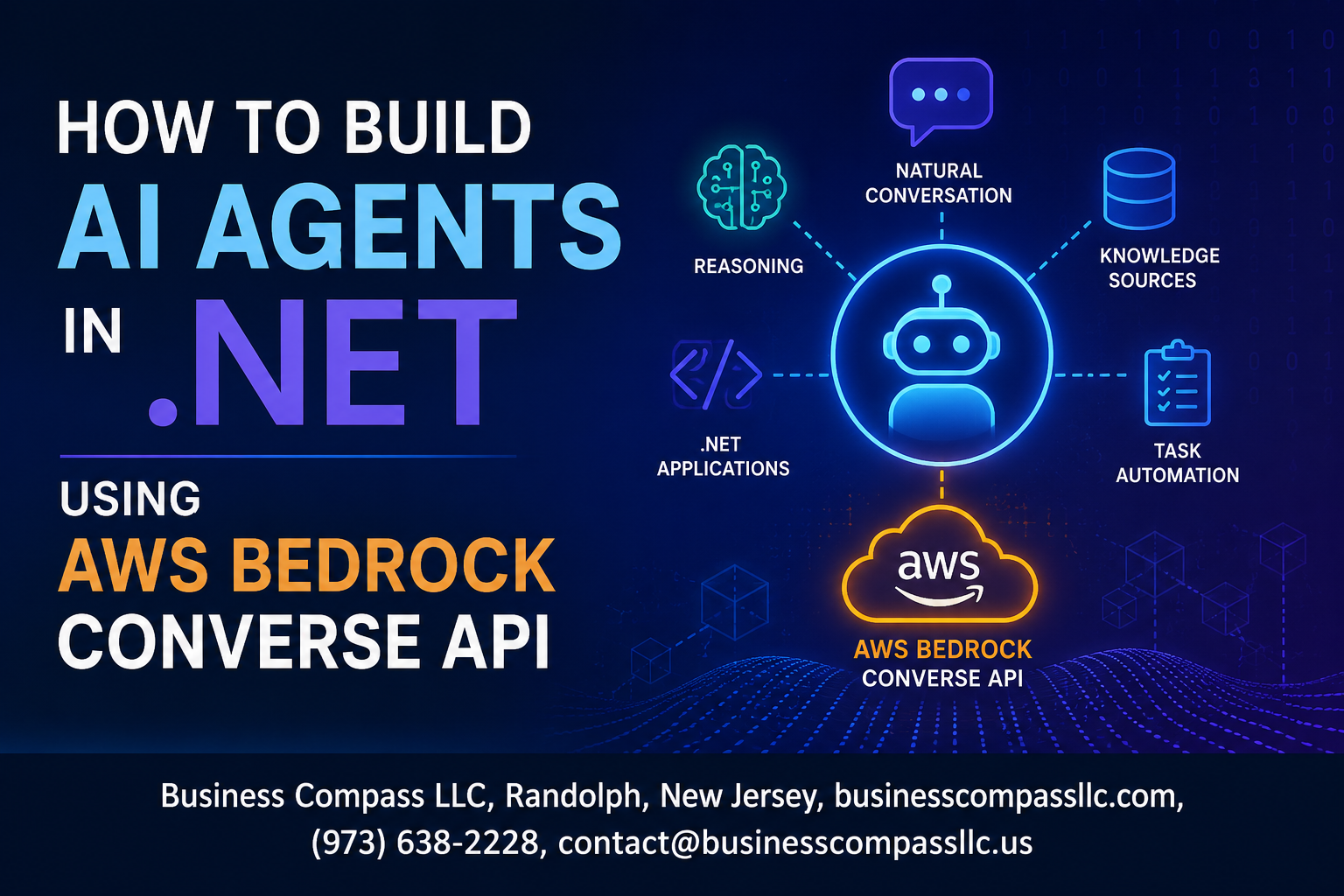
Building AI agents in .NET just got easier with AWS Bedrock Converse API. This comprehensive guide walks .NET developers through creating intelligent conversational AI applications that can understand context, maintain memory, and deliver human-like interactions.
This tutorial is designed for .NET developers who want to integrate AWS AI services into their applications, from beginners exploring AI chatbot development .NET possibilities to experienced developers looking to leverage AWS Bedrock’s powerful language models.
We’ll start by setting up your .NET development environment and connecting to AWS Bedrock’s API endpoints. You’ll learn the core concepts behind the Converse API and how it differs from other AWS AI services. Next, we’ll build your first functional AI agent with basic conversation capabilities, then enhance it with advanced features like conversation memory and context awareness. Finally, we’ll cover performance optimization techniques and cost management strategies to keep your AI applications running efficiently in production.
By the end of this guide, you’ll have hands-on experience with .NET machine learning development using AWS Bedrock and the skills to create sophisticated AI agents for your own projects.
Setting Up Your .NET Development Environment for AWS Bedrock

Installing and configuring AWS SDK for .NET
Getting your development environment ready for building AI agents with AWS Bedrock starts with installing the AWS SDK for .NET. Open your Package Manager Console in Visual Studio and run Install-Package AWSSDK.BedrockRuntime to add the core Bedrock functionality. You’ll also want to grab AWSSDK.Bedrock for model management capabilities. For those using .NET CLI, simply execute dotnet add package AWSSDK.BedrockRuntime in your project directory. The AWS SDK for .NET provides comprehensive support for Bedrock Converse API, making it straightforward to integrate conversational AI into your .NET applications.
Setting up AWS credentials and IAM permissions
Your .NET AI agents need proper AWS credentials to communicate with Bedrock services. Create an IAM user specifically for your development work and attach the AmazonBedrockFullAccess policy for complete access during development. Store your credentials securely using AWS CLI with aws configure command, or set them as environment variables AWS_ACCESS_KEY_ID and AWS_SECRET_ACCESS_KEY. For production deployments, consider using IAM roles instead of hardcoded credentials. The Bedrock service requires specific permissions like bedrock:InvokeModel and bedrock:Converse to function properly with your .NET machine learning development projects.
Creating your first .NET project structure
Start building your AI chatbot development .NET project with a clean, organized structure. Create a new console application using dotnet new console -n BedrockAIAgent and organize your code into logical folders. Set up a Models directory for your conversation data structures, a Services folder for your Bedrock API implementation classes, and a Configuration folder for AWS settings. This structure supports scalable conversational AI .NET development and makes it easier to manage your AWS AI services integration. Add a appsettings.json file to store your AWS region and model preferences for your Bedrock API implementation.
Understanding AWS Bedrock Converse API Fundamentals

Exploring Bedrock’s AI model capabilities and limitations
AWS Bedrock provides access to multiple foundation models from leading AI companies including Anthropic’s Claude, Meta’s Llama, and Amazon’s Titan. Each model offers different strengths – Claude excels at reasoning and analysis, while Titan models optimize for cost-effectiveness. The AWS Bedrock .NET SDK supports streaming and batch processing, with token limits ranging from 4K to 200K depending on your chosen model. When building AI agents .NET applications, consider that some models handle code generation better, while others shine at creative writing or multilingual tasks.
Learning the Converse API request and response structure
The Converse API implementation uses a standardized message format across all Bedrock models, making it easier to switch between different AI providers. Your .NET application sends requests containing system prompts, user messages, and optional inference parameters like temperature and max tokens. The API returns structured responses with message content, usage statistics, and stop reasons. AWS Bedrock tutorial examples show how streaming responses enable real-time chat experiences, while the response metadata helps track token consumption for cost management.
Identifying optimal use cases for AI agent implementation
Conversational AI .NET applications work best for customer support automation, content generation, and interactive assistants. The Converse API excels at maintaining conversation context, making it perfect for multi-turn dialogues where agents need to remember previous interactions. Avoid using Bedrock for real-time applications requiring sub-second responses or scenarios needing perfect accuracy like medical diagnoses. AI chatbot development .NET projects benefit most when combining Bedrock’s language understanding with your existing business logic and data sources.
Mastering authentication and security best practices
AWS AI services integration requires proper IAM roles with bedrock:InvokeModel permissions. Use AWS SDK credential chains in your .NET applications rather than hardcoding access keys. Enable CloudTrail logging to monitor API calls and implement request signing for additional security. The .NET machine learning development workflow should include input sanitization to prevent prompt injection attacks and output filtering to ensure appropriate responses. Consider using AWS KMS for encrypting sensitive conversation data and implement rate limiting to prevent abuse of your AWS Bedrock Converse API endpoints.
Creating Your First AI Agent with Basic Conversation Flow

Building the foundational agent class architecture
Start by creating a dedicated agent class that serves as the backbone for your conversational AI implementation. The BedrockAgent class should encapsulate the AWS Bedrock client, conversation state management, and core message processing capabilities. Design the architecture with dependency injection in mind, allowing easy configuration of different foundation models like Claude or Titan. Include properties for model configuration, conversation history storage, and system prompts. This foundational approach ensures your .NET AI agents remain scalable and maintainable as you add more sophisticated features. Implement interfaces that define contracts for message handling, making your agent testable and extensible for future enhancements.
Implementing message handling and response generation
Create robust message handling methods that process user inputs and generate appropriate responses using the AWS Bedrock Converse API. Build a message queue system that manages conversation flow, tracks context, and maintains dialogue coherence across multiple exchanges. Your implementation should handle both synchronous and asynchronous message processing, depending on your application’s requirements. Use the .NET machine learning development patterns to structure request/response cycles effectively. Include proper serialization for message payloads and implement streaming responses for real-time conversational experiences. Design your response generation logic to handle various content types, including text, structured data, and potential media attachments that the Bedrock API supports.
Adding error handling and retry logic
Implement comprehensive error handling strategies that gracefully manage API failures, timeout scenarios, and rate limiting constraints inherent in AWS AI services integration. Create exponential backoff mechanisms with jitter to handle transient failures when calling the Bedrock API implementation. Your retry logic should differentiate between recoverable errors (network timeouts, temporary service unavailability) and permanent failures (authentication issues, invalid model parameters). Include circuit breaker patterns to prevent cascading failures in your AI chatbot development .NET applications. Log detailed error information for debugging while maintaining user privacy. Design fallback mechanisms that provide meaningful responses even when the primary AI service is unavailable, ensuring your conversational AI .NET application remains responsive under adverse conditions.
Enhancing AI Agents with Advanced Features and Memory

Implementing conversation history and context management
Building robust conversation memory requires storing chat interactions in a persistent storage solution like Azure Cosmos DB or AWS DynamoDB. The AWS Bedrock .NET SDK provides conversation ID tracking that you can leverage to maintain context across multiple API calls. Create a conversation manager class that serializes chat history and retrieves relevant context before each Bedrock Converse API request. This approach ensures your .NET AI agents remember previous exchanges and provide contextually appropriate responses, making conversations feel natural and continuous.
Adding function calling capabilities for external integrations
Function calling transforms your AI agents from simple chatbots into powerful automation tools. The Bedrock API implementation supports tool definitions where you specify external functions your agent can invoke. Define function schemas in your .NET application that describe available operations like database queries, API calls, or file operations. When the AI determines it needs external data, it returns a function call request that your application intercepts and executes. Popular integrations include weather APIs, calendar systems, and customer databases, enabling comprehensive conversational AI .NET solutions.
Creating custom prompt templates for consistent responses
Template-driven prompts ensure your AI agents maintain consistent personality and response quality across all interactions. Design modular prompt templates that include system instructions, conversation context, and user input placeholders. Store these templates in configuration files or database records, allowing easy updates without code deployments. Your AWS Bedrock tutorial implementation should include template versioning and A/B testing capabilities. Well-crafted templates improve response relevance and reduce hallucinations while maintaining brand voice consistency in your AI chatbot development .NET projects.
Building multi-turn conversation support
Multi-turn conversations require careful state management and conversation flow orchestration in your .NET machine learning development pipeline. Implement conversation state machines that track dialog phases, user intents, and required information collection. The AWS AI services integration handles token management automatically, but you need to structure conversation turns to maintain coherence. Design conversation flows that gracefully handle interruptions, topic changes, and clarification requests. Use session management to group related conversation turns and implement timeout mechanisms to prevent stale conversations from consuming resources unnecessarily.
Optimizing Performance and Managing Costs Effectively

Implementing efficient token usage strategies
Smart token management makes the difference between affordable AI solutions and budget-busting projects. Start by implementing request batching to combine multiple queries into single API calls when possible. Use shorter prompts and clear instructions to reduce unnecessary token consumption. Set maximum token limits for responses based on your specific use case – a customer service bot rarely needs 1000-token responses. Monitor your token patterns and identify opportunities to trim verbose prompts without losing functionality.
Adding response caching mechanisms
Build a robust caching layer using Redis or in-memory storage to avoid duplicate AWS Bedrock API calls. Cache responses for common queries, user preferences, and frequently requested information. Implement cache expiration policies that balance fresh content with cost savings – static information can be cached for hours while dynamic data needs shorter lifespans. Create cache keys based on user context and query parameters to serve personalized responses quickly. This approach cuts API costs by 40-60% for typical conversational AI applications.
Monitoring API usage and setting cost controls
Deploy comprehensive monitoring using AWS CloudWatch and custom metrics to track token consumption, request frequency, and cost per conversation. Set up automated alerts when spending exceeds predefined thresholds. Implement rate limiting per user or session to prevent runaway costs from malicious usage or infinite loops. Use AWS Cost Explorer to analyze spending patterns and identify optimization opportunities. Build dashboards showing real-time costs, token usage trends, and performance metrics to make data-driven scaling decisions.
Scaling your AI agents for production workloads
Design your .NET AI agents with horizontal scaling in mind using containerization and load balancing. Implement async programming patterns throughout your application to handle concurrent conversations efficiently. Use AWS Application Load Balancer to distribute traffic across multiple instances of your AI service. Plan for peak loads by implementing auto-scaling groups that respond to CPU usage and request queue depth. Consider regional deployment strategies to reduce latency for global users while managing Bedrock API regional availability and pricing differences.

Building AI agents with .NET and AWS Bedrock Converse API opens up incredible possibilities for creating intelligent, conversational applications. We’ve walked through everything from setting up your development environment to implementing advanced features like memory and conversation flow. The combination of .NET’s robust framework and AWS Bedrock’s powerful AI capabilities gives you the tools to create agents that can handle complex interactions while maintaining context across conversations.
The key to success lies in starting simple and gradually adding complexity as your understanding grows. Focus on getting the basic conversation flow right before diving into advanced features, and always keep performance and cost optimization in mind from the beginning. With these fundamentals in place, you’ll be well-equipped to build AI agents that deliver real value to your users and scale effectively with your application’s needs.