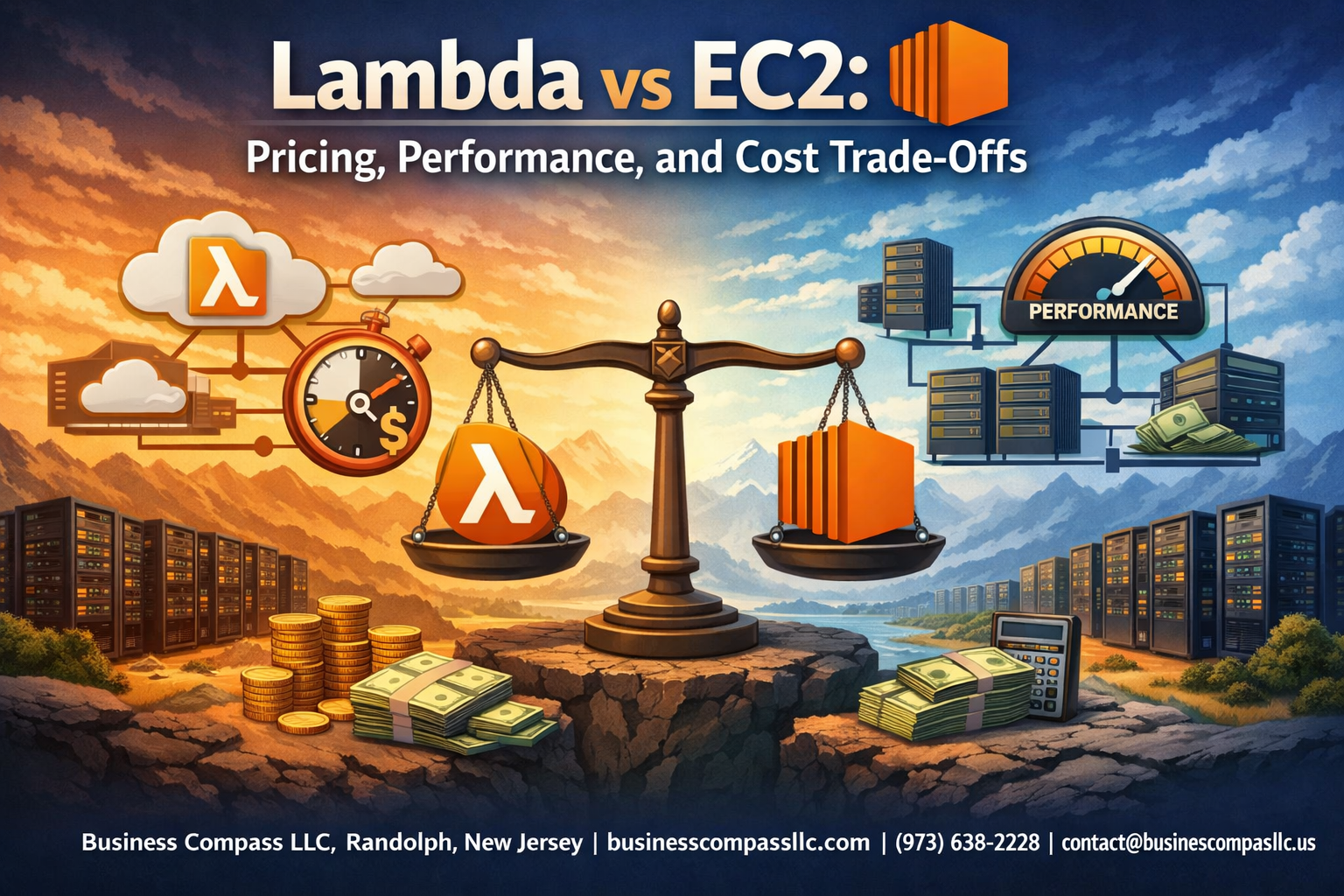
Choosing between AWS Lambda vs EC2 can make or break your cloud budget. This guide is for developers, DevOps engineers, and business decision-makers who need to understand the real costs and performance trade-offs between serverless computing and traditional virtual machines.
We’ll break down exactly how Lambda pricing comparison works against EC2’s more complex billing structure, so you can see where each service shines financially. You’ll also discover which workloads perform better on serverless vs virtual machines, with real-world scenarios that show when Lambda’s speed beats EC2’s raw power, and vice versa.
By the end, you’ll know exactly which AWS cost optimization strategy fits your specific needs, whether you’re running quick API calls or heavy computational tasks.
Understanding AWS Lambda and EC2 Fundamentals

How Lambda’s serverless architecture eliminates infrastructure management
AWS Lambda operates on a completely serverless model where you simply upload your code and Lambda handles everything else – server provisioning, scaling, patching, and maintenance. You never see or manage the underlying infrastructure, paying only for actual compute time in milliseconds. This serverless computing approach eliminates the overhead of capacity planning, operating system updates, and hardware management that traditionally consumes significant IT resources.
EC2’s virtual machine approach for complete control and customization
EC2 provides virtual machines with full administrative access, allowing you to install custom software, configure operating systems, and modify networking settings. This traditional virtual machine model gives you complete control over your computing environment, from the operating system level up to application deployment. You can choose from hundreds of instance types optimized for different workloads, customize security groups, and maintain persistent storage configurations across your infrastructure.
Key operational differences that impact your workload decisions
Lambda Characteristics:
- Automatic scaling from zero to thousands of concurrent executions
- Maximum 15-minute execution time limit
- Event-driven execution model
- No server management required
EC2 Characteristics:
- Manual or auto-scaling configuration required
- Persistent compute instances running 24/7
- Full control over runtime environment
- Requires ongoing maintenance and monitoring
The choice between AWS Lambda vs EC2 fundamentally depends on whether you need infrastructure control or prefer managed simplicity. Lambda excels for sporadic, event-driven workloads, while EC2 suits applications requiring persistent connections, custom configurations, or long-running processes.
Lambda Pricing Model Breakdown

Pay-per-request billing structure and execution duration costs
AWS Lambda charges you based on two main factors: the number of requests and execution duration. You pay $0.20 per million requests, plus compute time measured in GB-seconds. The pricing scales linearly with memory allocation – choosing 512MB costs twice as much as 256MB for the same execution time.
Memory allocation pricing tiers and their performance implications
Lambda memory options range from 128MB to 10GB, directly affecting CPU allocation and pricing. Higher memory tiers provide proportionally more CPU power, often reducing execution time and total costs. A function with 1GB memory might complete tasks 3x faster than 256MB, making the higher tier more cost-effective despite the per-second premium.
Free tier benefits and cost advantages for low-traffic applications
The AWS Lambda free tier includes 1 million requests monthly and 400,000 GB-seconds of compute time. This generous allowance makes serverless computing practically free for small applications, side projects, and development environments. Many startups operate entirely within these limits during early stages.
Hidden costs including data transfer and API Gateway fees
Beyond Lambda pricing, consider additional AWS services that often accompany serverless architectures. API Gateway charges $3.50 per million requests, VPC networking adds data processing fees, and CloudWatch logging incurs storage costs. These supplementary charges can double your total serverless computing cost, making accurate cost estimation crucial for budget planning.
EC2 Pricing Structure Analysis

On-demand instance pricing flexibility for variable workloads
On-demand instances give you complete control over your EC2 cost analysis without upfront commitments. You pay by the hour or second for compute capacity, making this pricing model perfect for unpredictable workloads or development environments. The flexibility comes at a premium – these instances cost the most but provide instant access to resources whenever needed.
Reserved instances for predictable long-term cost savings
Reserved instances offer substantial discounts up to 75% compared to on-demand pricing when you commit to one or three-year terms. This EC2 pricing model works best for steady-state applications with predictable usage patterns. You can choose between Standard, Convertible, or Scheduled Reserved Instances based on your flexibility needs.
Spot instances for maximum cost efficiency with flexible timing
Spot instances deliver the deepest AWS cost optimization savings, often 90% less than on-demand rates, by using Amazon’s spare compute capacity. Your instances may be interrupted with two-minute notice when capacity is needed elsewhere. This makes spot pricing ideal for fault-tolerant applications, batch processing, or background tasks that can handle interruptions gracefully.
Additional costs for storage, data transfer, and load balancing
Beyond compute costs, EC2 instances incur charges for:
- EBS storage volumes – Based on provisioned storage size and type
- Data transfer – Outbound internet traffic and cross-region transfers
- Elastic Load Balancers – Hourly charges plus data processing fees
- Elastic IP addresses – When not associated with running instances
- CloudWatch monitoring – Detailed metrics and custom dashboards
Performance Comparison Across Different Workloads

Lambda’s Cold Start Latency Versus EC2’s Consistent Response Times
AWS Lambda experiences cold start delays when functions haven’t been invoked recently, typically adding 100-1000ms latency depending on runtime and package size. EC2 instances maintain consistent response times since they run continuously, making them ideal for latency-sensitive applications requiring predictable performance.
Scaling Capabilities and Automatic Resource Allocation Differences
Lambda automatically scales from zero to thousands of concurrent executions within seconds, handling traffic spikes without configuration. EC2 requires manual scaling or Auto Scaling Groups with predefined rules, offering more control but slower response to sudden demand changes.
CPU and Memory Performance Limitations in Each Service
- Lambda constraints:
- Maximum 15-minute execution time
- Up to 10GB memory allocation
- CPU power scales proportionally with memory
- EC2 advantages:
- Unlimited execution duration
- Customizable CPU and memory configurations
- Access to specialized instance types (GPU, high-memory)
- Persistent storage and dedicated resources
Cost-Effective Use Cases for Lambda

Event-driven applications with sporadic traffic patterns
AWS Lambda vs EC2 pricing becomes a clear winner for applications that experience unpredictable traffic spikes. Web APIs handling occasional requests, IoT data processing from sensors, and image processing triggered by uploads benefit significantly from Lambda’s pay-per-execution model. You only pay when code runs, making it perfect for applications sitting idle most of the time.
Microservices architectures requiring minimal maintenance overhead
Serverless computing cost advantages shine in microservices where each function handles a specific task. Authentication services, payment processing, and data validation functions work exceptionally well with Lambda. The automatic scaling and zero server management reduce operational overhead while maintaining high availability across distributed systems.
Short-duration tasks and batch processing jobs
Lambda use cases excel with tasks completing under 15 minutes, such as file format conversions, data transformations, and scheduled maintenance scripts. ETL operations processing small to medium datasets, report generation triggered by events, and automated backup procedures demonstrate how AWS cost optimization strategies favor Lambda over maintaining dedicated EC2 instances for intermittent workloads.
Optimal EC2 Scenarios for Maximum Value

Always-on applications requiring consistent performance
Traditional web applications and production workloads demand reliable uptime and predictable response times that make EC2 the clear winner over AWS Lambda. Database servers, web hosting platforms, and enterprise applications benefit from EC2’s dedicated resources, avoiding Lambda’s cold start latency issues. When your application serves thousands of users simultaneously, EC2 instances provide the consistent performance baseline that serverless computing simply can’t match.
Resource-intensive workloads needing specific hardware configurations
High-performance computing tasks like machine learning training, video rendering, and data analytics require specialized hardware that EC2 delivers through GPU instances, high-memory configurations, and custom storage options. These workloads often exceed Lambda’s 15-minute execution limit and 10GB memory ceiling, making EC2 cost optimization strategies essential. Scientific computing and batch processing jobs particularly shine on EC2 when you need full control over the underlying infrastructure.
Applications requiring custom operating systems or specialized software
Legacy applications running on Windows, custom Linux distributions, or proprietary software need the flexibility that only virtual machines provide. EC2 allows complete operating system control, enabling installation of specific drivers, security tools, or compliance software that Lambda’s managed environment cannot support. Financial institutions and healthcare organizations frequently choose EC2 for applications requiring specialized security configurations or regulatory compliance tools.
Long-running processes with predictable resource requirements
Background services, data pipelines, and monitoring systems that run continuously for hours or days find better value in EC2’s pricing model compared to Lambda’s per-invocation costs. Reserved instances and spot pricing make EC2 particularly attractive for predictable workloads where you can forecast resource usage patterns. These scenarios showcase clear AWS workload optimization benefits when choosing the right compute service for sustained operations.
Making the Right Choice for Your Business

Calculating total cost of ownership beyond basic service fees
AWS Lambda vs EC2 decisions require looking past headline pricing to understand true operational costs. Lambda eliminates infrastructure management, patching, and monitoring overhead, while EC2 demands dedicated DevOps resources for maintenance, security updates, and capacity planning. Factor in hidden expenses like data transfer costs, storage fees, and the time your team spends on server administration when comparing serverless vs virtual machines.
Evaluating development team expertise and operational preferences
Your team’s technical background plays a major role in AWS cost optimization strategies. Organizations with strong infrastructure expertise often prefer EC2’s control and customization options, while teams focused on rapid development benefit from Lambda’s simplified deployment model. Consider whether your developers want to manage operating systems and scaling policies, or if they’d rather concentrate on application logic and business features.
Planning for future scalability and changing business requirements
Business growth patterns should guide your AWS workload optimization strategy. Lambda excels for unpredictable traffic spikes and seasonal variations, automatically scaling without capacity planning headaches. EC2 becomes more cost-effective for steady, predictable workloads where you can leverage reserved instances and spot pricing. Plan for changing requirements by starting with Lambda for new projects, then migrating stable, high-volume components to EC2 when usage patterns become clear.

Both Lambda and EC2 offer distinct advantages depending on your specific needs and workload patterns. Lambda shines for event-driven applications, sporadic workloads, and scenarios where you want to pay only for actual compute time without managing infrastructure. Its serverless model makes it perfect for startups and small applications that need quick deployment and automatic scaling. On the other hand, EC2 provides better value for consistent, long-running workloads where you can predict usage patterns and benefit from reserved instances or sustained workloads that justify the overhead costs.
The key to making the right choice lies in honestly evaluating your application’s behavior, traffic patterns, and your team’s operational capabilities. If you’re running background jobs that execute sporadically or building APIs with unpredictable traffic, Lambda’s pay-per-execution model will likely save you money. But if you’re hosting databases, running continuous services, or need specific hardware configurations, EC2’s flexibility and cost predictability make more sense. Start by analyzing your current usage patterns, calculate costs for both options, and remember that you can always use both services together for different parts of your architecture.