Securing AWS from the Network Up: VPC to Zero Trust Architecture
If you’re running workloads on AWS, network security isn’t something you can bolt on later. It needs to be built in from the start — layer by layer, from your VPC configuration all the way up to a full Zero Trust Architecture on AWS.
This guide is for cloud engineers, DevOps teams, and security-minded developers who want a practical roadmap for locking down their AWS infrastructure — not a checklist of vague best practices.
Here’s what we’ll walk through:
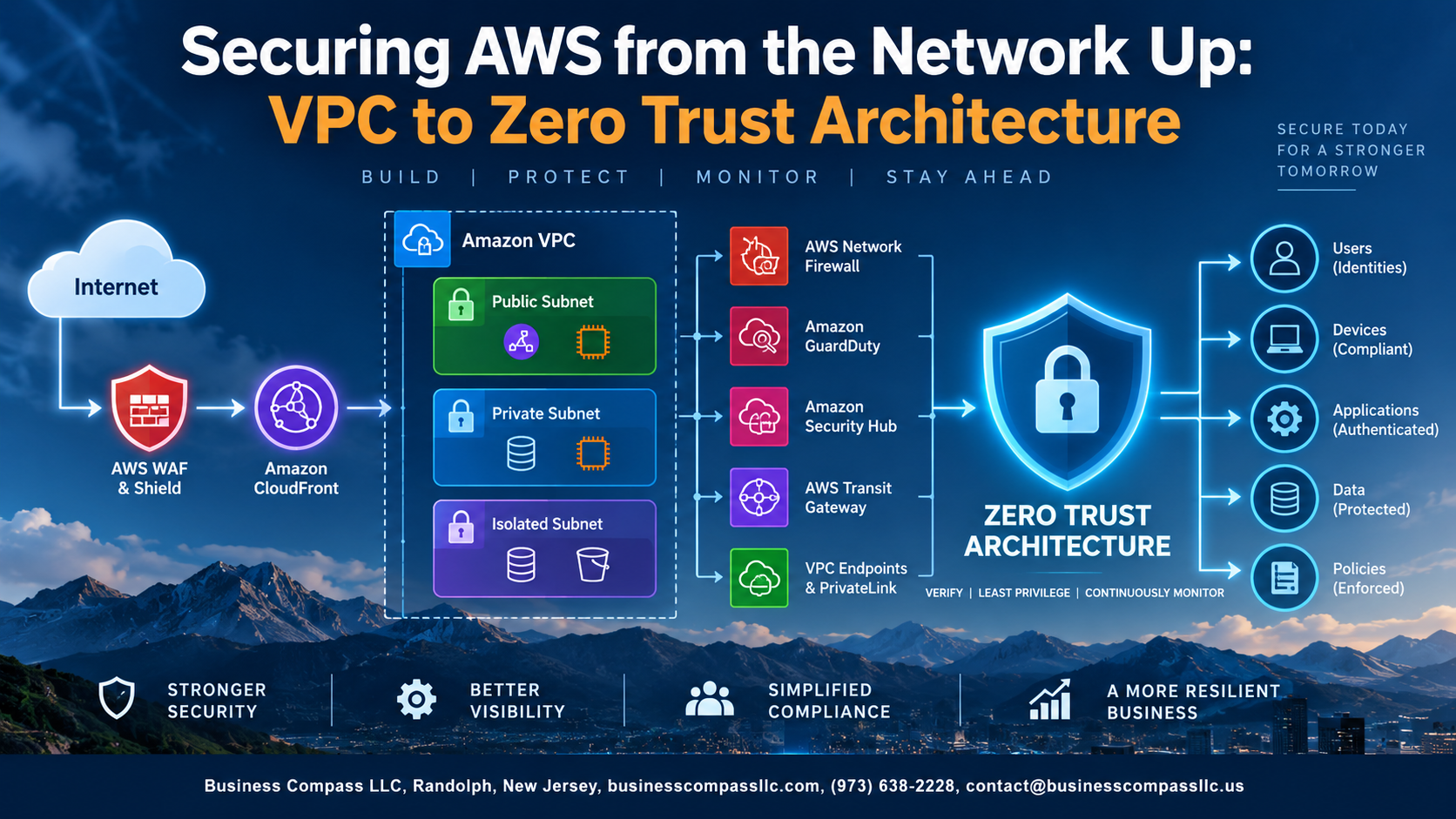
- How to build a solid foundation using AWS VPC security best practices, including subnet design, security groups, and network ACLs
- How to protect data and control access, covering AWS data encryption in transit and at rest, plus AWS IAM least privilege to make sure the right people have access to only what they actually need
- How to shift toward Zero Trust cloud security, including AWS threat detection and monitoring tools that help you catch problems before they become breaches
By the end, you’ll have a clear picture of how each layer connects — and what it takes to move from basic AWS perimeter security to a mature, Zero Trust-ready environment.
Let’s get into it.
Building a Secure Foundation with AWS VPC

Design Subnets Strategically to Isolate Workloads
Place databases in private subnets, apps in isolated tiers.
Control Traffic Flow Using Route Tables and Gateways
Route public traffic through Internet Gateways; keep internal workloads behind NAT.
Protect Resources with Network Access Control Lists
Deny unexpected ports at the subnet boundary.
Limit Exposure by Hardening Security Group Rules
Allow only specific IPs and ports per resource.
Strengthening Perimeter Security Across AWS Networks

Block Malicious Traffic with AWS WAF and Shield
Deploy AWS WAF rules to filter SQL injection and XSS attacks, while Shield Advanced guards against DDoS threats.
Inspect and Filter Packets Using AWS Network Firewall
Stateful packet inspection blocks unauthorized traffic before it reaches your workloads.
Reduce Attack Surface by Restricting Public-Facing Services
Keep services private whenever possible.
Securing Data in Transit and at Rest Within AWS

Enforce Encryption with TLS, Manage Keys, Use Private Endpoints, and Audit Access
Protecting AWS data encryption in transit means enforcing TLS everywhere, rotating keys through AWS KMS, and routing sensitive transfers via private endpoints to eliminate public exposure. Continuously audit data access patterns using CloudTrail and Macie — catching anomalies early stops breaches before they escalate across your AWS network security perimeter.
Achieving Least Privilege Access with IAM and Beyond

Define Granular Permissions Using IAM Policies and Roles
Attach permissions only to roles, never users. Use condition keys to restrict access by IP or time.
Eliminate Standing Privileges with Just-in-Time Access
AWS IAM Identity Center grants temporary credentials on demand, cutting exposure windows dramatically.
Enforce Strong Authentication with MFA and SSO
Require MFA across all accounts.
Transitioning to a Zero Trust Architecture on AWS
Verify Every Identity and Device Before Granting Access
Never trust, always verify — authenticate users, devices, and services every time using AWS IAM Identity Center and multi-factor authentication.
Segment Workloads to Contain Potential Breaches
- Use micro-segmentation via Security Groups
Implement Continuous Authorization Using Dynamic Policies
AWS SCP and attribute-based access control enforce real-time, context-aware permissions.
Monitor All Traffic and Behavior with Real-Time Visibility
GuardDuty and CloudTrail keep watch continuously.
Monitoring, Detecting, and Responding to Threats Proactively

Centralize Logging and Insights with AWS CloudTrail and GuardDuty
Enable CloudTrail across all regions and pipe logs into GuardDuty for real-time threat detection.
Automate Threat Detection Using AWS Security Hub
Security Hub aggregates findings centrally, cutting noise dramatically.
Accelerate Incident Response with Automated Remediation Workflows
- Trigger Lambda functions on findings
- Auto-isolate compromised instances instantly

Locking down your AWS environment is not a one-time checkbox exercise — it’s an ongoing practice that layers network controls, encryption, access management, and real-time threat detection to keep your infrastructure genuinely protected. From building a solid VPC foundation and tightening perimeter defenses, to encrypting your data and applying least privilege access, each step builds on the last to reduce risk at every level.
Moving toward Zero Trust takes that commitment even further by treating every request as potentially untrusted until verified — and pairing that mindset with proactive monitoring means you’re not just preventing breaches, you’re catching and responding to threats before they spiral. Start where you are, tighten what you can, and keep moving forward. Your cloud security posture will be stronger for it.