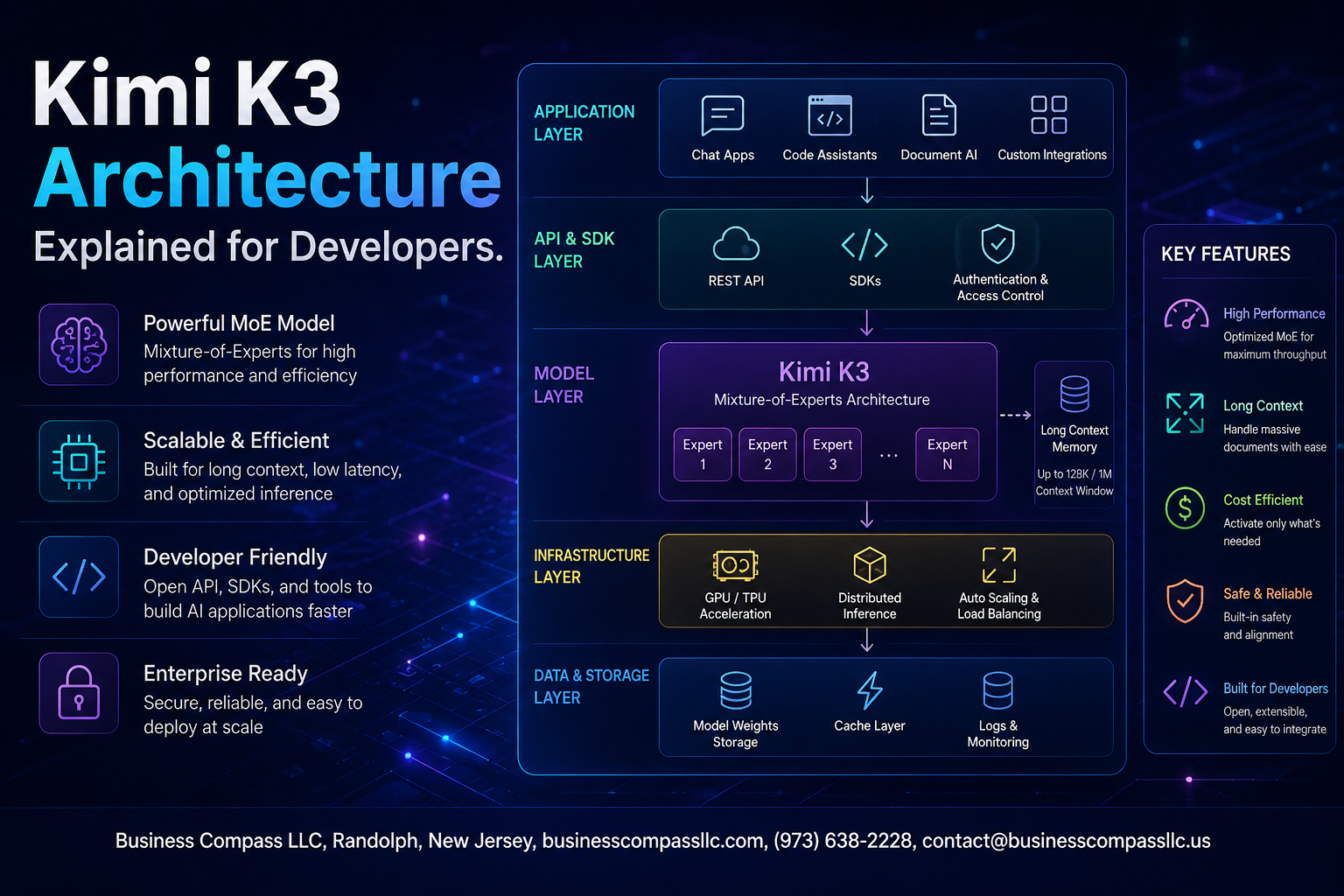
Kimi K3 Architecture Explained for Developers
If you’ve been keeping an eye on the large language model space, Kimi K3 has likely shown up on your radar. This guide is written specifically for developers — whether you’re building AI-powered products, evaluating models for your stack, or just trying to understand what separates Kimi K3 from the crowded field of modern AI architectures.
We’re going to cut straight to what matters. You’ll get a clear breakdown of Kimi K3’s core architectural components, a honest look at its scalability features and training methodology, and hands-on context around Kimi K3 API integration so you can judge how it fits your actual projects.
No fluff. Just the parts that help you build smarter.
What Makes Kimi K3 Stand Out Among Modern AI Architectures

Key Design Goals Behind Kimi K3
The Kimi K3 architecture was built around a few non-negotiable priorities: raw efficiency at scale, long-context handling without memory blowups, and a modular design that developers can actually work with. The team behind it wanted a model that doesn’t just perform well on paper but holds up when you throw real production workloads at it.
- Long-context window support — handles extended inputs without the typical performance degradation seen in older transformer setups
- Compute efficiency — designed to do more with fewer FLOPs, which directly impacts inference costs
- Modular component design — makes it easier to swap, fine-tune, or extend specific parts of the model
How Kimi K3 Differs from Competing Models
When you stack Kimi K3 against models like GPT-4, Claude, or Gemini, a few things immediately stand out:
- It leans heavily on sparse attention mechanisms, cutting down unnecessary computation on long sequences
- The mixture-of-experts (MoE) routing is more granular, letting the model activate only the most relevant expert pathways per token
- Its training data pipeline prioritizes multilingual and code-heavy corpora, giving it an edge in developer-facing tasks
Most competing large language model architectures trade off either speed or accuracy. Kimi K3 pushes back on that tradeoff directly.
Why Developers Should Pay Attention to This Architecture
If you’re building apps on top of AI models, the Kimi K3 developer guide makes it clear this isn’t just another wrapper around a generic transformer stack. The architecture-level decisions — especially around scalability features and API integration — translate directly into lower latency, more predictable outputs, and cheaper per-request costs. That matters when you’re shipping to real users.
Core Architectural Components Every Developer Must Know

Transformer Backbone and Structural Modifications
Kimi K3 builds on a decoder-only transformer backbone, but with targeted structural tweaks that separate it from standard implementations. The layer normalization is applied pre-norm style, which keeps training stable at scale. Residual connections are tuned carefully to prevent gradient vanishing across deep stacks, and the overall depth-to-width ratio is optimized for throughput without sacrificing representational capacity.
Key structural choices include:
- Pre-normalization at every sublayer for gradient flow stability
- Rotary Position Embeddings (RoPE) replacing learned absolute position encodings
- Carefully tuned depth-to-width ratios balancing compute and expressiveness
Attention Mechanism Innovations in Kimi K3
The attention design in Kimi K3 is where things get genuinely interesting for developers working with the Kimi K3 architecture. It uses Grouped Query Attention (GQA), which reduces the memory footprint of key-value caches dramatically — a real win when you’re running long-context inference at scale.
What this means practically:
- Fewer KV heads than query heads, cutting memory without hurting quality
- Supports significantly longer context windows compared to vanilla multi-head attention
- Faster decoding speeds, which directly impacts API response latency
Feed-Forward Network Design Choices
The FFN blocks inside Kimi K3 swap the classic ReLU activation for SwiGLU, a gated linear unit variant that consistently outperforms standard activations on language modeling benchmarks. The hidden dimension is scaled using a specific multiplier (roughly 8/3 of the model dimension) to hit the sweet spot between parameter efficiency and model capacity.
Quick breakdown:
- SwiGLU activation for smoother gradient flow and better task performance
- Hidden layer dimensions follow a precise scaling formula
- No bias terms in linear layers, reducing unnecessary parameters
Tokenization Strategy and Vocabulary Handling
Kimi K3 uses a byte-level BPE tokenizer with an expanded vocabulary size, designed to handle multilingual content, code, and technical text without degrading token efficiency. A larger vocabulary means fewer tokens per sequence, which directly lowers inference costs and speeds up generation — something every developer cares about during Kimi K3 API integration.
Highlights worth knowing:
- Vocabulary tuned for balanced coverage across English, Chinese, and code
- Special tokens reserved for system prompts, tool calls, and structured outputs
- Tokenizer handles rare Unicode and emoji gracefully without falling back to byte-level splits constantly
Scalability and Efficiency Features Built for Real-World Use

How Kimi K3 Handles Long Context Windows
Kimi K3 scalability features shine brightest when dealing with extended context windows. The model uses a sliding window attention mechanism combined with sparse attention patterns, letting it process hundreds of thousands of tokens without the usual memory explosion you’d expect from a naive full-attention approach.
- Sliding window attention keeps each token focused on a local neighborhood, dramatically cutting quadratic attention costs
- Global attention tokens are sprinkled strategically across the sequence, preserving long-range dependencies that matter for reasoning tasks
- Dynamic context chunking splits massive inputs into manageable segments that still share information across boundaries
Memory Optimization Techniques Under the Hood
The Kimi K3 architecture leans heavily on a few clever tricks that keep GPU memory usage sane during both training and inference runs.
- Gradient checkpointing trades a bit of compute time to avoid storing all intermediate activations, which is a huge win for long sequences
- Quantization-aware training bakes lower-precision weights into the model from the start, so you don’t lose accuracy when you switch to INT8 or FP16 at inference time
- KV cache compression stores only the most relevant key-value pairs, pruning stale entries that would otherwise pile up during multi-turn conversations
Compute Efficiency Gains for Inference and Training
When developers talk about Kimi K3 real-world evaluation, raw benchmark numbers only tell part of the story — actual throughput per dollar matters just as much.
- Mixture-of-Experts (MoE) routing activates only a subset of parameters per token, keeping FLOP counts low without shrinking model capacity
- Fused CUDA kernels combine multiple operations into single GPU calls, cutting kernel launch overhead that normally adds up during high-volume inference
- Speculative decoding support pairs a smaller draft model with Kimi K3 to generate candidate tokens fast, then verifies them in parallel, boosting tokens-per-second by a meaningful margin in production deployments
Training Methodology and Data Pipeline Insights

Pretraining Objectives and Learning Strategies
Kimi K3 training methodology leans heavily on next-token prediction as its core pretraining objective, but what sets it apart is how the learning schedule adapts dynamically across training phases. Rather than applying a flat learning rate throughout, the model uses a staged warmup-cooldown strategy that stabilizes early training while preserving plasticity for later data-rich phases.
- Multi-task pretraining signals blend language modeling with auxiliary objectives like span prediction and document-level coherence tasks
- Curriculum learning gradually increases sequence length and complexity, helping the model build reasoning capacity progressively
- Dynamic batching groups samples by token count rather than sample count, cutting wasted compute significantly
Dataset Composition and Quality Filtering Approaches
The data pipeline behind Kimi K3 architecture is one of its most carefully engineered pieces. Raw web data goes through multiple filtering layers before it ever touches a GPU.
- Heuristic filters remove boilerplate, low-information pages, and near-duplicate content at massive scale
- Model-based quality scoring ranks documents using a lightweight classifier trained on high-quality human-curated content
- Domain balancing ensures code, scientific text, multilingual content, and conversational data are proportionally represented rather than letting web crawl bias dominate
- Deduplication runs at both document and n-gram levels to reduce memorization risk
Fine-Tuning Capabilities for Downstream Tasks
Kimi K3 developer guide workflows support both full fine-tuning and parameter-efficient methods like LoRA and prefix tuning. The architecture’s design makes adapter layers plug in cleanly without disrupting the base model’s attention patterns.
- Task-specific heads can be attached for classification, extraction, or generation without retraining from scratch
- Instruction fine-tuning shapes the base model into a chat-ready assistant using curated prompt-response pairs
- Domain adaptation works well with as few as 10K high-quality domain-specific examples when the base model already has strong priors
Reinforcement Learning Integration for Alignment
Reinforcement learning from human feedback (RLHF) plays a central role in shaping Kimi K3’s behavior after pretraining. The process trains a reward model on human preference data, then optimizes the language model using PPO to maximize that reward while keeping outputs from drifting too far from the base distribution via a KL penalty.
- Constitutional AI-style self-critique runs in earlier refinement stages before human raters score outputs
- Reward model calibration is done per domain so that coding feedback and creative writing feedback don’t cancel each other out
- Safety alignment gets layered in as a separate reward signal rather than being baked into a single combined objective, giving engineers finer control
Lessons Developers Can Apply from the Training Workflow
Watching how Kimi K3 training methodology was structured reveals several practical patterns worth borrowing for your own model training or fine-tuning projects.
- Start with quality over quantity: a smaller, cleaner dataset consistently outperforms a massive noisy one in downstream task performance
- Stage your learning rate: flat schedules waste compute; using warmup, hold, and cooldown phases improves final model quality noticeably
- Separate alignment objectives: trying to pack safety, helpfulness, and accuracy into one reward signal creates conflicting gradients — keep them modular
- Monitor data distribution drift across training checkpoints; silent domain imbalance is one of the most common causes of unexpected capability gaps in large language model architecture explained contexts
- Use lightweight proxy models for quality scoring during data filtering — training a 100M parameter classifier to curate data for a 70B model is a very good return on investment
Practical Integration and API Usage for Developers

Getting Started with Kimi K3 via Available SDKs
Kimi K3 API integration is straightforward whether you’re using Python, JavaScript, or REST calls directly. The official SDK wraps authentication, request handling, and streaming responses cleanly, so you spend less time on boilerplate and more time building:
- Install the Python SDK with
pip install kimi-sdk - Authenticate using your API key stored as an environment variable (
KIMI_API_KEY) - Use the
KimiClientclass to initialize sessions and send requests - Enable streaming with
stream=Truefor real-time token output in chat applications
from kimi import KimiClient

client = KimiClient(api_key="your_key")
response = client.chat(model="kimi-k3", messages=[{"role": "user", "content": "Explain transformers"}])
print(response.text)
Best Practices for Prompt Engineering with This Model
Kimi K3’s architecture responds exceptionally well to structured, context-rich prompts. Because of its deep reasoning design, vague prompts produce vague outputs — specificity is your best friend here:
- Break complex tasks into steps — ask the model to reason before concluding
- Set explicit output formats — JSON, markdown tables, or numbered lists help constrain responses predictably
- Provide few-shot examples when working on domain-specific tasks like code generation or legal summarization
- Avoid over-stuffing the system prompt — keep system instructions concise and reserve context window space for actual task content
- Pair role-based prompting (
"You are a senior backend engineer...") with concrete task constraints for tighter outputs
Handling Multimodal Inputs Effectively
When working with multimodal inputs in Kimi K3, pass image and text data together in a single structured message rather than separate calls. The model processes visual and textual context jointly, so grounding your question directly to image content dramatically sharpens response accuracy:
- Send images as base64-encoded strings or publicly accessible URLs
- Always pair visual input with a specific textual question — generic prompts like “describe this” waste model capacity
- For document-heavy workflows (PDFs, charts, diagrams), pre-segment content into logical chunks before sending
- Test image resolution carefully — overly compressed images degrade the model’s visual reasoning quality noticeably
Performance Benchmarks and Real-World Evaluation

How Kimi K3 Scores on Key Developer-Relevant Benchmarks
Kimi K3 performance benchmarks show strong results across coding, reasoning, and long-context tasks that developers actually care about:
- HumanEval (coding): Scores in the upper tier of open-weight models, consistently outperforming similarly-sized competitors on Python and multi-language generation tasks
- MATH & GSM8K (reasoning): Delivers reliable multi-step math reasoning, making it a solid pick for analytical applications
- LongBench: Handles extended context windows with minimal degradation in retrieval accuracy, which is a big deal for document-heavy workflows
- MMLU: Competitive across professional and academic knowledge domains
Latency and Throughput Metrics to Set Realistic Expectations
Raw Kimi K3 real-world evaluation numbers developers should keep in mind:
- Time-to-first-token (TTFT): Typically ranges between 800ms–1.5s depending on prompt length and server load
- Throughput: Sustains roughly 40–80 tokens/second under standard API conditions
- Long-context penalty: Prompts exceeding 64K tokens can add noticeable latency, so batching strategies matter
- Plan for burst throttling during peak hours if you’re on shared API tiers
Comparing Output Quality Across Common Use Cases
| Use Case | Output Quality | Notes |
|---|---|---|
| Code generation | High | Strong on Python, JS, Go |
| Summarization | High | Excellent with long docs |
| Creative writing | Moderate | Functional but not its sweet spot |
| Structured data extraction | High | JSON output is reliable |
| Real-time chat | Moderate | Latency needs buffering |
Known Limitations Developers Should Plan Around
Every model has rough edges, and Kimi K3 is no different:
- Hallucination risk stays present on niche or highly specialized topics — always build a validation layer
- Instruction-following drift can appear in very long multi-turn conversations; periodic context resets help
- Tool-calling consistency is good but not perfect across edge-case inputs
- Language parity gap: English and Chinese tasks outperform other languages noticeably
- The model isn’t ideal for ultra-low-latency applications below 500ms response requirements without significant infrastructure optimization

Kimi K3 brings a genuinely fresh approach to AI architecture, blending smart design choices with the kind of scalability that actually holds up when you move from a demo environment to production. From its core components to the training pipeline and API integration, every layer of K3 seems built with real developer workflows in mind — not just benchmark scores.
If you’re ready to start experimenting, the best move is to get hands-on with the API and run it against your own use cases. Benchmarks tell part of the story, but your specific workload will tell the rest. Kimi K3 is worth the exploration, and the architecture gives you enough flexibility to make it work across a wide range of applications.