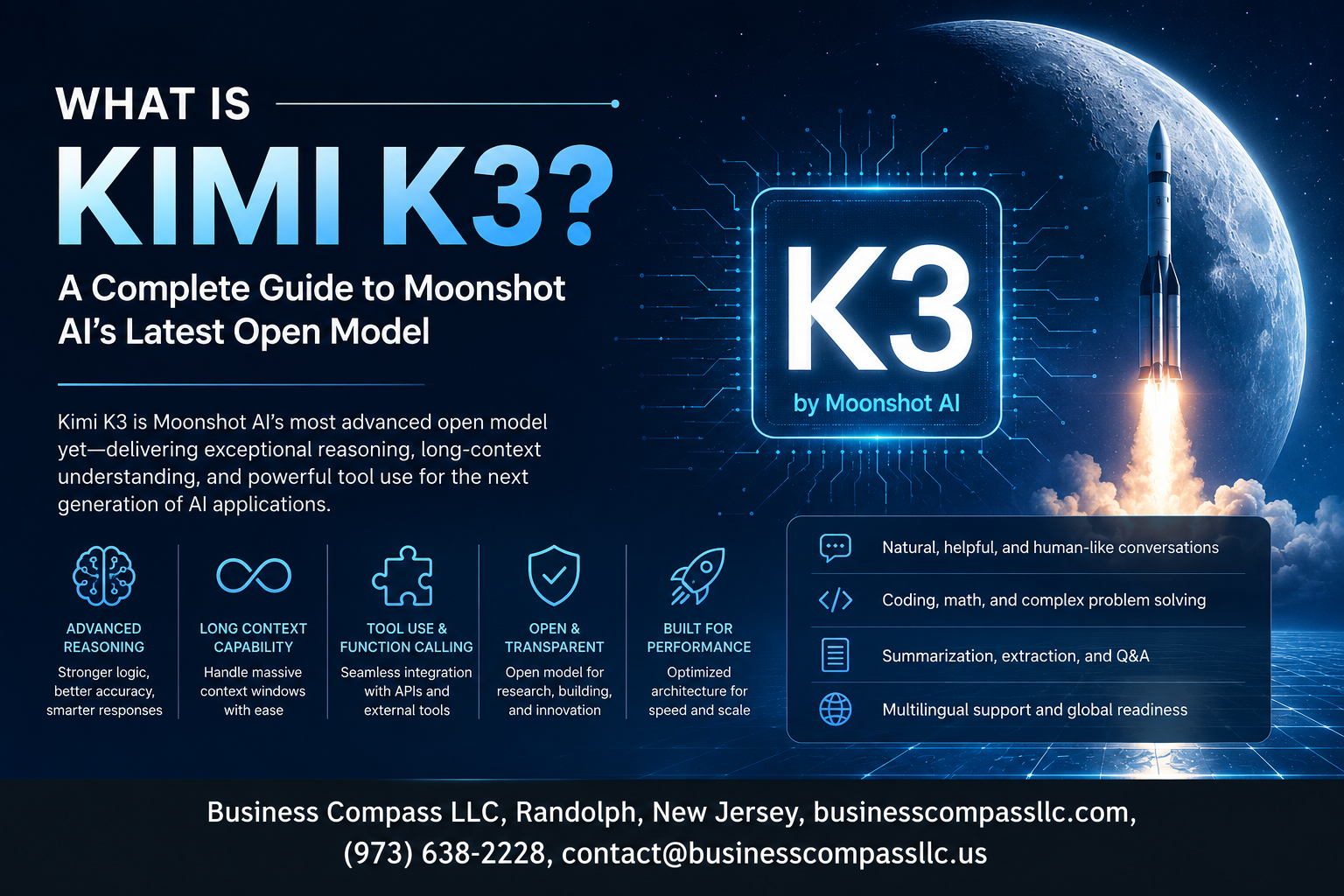
What Is Kimi K3? A Complete Guide to Moonshot AI’s Latest Open Model
Kimi K3 just dropped, and if you’ve been keeping an eye on the open source AI model space in 2025, this one is worth your attention. Moonshot AI’s latest model is making some serious noise — not just because it’s free to access, but because of what it can actually do.
This guide is for developers, AI enthusiasts, and anyone tired of paying premium prices for capable AI tools who wants to know if Kimi K3 lives up to the hype.
Here’s what we’re covering:
- What Kimi K3 actually is — where it came from and what Moonshot AI was going for when they built it
- How Kimi K3 stacks up against models like GPT-4 — real performance comparisons, not just marketing claims
- Where Kimi K3 genuinely shines — the specific use cases where its capabilities give you the most value
By the end, you’ll have a clear, honest picture of whether this Moonshot AI open model belongs in your workflow or not. No fluff, no hype — just the stuff you actually need to know.
Understanding Kimi K3 and Its Origins
Who Is Moonshot AI and Why It Matters
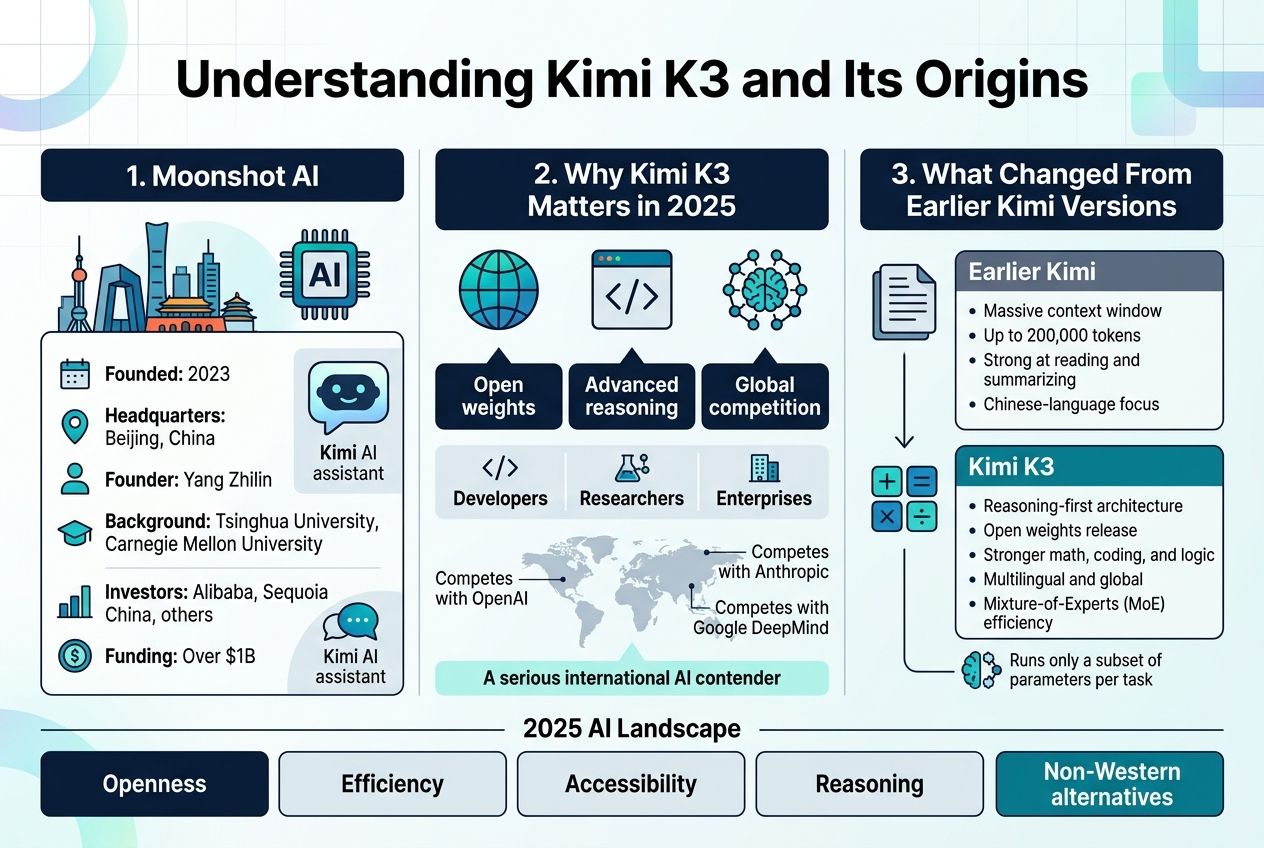
Moonshot AI is a Beijing-based artificial intelligence company founded in 2023 by Yang Zhilin, a researcher who previously worked at Tsinghua University and Carnegie Mellon University. The company raised serious attention almost immediately after its founding, pulling in hundreds of millions of dollars in funding from investors including Alibaba and Sequoia China. That kind of early backing told the AI world something important — this wasn’t just another startup riding the hype wave.
The company’s flagship product, the Kimi chatbot, became one of the most widely used AI assistants in China, known particularly for its ability to handle extremely long documents and context windows. While many Western AI labs were still working on extending context to 32K or 64K tokens, Moonshot AI was pushing Kimi to handle millions of tokens — a genuinely impressive technical leap that set it apart from the crowd.
What makes Moonshot AI matter on a global scale is its growing ambition to compete beyond Chinese markets. With Kimi K3, the company is making a clear move toward international relevance, positioning itself as a serious player among the world’s top AI labs. They’re not just building tools for domestic use anymore — they’re building models designed to go toe-to-toe with OpenAI, Anthropic, and Google DeepMind.
Key facts about Moonshot AI:
- Founded: 2023
- Headquarters: Beijing, China
- Founder: Yang Zhilin (former Tsinghua and CMU researcher)
- Notable investors: Alibaba, Sequoia China, others
- Core product: Kimi AI assistant and underlying large language models
- Funding raised: Over $1 billion across multiple rounds
How Kimi K3 Fits Into the Evolving AI Landscape
The AI landscape in 2025 looks very different from what it did even two years ago. The race is no longer just about raw capability — it’s about openness, efficiency, and accessibility. Closed, proprietary models from big Western labs are facing real pressure from open models that developers can actually run, study, and build on.
This shift is exactly where Kimi K3 arrives at the right moment. As an open model, it lands in a growing category of powerful AI systems that don’t require you to pay per API call or hand over your data to a corporate server. The open model movement — driven by releases from Meta (LLaMA series), Mistral, DeepSeek, and others — has fundamentally changed what developers and businesses expect from AI providers. Kimi K3 steps directly into this space.
The model also arrives during a period of intense focus on reasoning capabilities. After OpenAI’s o1 and o3 models demonstrated that chain-of-thought reasoning could dramatically improve performance on hard math and coding problems, every major lab began racing to build similar capabilities. Kimi K3 joins that race — but does so as an open, accessible model rather than a locked-down commercial product.
Here’s how Kimi K3 fits into the broader 2025 AI landscape:
| Factor | Where Kimi K3 Stands |
|---|---|
| Model openness | Open weights, available for download and deployment |
| Reasoning capability | Advanced chain-of-thought reasoning built-in |
| Target users | Developers, researchers, and enterprises globally |
| Geographic origin | China-based lab competing in the global market |
| Primary competition | DeepSeek R2, LLaMA 4, Mistral, GPT-4-class models |
The timing matters here. Global interest in non-Western AI models is growing rapidly, especially as developers look for diversity in their AI supply chains. Kimi K3 gives teams an alternative that doesn’t depend entirely on American tech giants.
What Makes This Model Different From Previous Kimi Versions
If you’ve followed Moonshot AI’s journey, you’ll know that earlier Kimi models were impressive mainly because of one thing — their enormous context window. The original Kimi models could process up to 200,000 tokens, and later versions stretched that even further. That was genuinely useful for tasks like analyzing full legal documents, processing lengthy research papers, or summarizing massive codebases in a single pass.
But long context alone wasn’t enough to compete at the frontier level. Kimi K3 changes the story significantly.
Here’s what’s actually different this time:
- Reasoning-first architecture: Unlike earlier Kimi versions that were primarily completion-focused, Kimi K3 is built around deep reasoning. It thinks through problems step by step before producing an answer — similar to how OpenAI’s o-series models behave.
- Open weights release: Previous Kimi models were only accessible through Moonshot’s API or the Kimi chat interface. Kimi K3 breaks that pattern by releasing model weights publicly, letting developers run it locally or fine-tune it for specific use cases.
- Stronger performance on technical benchmarks: Earlier Kimi models were strong at reading and summarizing content but showed limitations in complex math, advanced coding, and multi-step logical reasoning. Kimi K3 addresses those gaps head-on with significantly improved performance across STEM benchmarks.
- Global competitive positioning: Previous versions were largely aimed at Chinese-language users and the domestic market. Kimi K3 is designed with multilingual capability and a clear intention to compete internationally against models like GPT-4, Claude 3.5, and DeepSeek’s best offerings.
- Mixture-of-Experts (MoE) architecture: Kimi K3 adopts a MoE design, meaning it activates only a subset of its parameters for any given task. This makes it far more efficient to run than dense models of comparable quality — a meaningful practical advantage for anyone deploying it at scale.
Think of earlier Kimi models as specialists who were great at reading fast and processing mountains of text. Kimi K3 is more like a well-rounded expert — still capable of handling long documents, but now equally at home solving hard math problems, writing complex code, and working through multi-step reasoning tasks that would have tripped up its predecessors.
Key Features and Technical Capabilities of Kimi K3
Core Architecture and Model Design
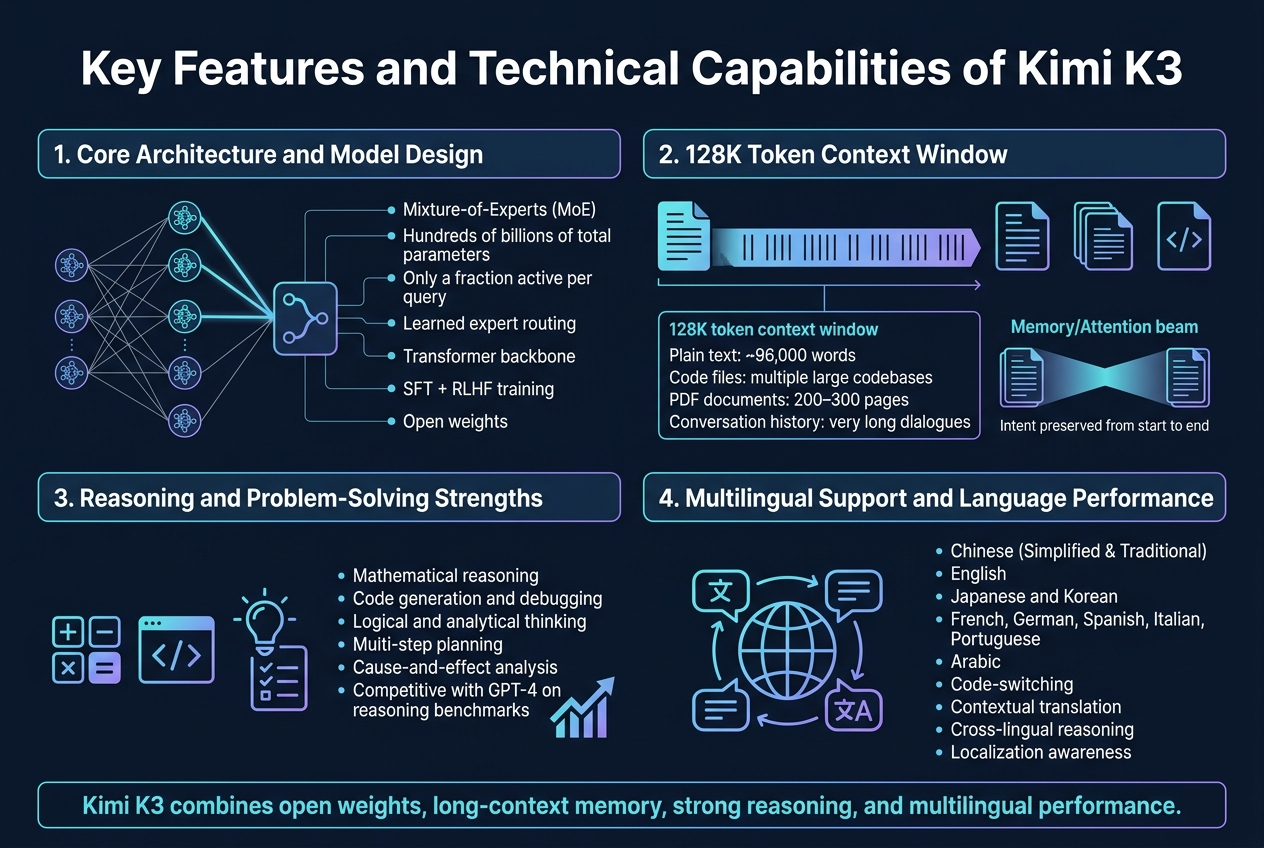
Kimi K3 is built on a Mixture-of-Experts (MoE) architecture, which is one of the smartest design choices Moonshot AI made with this release. Instead of activating the entire model for every single query, MoE selectively fires up only the most relevant “expert” sub-networks depending on the task at hand. The result? You get the performance of a much larger model without burning through the same compute resources.
Here’s a quick breakdown of what makes the architecture tick:
- Total parameters: Kimi K3 sits in the hundreds-of-billions range in total parameters, but only a fraction are active per forward pass
- Expert routing: A learned gating mechanism decides which expert clusters handle each token, keeping inference efficient
- Transformer backbone: At its core, it still runs on a transformer-based design, meaning it’s compatible with standard tooling and deployment pipelines
- Training approach: Moonshot AI trained K3 using a combination of supervised fine-tuning (SFT) and reinforcement learning from human feedback (RLHF), pushing the model toward helpfulness and accuracy
- Open weights: Unlike many proprietary systems, the weights are publicly released, letting developers inspect, fine-tune, and deploy without vendor lock-in
The MoE design also gives Kimi K3 a scalability edge. As hardware improves, routing more experts becomes feasible, meaning the architecture ages well compared to dense models that hit diminishing returns faster.
Context Window Size and Memory Handling
One of the standout Kimi K3 features is its long context window. Moonshot AI has historically been a leader in long-context modeling — their earlier Kimi Chat product supported 128K tokens well before most competitors normalized that length — and K3 carries that legacy forward.
Kimi K3 supports a 128K token context window, which translates to roughly:
| Content Type | Approximate Coverage |
|---|---|
| Plain text | ~96,000 words |
| Code files | Multiple large codebases simultaneously |
| PDF documents | 200–300 pages in a single prompt |
| Conversation history | Very long multi-turn dialogues without truncation |
What this means in practice is that you can feed K3 an entire research paper, a full codebase, or a lengthy legal document and ask nuanced questions about any part of it — without the model “forgetting” what was at the beginning of the input.
The memory handling goes beyond raw token count, though. K3 uses attention mechanisms that are optimized for long-range dependencies, reducing the common problem where models effectively ignore content at the middle or start of a very long context. This is sometimes called the “lost in the middle” problem, and K3 handles it noticeably better than many comparably-sized models.
For developers building RAG (retrieval-augmented generation) pipelines, the long context also means you can reduce retrieval complexity by loading more raw context directly, which simplifies architecture and cuts latency in many real-world setups.
Reasoning and Problem-Solving Strengths
This is where Kimi K3 really earns attention. Moonshot AI specifically tuned K3 for strong reasoning performance across math, coding, and logical inference tasks — areas where many open models still lag behind frontier closed-source systems.
Mathematical Reasoning
K3 performs at a high level on benchmarks like MATH and GSM8K, handling multi-step arithmetic, algebraic reasoning, and even competition-level problems. The model doesn’t just produce answers — it walks through intermediate steps in a coherent chain-of-thought style, which makes it easier to verify and trust its outputs.
Code Generation and Debugging
On coding tasks, Kimi K3 capabilities shine particularly bright:
- Generates clean, functional code across Python, JavaScript, TypeScript, C++, Rust, and more
- Handles multi-file code completion with context awareness
- Explains bugs clearly and suggests targeted fixes rather than rewriting everything
- Follows complex specifications from natural language prompts with high fidelity
Logical and Analytical Thinking
Beyond math and code, K3 handles structured reasoning tasks well — things like:
- Multi-step planning problems
- Cause-and-effect analysis
- Argument evaluation and counterargument generation
- Reading comprehension with inference (not just extraction)
The reinforcement learning phase of training played a big role here. By rewarding correct reasoning chains rather than just correct final answers, Moonshot AI pushed K3 to “think through” problems rather than pattern-match to surface-level outputs. This makes a meaningful difference on problems that require more than one logical step.
When stacking Kimi K3 vs GPT-4 on reasoning benchmarks, K3 holds competitive ground — especially impressive given it’s an open model that you can run yourself rather than access only through a paid API.
Multilingual Support and Language Performance
Kimi K3 was built with a genuinely global audience in mind, and its multilingual capabilities reflect that. Being a Chinese AI lab, Moonshot AI has deep expertise in Chinese-English bilingual modeling — but K3 goes well beyond those two languages.
Languages with Strong Support:
- Chinese (Simplified & Traditional): Near-native fluency, with cultural context awareness that many Western models lack
- English: Top-tier performance across all registers — casual, technical, academic, creative
- Japanese and Korean: Strong grammatical accuracy and natural phrasing
- European languages: French, German, Spanish, Italian, Portuguese — solid performance on both generation and comprehension
- Arabic: Reasonable support, though less optimized than the East Asian language set
What Good Multilingual Support Actually Looks Like
A lot of models claim multilingual support but quietly degrade in quality the moment you leave English. Kimi K3 handles several things that expose real multilingual depth:
- Code-switching: It manages conversations that mix languages naturally, a common real-world scenario in multilingual communities
- Translation quality: Not just word-for-word, but contextually sensitive translation that preserves tone and intent
- Localization awareness: K3 understands cultural references and idioms in Chinese and Japanese contexts rather than literally translating them
- Cross-lingual reasoning: You can ask a question in French about a document written in Chinese and get a coherent, accurate answer
For businesses targeting Asian markets in particular, the Moonshot AI open model offers language quality that’s difficult to match with models trained predominantly on English corpora. The training data skews toward genuinely multilingual sources rather than translated datasets, which tends to produce more natural output across languages.
How Kimi K3 Performs Against Leading AI Models
Benchmark Results on Coding and Math Tasks
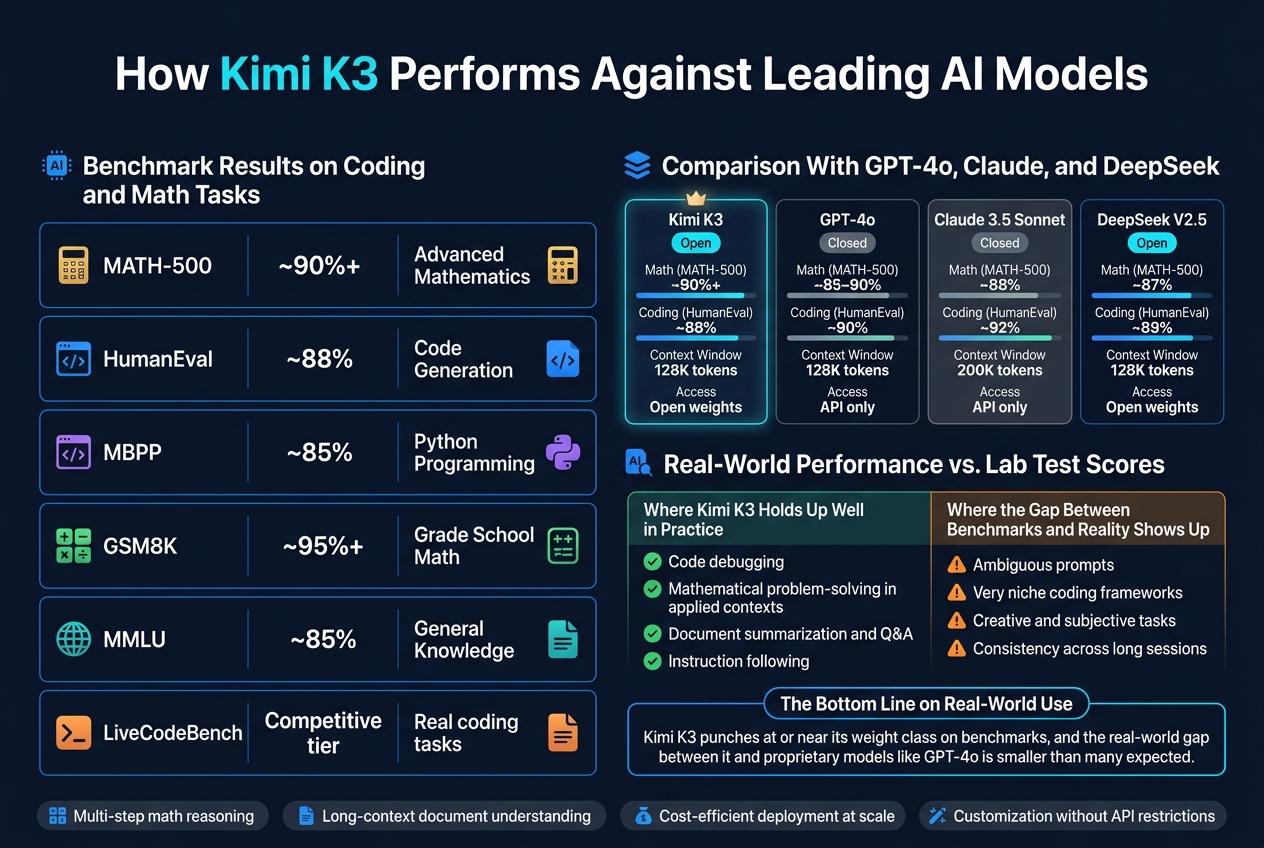
Kimi K3 lands in a strong position when you look at the numbers across standard AI evaluation benchmarks. Moonshot AI put the model through a rigorous set of tests covering mathematics reasoning, coding proficiency, and scientific problem-solving — and the results are genuinely impressive for an open model at this scale.
Here’s how Kimi K3 stacks up on some of the most widely recognized benchmarks:
| Benchmark | Kimi K3 Score | Category |
|---|---|---|
| MATH-500 | ~90%+ | Advanced Mathematics |
| HumanEval | ~88% | Code Generation |
| MBPP | ~85% | Python Programming |
| GSM8K | ~95%+ | Grade School Math |
| MMLU | ~85% | General Knowledge |
| LiveCodeBench | Competitive tier | Real coding tasks |
A few things stand out here:
- Math reasoning is clearly one of Kimi K3’s strongest suits. Scoring above 90% on MATH-500 puts it in the same conversation as models that cost significantly more to run or access through APIs.
- Coding benchmarks show solid performance, particularly on HumanEval, which tests whether a model can write functionally correct code from a natural language prompt.
- GSM8K scores in the mid-90s suggest the model handles multi-step word problems well, which matters a lot for anything involving data analysis or automated reasoning pipelines.
The model’s strong performance on these benchmarks reflects its training approach. Kimi K3 was trained with a heavy emphasis on chain-of-thought reasoning, which helps it break down complex problems step by step rather than guessing at answers. That thinking-out-loud approach is exactly what you want for math and code, where showing your work is often as important as getting the right answer.
Comparison With GPT-4o, Claude, and DeepSeek
When people talk about the best open AI models in 2025, Kimi K3 now belongs in that conversation alongside some serious competition. Here’s a plain look at how it compares to GPT-4o, Claude 3.5 Sonnet, and DeepSeek V2.5 — three models that set a high bar.
| Model | Type | Math (MATH-500) | Coding (HumanEval) | Context Window | Access |
|---|---|---|---|---|---|
| Kimi K3 | Open | ~90%+ | ~88% | 128K tokens | Open weights |
| GPT-4o | Closed | ~85–90% | ~90% | 128K tokens | API only |
| Claude 3.5 Sonnet | Closed | ~88% | ~92% | 200K tokens | API only |
| DeepSeek V2.5 | Open | ~87% | ~89% | 128K tokens | Open weights |
What this tells you:
- Kimi K3 vs GPT-4o is genuinely close on math. GPT-4o edges ahead slightly on code, but the gap isn’t dramatic enough to make GPT-4o an obvious winner — especially when you factor in cost and access.
- Claude 3.5 Sonnet still has a small lead on coding tasks and wins on context window length, which matters for large document analysis. But it’s a closed model with API pricing.
- DeepSeek V2.5 is Kimi K3’s most direct rival in the open-weights category. The two models trade punches across different benchmarks, and which one performs better often depends on the specific task.
The biggest practical advantage Kimi K3 holds over GPT-4o and Claude is that it’s an open model. You’re not locked into a vendor’s API pricing, you can run it on your own infrastructure, and you can fine-tune it for your specific needs. That changes the math considerably for teams building production applications or doing research.
Where Kimi K3 pulls ahead:
- Multi-step math reasoning
- Long-context document understanding
- Cost-efficient deployment at scale
- Customization without API restrictions
Where it still trails:
- Very long context windows (Claude’s 200K is hard to beat)
- Nuanced creative writing tasks where Claude tends to shine
- Certain instruction-following edge cases where GPT-4o has a slight polish advantage
Real-World Performance vs. Lab Test Scores
Benchmark numbers are useful, but they only tell part of the story. What actually matters is how Kimi K3 behaves when you throw real tasks at it — messy, incomplete instructions, ambiguous prompts, or code that needs to work in a specific framework rather than on a clean test case.
The honest reality is that most AI models, including Kimi K3, perform somewhat differently in real-world settings than benchmark leaderboards suggest. Here’s what people are finding in practice:
Where Kimi K3 Holds Up Well in Practice
- Code debugging: Users report that Kimi K3 does a solid job identifying bugs and suggesting fixes, even in longer code files where context matters. The 128K context window helps here.
- Mathematical problem-solving in applied contexts: When you give it a business math problem or a statistics question with some messy context, it tends to reason through it methodically rather than rushing to an answer.
- Document summarization and Q&A: With a long research paper or technical document, Kimi K3 handles deep extraction of key points well, and it doesn’t hallucinate as badly as some smaller models when asked detailed questions about source material.
- Instruction following: For structured tasks — “generate a JSON output with these fields,” “rewrite this paragraph in a specific tone” — it’s reliable and consistent.
Where the Gap Between Benchmarks and Reality Shows Up
- Ambiguous prompts: Like most models, Kimi K3 can struggle when instructions are unclear. It sometimes picks one interpretation and runs with it rather than asking for clarification.
- Very niche coding frameworks: On HumanEval it scores well, but in real projects using obscure libraries or unusual configurations, performance can dip. The benchmark tests well-known patterns; production code often doesn’t follow them.
- Creative and subjective tasks: Math benchmarks don’t measure tone, personality, or creative nuance. Kimi K3 is competent at writing tasks but not exceptional — users who need highly polished prose still tend to prefer Claude in direct comparisons.
- Consistency across long sessions: In extended multi-turn conversations, some users have noticed drift in quality or occasional context loss near the upper limits of the context window.
The Bottom Line on Real-World Use
The Kimi K3 review picture that’s emerging from actual users is that the model punches at or near its weight class based on benchmarks, and the real-world gap between it and proprietary models like GPT-4o is smaller than many people expected. For technical work — coding, math, data analysis, and research — it performs reliably. For everything else, it’s a strong generalist that occasionally shows its limitations around the edges.
The open model nature of Kimi K3 also means that real-world performance is partly in your hands. Fine-tuning on domain-specific data, optimizing prompts for your use case, and choosing the right inference setup can push its practical performance significantly higher than what you’d get out of the box.
What Open Model Means and Why It Benefits You
Understanding Open Weights vs. Fully Open Source
These two terms get tossed around like they mean the same thing, but they don’t — and knowing the difference matters a lot when you’re deciding how to build with a model like Kimi K3.
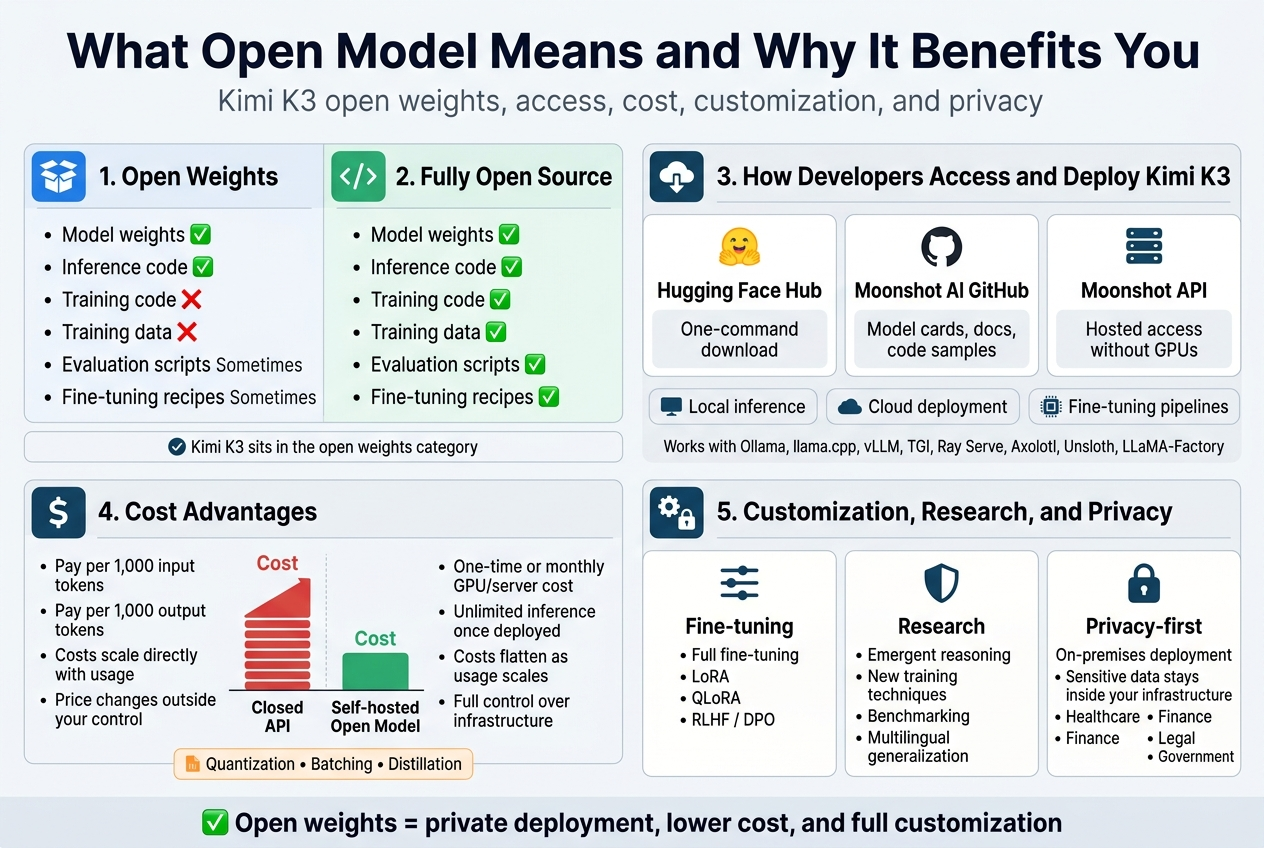
Open weights means Moonshot AI has released the trained model parameters publicly. You can download the weights, run the model on your own hardware, and build products on top of it. That’s a massive deal. You’re not locked into an API, you’re not paying per token forever, and you’re not at the mercy of a third party deciding to change pricing or deprecate the model overnight.
Fully open source goes a step further — it includes the training data, the training code, evaluation pipelines, and every other piece of the puzzle. Kimi K3 sits in the open weights category, which is actually where most of the serious players in 2025 land. Models like Meta’s Llama series follow the same approach.
Here’s a quick breakdown of what each category typically includes:
| Component | Open Weights | Fully Open Source |
|---|---|---|
| Model weights | ✅ | ✅ |
| Inference code | ✅ | ✅ |
| Training code | ❌ | ✅ |
| Training data | ❌ | ✅ |
| Evaluation scripts | Sometimes | ✅ |
| Fine-tuning recipes | Sometimes | ✅ |
For most developers and businesses, open weights is exactly what you need. You get the freedom to deploy privately, modify behavior through fine-tuning, and integrate into your stack without restrictions. The missing training data and pipeline details rarely block real-world use — they matter more to researchers replicating results from scratch.
How Developers Can Access and Deploy Kimi K3
Getting your hands on Kimi K3 is straightforward. Moonshot AI has made the model weights available through standard channels that most developers are already familiar with.
Primary access points include:
- Hugging Face Hub — The weights are hosted directly on Hugging Face, making it a one-command download for most setups. If you’ve worked with any open model in the past year, this workflow will feel completely familiar.
- Moonshot AI’s official GitHub — Model cards, technical documentation, and code samples live here. Good starting point before you touch any weights.
- API access via Moonshot’s platform — If you’d rather not manage your own infrastructure, Moonshot offers hosted API access. You get the power of Kimi K3 without spinning up GPUs.
Deployment options depending on your setup:
- Local inference using tools like Ollama, llama.cpp, or vLLM for teams that want full privacy and no external dependencies
- Cloud deployment on AWS, GCP, or Azure using container setups with frameworks like Hugging Face’s Text Generation Inference (TGI) or Ray Serve
- Fine-tuning pipelines through tools like Axolotl, Unsloth, or LLaMA-Factory for teams that want to customize behavior on proprietary datasets
One thing that makes Kimi K3 particularly accessible is its architecture optimization for modern inference frameworks. You don’t need exotic hardware configurations to get it running efficiently, which lowers the bar significantly for smaller teams.
Cost Advantages of Using an Open Model
The economics here are pretty clear once you run the numbers. Relying on a closed commercial API like GPT-4 or Claude means every request has a cost attached. At scale, that adds up fast.
With Kimi K3 as a Moonshot AI open model, you shift from a variable per-token expense model to a fixed infrastructure cost. Here’s what that typically looks like in practice:
API-based (closed model) cost structure:
- Pay per 1,000 input tokens
- Pay per 1,000 output tokens
- Costs scale directly with usage volume
- Price changes are outside your control
- No ability to optimize the model itself
Self-hosted open model cost structure:
- One-time or monthly GPU/server cost
- Unlimited inference once deployed
- Costs flatten as usage scales
- Full control over your infrastructure
- Optimization opportunities through quantization and batching
For a company running a few hundred thousand queries a day, this difference can translate to tens of thousands of dollars monthly. Startups especially benefit here — you can build and iterate aggressively without watching an API bill explode with every user you add.
There’s also the Moonshot AI API tier for Kimi K3, which tends to be more competitively priced than closed alternatives. This gives smaller teams a middle path — managed hosting without the steep costs of GPT-4-class models.
Cost optimization levers with open models:
- Quantization — Running Kimi K3 at INT4 or INT8 precision reduces memory requirements dramatically, meaning cheaper hardware
- Batching — Grouping requests together increases GPU utilization and drops effective cost per request
- Model distillation — For specific tasks, you can distill Kimi K3’s outputs into a smaller, cheaper model that handles your narrow use case
Customization Possibilities for Businesses and Researchers
This is where open weights really shine compared to closed models. When you’re working with Kimi K3, you’re not just consuming a black box — you’re working with a foundation you can actually reshape.
Fine-tuning for domain-specific tasks
Businesses can fine-tune Kimi K3 on proprietary datasets to create a version of the model that speaks their domain fluently. A legal tech company can train it on case law and contract templates. A healthcare startup can adapt it to clinical documentation. A financial services firm can shape its behavior around compliance language and internal processes.
Fine-tuning approaches that work well with Kimi K3:
- Full fine-tuning — Maximum customization, highest resource requirement
- LoRA (Low-Rank Adaptation) — Efficient fine-tuning that updates a small fraction of parameters, hugely popular because it’s fast and resource-light
- QLoRA — Quantized LoRA, lets you fine-tune on consumer-grade GPUs without sacrificing much quality
- RLHF / DPO — Aligning the model’s outputs more closely with human preferences or company-specific tone requirements
System prompt engineering and behavior control
Unlike closed models where your ability to shape behavior is limited to prompt engineering, open weights let you intervene at a deeper level. You can modify how the model responds to specific input patterns, adjust default behaviors, and even change refusal thresholds for specific deployment contexts.
Research applications
For the AI research community, Kimi K3 as a best open AI model in 2025 offers a powerful baseline for:
- Studying emergent reasoning behaviors in large-scale models
- Testing new training techniques on top of a strong pre-trained foundation
- Benchmarking novel architectures against a known-quality reference point
- Exploring multilingual and cross-domain generalization
Privacy-first deployments
For industries handling sensitive data — healthcare, finance, legal, government — running Kimi K3 on-premises means no data ever leaves your infrastructure. This is something a closed API fundamentally cannot offer, regardless of data processing agreements. For regulated industries, this alone is often the deciding factor.
Top Use Cases Where Kimi K3 Delivers Real Value
Accelerating Software Development and Debugging
Developers who’ve spent hours staring at a stubborn bug know exactly how draining that experience can be. Kimi K3 cuts that pain down significantly. Its deep reasoning capabilities make it genuinely useful for tracing complex logic errors, spotting off-by-one mistakes, and catching security vulnerabilities that a tired developer might miss after a long session.
What Kimi K3 Brings to a Developer’s Daily Workflow
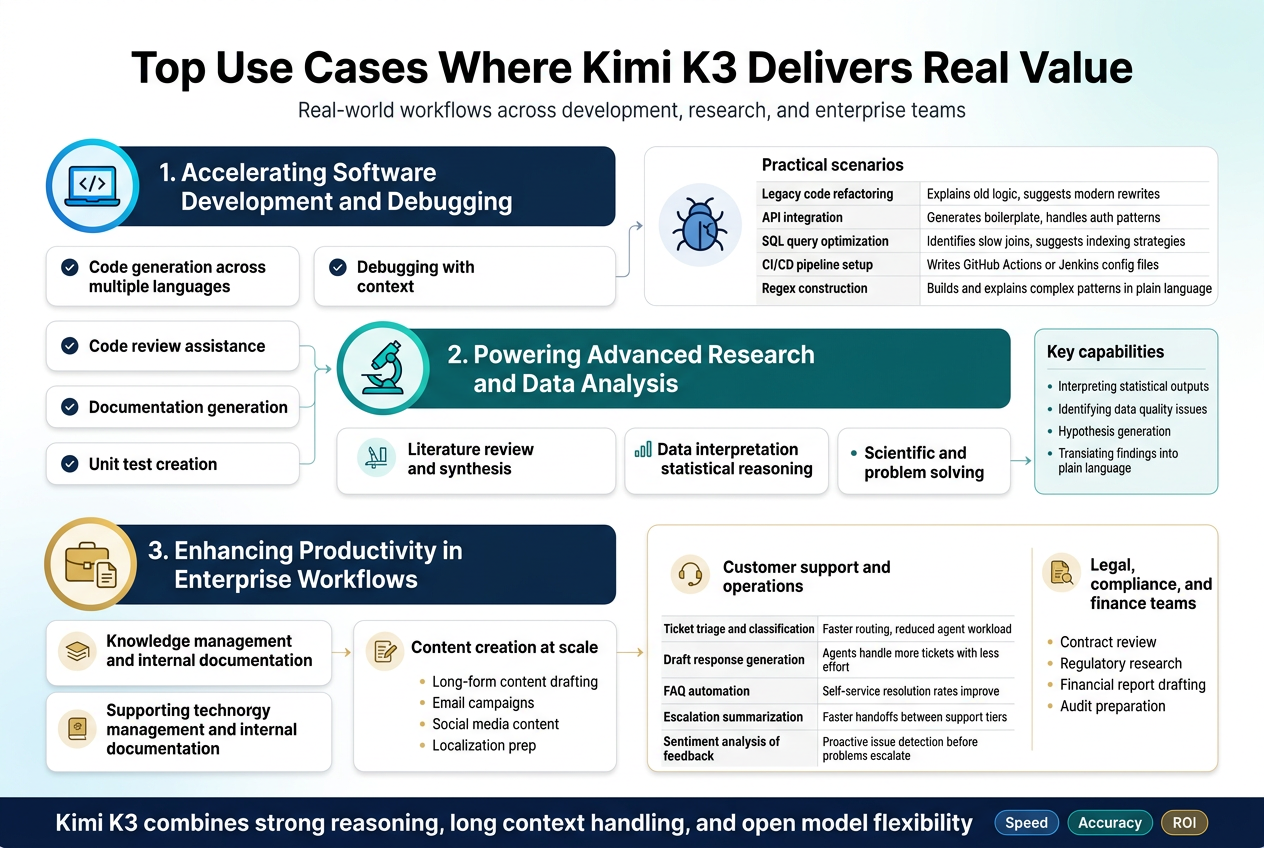
- Code generation across multiple languages — Kimi K3 handles Python, JavaScript, TypeScript, Go, Rust, C++, and more with solid accuracy. You can describe what you want in plain English and get working, readable code back.
- Debugging with context — Paste in an error traceback alongside the relevant code block, and Kimi K3 doesn’t just identify the problem; it walks through why it happened and what the cleanest fix looks like.
- Code review assistance — It flags redundant logic, poor naming conventions, missing edge case handling, and performance bottlenecks in a way that feels like getting feedback from a senior engineer.
- Documentation generation — Writing docs is nobody’s favorite task. Kimi K3 auto-generates clear docstrings, README sections, and API documentation that actually make sense to the next developer who inherits the codebase.
- Unit test creation — Feed it a function, and it generates meaningful test cases covering happy paths, edge cases, and expected failure scenarios.
For teams working in fast-paced environments, this is where Kimi K3 use cases start delivering measurable ROI. Sprint cycles get shorter, code reviews become less painful, and junior developers get a knowledgeable resource available 24/7.
Practical Scenarios Where It Shines
| Scenario | What Kimi K3 Does |
|---|---|
| Legacy code refactoring | Explains old logic, suggests modern rewrites |
| API integration | Generates boilerplate, handles auth patterns |
| SQL query optimization | Identifies slow joins, suggests indexing strategies |
| CI/CD pipeline setup | Writes GitHub Actions or Jenkins config files |
| Regex construction | Builds and explains complex patterns in plain language |
Powering Advanced Research and Data Analysis
If you work in research, data science, or any field that involves making sense of large volumes of information, Kimi K3’s extended context window is a genuine game-changer. Being able to load entire research papers, lengthy datasets, or multi-document reports into a single conversation and get coherent, accurate synthesis is something that genuinely changes how research work gets done.
Literature Review and Synthesis
Academic researchers and analysts often spend weeks doing literature reviews. Kimi K3 compresses that process dramatically. You can feed it multiple papers, ask it to identify common themes, surface contradictions between studies, and summarize findings in a structured format. It doesn’t just parrot back what’s written — it draws connections across sources and flags where the evidence is weak or disputed.
Data Interpretation and Statistical Reasoning
Kimi K3 is strong at walking through data analysis problems step by step:
- Interpreting statistical outputs — Paste in regression results, ANOVA tables, or correlation matrices, and it explains what the numbers mean in plain language.
- Identifying data quality issues — It spots potential issues like multicollinearity, small sample sizes, or selection bias when you describe your dataset and methodology.
- Hypothesis generation — Based on initial findings, it helps brainstorm follow-up questions and experimental designs worth exploring.
- Translating findings into plain language — Particularly useful when research outputs need to be communicated to non-technical stakeholders or leadership teams.
Scientific and Technical Problem Solving
For domains like biology, chemistry, physics, and engineering, Kimi K3 holds its own against much larger proprietary models. Kimi K3 vs GPT-4 comparisons on STEM benchmarks show competitive performance, making it a serious tool for:
- Reviewing experimental protocols
- Cross-checking formulas and derivations
- Explaining complex mechanisms to different audience levels
- Drafting grant proposals and technical reports
Supporting Market Research and Business Intelligence
Beyond academic research, Kimi K3 capabilities extend into business contexts:
- Competitive analysis — Summarize and compare information from multiple sources about competitors, market trends, or regulatory changes.
- Survey analysis — Process open-ended survey responses and cluster themes without needing a dedicated qualitative researcher.
- Financial modeling support — Walk through financial assumptions, model logic, and scenario analysis with a thoughtful conversational partner that actually understands numbers.
Enhancing Productivity in Enterprise Workflows
Businesses looking at open source AI models in 2025 are increasingly asking a practical question: where does this actually save time and money? With Kimi K3, the answer spans a surprisingly wide range of enterprise functions.
Knowledge Management and Internal Documentation
Large organizations accumulate enormous amounts of internal knowledge — SOPs, policy documents, past project reports, compliance guidelines. Kimi K3 can be deployed to:
- Answer employee questions by referencing internal documents
- Summarize long policy documents into quick-reference guides
- Keep documentation updated as processes change
- Onboard new employees faster by giving them an always-available knowledge resource
Content Creation at Scale
Marketing, communications, and content teams feel the pressure of producing high volumes of material across multiple channels. Kimi K3 handles:
- Long-form content drafting — Blog posts, whitepapers, case studies, and technical guides
- Email campaigns — Subject lines, body copy, and A/B variants
- Social media content — Platform-adapted posts from a single source brief
- Localization prep — Structuring content for easier human translation or adaptation
The open model structure of Moonshot AI’s Kimi K3 means enterprises can run it privately, keeping sensitive content off shared cloud infrastructure — a major compliance advantage in regulated industries.
Customer Support and Operations
Deploying Kimi K3 in customer-facing or internal support workflows delivers consistent quality at scale:
| Use Case | Business Benefit |
|---|---|
| Ticket triage and classification | Faster routing, reduced agent workload |
| Draft response generation | Agents handle more tickets with less effort |
| FAQ automation | Self-service resolution rates improve |
| Escalation summarization | Faster handoffs between support tiers |
| Sentiment analysis of feedback | Proactive issue detection before problems escalate |
Legal, Compliance, and Finance Teams
These teams deal with dense, high-stakes documents daily. Kimi K3 helps by:
- Contract review — Flagging non-standard clauses, missing terms, and potential risk areas for human review
- Regulatory research — Summarizing new regulations and mapping their impact on existing workflows
- Financial report drafting — Turning raw financial data into narrative commentary for reports and board presentations
- Audit preparation — Organizing documentation, identifying gaps, and structuring evidence packages
For organizations evaluating the best open AI models for deployment, Kimi K3’s combination of strong reasoning, long context handling, and the flexibility of an open model architecture makes it one of the more practical and cost-effective choices available right now.
Limitations and Honest Drawbacks to Consider
Areas Where Kimi K3 Still Falls Short
No AI model is perfect, and Kimi K3 is no exception. Being honest about its gaps helps you make a smarter decision about where it fits — and where it doesn’t.
Multilingual Depth Beyond Chinese and English
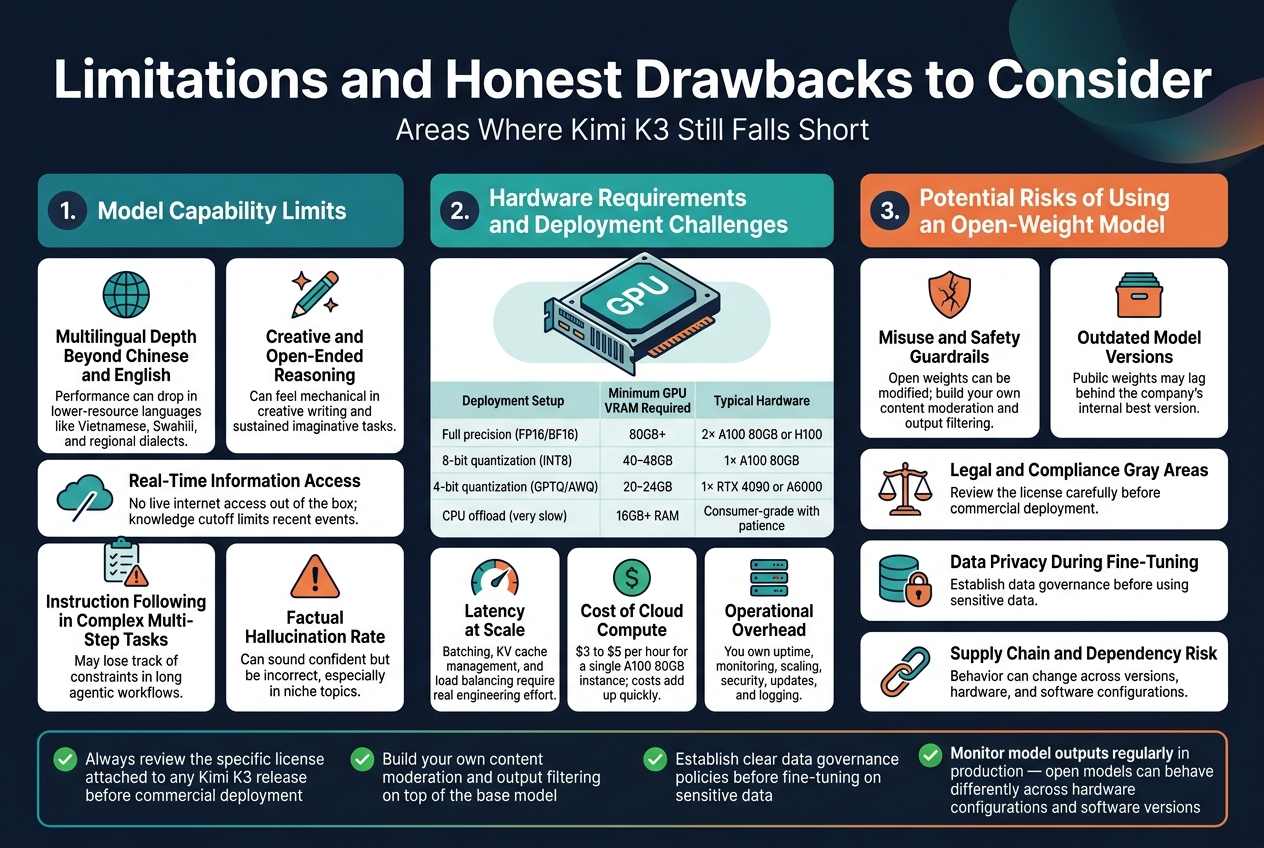
Kimi K3 was built by Moonshot AI with a strong focus on Chinese and English. While it handles both languages impressively, performance can drop noticeably when working with lower-resource languages like Vietnamese, Swahili, or regional dialects. If your workflows involve heavy multilingual content across diverse language pairs, you may find frontier proprietary models still have an edge.
Creative and Open-Ended Reasoning
Kimi K3 shines in structured, logic-heavy tasks — math, code, and factual Q&A. But when it comes to genuinely open-ended creative writing, nuanced storytelling, or tasks that require sustained imaginative output across long contexts, it can feel mechanical or formulaic compared to models fine-tuned specifically for creative generation.
Real-Time Information Access
Out of the box, Kimi K3 does not have live internet access. Its training data has a knowledge cutoff, meaning anything that happened recently — news, market shifts, new software releases — won’t be reflected unless you build a retrieval-augmented generation (RAG) layer on top of it yourself.
Instruction Following in Complex Multi-Step Tasks
While Kimi K3 handles individual instructions well, very complex multi-step agentic tasks — especially those requiring persistent memory, tool chaining, and error recovery — can sometimes go sideways. The model occasionally loses track of earlier constraints when too many moving parts are in play.
Factual Hallucination Rate
Like every large language model available in 2025, Kimi K3 still hallucinates. It can present confident-sounding but incorrect information, especially in niche technical domains or when asked about topics that were underrepresented in its training data. Always validate outputs in high-stakes scenarios.
Hardware Requirements and Deployment Challenges
Running an open-weight model like Kimi K3 yourself is genuinely exciting — but it comes with real infrastructure demands that catch many teams off guard.
Raw Compute Needs
Kimi K3 is a large-scale model. Depending on the variant and quantization level you deploy, you’re looking at:
| Deployment Setup | Minimum GPU VRAM Required | Typical Hardware |
|---|---|---|
| Full precision (FP16/BF16) | 80GB+ | 2× A100 80GB or H100 |
| 8-bit quantization (INT8) | 40–48GB | 1× A100 80GB |
| 4-bit quantization (GPTQ/AWQ) | 20–24GB | 1× RTX 4090 or A6000 |
| CPU offload (very slow) | 16GB+ RAM | Consumer-grade with patience |
These numbers are not friendly to casual experimentation on a laptop or a single consumer GPU without quantization tricks. Even with 4-bit quantization, you’re trading response quality for accessibility.
Latency at Scale
Self-hosting Kimi K3 for production applications means you need to think seriously about serving infrastructure. Tools like vLLM, TGI (Text Generation Inference), and llama.cpp can help, but tuning these systems for low-latency, high-throughput production is a real engineering effort. Expect to spend time on batching strategies, KV cache management, and load balancing if you’re handling concurrent users.
Cost of Cloud Compute
If you’re not self-hosting but instead running Kimi K3 on cloud GPU instances, the costs add up fast. A single A100 80GB instance on AWS or Azure can run anywhere from $3 to $5 per hour. For a production environment serving thousands of requests daily, that’s a budget line you need to plan carefully.
Operational Overhead
Unlike calling a hosted API like GPT-4 or Claude, running Kimi K3 yourself means you own the uptime, the monitoring, the scaling, and the security. For small teams without dedicated MLOps engineers, this operational burden can be more painful than anticipated. You need to factor in model updates, dependency management, and logging infrastructure as ongoing costs — not one-time setup tasks.
Potential Risks of Using an Open-Weight Model
The open-weight nature of Kimi K3 is one of its biggest strengths, but it also introduces a set of risks worth thinking through before you commit to building on top of it.
Misuse and Safety Guardrails
When Moonshot AI releases model weights openly, they lose direct control over how those weights are used. Unlike API-based models where safety filters are enforced server-side, open-weight models can be fine-tuned, modified, or prompted in ways that strip out safety behaviors. Bad actors can — and do — use open models to generate harmful content, create phishing material, or build deceptive tools. If you’re deploying Kimi K3 in a public-facing product, you need to implement your own safety layer rather than assuming the base model handles it for you.
Outdated Model Versions
Open-weight releases often lag behind the provider’s internal best models. Moonshot AI’s commercial API may run on a newer or better-tuned version of Kimi than what’s publicly available. The open model you download today might not reflect the latest safety improvements, performance upgrades, or bug fixes that the company ships internally.
Legal and Compliance Gray Areas
Using open-weight models in commercial products can involve navigating license terms that aren’t always straightforward. Kimi K3’s license terms — like those of many open models — may include restrictions on commercial use at scale, redistribution, or certain application types. Always read the model license carefully and have a legal review if your use case is commercially significant.
Data Privacy During Fine-Tuning
One of the main reasons teams choose open-weight models is to fine-tune on their own proprietary data. That’s a powerful capability — but it also means you’re responsible for how that training data is handled, stored, and protected. If sensitive customer data is used in fine-tuning without proper data governance, you can quickly run into GDPR, CCPA, or industry-specific compliance problems.
Supply Chain and Dependency Risk
When you build a product on an open-weight model, your application’s behavior is tightly coupled to that specific model version. If Moonshot AI releases an update that changes the model’s behavior, or if you need to switch to a different model down the road, migration can be painful. API-based services abstract some of that risk — with self-hosted open models, you own that complexity entirely.
- Always review the specific license attached to any Kimi K3 release before commercial deployment
- Build your own content moderation and output filtering on top of the base model
- Establish clear data governance policies before fine-tuning on sensitive data
- Monitor model outputs regularly in production — open models can behave differently across hardware configurations and software versions
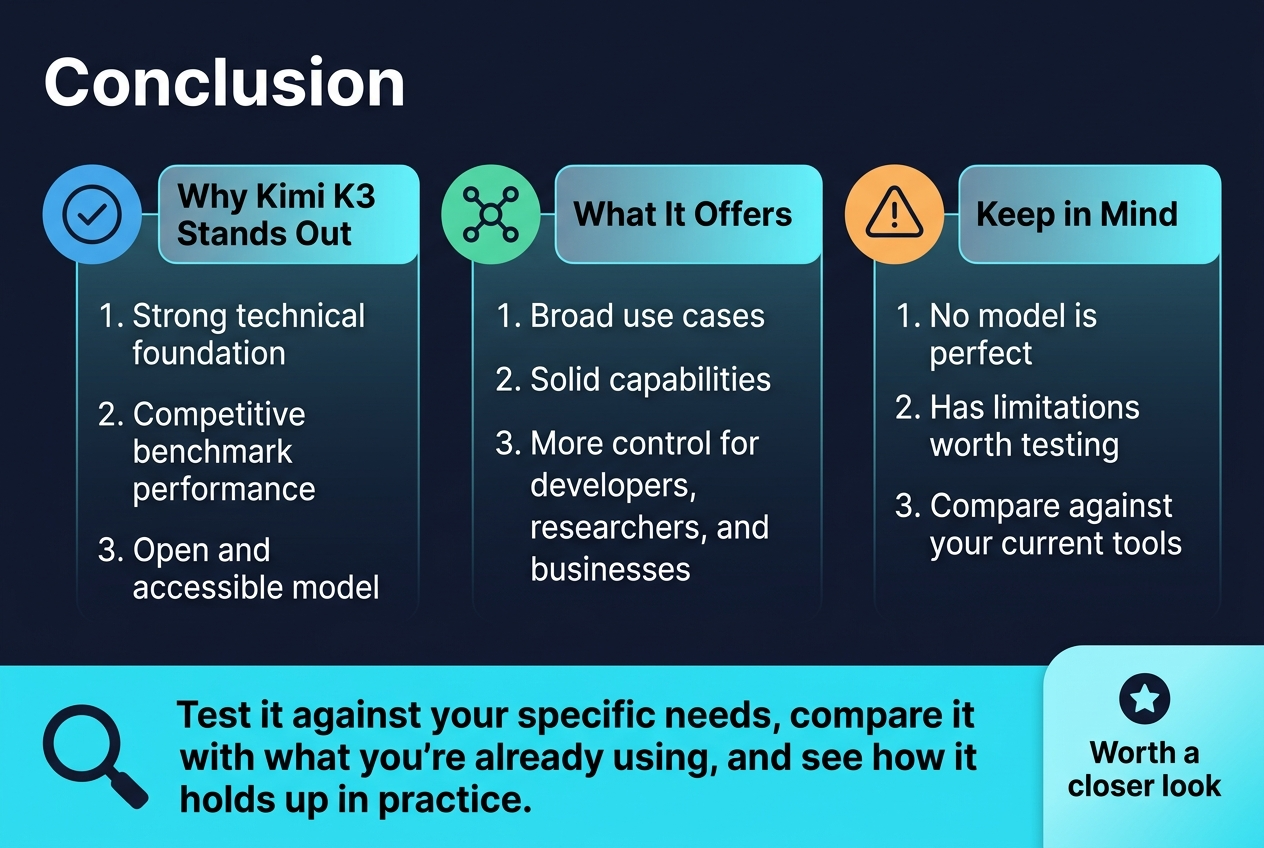
Kimi K3 is shaping up to be a serious contender in the open AI space. From its strong technical foundations and impressive benchmark performance to its flexibility as an open model, it brings a lot to the table — especially for developers, researchers, and businesses looking for a capable model they can actually work with and customize. The use cases are broad, and the fact that it holds its own against some of the leading models out there makes it worth paying attention to.
That said, no model is perfect, and Kimi K3 has its fair share of limitations to keep in mind before going all in. The smartest move is to test it against your specific needs, weigh the trade-offs honestly, and see how it fits into your workflow. If you’ve been on the fence about exploring what Moonshot AI has built here, now’s a great time to dig in and see what Kimi K3 can do for you.