Designing a Scalable AI Orchestration Layer with Node.js
If you’re building a system that coordinates multiple AI services — think routing requests between language models, vision APIs, and custom ML endpoints — you already know how quickly things get messy. One service goes down, latency spikes, or a poorly structured workflow turns your pipeline into a bottleneck. That’s the exact problem AI orchestration with Node.js is built to solve.
This guide is for backend engineers and architects who are past the “hello world” stage with AI and are now dealing with the real headaches: keeping workflows reliable at scale, connecting multiple AI services without creating a tangled dependency nightmare, and locking down the system so it doesn’t become a security liability.
Here’s what we’ll walk through together:
- How to design the architectural foundation for a scalable AI pipeline architecture that doesn’t collapse under production load
- How to connect and manage multiple AI services in a clean, maintainable way using Node.js AI workflow automation patterns
- How to build resilience and security into the orchestration layer so your system handles failures gracefully and stays protected from common vulnerabilities
By the end, you’ll have a clear, practical blueprint for enterprise AI workflow orchestration — not just theory, but patterns you can actually build on.
Understanding AI Orchestration and Why It Matters

A. What AI Orchestration Actually Is
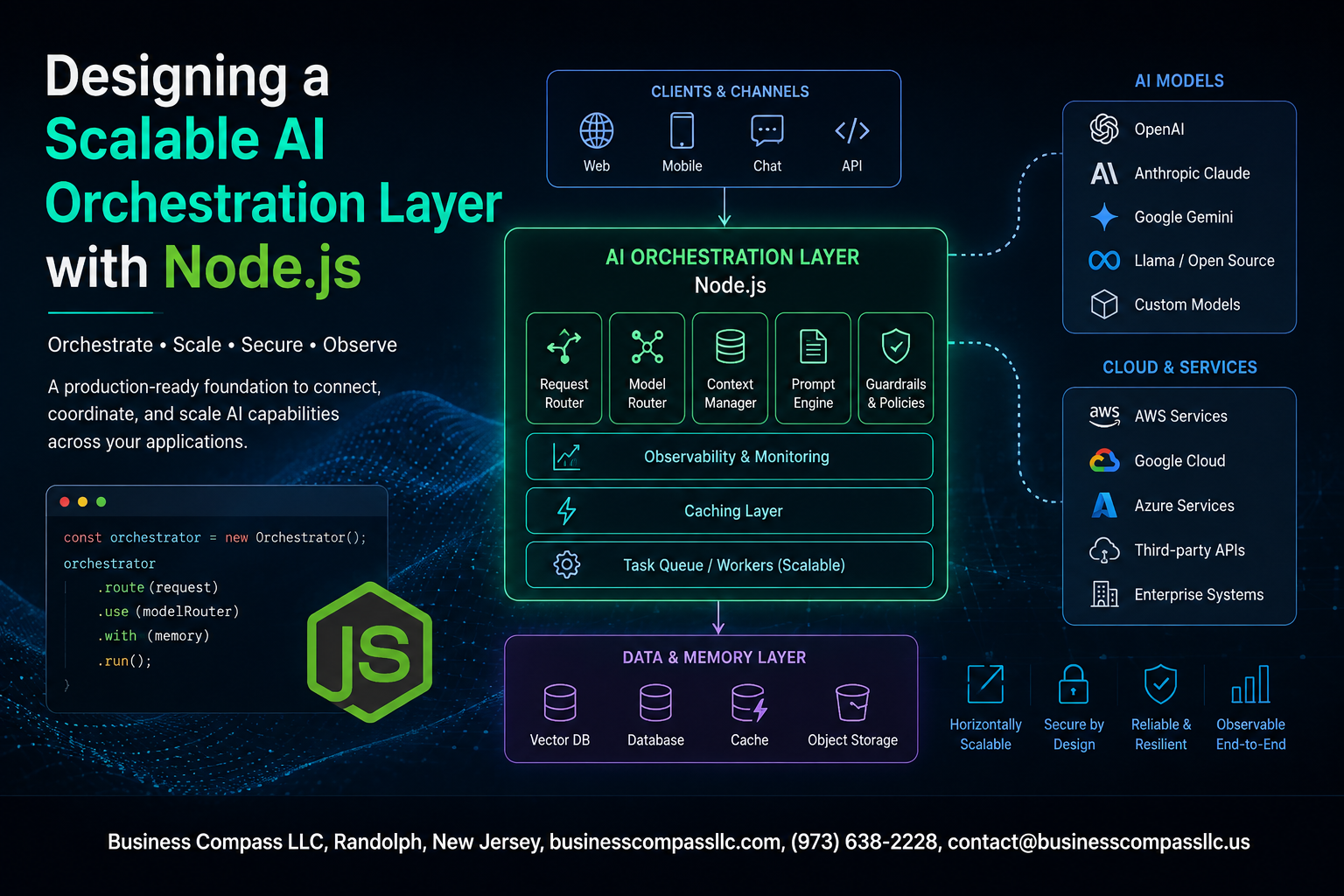
AI orchestration coordinates multiple AI models, APIs, and services into unified workflows — think routing user requests, chaining model outputs, and handling failures gracefully.
B. Core Challenges
- Latency spikes across services
- Inconsistent API contracts
- Cascading failures
C. Why Node.js Wins Here
Node’s non-blocking I/O handles concurrent AI service calls beautifully, making AI orchestration with Node.js a natural, high-performance choice.
Laying the Architectural Foundation for Scalability

A. Choose the Right Design Patterns
- Event-driven and queue-based patterns handle async AI calls cleanly.
B. Structure Your Node.js Project
- Separate routes, services, and adapters from day one.
C. Stateless vs. Stateful Orchestration
- Offload state to Redis; keep workers stateless.
D. Separate Orchestration from Business Logic
- Orchestration routes tasks; business logic owns decisions.
Connecting and Managing Multiple AI Services Efficiently

Integrate Third-Party AI APIs with Minimal Coupling
Use an adapter pattern — wrap each provider (OpenAI, Anthropic, etc.) in its own module, keeping core logic untouched when swapping services.
Build a Unified Interface to Abstract Provider Differences
A single AIClient interface handles requests regardless of backend, hiding provider quirks cleanly.
Handle Authentication and Rate Limiting
- Store credentials in environment variables
- Use token-bucket libraries for per-service throttling
Building Resilient Workflow Execution Pipelines

Design Sequential and Parallel AI Task Execution Flows
Building resilient AI orchestration with Node.js means chaining tasks sequentially when outputs feed into inputs, while running independent tasks in parallel using Promise.all(). Pair this with retry logic, dead-letter queues, structured logging, and timeout guards to keep your scalable AI pipeline architecture running smoothly under real-world pressure.
Scaling the Orchestration Layer Under Real-World Load

Leverage Node.js Clustering and Worker Threads for Concurrency
Spin up Node.js cluster workers to max out CPU cores, offloading heavy AI inference tasks to worker threads.
Deploy Stateless Orchestration Nodes Behind a Load Balancer
Keep nodes stateless so any instance handles any request, scaling AI services in Node.js horizontally without session headaches.
Cache AI Responses Intelligently
- Use Redis TTL-based caching to skip redundant API calls
- Cut costs and latency significantly
Securing the Orchestration Layer from Common Vulnerabilities

A. Enforce Strict Input Validation
Sanitize every payload before routing to AI services — reject unexpected fields, enforce type checks.
B. Least-Privilege Access Controls
Grant each service only what it needs, nothing more.
C. Secure Credential Storage
Store API keys in environment vaults like AWS Secrets Manager.
D. Audit Logging
Track every orchestration call for debugging and compliance.

Building a scalable AI orchestration layer with Node.js is no small feat, but breaking it down into the right pieces makes it very manageable. From setting up a solid architectural foundation to connecting multiple AI services, designing resilient pipelines, and handling real-world load, each layer plays a critical role in keeping your system running smoothly. And with security baked in from the start, you are not just building something that works today but something that holds up over time.
The good news is that Node.js gives you a genuinely powerful toolkit to pull all of this together. If you are ready to get started, pick one piece of this architecture, whether that is your workflow execution pipeline or your service connection strategy, and start building. Getting something working in a smaller scope first is the fastest way to understand what your system actually needs before you scale it up.