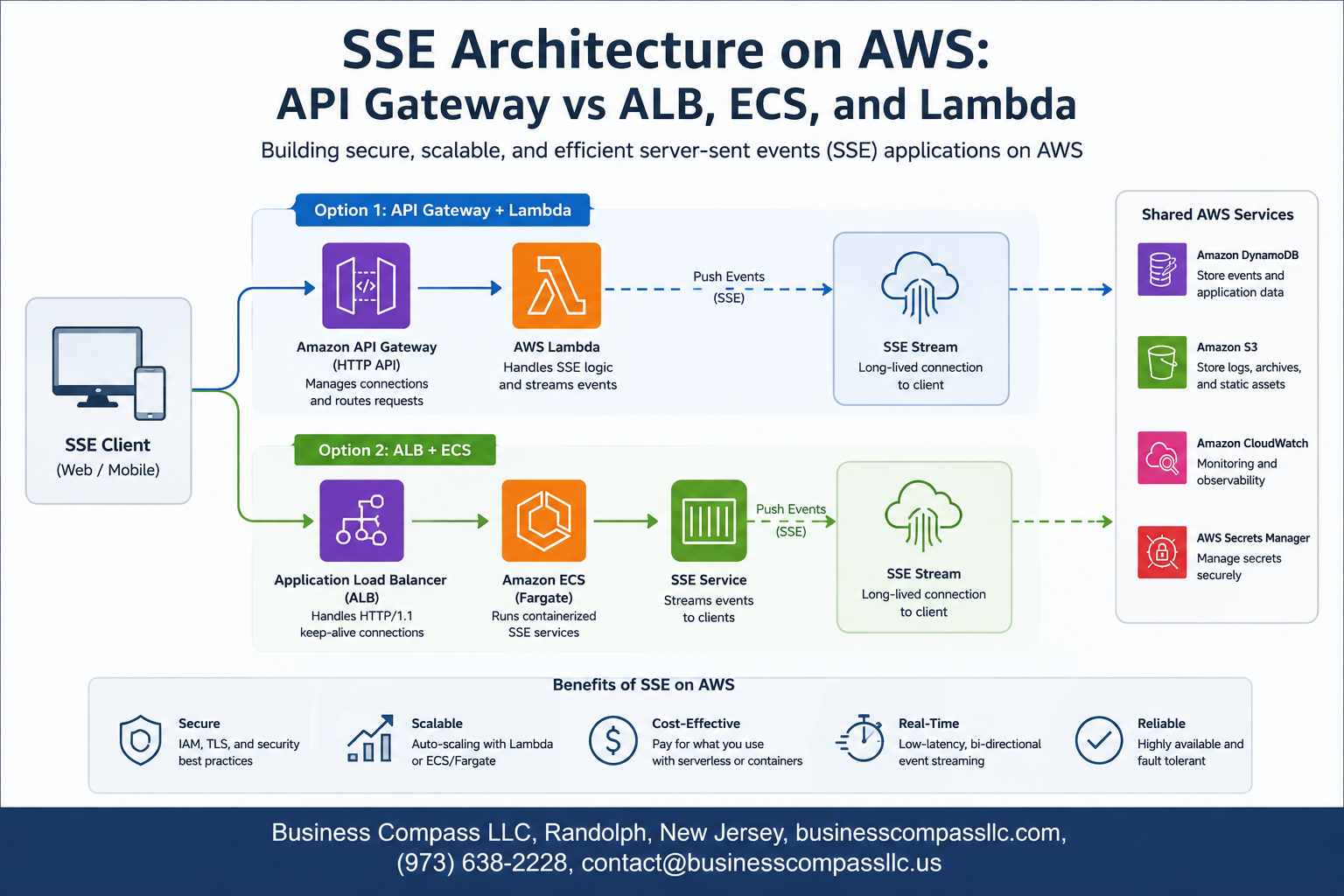
SSE Architecture on AWS: API Gateway vs ALB, ECS, and Lambda
If you’re building real-time features — live dashboards, activity feeds, stock tickers, or notification streams — you’ve probably run into Server-Sent Events as a solid, lightweight option. But getting SSE on AWS to work reliably at scale isn’t just about writing the right backend code. The infrastructure decisions you make around routing, compute, and connection handling matter just as much.
This guide is for backend engineers and cloud architects who are already comfortable with AWS basics and want to make smart, informed choices about their AWS real-time event streaming architecture. No hand-holding on the fundamentals here — just the trade-offs that actually matter.
Here’s what we’ll dig into:
- API Gateway vs ALB for SSE — why one of these will quietly cause you pain if you pick the wrong one for your streaming use case
- AWS ECS real-time streaming — how to run persistent SSE connections efficiently without over-provisioning or dropping streams
- Lambda SSE execution limits — yes, you can use Lambda for server-sent events, but there’s a right way to do it before you hit the walls
By the end, you’ll have a clear picture of which setup fits your workload — and which ones to avoid before they become production problems.
Understanding SSE and Why It Matters for Modern Applications

How SSE Differs from WebSockets and Traditional Polling
SSE on AWS enables one-way, persistent HTTP streams from server to client — simpler than WebSockets, far more efficient than polling. No constant reconnection overhead, no bidirectional complexity. Your server pushes updates automatically, keeping clients in sync with minimal infrastructure effort, making AWS real-time event streaming architecture genuinely straightforward to build and scale.
Breaking Down the AWS Components for SSE Delivery
Role of API Gateway in Managing SSE Connections
API Gateway supports SSE but enforces a 29-second timeout, making long-lived streams tricky.
How ALB Handles Long-Lived HTTP Connections
ALB handles persistent HTTP connections far better, with configurable idle timeouts up to 4,000 seconds.
ECS as a Scalable Backend for SSE Workloads
ECS runs continuously, making it perfect for SSE workloads.
Lambda and Its Limitations with Persistent Connections
Lambda’s execution limits make sustained SSE streams nearly impossible.
API Gateway vs ALB for SSE Traffic Management

Connection Timeout Constraints and How They Impact SSE
API Gateway caps connections at 29 seconds — a dealbreaker for SSE on AWS. ALB handles long-running streams comfortably, supports idle timeouts up to 4,000 seconds, and gives you real control. For API Gateway vs ALB for SSE, ALB wins on connection flexibility every time.
Running SSE Workloads Efficiently on ECS

Designing Containers to Handle Thousands of Open Connections
Run your ECS tasks using async event loops (Node.js or Python asyncio) to hold thousands of SSE connections per container without blocking threads.
Auto Scaling Strategies
- Scale on active connection count via custom CloudWatch metrics
Optimizing Task Definitions
- Increase
nofileulimits for high connection volumes
Using Lambda for SSE Without Hitting Execution Limits

Streaming Responses with Lambda Function URLs
Lambda Function URLs support streaming, letting you push SSE events directly without buffering.
Working Around the 15-Minute Execution Timeout
Break long streams into reconnectable chunks; clients auto-reconnect using Last-Event-ID.
Combining Lambda with SQS or EventBridge for Event-Driven SSE
Fan out events through SQS, triggering short-lived Lambda functions per client connection.
When Lambda Is the Right Fit
Sporadic, low-concurrency server-sent events AWS Lambda workloads with unpredictable traffic.
Selecting the Right Architecture for Your SSE Use Case

Decision Framework Based on Scale, Cost, and Complexity
- Low scale: Lambda + API Gateway works fine
- High throughput: ALB + ECS wins every time
Hybrid Architectures Combining ALB, ECS, and Lambda
Route short-lived SSE streams through Lambda; persistent connections through ECS behind ALB.
Monitoring SSE Pipelines
Track active connections, dropped streams, and latency using CloudWatch.

Choosing the right AWS architecture for SSE comes down to understanding your workload’s specific needs. API Gateway works well for simpler setups, but ALB often handles long-lived SSE connections more reliably at scale. ECS gives you the control and flexibility to run persistent SSE workloads without worrying about execution timeouts, while Lambda can absolutely work for SSE — you just need to be smart about how you structure your functions to avoid hitting those limits.
There’s no single “best” answer here. The right stack depends on your connection volume, latency requirements, cost constraints, and how much operational overhead your team can manage. Start by mapping out your actual SSE traffic patterns, then match them to the strengths of each component. If you’re still unsure where to begin, prototype a small version of your use case with ALB and ECS — it’s often the most straightforward path to a stable, scalable SSE setup on AWS.