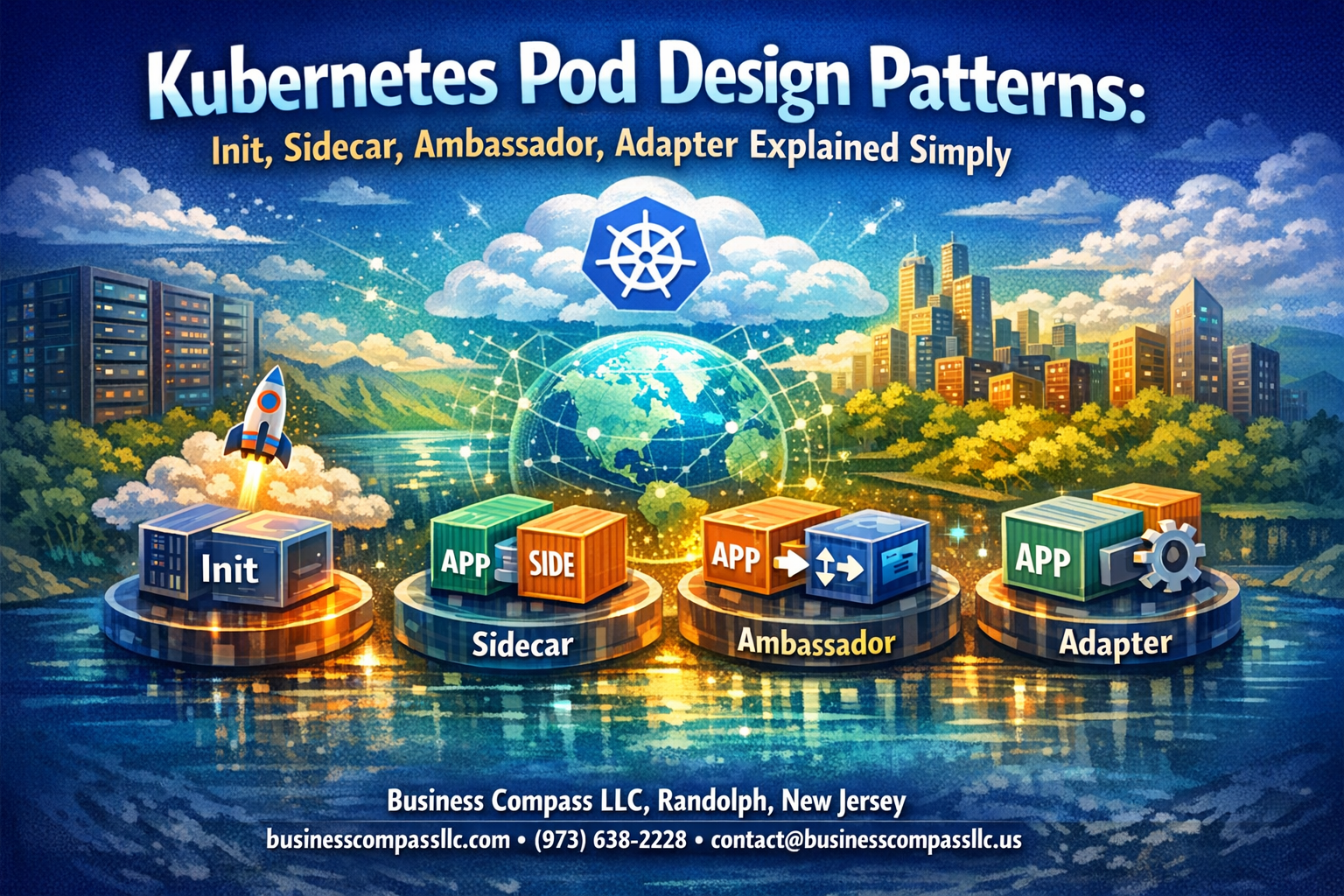
Kubernetes pod design patterns help you build better containerized applications by organizing how containers work together within a single pod. These patterns solve common problems like startup dependencies, service communication, and data transformation without changing your main application code.
This guide is for developers and DevOps engineers who want to understand how to design robust Kubernetes applications using proven container patterns. You’ll learn practical approaches that make your pods more reliable and easier to maintain.
We’ll explore the four essential Kubernetes pod patterns that every container developer should know. You’ll discover how init containers handle sequential startup requirements and see real sidecar container examples that enhance your applications. We’ll also cover how the ambassador pattern microservices approach simplifies external connections and how the adapter pattern kubernetes implementation transforms data on the fly.
By the end, you’ll know exactly which kubernetes container patterns work best for different scenarios and how to implement them in your own projects.
Understanding Kubernetes Pod Design Patterns Fundamentals

Master the core concept of multi-container pods
Multi-container pods represent the fundamental building block where kubernetes pod design patterns come alive. Instead of cramming everything into a single container, these patterns leverage multiple specialized containers working together within the same pod. Each container handles specific responsibilities while sharing the same network namespace, storage volumes, and lifecycle. This approach transforms how we architect kubernetes pod architecture by promoting separation of concerns and reusability.
Discover how design patterns solve complex deployment challenges
Container design patterns tackle real-world problems that plague modern deployments. When your main application needs configuration setup before starting, logging sidecars for monitoring, or protocol translation for external services, these patterns provide proven solutions. They eliminate the need to rebuild application images for infrastructure concerns, reduce coupling between components, and enable teams to develop, test, and deploy different parts of the system independently while maintaining seamless integration.
Learn when to implement each pattern for maximum efficiency
Choosing the right kubernetes container patterns depends on your specific challenges and timing requirements. Use init containers when you need sequential startup dependencies or one-time setup tasks. Deploy sidecar containers for ongoing auxiliary services like logging, monitoring, or security proxies. Implement ambassador patterns when dealing with complex service discovery or protocol adaptation. Apply adapter patterns when you need data transformation without modifying existing applications, ensuring clean separation between business logic and infrastructure concerns.
Init Container Pattern: Sequential Startup Made Simple

Execute prerequisite tasks before main application starts
Init containers run to completion before your main application container launches, making them perfect for handling setup tasks. These containers share the same pod lifecycle as your main application but execute sequentially, ensuring each prerequisite completes successfully before the next step begins.
Ensure dependencies and configurations are ready
The init container pattern shines when your application needs external services or configurations ready before startup. You can check database connectivity, wait for required services to become available, or download configuration files from external sources. This approach prevents your main application from crashing due to missing dependencies.
Handle database migrations and file system preparations
Database schema migrations represent a classic init container use case in Kubernetes pod design patterns. Your init container can:
- Execute database migration scripts
- Create required directories and set proper permissions
- Download and extract application assets
- Generate configuration files based on environment variables
- Validate system requirements before main container starts
Implement proper error handling and retry mechanisms
Robust init containers include retry logic and proper error handling to deal with transient failures. Configure appropriate restart policies and timeout values to prevent infinite loops while allowing sufficient time for external dependencies to become ready. Failed init containers will restart according to the pod’s restart policy, ensuring your application only starts when all prerequisites are met.
Sidecar Pattern: Enhance Your Main Application Seamlessly
Add monitoring and logging capabilities without code changes
The sidecar pattern kubernetes excels at adding observability features to your main application without touching its source code. Deploy logging agents like Fluentd or monitoring tools like Prometheus exporters alongside your primary container, creating a clean separation of concerns. Your application continues running unchanged while the sidecar handles metrics collection, log aggregation, and data forwarding to external systems.
Implement security proxies and SSL termination
Security becomes effortless when sidecar containers handle authentication, authorization, and encryption tasks. Popular service mesh solutions like Istio leverage this kubernetes pod pattern to inject security proxies that manage SSL/TLS termination, mutual authentication, and traffic encryption. Your main application communicates over plain HTTP locally while the sidecar manages all security protocols with external services.
Deploy configuration management and secret rotation
Configuration updates and secret management become seamless with dedicated sidecar containers. These auxiliary containers can pull configuration changes from external sources, rotate API keys and certificates, and update shared volumes without restarting your main application. This approach maintains zero-downtime operations while keeping sensitive data handling separate from business logic.
Scale auxiliary services independently from main containers
One major advantage of sidecar container examples lies in independent scaling capabilities. Your monitoring sidecar might need different resource allocations than your main application, and this kubernetes container pattern allows precise resource management. Scale logging components based on data volume, security proxies based on traffic patterns, and configuration managers based on update frequency, all without affecting your core application’s performance characteristics.
Ambassador Pattern: Simplify External Service Communication

Abstract complex service discovery and load balancing
The ambassador pattern kubernetes design acts as a proxy container that sits alongside your main application, handling all the messy details of connecting to external services. Instead of hardcoding service URLs or managing load balancing logic in your application code, the ambassador container takes care of service discovery automatically. Your application simply connects to localhost, while the ambassador figures out which actual service instances are available and routes traffic accordingly.
Handle circuit breakers and retry logic transparently
Ambassador containers excel at implementing resilience patterns without cluttering your main application. They can detect when external services are down and automatically implement circuit breaker logic, preventing cascading failures across your microservices architecture. Retry mechanisms, timeout handling, and fallback responses all happen transparently through the ambassador, keeping your core application code clean and focused on business logic rather than infrastructure concerns.
Manage multiple environment configurations effortlessly
The ambassador pattern microservices approach shines when dealing with different environments like development, staging, and production. Each environment can have its own ambassador configuration, pointing to different service endpoints, using different authentication methods, or applying environment-specific routing rules. Your application container remains unchanged across environments – only the ambassador configuration needs updating, making deployments safer and more predictable.
Adapter Pattern: Transform Data Without Application Modifications

Convert legacy application outputs to modern formats
The adapter pattern kubernetes works like a translator between old and new systems. Picture your legacy application spitting out data in XML format while your monitoring tools expect JSON. An adapter container sits alongside your main application, catches that XML output, and transforms it into the JSON format your modern stack needs. This pattern keeps your legacy code untouched while making it compatible with contemporary infrastructure.
Normalize metrics and logs for centralized monitoring
Different applications produce metrics in various formats – some use StatsD, others Prometheus format, and legacy systems might export custom formats. The adapter pattern standardizes these outputs without touching application code. Your adapter container collects diverse metric formats and converts them into a unified structure that your centralized monitoring system can ingest. This approach simplifies observability across heterogeneous environments while maintaining application independence.
Bridge incompatible APIs and protocols seamlessly
When applications need to communicate but speak different protocols, adapter containers bridge the gap effortlessly. Your modern microservice might expect REST APIs while connecting to a legacy SOAP service. The adapter handles protocol translation, authentication differences, and data format conversion. This kubernetes pod architecture approach isolates complexity from your main application logic, making integration painless and maintainable.
Maintain backward compatibility during system upgrades
System migrations become less risky with adapter patterns. While upgrading your database from MySQL to PostgreSQL, an adapter container can translate query formats and response structures. Your application continues working with familiar interfaces while the adapter handles backend changes transparently. This strategy reduces migration complexity and allows gradual system evolution without breaking existing functionality.
Choosing the Right Pattern for Your Use Case

Evaluate your application requirements and constraints
Start by asking yourself what problems you’re actually trying to solve. If your main container needs specific setup work done before it starts, the init container pattern is your go-to solution. For applications requiring logging, monitoring, or security enhancements without touching the main codebase, sidecar patterns work perfectly. When dealing with legacy applications that can’t handle modern service discovery or need protocol translation, ambassador patterns bridge that gap seamlessly.
Consider your team’s expertise and operational complexity tolerance. Init containers add minimal overhead but require careful dependency management. Sidecar containers increase resource usage and pod complexity but provide powerful extensibility. The adapter pattern excels when you need data transformation between incompatible systems, while ambassador patterns shine in microservices architectures requiring external service abstraction.
Compare pattern benefits and implementation complexity
Each Kubernetes pod design pattern offers distinct advantages with varying implementation challenges. Init containers provide the simplest setup for sequential startup requirements, requiring minimal configuration changes to your existing deployments. Sidecar patterns offer maximum flexibility for extending functionality but demand careful resource allocation and inter-container communication planning.
Ambassador patterns excel at decoupling your application from external service complexities, though they introduce additional network hops that might impact performance. Adapter patterns solve data transformation challenges elegantly but require thorough understanding of both input and output formats. Choose patterns based on your specific use case rather than following trends.
Avoid common pitfalls and anti-patterns
Don’t overcomplicate simple problems by forcing multiple patterns into a single pod when one would suffice. Mixing sidecar and ambassador patterns without clear separation of concerns creates maintenance nightmares and debugging challenges. Avoid using init containers for long-running processes – they’re designed for setup tasks, not background services.
Resource limits become critical when implementing kubernetes container patterns. Many teams forget to account for sidecar container resource consumption, leading to resource starvation. Never use adapter patterns when direct API changes would be simpler and more maintainable long-term.
Kubernetes pod design patterns give you powerful tools to solve common application challenges without overcomplicating your deployments. Init containers handle your setup tasks before your main app starts, sidecars add functionality like logging or monitoring alongside your application, ambassadors act as smart proxies for external services, and adapters transform data formats on the fly. Each pattern serves a specific purpose and can make your containerized applications more robust and maintainable.
The key is matching the right pattern to your specific needs. If you need sequential startup steps, go with init containers. When you want to add features without touching your main code, sidecars are your friend. For complex external service interactions, ambassadors shine, and adapters are perfect when you need data transformation between services. Start small with one pattern that addresses your biggest pain point, then gradually incorporate others as your Kubernetes expertise grows.