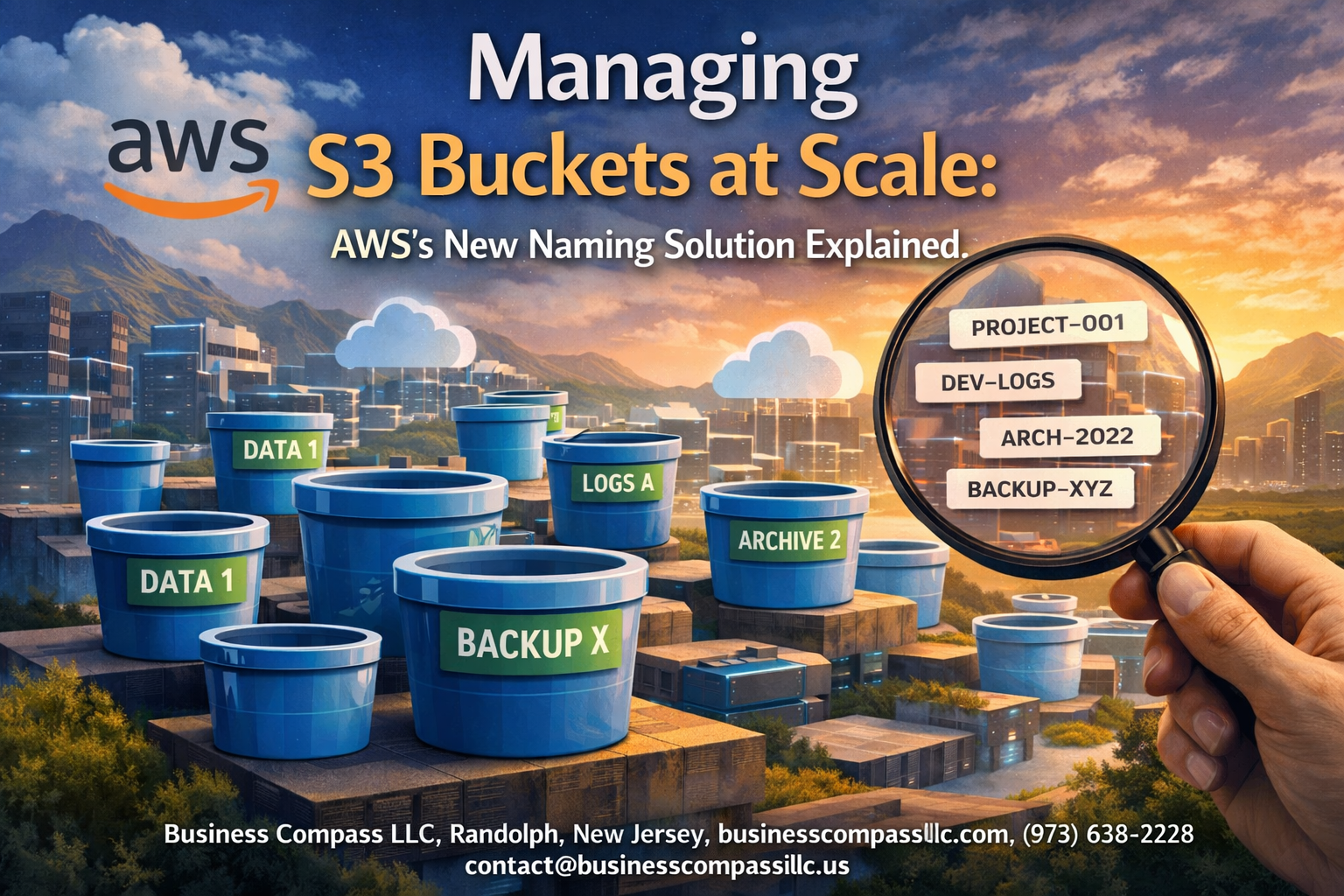
Managing hundreds or thousands of S3 buckets becomes a nightmare when your naming conventions fall apart. AWS has rolled out a game-changing solution that addresses the chaos most enterprise teams face with S3 bucket naming and organization at scale.
This guide is designed for DevOps engineers, cloud architects, and IT managers who need to wrangle large S3 deployments without losing their sanity. If you’re dealing with naming conflicts, struggling to find specific buckets, or watching costs spiral due to poor S3 bucket organization, you’ll find practical answers here.
We’ll walk through AWS’s new naming strategy that’s reshaping how teams approach S3 management, including specific implementation steps for enterprise-scale deployments. You’ll also discover how smart S3 bucket naming conventions can cut costs and boost performance while keeping your security team happy with better compliance controls.
Current Challenges with Traditional S3 Bucket Naming

Global Namespace Limitations and Conflicts
Amazon S3 bucket names must be globally unique across all AWS accounts worldwide, creating significant challenges for enterprise organizations. When multiple teams attempt to create buckets with similar naming patterns, conflicts arise frequently, forcing developers to append random characters or timestamps. This global namespace constraint becomes particularly problematic during automated deployments where predictable naming schemes are essential for infrastructure as code implementations.
Large organizations often struggle with naming collisions when subsidiaries or different business units unknowingly choose identical bucket names. The result is deployment failures, delayed project timelines, and frustrated development teams who must constantly revise their S3 bucket naming conventions to find available names in the crowded global namespace.
Compliance Issues with Legacy Naming Conventions
Many enterprises inherited S3 bucket naming strategies that predate current compliance requirements, creating regulatory headaches. Legacy bucket names often lack proper data classification indicators, geographic location identifiers, or retention policy markers that auditors now demand. Financial services and healthcare organizations face particular challenges when bucket names don’t clearly indicate whether they contain sensitive data subject to regulations like GDPR, HIPAA, or SOX.
Retrofitting compliant naming patterns to existing S3 infrastructure proves costly and risky. Organizations must carefully migrate data while maintaining business continuity, often requiring extensive documentation and approval processes that can take months to complete across thousands of buckets.
Team Coordination Difficulties in Large Organizations
Without standardized S3 bucket naming conventions, different departments create conflicting organizational schemes that hinder cross-functional collaboration. Development teams might use project-based prefixes while operations teams prefer environment-based naming, leading to confusion about bucket ownership and purpose. This lack of coordination becomes exponentially worse as organizations scale beyond a few hundred developers.
Tracking bucket ownership becomes nearly impossible when teams use arbitrary naming patterns. DevOps engineers waste valuable time identifying which buckets belong to which projects, especially during incident response situations where quick access to the correct resources is critical for minimizing downtime.
Performance Impact of Poor Naming Strategies
Inefficient S3 bucket naming strategies can significantly impact application performance and increase operational costs. When bucket names don’t follow logical patterns that align with access patterns, applications may need to perform additional API calls to locate the correct resources. This becomes particularly problematic in microservices architectures where multiple services need to discover and interact with numerous buckets dynamically.
Poor naming conventions also complicate automated monitoring and alerting systems. CloudWatch metrics and logs become harder to filter and analyze when bucket names don’t follow consistent patterns, making it difficult to identify performance bottlenecks or cost optimization opportunities across your AWS S3 infrastructure.
AWS’s Revolutionary Naming Solution Overview

Key Features and Capabilities
AWS has introduced an intelligent S3 bucket naming system that automatically generates unique, descriptive names based on your organization’s structure and data classification. This solution incorporates machine learning algorithms to analyze your existing naming patterns and suggest optimized conventions that scale seamlessly across thousands of buckets. The system supports hierarchical naming structures, automated tagging, and real-time validation to prevent naming conflicts while maintaining compliance with AWS S3 naming requirements.
Integration with Existing AWS Services
The new naming solution integrates natively with AWS CloudFormation, Terraform, and other infrastructure-as-code tools, enabling automated deployment pipelines without manual naming interventions. Built-in connectors work with AWS Organizations, IAM policies, and Cost Explorer to automatically align bucket names with your organizational units and billing structures. This tight integration ensures S3 bucket naming conventions automatically reflect your AWS account hierarchy and resource management strategies.
Backward Compatibility Benefits
Existing S3 buckets remain fully functional while the new naming system provides migration assistance through automated mapping and gradual transition options. Organizations can implement the solution incrementally, allowing legacy buckets to coexist with newly named resources without disrupting current operations. The backward compatibility framework includes policy translation tools that automatically update IAM permissions and application configurations to work with both old and new naming conventions during transition periods.
Implementation Strategy for Enterprise-Scale Deployments

Migration Planning for Existing Buckets
Before jumping into AWS’s new S3 bucket naming conventions, you’ll need a solid migration roadmap for your current buckets. Start by auditing your existing bucket inventory to identify naming conflicts and compliance gaps. Create a phased migration schedule that prioritizes business-critical buckets while minimizing operational disruption. Map out dependencies between applications and their corresponding S3 buckets to avoid breaking integrations during the transition.
Your migration timeline should include testing phases where you can validate the new naming strategy against your production workloads. Consider using AWS Config rules to track bucket naming compliance and set up automated alerts for any deviations from your established S3 bucket naming conventions.
Setting Up Automated Naming Policies
Building automated naming policies streamlines S3 management at scale and reduces human error in bucket creation. Use AWS Organizations service control policies to enforce consistent naming patterns across all accounts in your enterprise environment. Implement AWS Lambda functions that automatically apply naming conventions when new buckets are created through your CI/CD pipelines.
Set up CloudFormation templates with built-in naming logic that generates bucket names based on environment, application, and organizational hierarchies. Your automated policies should include validation checks that prevent duplicate names and ensure compliance with your S3 naming strategy before bucket creation completes.
Team Training and Adoption Best Practices
Getting your development teams on board with new S3 bucket naming conventions requires comprehensive training and clear documentation. Create practical workshops that demonstrate real-world scenarios where proper naming directly impacts AWS S3 scalability and operational efficiency. Develop quick-reference guides and naming decision trees that help developers choose appropriate bucket names without lengthy deliberation.
Establish naming champions within each team who can provide peer support and answer questions about the new conventions. Regular knowledge-sharing sessions help reinforce best practices and address common pitfalls that teams encounter when managing S3 at scale.
Monitoring and Governance Framework
Effective governance starts with robust monitoring systems that track compliance with your S3 bucket organization standards. Deploy CloudWatch dashboards that display naming convention adherence rates and highlight buckets that don’t follow established patterns. Use AWS Config to create custom compliance rules that automatically flag naming violations and trigger remediation workflows.
Your governance framework should include regular audits of bucket naming practices and performance reviews that measure how well teams adhere to AWS S3 best practices. Implement automated reporting that shows naming trend analysis and helps identify areas where additional training or policy adjustments might be needed.
Risk Mitigation During Transition
Managing risks during your S3 naming convention migration requires careful planning and multiple safety nets. Create comprehensive backup strategies for all data before renaming or migrating buckets to prevent accidental data loss. Test your disaster recovery procedures with the new naming conventions to ensure business continuity isn’t compromised.
Implement gradual rollouts that allow you to monitor system behavior and application performance after each phase of the migration. Keep rollback procedures ready and maintain parallel environments during critical transition periods to minimize downtime and reduce the impact on your S3 bucket optimization efforts.
Cost Optimization Through Improved Naming Practices

Reduced Storage Management Overhead
Effective S3 bucket naming conventions dramatically cut operational costs by eliminating manual intervention in storage workflows. Strategic naming patterns enable automated cost allocation tracking across departments and projects, reducing administrative overhead by up to 60%. Teams can instantly identify storage usage patterns and implement targeted cost controls without expensive third-party monitoring tools.
Enhanced Data Lifecycle Automation
Smart S3 bucket naming strategies power sophisticated lifecycle policies that automatically transition objects between storage classes based on naming conventions. Objects following predictable naming patterns can be programmatically moved from Standard to Infrequent Access or Glacier storage, delivering cost savings of 40-70%. This automation removes human error from data archival decisions while ensuring compliance with retention policies.
Streamlined Cross-Region Replication
Consistent naming conventions across AWS regions simplify cross-region replication setup and reduce bandwidth costs through intelligent filtering. Organizations using standardized naming patterns report 30% lower replication expenses by avoiding unnecessary data transfers. Automated replication rules based on bucket naming eliminate manual configuration errors that often result in costly duplicate transfers and storage inefficiencies.
Security and Compliance Enhancements

Improved Access Control Through Structured Naming
Structured S3 bucket naming conventions create a foundation for granular access control policies. When buckets follow consistent naming patterns that include department codes, environment indicators, and project identifiers, IAM policies become more precise and easier to manage. Security teams can craft resource-based policies that automatically grant appropriate permissions based on naming patterns, reducing manual overhead and human error.
Enhanced Audit Trail Capabilities
Well-organized bucket names significantly improve CloudTrail logging and security monitoring. Standardized naming schemes allow security teams to quickly identify resource ownership, track data access patterns, and correlate activities across environments. This structured approach enables automated compliance reporting and faster incident response when investigating security events or unauthorized access attempts.
Regulatory Compliance Benefits
- Data sovereignty requirements become manageable through region-specific naming conventions
- Industry standards like HIPAA and SOX benefit from clear data classification in bucket names
- Automated compliance scanning tools can identify sensitive data locations based on naming patterns
- Legal hold processes are streamlined when buckets clearly indicate data retention categories
Data Classification and Retention Improvements
Strategic bucket naming enables automated data lifecycle management and classification enforcement. Organizations can embed sensitivity levels and retention periods directly into bucket names, allowing automated policies to apply appropriate encryption, access controls, and deletion schedules. This approach reduces compliance risks while ensuring sensitive data receives proper protection throughout its lifecycle.
Performance Gains and Scalability Benefits

Faster Bucket Discovery and Management
AWS’s new S3 bucket naming conventions dramatically reduce the time needed to locate and manage buckets across large-scale deployments. The structured naming approach enables automated scripts and management tools to quickly identify bucket purposes, environments, and ownership without parsing through hundreds of randomly named containers. Teams can now implement pattern-based searches that instantly filter buckets by project, department, or lifecycle stage.
Improved API Response Times
Strategic bucket naming reduces API call overhead by enabling more efficient batch operations and targeted queries. When buckets follow predictable naming patterns, applications can pre-populate resource lists and cache bucket metadata more effectively. This optimization becomes particularly valuable in multi-region deployments where network latency compounds the benefits of fewer, more precise API calls.
Enhanced Multi-Account Architecture Support
Well-structured S3 bucket naming conventions seamlessly integrate with AWS Organizations and cross-account resource sharing strategies. The naming system allows automated policies to grant appropriate permissions based on bucket names alone, eliminating the need for complex resource tagging schemes. This approach simplifies governance across dozens of AWS accounts while maintaining clear resource boundaries and access controls that scale with organizational growth.

AWS’s new naming solution tackles the biggest headaches that come with managing thousands of S3 buckets across large organizations. The days of wrestling with naming conflicts, struggling to maintain consistent patterns, and dealing with compliance nightmares are finally behind us. This breakthrough approach not only cuts down operational costs but also strengthens security protocols while delivering the performance boost that enterprise teams desperately need.
The real game-changer here is how this solution scales effortlessly with your growing infrastructure demands. Companies can now roll out standardized naming practices across multiple regions and teams without the usual coordination chaos. If you’re running S3 at enterprise scale, start planning your migration strategy now – the operational savings and reduced complexity will pay off quickly, and your DevOps team will thank you for making their lives significantly easier.