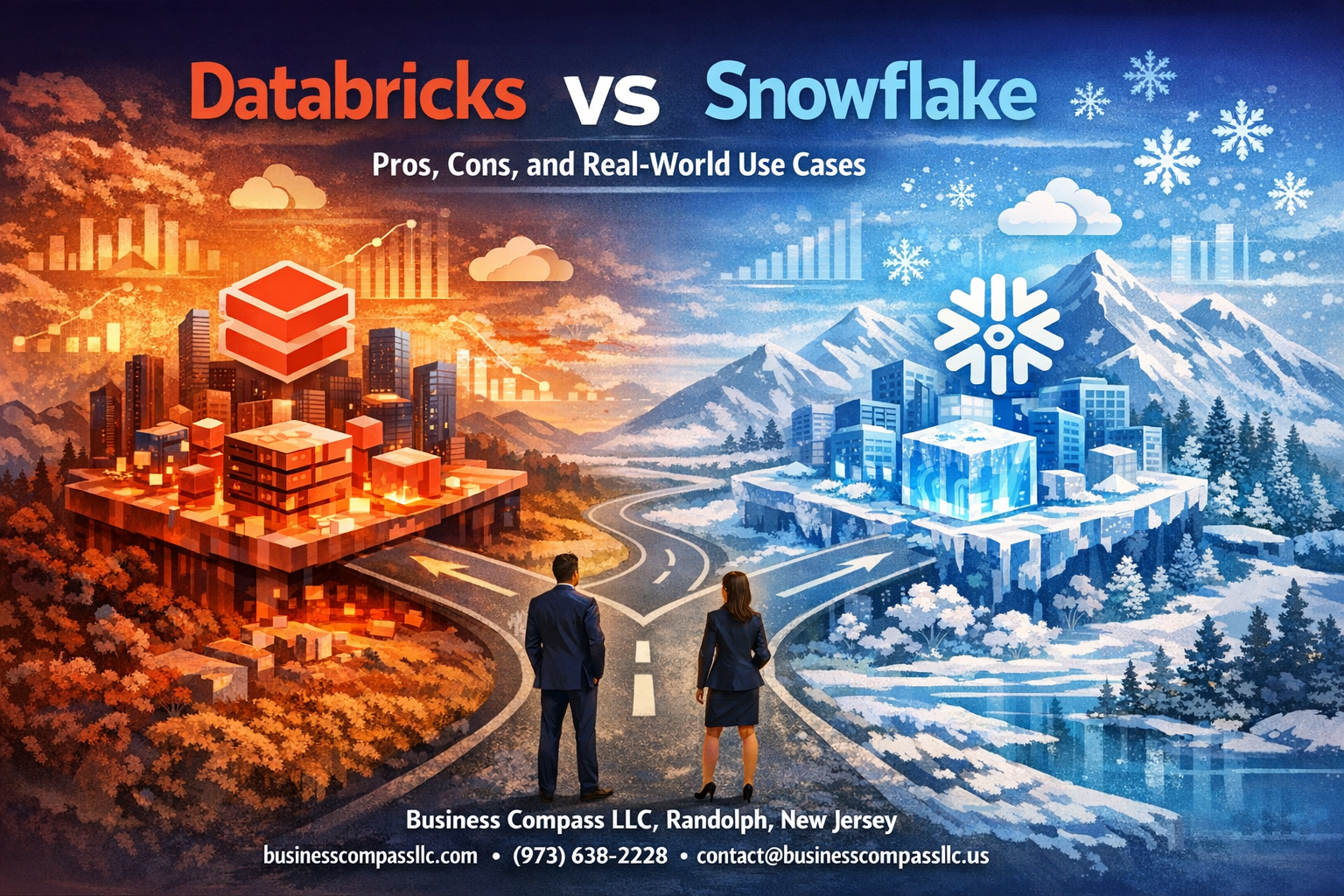
Choosing between Databricks vs Snowflake can make or break your data strategy. Both platforms dominate the cloud data space, but they solve different problems and serve different needs.
This comparison is for data engineers, analysts, and technical leaders who need to pick the right platform for their organization’s data workloads. Maybe you’re building a new data stack from scratch, or you’re considering switching from your current solution.
We’ll break down the core strengths each platform brings to data processing and analytics, helping you understand where each one shines. You’ll also get a clear picture of how their pricing models stack up against real usage scenarios. Finally, we’ll walk through specific use cases where companies chose one over the other, so you can see how these decisions play out in practice.
Platform Overview and Core Capabilities

Databricks unified analytics platform architecture
Databricks operates as a unified data and AI platform built on top of cloud infrastructure, offering a collaborative workspace where data engineers, data scientists, and analysts can work together seamlessly. The platform centers around Apache Spark as its core processing engine, providing distributed computing capabilities that handle everything from ETL workflows to machine learning model training. This lakehouse architecture combines the best features of data lakes and data warehouses, storing structured and unstructured data in open formats like Delta Lake while maintaining ACID transactions and schema enforcement.
The platform’s notebook-based interface supports multiple programming languages including Python, R, Scala, and SQL, making it accessible to different technical skill levels. Auto-scaling clusters spin up and down based on workload demands, while the integrated MLflow component manages the complete machine learning lifecycle from experimentation to production deployment. Databricks also includes collaborative features like shared workspaces, version control, and real-time co-authoring capabilities.
Snowflake cloud data warehouse foundation
Snowflake takes a different approach with its cloud-native data warehouse architecture that separates compute from storage. This unique multi-cluster shared data architecture allows multiple compute clusters to access the same data simultaneously without performance degradation. The platform handles all infrastructure management automatically, including scaling, patching, and optimization, which removes operational overhead from data teams.
Built specifically for the cloud, Snowflake stores data in a proprietary columnar format optimized for analytical queries. The platform supports semi-structured data natively, automatically detecting and parsing JSON, XML, and other formats without requiring predefined schemas. Virtual warehouses can be created instantly and scaled up or down independently based on query complexity and user demand. Snowflake’s Time Travel feature maintains historical versions of data for up to 90 days, enabling easy recovery and analysis of data changes over time.
Key differentiators in data processing approaches
The fundamental difference lies in their core philosophies: Databricks embraces the lakehouse concept with unified batch and streaming processing, while Snowflake focuses on delivering the ultimate cloud data warehouse experience. Databricks excels at complex data transformations, machine learning workflows, and streaming analytics through its Spark foundation. Users can process raw data directly without extensive preprocessing, making it ideal for exploratory data analysis and advanced analytics.
Snowflake prioritizes query performance and ease of use for traditional business intelligence workloads. Its automatic query optimization and caching mechanisms deliver consistently fast results for SQL-based analytics. The platform handles data compression, clustering, and indexing automatically, requiring minimal tuning from users. While Snowflake recently added support for Python and other languages through Snowpark, its strength remains in SQL-centric analytical workloads.
| Feature | Databricks | Snowflake |
|---|---|---|
| Primary Use Case | Data science, ML, complex analytics | Business intelligence, reporting |
| Processing Model | Unified batch and streaming | Primarily batch with near real-time |
| Query Language | Multi-language (Python, R, Scala, SQL) | SQL-first with Python support |
| Data Format | Open formats (Delta Lake, Parquet) | Proprietary optimized format |
Target user personas and organizational fit
Databricks attracts organizations with strong data science and engineering teams who need to build complex data pipelines and machine learning models. Companies in technology, financial services, and research-heavy industries often choose Databricks when they have advanced analytics requirements and skilled technical resources. The platform suits teams comfortable with programming and who need flexibility in their data processing approaches.
Data scientists and machine learning engineers gravitate toward Databricks for its comprehensive ML capabilities and collaborative notebooks. Data engineers appreciate the platform’s ability to handle both batch and streaming workloads within a single environment. Organizations pursuing AI initiatives or dealing with large-scale data processing typically find Databricks more aligned with their technical needs.
Snowflake appeals to organizations prioritizing ease of use and fast time-to-insight for business analytics. Companies with strong SQL skills but limited data engineering resources often prefer Snowflake’s managed approach. The platform fits well in traditional enterprises, retail, healthcare, and any organization where business analysts and BI developers are the primary data consumers.
Business analysts, financial analysts, and BI developers find Snowflake’s SQL-centric interface more accessible than Databricks’ programming-heavy environment. Organizations looking to modernize their data warehouse without significant changes to existing workflows often choose Snowflake for its familiar SQL interface and automatic optimization features.
Data Processing and Analytics Strengths

Databricks Machine Learning and AI Workflow Advantages
Databricks shines when it comes to machine learning workflows, offering a unified platform that handles everything from data preparation to model deployment. The platform’s collaborative notebooks allow data scientists and engineers to work together seamlessly, sharing code, visualizations, and insights in real-time. MLflow, Databricks’ built-in MLOps solution, tracks experiments, manages model versions, and automates deployment pipelines without requiring additional tools.
The platform’s AutoML capabilities accelerate model development by automatically testing different algorithms and hyperparameters. Data scientists can focus on feature engineering and business logic while AutoML handles the heavy lifting of model selection. Feature Store integration ensures consistent feature definitions across teams and prevents data leakage between training and serving environments.
Databricks Unity Catalog provides governance and lineage tracking for ML assets, making it easier to maintain compliance and understand data dependencies. The platform’s support for popular frameworks like TensorFlow, PyTorch, and scikit-learn means teams don’t need to rewrite existing code when migrating to the platform.
Snowflake SQL-First Approach Benefits
Snowflake’s architecture centers around SQL, making it incredibly accessible to analysts and business users who already know this standard query language. The platform’s SQL engine handles complex analytical queries efficiently, supporting advanced functions like window functions, recursive CTEs, and JSON processing without requiring specialized knowledge.
Zero-copy cloning allows teams to create instant copies of databases or tables for testing and development without consuming additional storage. This feature enables safe experimentation with production data and supports agile development practices.
Snowflake’s separation of compute and storage means multiple teams can query the same data simultaneously without performance conflicts. Each virtual warehouse can be sized independently and automatically suspended when not in use, preventing resource waste.
The platform’s native support for semi-structured data like JSON, Avro, and Parquet eliminates the need for complex ETL processes to flatten nested data. Analysts can query JSON documents directly using SQL, making it easier to work with modern data sources like APIs and log files.
Real-Time Streaming Capabilities Comparison
| Feature | Databricks | Snowflake |
|---|---|---|
| Streaming Framework | Spark Structured Streaming | Snowpipe Streaming |
| Latency | Sub-second to seconds | Seconds to minutes |
| Data Sources | Kafka, Kinesis, Event Hubs | REST APIs, Kafka, Snowpipe |
| Processing Model | Micro-batch and continuous | Continuous ingestion |
| Transformation | Complex real-time transforms | Basic transformations |
Databricks excels at complex real-time processing with Spark Structured Streaming, handling windowing operations, stateful processing, and complex joins on streaming data. The platform can process millions of events per second with low latency, making it ideal for fraud detection, recommendation engines, and IoT analytics.
Snowflake’s streaming approach focuses on continuous data ingestion rather than complex stream processing. Snowpipe Streaming provides near real-time data loading with automatic scaling and error handling. While not designed for complex real-time analytics, it excels at keeping data warehouses current with minimal latency.
Data Transformation and ETL Performance
Databricks leverages Apache Spark’s distributed computing engine for large-scale data transformations, automatically parallelizing operations across multiple nodes. Delta Lake’s ACID transactions ensure data consistency during complex multi-step transformations, while automatic compaction and vacuum operations maintain optimal file sizes.
The platform’s Photon engine accelerates SQL queries and data transformations by up to 12x compared to standard Spark, particularly for selective queries and aggregations. Auto Loader simplifies incremental data processing by automatically detecting new files and processing only changed data.
Snowflake’s columnar storage and query optimization engine excel at analytical workloads, automatically creating micro-partitions and maintaining column statistics for optimal query performance. The platform’s ability to scale compute resources instantly means ETL jobs can access additional processing power on-demand without manual intervention.
Time Travel and Fail-safe features provide data recovery options during transformation failures, while result caching reduces redundant processing for repeated queries. Snowflake’s automatic clustering maintains optimal data organization without manual tuning, ensuring consistent performance as data volumes grow.
Cost Structure and Pricing Models

Databricks Compute-Based Pricing Transparency
Databricks operates on a consumption-based pricing model centered around Databricks Units (DBUs), which measure compute resources used during data processing and analytics workloads. Each cluster configuration has a specific DBU rate per hour, with costs varying based on instance types, cluster sizes, and workload complexity. This approach provides clear visibility into what drives your expenses—every query, job, and notebook session directly correlates to measurable compute consumption.
The pricing structure includes several key components: compute costs for different cluster types (All-Purpose, Job, SQL Analytics), storage costs for Delta Lake, and potential premium features like Unity Catalog or MLflow. Databricks publishes detailed DBU rates across different cloud providers (AWS, Azure, GCP), making it easier to estimate costs upfront. You can also leverage spot instances and auto-scaling features to optimize expenses, with clusters automatically starting and stopping based on workload demands.
What makes Databricks pricing particularly transparent is the granular tracking available through the usage dashboard. You can monitor DBU consumption by workspace, user, job, and time period, enabling precise cost allocation and budgeting. This visibility helps organizations identify expensive workloads and optimize their data processing pipelines accordingly.
Snowflake Storage and Compute Separation Benefits
Snowflake’s architecture fundamentally separates storage and compute resources, creating unique cost advantages and flexibility that traditional data warehouses can’t match. Storage costs are based on the actual data volume compressed in Snowflake’s proprietary format, typically achieving 50-80% compression ratios compared to raw data. You only pay for what you store, with costs ranging from $23-40 per TB per month depending on your cloud region.
Compute costs operate independently through virtual warehouses that can be sized from XS to 6XL, with each size doubling the compute power and cost. Virtual warehouses can be started, stopped, suspended, and resized on-demand without affecting data availability. This separation means you can:
- Scale compute resources up during heavy analytical workloads
- Scale down or suspend warehouses during idle periods
- Run multiple concurrent workloads on separate virtual warehouses
- Size different warehouses based on specific use case requirements
The pay-per-second billing (with a one-minute minimum) provides exceptional cost control for sporadic or batch workloads. Teams can spin up powerful warehouses for intensive processing and immediately scale back down, paying only for actual usage time. This elasticity particularly benefits organizations with variable workload patterns or seasonal analytics demands.
Hidden Costs and Budget Predictability Factors
Both platforms present potential hidden costs that can catch organizations off-guard without proper planning and monitoring. Databricks’ main cost surprises typically stem from long-running clusters, inefficient Spark jobs, and premium feature adoption. All-Purpose clusters left running overnight or over weekends can generate significant unexpected bills, especially with larger instance types. Data transfer costs between regions or cloud providers can also accumulate quickly for distributed architectures.
Snowflake’s hidden costs often emerge from:
- Query spillage to remote storage when warehouses lack sufficient memory
- Automatic clustering and search optimization services that incur background compute costs
- Cross-region data replication and sharing
- Warehouse auto-suspension delays that keep resources running longer than expected
| Factor | Databricks | Snowflake |
|---|---|---|
| Auto-scaling predictability | High – clear DBU rates | High – second-level billing |
| Data transfer costs | Can be significant | Moderate within same cloud |
| Idle resource risks | High – manual cluster management | Low – auto-suspend features |
| Performance optimization costs | Included in compute | May require additional services |
Budget predictability requires establishing proper governance policies, monitoring dashboards, and cost allocation strategies. Databricks users should implement cluster policies, job scheduling, and workspace-level budget alerts. Snowflake users benefit from resource monitors, warehouse auto-suspend configurations, and query timeout settings. Both platforms offer cost management APIs and third-party tools for enhanced financial visibility and control.
Regular cost reviews, workload optimization, and team education about pricing models help prevent bill shock and ensure sustainable data platform operations.
Performance and Scalability Analysis

Query Performance Benchmarks Across Workloads
Both platforms deliver exceptional query performance, but their strengths shine in different scenarios. Databricks typically outperforms Snowflake in complex analytical workloads, especially those involving machine learning and real-time data processing. The platform’s Delta Lake architecture and Photon engine can handle large-scale ETL operations with remarkable speed, often completing jobs 30-50% faster than traditional data warehouses.
Snowflake excels in standard SQL queries and business intelligence workloads. Its unique architecture separates compute from storage, allowing multiple teams to run concurrent queries without performance degradation. In benchmark tests, Snowflake consistently delivers sub-second response times for dashboard queries and reporting tasks.
| Workload Type | Databricks Performance | Snowflake Performance |
|---|---|---|
| Complex ETL | Excellent (30-50% faster) | Good |
| BI/Reporting | Good | Excellent (sub-second) |
| ML Training | Excellent | Limited |
| Ad-hoc Analytics | Very Good | Excellent |
Auto-scaling Capabilities and Efficiency
Databricks provides granular auto-scaling control through its cluster management system. Clusters can scale from 2 to 30+ nodes based on workload demands, with scaling decisions happening in under 60 seconds. The platform’s intelligent scaling algorithms consider factors like job complexity, data volume, and historical usage patterns to optimize resource allocation.
Snowflake’s auto-scaling operates differently but equally effectively. Virtual warehouses can be configured to automatically suspend during idle periods and resume instantly when queries arrive. The platform supports multi-cluster warehouses that automatically add or remove compute resources based on query queuing and concurrency needs.
Key auto-scaling advantages:
- Databricks: Fine-tuned control over cluster configurations, spot instance support for cost optimization
- Snowflake: Instant scaling with zero warm-up time, automatic suspension to minimize costs
Multi-cloud Deployment Flexibility
Databricks maintains a consistent experience across AWS, Azure, and Google Cloud Platform. The unified interface and API structure remain identical regardless of the underlying cloud provider, making multi-cloud strategies seamless. Organizations can deploy workloads where data residency requirements or cost considerations dictate.
Snowflake offers native support across all three major cloud providers with identical SQL interface and functionality. Data can be replicated across clouds automatically, and federated queries can access data stored in different cloud environments without complex configuration.
Both platforms handle cross-cloud data sharing elegantly:
- Data replication: Automatic synchronization across regions and clouds
- Security compliance: Maintains encryption and governance standards across all deployments
- Performance optimization: Intelligent query routing to minimize data movement costs
Concurrent User Handling Capacity
Databricks handles concurrent users through its workspace model, where multiple teams can share clusters or maintain isolated environments. Interactive notebooks support dozens of simultaneous users per cluster, while production workloads can run on dedicated infrastructure to avoid resource conflicts.
Snowflake’s architecture naturally supports massive concurrency. Each virtual warehouse operates independently, and the platform can handle thousands of concurrent queries without performance degradation. The separation of compute and storage means that adding more users doesn’t require complex capacity planning.
Concurrency capabilities comparison:
- Databricks: 50-100 concurrent users per standard cluster, unlimited with proper scaling
- Snowflake: 1000+ concurrent users per warehouse, virtually unlimited across multiple warehouses
- Resource isolation: Both platforms prevent query interference through proper workload separation
Performance monitoring tools in both platforms provide real-time insights into user activity, resource consumption, and query performance, enabling administrators to optimize concurrent usage patterns effectively.
Integration Ecosystem and Tool Compatibility
Third-party Connector Availability and Quality
Both Databricks and Snowflake shine when it comes to connecting with external systems, but they take different approaches. Databricks leverages its Apache Spark foundation to offer native connectors for hundreds of data sources, from traditional databases like MySQL and PostgreSQL to modern cloud services like AWS S3, Azure Blob Storage, and Google Cloud Platform. The quality of these connectors is generally excellent since they’re built on battle-tested Spark libraries that have been refined by the open-source community for years.
Snowflake takes a more curated approach with its partner ecosystem. They maintain high-quality, certified connectors for major platforms like Salesforce, ServiceNow, and SAP. What sets Snowflake apart is their rigorous certification process – each connector goes through extensive testing to ensure reliability and performance. This means you get fewer options compared to Databricks, but the ones available are rock-solid.
For real-time streaming data, Databricks has a clear advantage with built-in support for Kafka, Kinesis, and Event Hubs through Structured Streaming. Snowflake recently introduced Snowpipe Streaming, but it’s still catching up in terms of connector variety and community support.
The winner here depends on your needs: choose Databricks if you want maximum flexibility and don’t mind occasionally troubleshooting community connectors, or pick Snowflake if you prefer fewer, highly reliable options.
Business Intelligence Tool Partnerships
The BI landscape reveals interesting strategic differences between these platforms. Snowflake has invested heavily in partnerships with traditional BI vendors, creating optimized connections with Tableau, Power BI, Looker, and Qlik. These partnerships go beyond basic connectivity – Snowflake works directly with BI vendors to optimize query performance, enable advanced features like live connections, and provide seamless authentication experiences.
Databricks takes a more comprehensive approach by supporting both traditional BI tools and modern analytics platforms. Their partnerships with Tableau and Power BI are solid, but they really excel with tools that can handle more complex analytics workloads. The platform integrates beautifully with tools like Apache Superset, Grafana, and even custom visualization frameworks built with libraries like D3.js or Plotly.
| Platform | Traditional BI | Modern Analytics | Custom Dashboards |
|---|---|---|---|
| Snowflake | Excellent | Good | Limited |
| Databricks | Very Good | Excellent | Excellent |
One area where Snowflake clearly wins is ease of setup. Their partnerships with major BI tools often include one-click integrations and pre-built templates. Databricks requires more technical expertise to set up these connections, but offers greater flexibility once configured.
API Accessibility and Developer Experience
Developer experience reveals the core philosophies of each platform. Databricks embraces a code-first approach with comprehensive REST APIs, Python SDKs, and strong support for popular development frameworks. Their API coverage is extensive – you can programmatically manage clusters, submit jobs, access the workspace, and even manipulate notebooks. The documentation is developer-friendly with plenty of code examples and interactive tutorials.
Snowflake’s API story has improved dramatically over the past two years. Their SQL API allows you to execute queries programmatically, while the newer REST APIs handle account management and data loading tasks. What makes Snowflake’s APIs particularly appealing is their consistency and reliability – they rarely change breaking functionality, making them perfect for production applications.
Authentication differs significantly between the platforms. Databricks uses personal access tokens and service principals, which integrate well with modern CI/CD pipelines and infrastructure-as-code tools. Snowflake supports various authentication methods including OAuth, SAML, and key-pair authentication, making it easier to integrate with enterprise security systems.
For data scientists and analysts who prefer working in notebooks, Databricks provides native support for Jupyter, while Snowflake requires third-party solutions or their web-based Snowsight interface. However, Snowflake’s recent introduction of Snowpark brings Python and Scala support directly to the platform, closing the gap for programmatic access.
SDK quality varies by language, with both platforms offering robust Python support but Databricks having better coverage for Scala and R developers.
Real-World Implementation Scenarios

Manufacturing Predictive Analytics Use Case
Databricks Scenario: A global automotive manufacturer implemented Databricks to predict equipment failures across their production lines. They ingested streaming sensor data from 10,000+ machines using Apache Kafka, processing real-time vibration, temperature, and pressure readings. The unified analytics platform allowed their data scientists to build machine learning models using MLflow for experiment tracking and model versioning. The collaborative notebooks enabled cross-functional teams to work together, combining domain expertise from engineers with data science capabilities. The result was a 35% reduction in unplanned downtime and $2.3 million in annual savings.
Snowflake Scenario: A pharmaceutical manufacturing company chose Snowflake to centralize quality control data from multiple facilities worldwide. They needed to comply with FDA regulations while analyzing batch production data to identify quality trends. Snowflake’s secure data sharing features allowed different manufacturing sites to access relevant datasets without data movement. The platform’s ability to handle structured quality metrics alongside semi-structured sensor logs in a single query simplified their analytics workflows. Their quality teams could quickly identify correlations between environmental conditions and product quality, leading to 22% fewer rejected batches.
Financial Services Risk Modeling Application
Databricks Scenario: A major investment bank deployed Databricks for credit risk modeling across their loan portfolio. They needed to process massive datasets containing transaction histories, market data, and external economic indicators. The platform’s Delta Lake architecture provided ACID transactions for their financial data, ensuring consistency during model training. Data scientists used Databricks’ distributed computing capabilities to run complex Monte Carlo simulations for stress testing scenarios. The collaborative environment allowed risk analysts and quantitative researchers to iterate quickly on model improvements. This implementation helped them reduce model training time from days to hours while improving prediction accuracy by 18%.
Snowflake Scenario: A regional bank implemented Snowflake for regulatory reporting and compliance analytics. They needed to aggregate data from multiple legacy systems to generate daily risk reports for regulators. Snowflake’s automatic scaling handled the month-end reporting spikes without manual intervention. The platform’s role-based access controls ensured sensitive customer data remained protected while enabling different teams to access appropriate datasets. Their risk management team could run complex queries joining customer data, transaction records, and external market feeds in seconds rather than hours. This reduced their regulatory reporting preparation time by 60% and eliminated manual data reconciliation errors.
Retail Customer Segmentation and Personalization
Databricks Scenario: A fashion e-commerce company used Databricks to build real-time personalization engines. They combined clickstream data, purchase history, and social media sentiment to create dynamic customer segments. The platform’s streaming capabilities processed millions of customer interactions daily, updating recommendation models continuously. Their data science team leveraged AutoML features to quickly prototype and deploy new recommendation algorithms. The unified platform eliminated data silos between marketing, merchandising, and analytics teams. This implementation increased conversion rates by 28% and average order value by 15%, while reducing customer acquisition costs.
Snowflake Scenario: A multinational retailer chose Snowflake to consolidate customer data from online and offline channels. They needed to create unified customer profiles combining point-of-sale data, loyalty program interactions, and digital touchpoints. Snowflake’s data sharing capabilities allowed regional teams to access global customer insights while maintaining local data governance requirements. The platform’s performance on complex aggregation queries enabled marketing teams to create detailed customer segments for targeted campaigns. Their customer analytics team could analyze purchasing patterns across 50+ countries simultaneously, identifying global trends and regional preferences that drove a 23% improvement in campaign effectiveness.
Healthcare Data Compliance and Research Workflows
Databricks Scenario: A pharmaceutical research organization implemented Databricks for clinical trial data analysis while maintaining HIPAA compliance. They needed to process genomic data, patient records, and treatment outcomes from multiple research sites. The platform’s security features, including field-level encryption and audit logging, met strict regulatory requirements. Researchers used collaborative notebooks to share analysis workflows while maintaining patient privacy. The distributed computing capabilities accelerated genomic analysis pipelines from weeks to days. Their research teams could identify patient cohorts for new studies 70% faster while ensuring all data handling met FDA submission standards.
Snowflake Scenario: A hospital network deployed Snowflake for population health analytics across their integrated delivery system. They combined electronic health records, insurance claims, and social determinants data to identify at-risk patient populations. Snowflake’s healthcare data cloud provided pre-built connectors for major EHR systems, simplifying data ingestion. The platform’s secure data sharing enabled collaboration with external research partners without exposing sensitive patient information. Clinical teams could analyze treatment effectiveness across different patient demographics, leading to improved care protocols that reduced readmission rates by 19% and helped identify cost-saving opportunities worth $4.2 million annually.

Both Databricks and Snowflake bring unique strengths to the data analytics landscape. Databricks shines when you need advanced machine learning capabilities and unified data processing across different workloads. Its collaborative notebooks and strong Apache Spark foundation make it perfect for data science teams working on complex analytics projects. Snowflake, on the other hand, excels at cloud data warehousing with its automatic scaling and pay-per-use model that can help control costs for straightforward analytical workloads.
Your choice between these platforms really depends on what your team needs most. If you’re building ML models and need flexible data processing, Databricks might be your best bet. If you want a simple, scalable data warehouse that just works without much maintenance, Snowflake could be the winner. Many organizations actually end up using both platforms together, leveraging each tool’s strengths for different parts of their data pipeline. Take time to evaluate your specific use cases, budget constraints, and team expertise before making the jump.