

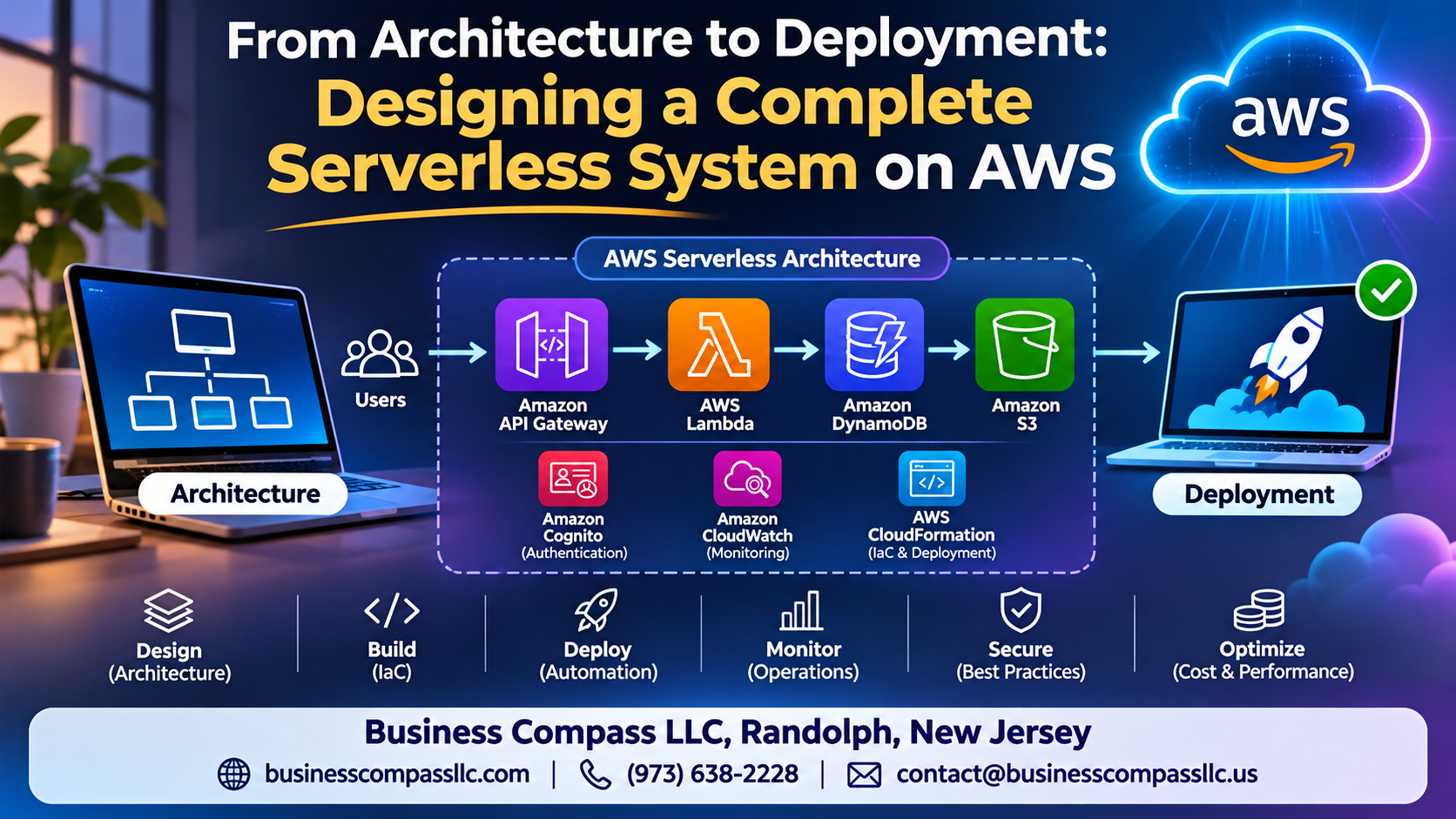
From Architecture to Deployment: Designing a Complete Serverless System on AWS
Building a serverless system on AWS sounds straightforward until you’re knee-deep in Lambda timeouts, runaway costs, and a deployment pipeline held together with duct tape.
This guide is for backend developers, cloud engineers, and architects who already know the basics of AWS and want a practical, end-to-end roadmap for building serverless applications that actually work in production.
Here’s what we’ll walk through:
- How to design a scalable serverless architecture that handles real traffic without falling apart under pressure
- How to lock down your serverless application security so you’re not leaving doors open at the IAM, API, or data layer
- How to set up a serverless CI/CD pipeline and pair it with solid monitoring and debugging so you can ship fast and fix problems before your users notice them
No fluff, no hand-waving. Just the decisions, patterns, and AWS serverless best practices you need to go from a blank slate to a production-ready cloud-native application.
Core Principles of Serverless Architecture on AWS

Key Benefits of Going Serverless
- Zero server management, automatic scaling, pay-per-execution pricing
Right Use Cases
- Event-driven APIs, data pipelines, scheduled tasks
Serverless vs Traditional Cloud
Serverless architecture on AWS removes infrastructure overhead entirely. Unlike traditional cloud setups requiring constant provisioning, AWS Lambda deployment scales automatically, cuts idle costs, and ships features faster — perfect for unpredictable, bursty workloads.
Essential AWS Services That Power Your Serverless System

Leverage AWS Lambda for Scalable Function Execution
AWS Lambda runs your code automatically, scaling from zero to thousands of requests instantly.
Use API Gateway to Build Robust API Layers
API Gateway handles routing, throttling, and auth seamlessly.
Store and Manage Data with DynamoDB and S3
DynamoDB delivers fast NoSQL storage; S3 handles files reliably.
Streamline Event-Driven Workflows with SNS and SQS
SNS broadcasts messages; SQS queues them, keeping your serverless architecture AWS workflows decoupled and resilient.
Designing a Scalable and Resilient Serverless Architecture

Structure Your System with Microservices in Mind
Break your serverless architecture AWS system into small, focused Lambda functions—each handling one job.
Implement Event-Driven Patterns for Loose Coupling
Use SNS, SQS, and EventBridge to connect services without tight dependencies.
Plan for High Availability and Fault Tolerance
- Deploy across multiple AZs
- Add dead-letter queues
- Build retry logic in
Securing Your Serverless Application from the Ground Up

Control Access with IAM Roles and Least Privilege
Grant Lambda only the permissions it needs—nothing more.
Protect Your APIs with Authentication and Authorization
Use Amazon Cognito or API Gateway authorizers to verify every request.
Encrypt Data in Transit and at Rest
Enable TLS and KMS encryption across S3, DynamoDB, and Lambda environment variables.
Detect and Respond to Threats Using AWS Security Tools
- AWS GuardDuty flags suspicious activity
- CloudTrail logs every API call
- AWS Config tracks configuration drift automatically
Optimizing Performance and Controlling Costs

Reduce Cold Start Latency for Faster Function Responses
Use Provisioned Concurrency to keep Lambda functions warm.
Right-Size Memory and Timeout Settings for Efficiency
- Run AWS Lambda Power Tuning to find the sweet spot
- Avoid over-provisioning memory
Monitor Spending with AWS Cost Explorer and Budgets
Set billing alerts before costs spiral.
Building a Reliable CI/CD Pipeline for Serverless Deployments

Automate Infrastructure with AWS SAM or Serverless Framework
Use AWS SAM or Serverless Framework to define and deploy your serverless CI/CD pipeline as code.
Integrate Testing at Every Stage
Run unit, integration, and end-to-end tests automatically on every commit.
Deploy Safely & Roll Back Fast
Blue-green and canary strategies minimize risk during AWS Lambda deployment, enabling instant rollbacks.
Monitoring, Debugging, and Maintaining Your Serverless System

Gain Full Visibility with AWS CloudWatch and X-Ray
Use CloudWatch metrics alongside X-Ray tracing to pinpoint Lambda cold starts and bottlenecks instantly.
Set Up Proactive Alerts
- Trigger SNS alerts on error rate spikes
Analyze Logs Efficiently
CloudWatch Insights queries slash mean time to resolution dramatically.

Building a complete serverless system on AWS is a journey that touches every layer of your application — from the foundational principles and the right mix of AWS services to security, performance, cost control, and a solid CI/CD pipeline. Each piece plays a role, and when they work together, you get a system that scales smoothly, stays secure, and doesn’t drain your budget.
The good news is you don’t have to get everything perfect on day one. Start with a clear architecture, lock down your security early, and build your monitoring and deployment processes as you grow. Take what you’ve learned here and put it into action — even small, consistent improvements will get you to a serverless setup that’s reliable, efficient, and built to last.