

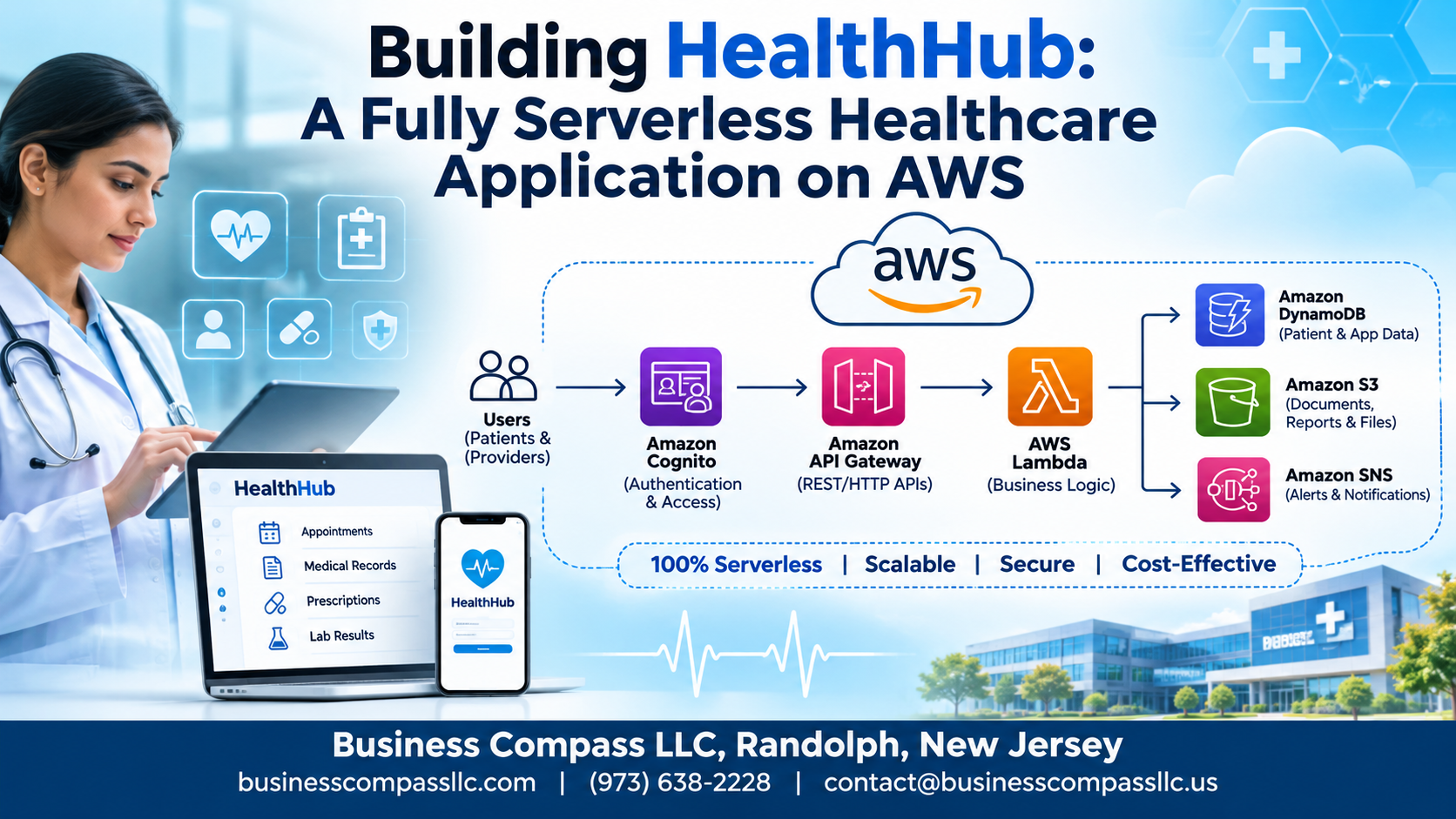
Building HealthHub: A Fully Serverless Healthcare Application on AWS
Building a healthcare app in the cloud sounds complicated — until you realize AWS already gives you most of what you need right out of the box.
This guide is for developers, cloud architects, and healthcare tech teams who want to build a real, production-ready serverless healthcare application on AWS without the headache of managing servers, patching infrastructure, or guessing at HIPAA compliance requirements.
Here’s what we’ll walk through together:
- Why serverless is a natural fit for healthcare — lower operational overhead, automatic scaling, and a pay-per-use model that makes sense for patient-facing workloads
- Designing a HIPAA-compliant serverless architecture — the specific AWS services, configurations, and guardrails that keep patient data protected and auditable
- Deploying and monitoring HealthHub with infrastructure as code — so your entire stack is repeatable, version-controlled, and easy to maintain across environments
By the end, you’ll have a clear, practical blueprint for building HealthHub — a cloud-based healthcare application that’s secure, scalable, and ready for real-world use. No fluff, no hand-waving. Just the actual decisions, trade-offs, and AWS best practices that make it work.
Let’s get into it.
Why Serverless Architecture Is the Right Choice for Healthcare Applications

Eliminate Infrastructure Management and Focus on Patient Care
Building a serverless healthcare application on AWS means your team stops patching servers and starts shipping features patients actually need. AWS Lambda handles scaling, security patches, and availability automatically — cutting operational overhead while keeping your HIPAA-compliant serverless architecture audit-ready without dedicated DevOps firefighting.
Core AWS Services Powering HealthHub

AWS Lambda for Event-Driven Business Logic
Lambda runs HealthHub’s core logic—appointment scheduling, prescription processing, lab result notifications—without managing servers.
Amazon API Gateway
Handles secure, scalable REST APIs with throttling and authorization built in.
DynamoDB, S3 & Cognito
- DynamoDB: Fast patient data queries
- S3: Medical image storage
- Cognito: Role-based access control
Designing a HIPAA-Compliant Serverless Architecture

Implementing End-to-End Data Encryption at Rest and in Transit
- Use AWS KMS for encrypting patient data stored in DynamoDB and S3.
- Enforce TLS 1.2+ via API Gateway for all data in transit.
Enforcing Least Privilege Access With IAM Policies
- Scope each Lambda function’s IAM role to only the resources it directly needs.
Enabling Audit Trails With AWS CloudTrail and CloudWatch
- CloudTrail logs every API call; CloudWatch Logs captures Lambda execution details for full visibility.
Building Key HealthHub Features on AWS

Patient Registration and Profile Management
HealthHub uses AWS Lambda and DynamoDB to handle patient profiles securely, keeping PHI encrypted at rest.
Appointment Scheduling With Real-Time Notifications via SNS
Amazon SNS pushes instant appointment reminders to patients via SMS or email.
Secure Telehealth Video Integration Using Amazon Chime
Amazon Chime SDK powers encrypted video sessions, meeting HIPAA-compliant serverless architecture standards effortlessly.
Monitoring, Debugging, and Optimizing HealthHub Performance

A. Leverage AWS X-Ray to Trace and Fix Latency Bottlenecks
Use X-Ray to pinpoint slow Lambda functions or DynamoDB queries instantly.
B. Set Up CloudWatch Alarms for Proactive Issue Detection
Get alerts before patients notice problems.
C. Optimize Lambda Cold Starts
Use provisioned concurrency for critical health workflows.
D. Control Costs With AWS Cost Explorer
Track serverless spending patterns and forecast growth accurately.
Deploying and Managing HealthHub With Infrastructure as Code

Automate Deployments Using AWS SAM or the Serverless Framework
Use AWS SAM templates to define Lambda functions, API Gateway, and DynamoDB resources as code, keeping your infrastructure as code healthcare setup clean and repeatable.
Implement CI/CD Pipelines With AWS CodePipeline and CodeBuild
- Trigger builds on every commit
- Run automated HIPAA compliance checks
Manage Multiple Environments Safely With Stage-Based Configurations
Separate dev, staging, and production using environment variables.

Building a serverless healthcare application on AWS is no small feat, but HealthHub shows just how powerful this approach can be. From choosing the right AWS services to designing a HIPAA-compliant architecture, every decision matters when patient data and care delivery are on the line. Keeping performance sharp through monitoring and debugging, while managing everything through Infrastructure as Code, means HealthHub stays reliable, scalable, and ready to grow without the headaches of traditional infrastructure.
If you’re thinking about building something similar, start small, get your compliance foundations right from day one, and let AWS handle the heavy lifting on the infrastructure side. The serverless path isn’t just a tech trend — for healthcare applications, it’s a smarter, safer, and more cost-effective way to build something that truly makes a difference for patients and providers alike.