

Agentic AI on AWS: How to Build, Deploy, and Scale Autonomous AI Agents
AI agents that can reason, plan, and act on their own are no longer a research experiment — they’re running in production right now, handling real business workflows without someone clicking buttons at every step. If you’re a cloud architect, ML engineer, or engineering lead who wants to build autonomous AI agents on AWS, you’re in the right place.
This guide walks you through what agentic AI actually is and why it’s different from a standard chatbot or API call. You’ll get a clear look at the core AWS services — including Amazon Bedrock — that make building and deploying LLM agents on AWS practical today. And you’ll see how to design an AI agent architecture that holds up when you move from a proof of concept to a production system serving real users at scale.
No fluff. No theory for theory’s sake. Just a practical breakdown of how to get autonomous AI agents running on AWS — and how to keep them secure, governable, and scalable once they are.
Understanding Agentic AI and Why It Matters

What Sets Agentic AI Apart from Traditional AI Models
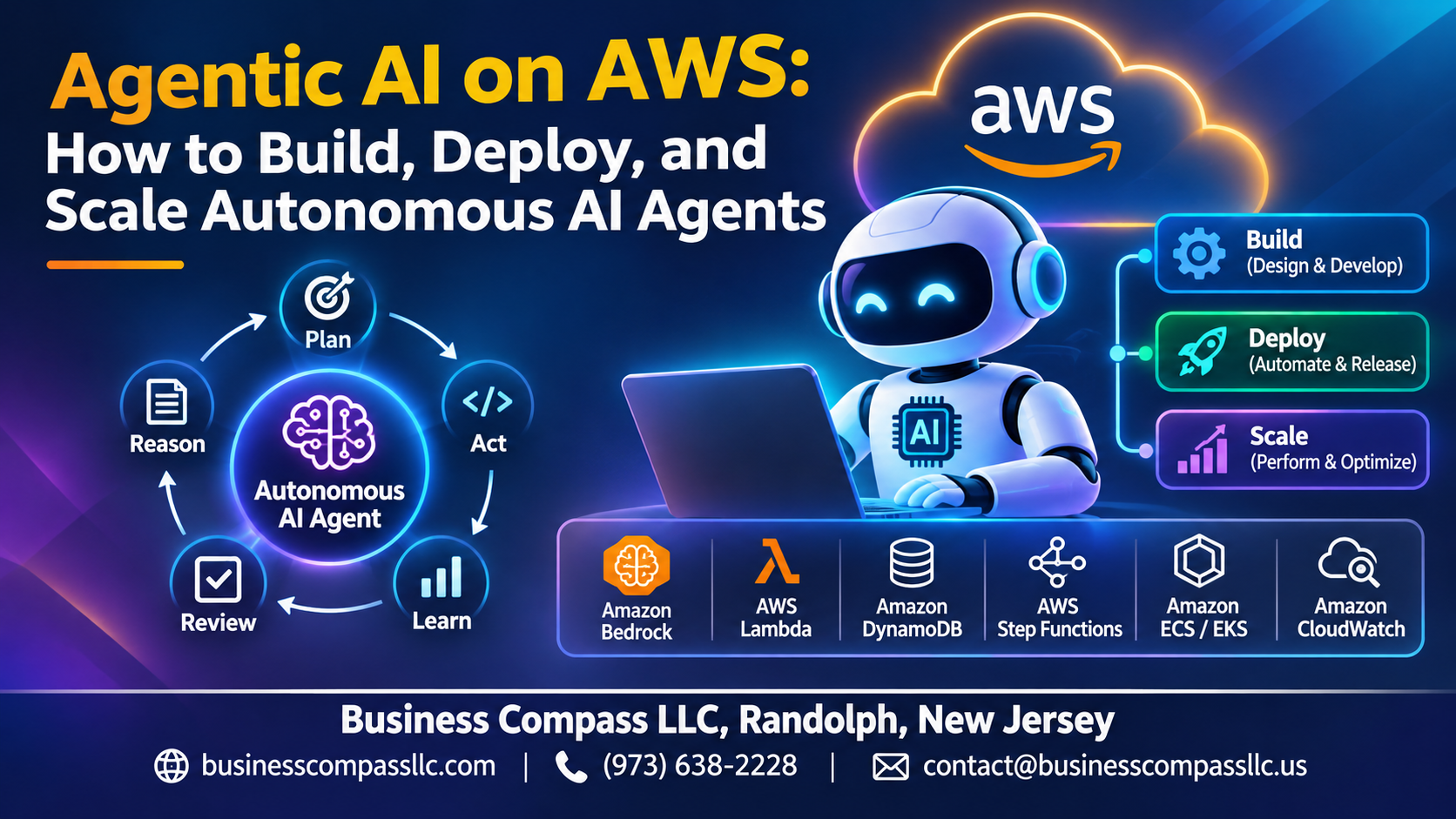
Unlike traditional AI that simply responds, agentic AI on AWS plans, reasons, and acts across multi-step tasks autonomously—making real decisions without constant human input.
Key Capabilities That Make AI Agents Truly Autonomous
- Tool use, memory, and goal-driven reasoning
Real-World Use Cases
- Customer support, code generation, supply chain automation
Core AWS Services That Power Autonomous AI Agents

Amazon Bedrock as the Foundation for Agent Development
Build agentic AI on AWS using Amazon Bedrock’s managed agents, which handle orchestration, memory, and tool-calling natively.
AWS Lambda, S3, DynamoDB & SageMaker
- Lambda: runs serverless agent actions
- S3/DynamoDB: stores agent memory and session data
- SageMaker: trains and deploys custom LLMs for specialized autonomous AI agents AWS workflows
Designing Your Agentic AI Architecture on AWS

A. Choosing the Right Agent Framework
- Use Amazon Bedrock Agents for managed, low-overhead deployments
- Pick LangChain or LlamaIndex for custom multi-agent systems AWS workflows
B. Multi-Agent Workflows
Structure agents as orchestrator-worker hierarchies, delegating subtasks cleanly.
C. External Tools & APIs
Connect agents via Lambda functions and Bedrock action groups.
Building and Deploying Your First AI Agent on AWS

Setting Up Your AWS Environment and Required Permissions
Create an IAM role with AmazonBedrockFullAccess and attach it to your agent. Enable Bedrock model access in your AWS console region.
Configuring Amazon Bedrock Agents Step by Step
- Pick a foundation model (Claude works great)
- Define action groups with Lambda functions
- Write clear instruction prompts
Connecting Knowledge Bases to Boost Agent Intelligence
Link an S3-backed Knowledge Base using OpenSearch Serverless for RAG-powered responses.
Testing Agent Behavior Before Going Live
Run test aliases, check CloudWatch logs, and validate responses against edge cases before deploying your autonomous AI agents AWS-wide.
Scaling Autonomous AI Agents for Production Workloads

Automating Agent Scaling with AWS Auto Scaling Groups
Scale AI agents production workloads by attaching Auto Scaling Groups to your ECS or EC2 clusters, triggering scale-out on CPU or queue depth metrics.
Reducing Latency and Cost with Intelligent Caching Strategies
Use ElastiCache to cache repeated LLM responses.
Monitoring Agent Performance Using Amazon CloudWatch
Track token usage and error rates with CloudWatch dashboards.
Securing and Governing AI Agents at Enterprise Scale

Applying Least Privilege Access with AWS IAM
Grant agents only the permissions they need—nothing more.
Auditing Agent Actions with AWS CloudTrail
Every agent action gets logged automatically.
Enforcing Compliance Through Bedrock Guardrails and Content Filters
Block harmful outputs before they reach users.
Managing Costs Without Sacrificing Agent Performance
- Set token limits
- Use caching
- Monitor with CloudWatch

Agentic AI on AWS is no longer a futuristic concept reserved for research labs — it’s a practical, accessible approach to building AI systems that can reason, plan, and act on their own. From choosing the right AWS services to designing a solid architecture, deploying your first agent, and eventually scaling it for real-world production workloads, the path is clearer than most people think. Add in the right security and governance guardrails, and you have a setup that can run reliably even at enterprise scale.
If you’re ready to get started, pick one use case, keep your first agent simple, and build from there. AWS gives you all the tools you need — the real work is just getting your hands dirty and iterating as you go. The teams seeing the biggest wins with agentic AI aren’t necessarily the ones with the most resources; they’re the ones who started early, learned fast, and weren’t afraid to experiment.