Stop Losing Time on Slow MySQL Exports to S3
If you’re managing large-scale data pipelines on AWS, you already know that moving MySQL data to Amazon S3 sounds simple until it isn’t. Exports stall, write speeds tank, and suddenly a routine data transfer becomes a Friday night incident.
This guide is for data engineers, cloud architects, and backend developers who need to build a high-performance MySQL AWS pipeline that actually holds up under pressure — not just in a dev environment with a few thousand rows.
Here’s what we’ll walk through together:
- Core architecture decisions that determine whether your MySQL to S3 export optimization succeeds or struggles from the start
- MySQL export performance tuning and AWS data pipeline architecture patterns that cut transfer times without overcomplicating your stack
- S3 write optimization for large datasets, plus how to lock down a secure MySQL export workflow and keep tabs on performance over time with solid AWS MySQL S3 monitoring
No fluff, no theory-for-theory’s-sake. Just practical decisions you can act on today.
Understanding the Core Architecture for MySQL to S3 Exports

Key AWS Services That Power Seamless MySQL Data Transfers
- AWS DMS, Glue, Lambda, and S3 form your core stack for MySQL Amazon S3 data transfer.
Critical Performance Bottlenecks
Skipping direct export vs. intermediate layer decisions early kills throughput. Network I/O, MySQL lock contention, and S3 multipart thresholds are your biggest enemies in any high-performance MySQL AWS pipeline.
Optimizing MySQL Database Configuration for High-Speed Exports

Tuning MySQL Buffer Pool and Query Cache for Export Workloads
Bump innodb_buffer_pool_size to 70–80% of available RAM to keep export queries fully in memory.
Leveraging Read Replicas to Offload Export Pressure
Route all MySQL to S3 export jobs to a read replica, keeping production untouched.
Selecting the Right Storage Engines
InnoDB wins for MySQL export performance tuning — consistent reads, no table locks.
Designing an Efficient Data Pipeline on AWS

A. AWS DMS for MySQL Data Movement
Handles reliable, scalable transfers with minimal downtime.
B. AWS Glue ETL Jobs
Speeds up MySQL to S3 export optimization through serverless transformations.
C. Amazon Kinesis
Streams large datasets in real time.
D. AWS Step Functions
Automates your high-performance MySQL AWS pipeline orchestration.
E. Same-Region Deployment
Cuts latency significantly.
Maximizing S3 Write Performance for Large MySQL Datasets

A. Multipart Uploads
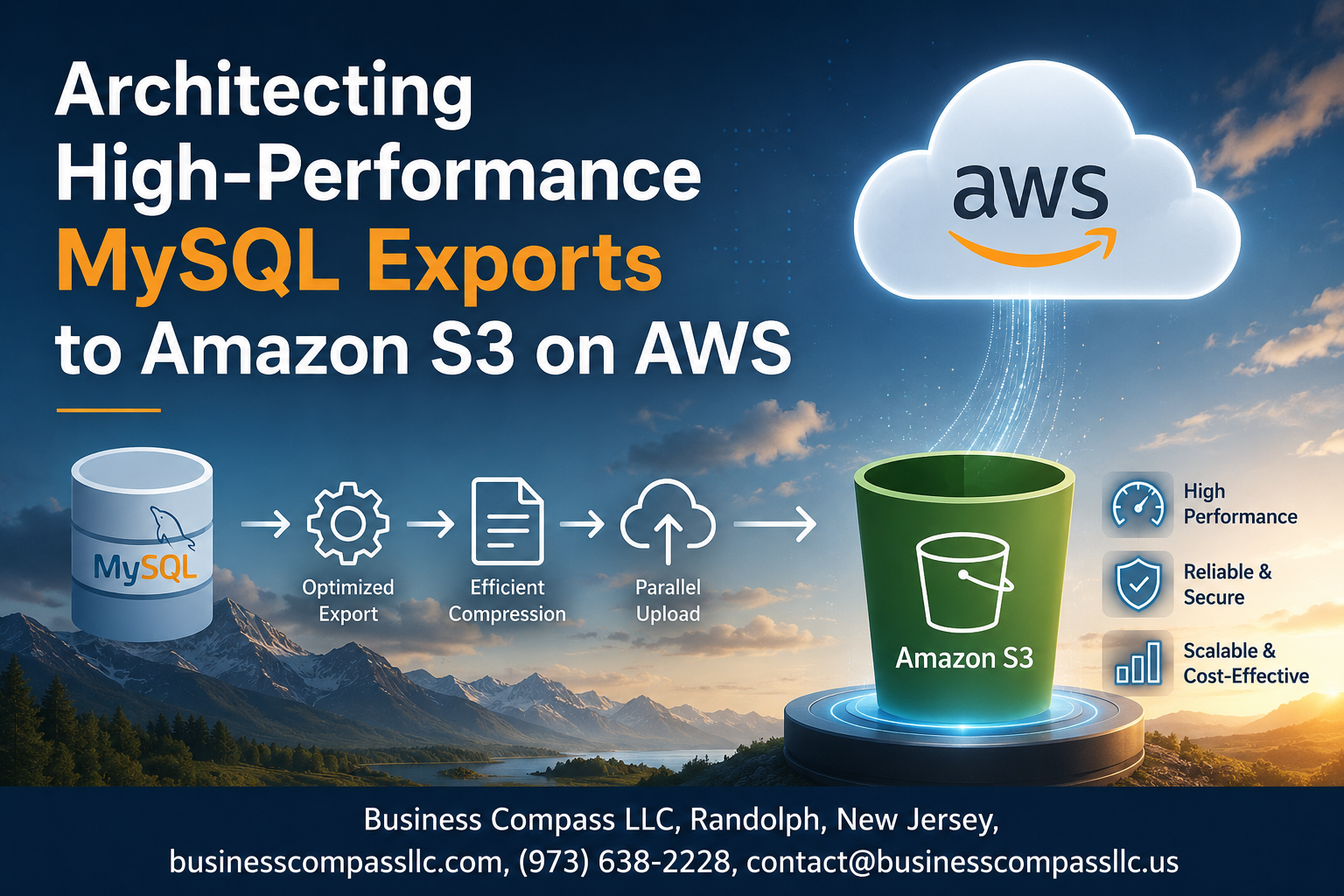
Split large files into parallel chunks using AWS SDK’s multipart upload — cuts transfer time dramatically.
B. S3 Prefix Structure
Distribute writes across randomized prefixes to dodge hot-partition throttling.
C. File Formats
Parquet/ORC compress MySQL exports up to 75%, slashing S3 storage costs.
D. Transfer Acceleration
Enable S3 Transfer Acceleration for cross-region MySQL Amazon S3 data transfer speed gains.
Securing and Governing Your MySQL Export Workflow

Encrypting Data in Transit and at Rest Using AWS KMS
Enable SSE-KMS on your S3 buckets and enforce TLS for all MySQL connections during your secure MySQL export workflow.
Enforcing Least Privilege Access With IAM Roles and Policies
- Grant only
s3:PutObjectandkms:GenerateDataKeypermissions
Auditing Export Activity Through AWS CloudTrail for Compliance
Track every API call touching your MySQL Amazon S3 data transfer pipeline.
Monitoring and Continuously Improving Export Performance

Tracking Pipeline Health with Amazon CloudWatch Metrics and Alarms
Set alarms on export duration, error rates, and throughput.
Identifying Slow Export Stages Using AWS X-Ray Tracing
Pinpoint bottlenecks across MySQL queries, compression, and S3 writes.
Benchmarking Export Speeds
- Baseline: rows/second, MB/s transferred
- Compare runs after each tuning change
Iterating on Architecture Improvements
Real workload data drives smarter decisions than guesswork.

Getting MySQL data into S3 efficiently comes down to making smart decisions at every layer — from how your database is configured, to how your pipeline is designed, to how data lands in S3. When each piece is tuned properly, you end up with exports that are faster, more reliable, and far less likely to cause headaches at scale.
Start with the fundamentals: optimize your MySQL settings, design a pipeline that moves data in parallel, and write to S3 in a way that takes full advantage of its performance capabilities. Layer in solid security controls and keep a close eye on your metrics so you can catch bottlenecks before they become real problems. The teams that get this right aren’t doing anything magical — they’re just being deliberate about each step in the process. Take what fits your setup, test it, and keep refining from there.