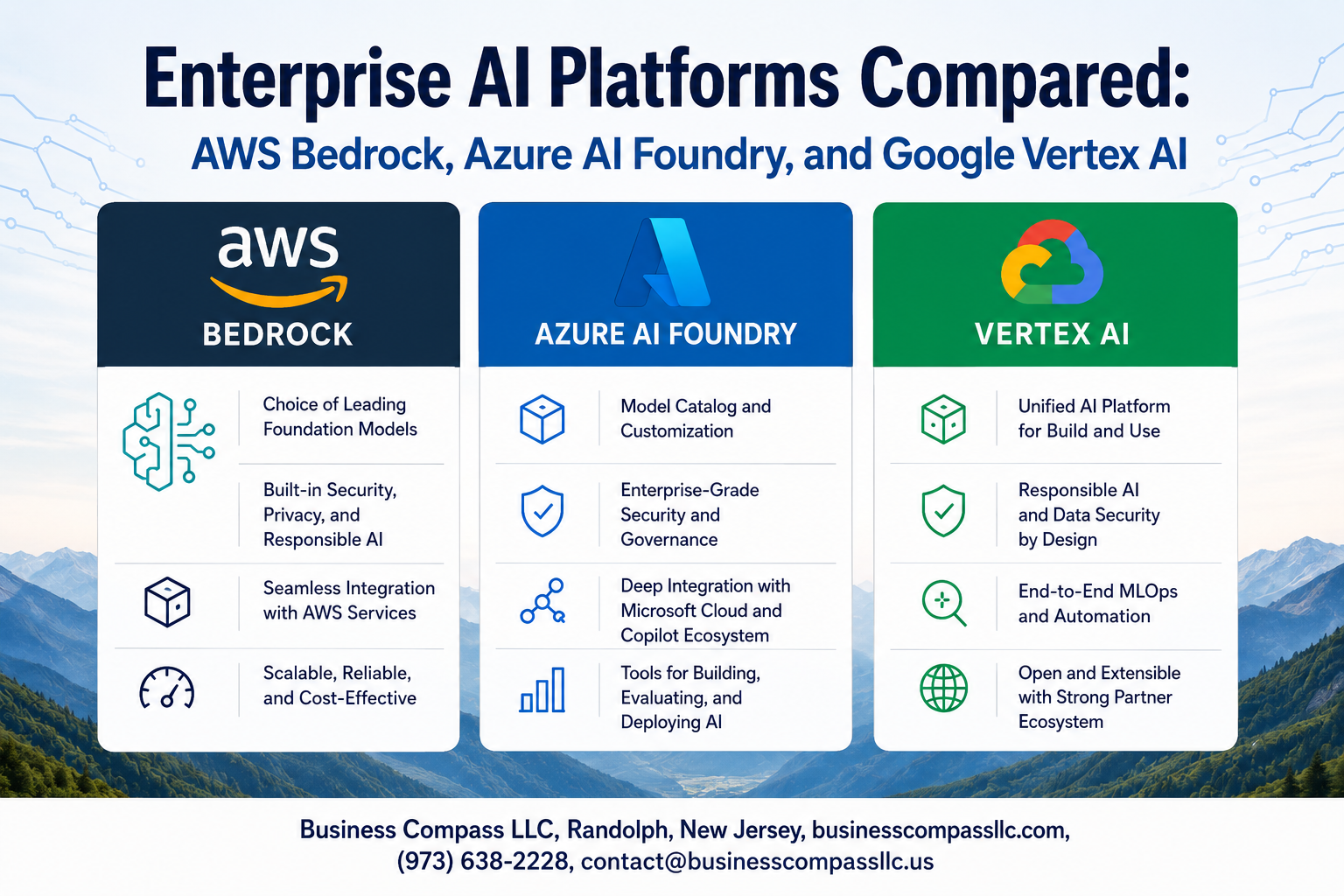
Choosing the right enterprise AI platforms can make or break your company’s machine learning initiatives. Business leaders, IT decision-makers, and data science teams need clear insights to navigate the complex landscape of cloud AI services comparison between industry giants.
This guide breaks down AWS Bedrock vs Azure AI vs Google Vertex AI to help you make an informed decision for your organization. We’ll examine each platform’s core strengths and weaknesses, compare their key features side-by-side, and provide actionable implementation strategies based on different business scenarios.
You’ll discover how AWS Bedrock’s foundation model approach stacks up against Azure AI Foundry’s comprehensive tooling ecosystem and Google Vertex AI’s unified machine learning workflows. We’ll also cover pricing models, integration capabilities, and real-world deployment considerations that impact your enterprise AI implementation strategy.
Understanding Enterprise AI Platform Fundamentals

Core Capabilities That Drive Business Transformation
Enterprise AI platforms deliver transformative capabilities that reshape how organizations operate and compete. These platforms provide foundational machine learning infrastructure that spans from data preprocessing and model training to deployment and monitoring at scale. Modern cloud AI services comparison reveals that successful platforms offer automated machine learning workflows, reducing the complexity traditionally associated with AI implementation.
The most impactful capability lies in democratizing AI development across organizations. No-code and low-code interfaces enable business analysts and domain experts to build predictive models without extensive programming knowledge. Pre-trained models for natural language processing, computer vision, and speech recognition accelerate time-to-value for common business use cases like customer sentiment analysis, document processing, and automated content generation.
Real-time inference capabilities allow organizations to embed AI decisions directly into customer-facing applications and operational workflows. This creates opportunities for personalized recommendations, fraud detection, and intelligent automation that directly impact revenue and efficiency.
Key Technical Requirements for Enterprise Deployment
Enterprise AI implementation strategy demands robust technical foundations that support production-grade workloads. Scalability remains paramount – platforms must handle varying computational demands from experimental model training to high-volume inference serving millions of requests daily.
Security and compliance frameworks are non-negotiable for enterprise deployments. Organizations require end-to-end encryption, role-based access controls, and audit trails that meet industry regulations like GDPR, HIPAA, and SOX. Data governance features must track data lineage and ensure sensitive information remains protected throughout the AI lifecycle.
Model governance capabilities distinguish enterprise-grade platforms from basic machine learning tools. Version control for models, automated testing pipelines, and performance monitoring prevent model drift and ensure consistent business outcomes. These platforms must support multiple programming languages and frameworks while providing consistent APIs for seamless integration.
High availability and disaster recovery become critical when AI drives core business processes. Enterprise platforms require geographically distributed infrastructure with automated failover capabilities to maintain service continuity.
Integration Considerations With Existing Infrastructure
Enterprise AI platforms must seamlessly connect with existing data ecosystems and business applications. Most organizations maintain hybrid environments spanning on-premises databases, cloud storage systems, and third-party SaaS applications. Successful integration requires robust data connectors that can access diverse data sources without creating security vulnerabilities.
API-first architectures enable AI models to integrate with existing business applications, customer relationship management systems, and enterprise resource planning platforms. REST APIs and SDK support across multiple programming languages ensure development teams can incorporate AI capabilities using familiar tools and workflows.
Data pipeline integration becomes crucial for maintaining model accuracy. Real-time data streaming capabilities allow models to process fresh information and adapt to changing business conditions. Batch processing integration supports large-scale data preparation and model retraining workflows that align with existing ETL processes.
Legacy system compatibility often determines adoption success. Modern enterprise AI platforms provide flexible deployment options, including containerized solutions that can run within existing infrastructure constraints while maintaining performance and security standards.
Cost Structures and Pricing Models
Enterprise AI platform evaluation requires understanding diverse pricing structures that impact total cost of ownership. Compute-based pricing models charge for actual resource consumption during model training and inference, making costs predictable for organizations with established usage patterns. Storage fees for training data, model artifacts, and inference logs add ongoing expenses that scale with data retention requirements.
Subscription-based pricing offers predictable monthly costs for platform access, development tools, and support services. This model works well for organizations building multiple AI applications or those requiring extensive experimentation phases. Pay-per-use pricing for pre-trained models and APIs provides cost efficiency for sporadic usage patterns.
Hidden costs often emerge from data transfer fees, especially when moving large datasets between regions or cloud providers. Enterprise support packages, professional services for implementation, and training programs add significant value but require budget consideration. Organizations must also factor in the cost of specialized talent needed to maximize platform capabilities and maintain AI systems over time.
Volume discounts and enterprise agreements can substantially reduce costs for large-scale deployments. Cloud AI services comparison reveals that negotiated contracts often include credits for experimentation, reduced data egress fees, and priority support that accelerates project timelines.
AWS Bedrock Deep Dive Analysis
Foundation model selection and customization options
AWS Bedrock stands out among enterprise AI platforms with its impressive collection of pre-trained foundation models from leading AI companies. The platform offers access to models from Anthropic (Claude), Meta (Llama 2), Stability AI, AI21 Labs, and Amazon’s own Titan models. This diverse ecosystem gives enterprises the flexibility to choose models that best fit their specific use cases and performance requirements.
The real power lies in Bedrock’s customization capabilities. You can fine-tune these foundation models using your own datasets through a straightforward process that doesn’t require deep machine learning expertise. The platform supports both fine-tuning and Retrieval Augmented Generation (RAG), allowing companies to create highly specialized AI solutions while maintaining data privacy.
AWS Bedrock features include model evaluation tools that help organizations compare different models’ performance on their specific tasks before committing to one. The platform also provides model versioning and governance features, ensuring enterprises can track changes and maintain consistency across deployments.
Serverless architecture benefits for scalability
Bedrock’s serverless architecture eliminates the complexity of infrastructure management that typically comes with deploying large language models. You don’t need to worry about provisioning servers, managing clusters, or scaling compute resources manually. The platform automatically handles scaling based on demand, making it particularly attractive for enterprises with variable workloads.
This cloud AI services comparison reveals that Bedrock’s pay-per-use pricing model offers significant cost advantages for many enterprise scenarios. Organizations only pay for the tokens they process, rather than maintaining expensive infrastructure that might sit idle during off-peak hours. This approach makes advanced AI capabilities accessible to companies of all sizes.
The serverless nature also means faster time-to-market for AI applications. Development teams can focus on building business logic and user experiences rather than dealing with infrastructure complexities. Bedrock handles model hosting, load balancing, and automatic scaling behind the scenes.
Security and compliance features for enterprise use
Security remains a top priority for enterprise machine learning platforms, and Bedrock delivers robust protections that meet stringent enterprise requirements. All data transmitted to and from Bedrock is encrypted in transit using TLS 1.2 or higher. Data at rest is protected with AWS Key Management Service (KMS) encryption, giving enterprises full control over their encryption keys.
The platform integrates seamlessly with AWS Identity and Access Management (IAM), allowing organizations to implement fine-grained access controls and maintain their existing security policies. VPC endpoints enable private connectivity between enterprise networks and Bedrock services, ensuring sensitive data never traverses the public internet.
Bedrock maintains compliance with major industry standards including SOC 2, ISO 27001, and GDPR. The platform also supports AWS CloudTrail logging, providing detailed audit trails of all API calls and model interactions. This comprehensive logging capability helps enterprises meet regulatory requirements and maintain visibility into their AI operations.
Data residency controls allow organizations to specify which AWS regions their data and models operate in, addressing sovereignty and compliance concerns. Bedrock also includes content filtering capabilities to help prevent the generation of harmful or inappropriate content, adding an additional layer of protection for enterprise applications.
Azure AI Foundry Comprehensive Overview
Microsoft ecosystem integration advantages
Azure AI Foundry shines brightest when your organization already runs on Microsoft technologies. The platform connects seamlessly with Office 365, Teams, Power Platform, and the broader Azure cloud infrastructure. This deep integration means your AI models can pull data directly from SharePoint, analyze Excel spreadsheets, or generate insights that automatically populate PowerBI dashboards.
The authentication and security frameworks work in harmony across the entire Microsoft stack. Single sign-on capabilities eliminate the friction typically associated with AI platform adoption, while existing Azure Active Directory permissions carry over naturally. Your IT team won’t need to learn completely new identity management systems or rebuild security protocols from scratch.
Development teams benefit from familiar tooling when working with Visual Studio and GitHub integration. The platform supports popular Microsoft development languages like C# and .NET, making it easier for existing enterprise development teams to build and deploy AI solutions without requiring extensive retraining on new programming languages or frameworks.
Low-code development tools and accessibility
Microsoft has invested heavily in making AI accessible to business users who lack extensive programming backgrounds. Azure AI Studio provides drag-and-drop interfaces for building machine learning pipelines, allowing domain experts to create sophisticated models without writing complex code.
The Power Platform integration deserves special attention here. Business analysts can build AI-powered apps using Power Apps, create automated workflows with Power Automate that incorporate machine learning predictions, and develop chatbots through Power Virtual Agents. These tools democratize AI development across organizations, enabling departments like marketing, finance, and operations to solve their own challenges.
Pre-built connectors to popular business applications like Salesforce, SAP, and Dynamics 365 reduce development time significantly. Instead of building custom integrations, teams can simply configure existing connectors to feed data into their AI models or push predictions back into business systems.
The visual model designer supports popular frameworks like scikit-learn, PyTorch, and TensorFlow while abstracting away much of the underlying complexity. Business users can experiment with different algorithms, adjust parameters through simple interfaces, and compare model performance without diving into code.
Advanced governance and monitoring capabilities
Azure AI Foundry takes enterprise governance seriously, offering comprehensive tools for model lifecycle management, compliance tracking, and risk assessment. The platform provides built-in model versioning and experiment tracking, making it easy to roll back to previous versions or understand how models evolved over time.
Responsible AI features help organizations identify and mitigate bias in their models. The platform automatically generates fairness assessments and provides recommendations for improving model equity across different demographic groups. This becomes crucial for enterprises operating in regulated industries or serving diverse customer bases.
The monitoring capabilities extend beyond basic performance metrics. Azure AI Foundry tracks data drift, model performance degradation, and resource utilization in real-time. Automated alerts notify teams when models start behaving unexpectedly, enabling quick intervention before issues impact business operations.
Audit trails capture every interaction with models, from training data access to prediction requests. This detailed logging supports compliance requirements in industries like healthcare and financial services, where organizations must demonstrate how AI systems make decisions.
Hybrid cloud deployment flexibility
Many enterprises can’t move all their data and applications to the public cloud due to regulatory requirements, security concerns, or existing infrastructure investments. Azure AI Foundry addresses this reality through robust hybrid deployment options that bridge on-premises and cloud environments.
Azure Stack Hub enables organizations to run Azure AI services in their own data centers while maintaining the same APIs and management interfaces as the public cloud. This approach works particularly well for scenarios involving sensitive data that must remain on-premises due to compliance requirements.
Edge deployment capabilities allow organizations to push AI models closer to where data gets generated. Manufacturing companies can deploy predictive maintenance models directly on factory equipment, while retail organizations can run inventory optimization models in individual stores. These edge deployments reduce latency and enable real-time decision-making.
The hybrid approach also supports gradual cloud migration strategies. Organizations can start by training models in the cloud using historical data, then deploy those models on-premises for inference. As comfort levels increase, more workloads can migrate to the cloud while maintaining the flexibility to keep sensitive operations local.
Container support through Azure Kubernetes Service makes it easier to deploy models consistently across different environments. Whether running in Azure, on-premises, or at the edge, containerized models behave identically and can be managed through the same orchestration tools.
Google Vertex AI Platform Evaluation
Machine learning lifecycle management strengths
Google Vertex AI shines brightest when it comes to managing the complete machine learning lifecycle. The platform brings together all ML operations under one unified environment, making it easier for enterprise teams to handle everything from data preparation to model deployment and monitoring.
The standout feature here is Vertex AI Workbench, which provides a Jupyter-based environment that seamlessly integrates with Google Cloud services. Data scientists can experiment, train, and validate models without jumping between different tools or platforms. The managed notebooks automatically scale compute resources, so teams don’t get bogged down with infrastructure management.
Model Registry acts as the central hub for versioning and organizing ML models. Teams can track model lineage, compare performance metrics across different versions, and maintain proper governance standards. This becomes crucial for enterprise AI platforms where regulatory compliance and auditability matter.
Vertex AI’s MLOps capabilities include automated pipeline execution through Kubeflow Pipelines. These pipelines handle the repetitive tasks like data validation, model training, and deployment, freeing up data scientists to focus on improving model quality rather than managing workflows. The platform also offers continuous monitoring that alerts teams when model performance degrades or data drift occurs.
Data processing and pipeline automation features
Vertex AI excels at handling large-scale data processing challenges that enterprise organizations face daily. The platform integrates deeply with Google Cloud’s data ecosystem, including BigQuery, Cloud Storage, and Dataflow, creating smooth data pipelines that can process massive datasets efficiently.
AutoML capabilities democratize machine learning for business users who might not have extensive coding experience. Teams can build high-quality models for common use cases like image classification, natural language processing, and tabular data analysis without writing complex code. The AutoML models often match or exceed custom-built solutions while requiring significantly less development time.
Feature Store stands out as a game-changer for enterprise machine learning platforms. This centralized repository stores, manages, and serves ML features across different projects and teams. The Feature Store handles feature versioning, lineage tracking, and real-time serving, which eliminates the common problem of feature inconsistencies between training and production environments.
Vertex AI Pipelines automate the entire ML workflow, from data ingestion to model deployment. These pipelines can trigger based on new data arrivals, schedule regular retraining, and automatically deploy models that meet performance thresholds. The visual pipeline designer makes it easy for teams to build complex workflows without deep technical knowledge.
Data Labeling Service accelerates the often tedious process of preparing training datasets. The service combines human labelers with active learning techniques to efficiently label large datasets while maintaining quality standards.
Multi-cloud and open-source compatibility benefits
Google Vertex AI stands apart from other enterprise AI platforms with its strong commitment to open-source technologies and multi-cloud compatibility. This approach gives organizations more flexibility and reduces vendor lock-in concerns that often arise with cloud AI services comparison.
The platform natively supports popular open-source frameworks like TensorFlow, PyTorch, XGBoost, and scikit-learn. Teams can use their existing code and models without significant modifications, making migration to Vertex AI smoother. Custom training jobs can run in pre-built containers or custom Docker images, providing maximum flexibility for unique requirements.
Anthos integration enables Vertex AI workloads to run across different cloud providers and on-premises environments. Organizations can train models in Google Cloud while deploying them on AWS, Azure, or their own data centers. This hybrid approach addresses data sovereignty requirements and allows companies to leverage existing infrastructure investments.
The support for Kubeflow, an open-source ML platform, means that organizations aren’t locked into Google’s proprietary tools. Teams can export their ML pipelines and run them on any Kubernetes cluster, providing an exit strategy that many enterprise buyers find reassuring.
Vertex AI’s commitment to open standards extends to model formats like ONNX and SavedModel, ensuring that models trained on the platform can be deployed anywhere. The platform also supports industry-standard APIs and protocols, making integration with existing enterprise systems straightforward.
The open-source approach also means faster innovation cycles. Google contributes improvements back to the open-source community, and the platform benefits from community contributions and innovations. This creates a virtuous cycle where Vertex AI stays current with the latest ML developments while giving organizations confidence in long-term viability.
Head-to-Head Feature Comparison
Model Variety and Fine-tuning Capabilities
AWS Bedrock leads the pack with the most extensive model selection, offering access to foundation models from Anthropic (Claude), Amazon (Titan), AI21 Labs, Cohere, Meta (Llama), Mistral, and Stability AI. This gives developers incredible flexibility to choose models that best fit their specific use cases. Azure AI Foundry takes a different approach, focusing heavily on OpenAI models while also providing access to Hugging Face and select third-party models through their model catalog.
Google Vertex AI positions itself with strong proprietary offerings like Gemini and PaLM models, plus access to open-source alternatives. What sets Vertex AI apart is its AutoML capabilities, allowing teams to build custom models without deep machine learning expertise.
When it comes to fine-tuning, all three enterprise AI platforms handle customization differently. AWS Bedrock offers fine-tuning for select models like Claude and Titan, with a straightforward API-driven approach. Azure AI Foundry shines with its comprehensive fine-tuning studio, providing visual tools that make model customization more accessible to non-technical team members. Google Vertex AI provides robust fine-tuning options with excellent integration into their broader ML pipeline tools.
The real difference lies in flexibility versus simplicity. AWS gives you the most choices but requires more decision-making. Azure strikes a balance with user-friendly interfaces, while Google focuses on end-to-end ML workflows.
Development Experience and Ease of Use
The development experience varies significantly across these cloud AI services. AWS Bedrock keeps things simple with a clean API structure that integrates seamlessly with existing AWS services. Developers familiar with AWS will feel right at home, and the consistent SDK experience across different programming languages makes integration straightforward.
Azure AI Foundry takes the crown for visual development tools. Their AI Studio provides an intuitive interface where teams can prototype, test, and deploy models without writing extensive code. The prompt flow feature allows developers to build complex AI applications using a visual drag-and-drop interface, making it accessible to citizen developers.
Google Vertex AI offers the most comprehensive development environment with Workbench, providing Jupyter notebooks, integrated version control, and collaborative features. The platform excels at supporting the complete machine learning lifecycle, from data preparation to model deployment.
Key differences emerge in learning curves and team collaboration:
- AWS Bedrock: Fastest to get started for AWS users, minimal learning curve
- Azure AI Foundry: Best for mixed technical teams, strong visual tools
- Google Vertex AI: Most powerful for data science teams, steeper initial learning curve
Documentation quality plays a crucial role here. AWS provides clear, code-heavy examples that get developers up and running quickly. Azure focuses on scenario-based tutorials that walk through real business use cases. Google offers the most technical depth with detailed explanations of underlying concepts.
Performance Benchmarks and Reliability Metrics
Performance comparison across these enterprise AI platforms depends heavily on specific workloads and model choices. AWS Bedrock delivers consistent latency with their global infrastructure, typically achieving sub-second response times for text generation tasks. Their multi-region deployment options ensure reliability even during high-demand periods.
Azure AI Foundry benefits from Microsoft’s robust global network, with particularly strong performance in enterprise environments already using Azure services. Their SLA guarantees are competitive, offering 99.9% uptime for most services. The platform handles scaling automatically, which reduces performance management overhead for development teams.
Google Vertex AI often outperforms competitors in specific scenarios, especially for custom models and large-scale batch processing. Their TPU infrastructure provides exceptional performance for training and inference workloads, though this advantage is most noticeable with Google’s own models.
Real-world performance metrics show:
- Latency: AWS and Azure typically neck-and-neck for API response times
- Throughput: Google Vertex AI leads for high-volume batch processing
- Reliability: All three maintain 99.9%+ uptime, with AWS having slight edge in global consistency
- Scaling: Azure provides smoothest auto-scaling experience
Cost-performance ratios vary significantly based on usage patterns. AWS charges per token with predictable pricing, Azure offers flexible consumption and reserved capacity options, while Google provides the most cost-effective solution for sustained high-volume workloads.
Enterprise Support and Documentation Quality
Enterprise support quality can make or break AI platform evaluation decisions. AWS provides comprehensive support through their enterprise support plans, with dedicated technical account managers and 24/7 access to solution architects. Their documentation follows a consistent structure across all services, making it easy for teams to find relevant information quickly.
Azure AI Foundry leverages Microsoft’s enterprise relationships, offering seamless integration with existing Microsoft support contracts. Their documentation excels at providing business context alongside technical details, helping decision-makers understand both implementation requirements and business value.
Google Vertex AI support varies more widely. While their technical documentation is exceptionally detailed and accurate, enterprise support responsiveness can be inconsistent compared to AWS and Azure. However, their community forums and developer resources are top-notch.
Support comparison highlights:
- Response Times: AWS and Azure typically faster for enterprise customers
- Technical Depth: Google provides most comprehensive technical resources
- Business Focus: Azure best at connecting technical features to business outcomes
- Training Resources: All three offer extensive learning paths, with Azure’s being most business-focused
Documentation accessibility matters for team adoption. AWS uses clear, consistent formatting but can feel technical-heavy for business users. Azure strikes the best balance with role-based documentation that serves both technical and business audiences. Google’s documentation is thorough but sometimes overwhelming for newcomers to the platform.
The availability of professional services and partner ecosystems also differs significantly. AWS and Azure both have extensive partner networks offering implementation services, while Google’s partner ecosystem is smaller but often more specialized in advanced ML use cases.
Implementation Strategy Recommendations

Choosing the Right Platform for Specific Use Cases
Your choice between AWS Bedrock, Azure AI Foundry, and Google Vertex AI should align with your specific business needs and existing infrastructure. For companies already deeply integrated with Microsoft’s ecosystem, Azure AI Foundry offers seamless integration with Office 365, Power Platform, and existing Azure services. This makes it ideal for organizations looking to embed AI capabilities into familiar business workflows.
AWS Bedrock shines for businesses requiring diverse foundation model access and robust security controls. If your team needs to experiment with multiple AI models from different providers while maintaining strict governance, Bedrock’s model marketplace approach provides unmatched flexibility. Companies in regulated industries often prefer AWS due to its extensive compliance certifications.
Google Vertex AI stands out for organizations prioritizing advanced machine learning capabilities and data science workflows. Its strength lies in custom model development, AutoML features, and tight integration with Google’s analytics stack. Teams with strong data science backgrounds often gravitate toward Vertex AI for its sophisticated MLOps capabilities.
Consider your primary use cases: document processing and knowledge management favor Azure AI Foundry, content generation and chatbots work well with AWS Bedrock, while predictive analytics and custom ML models align with Google Vertex AI’s strengths.
Migration Considerations and Timeline Planning
Planning your enterprise AI implementation requires careful attention to data migration, system integration, and phased deployment strategies. Start by auditing your current data landscape and identifying which datasets need to move to your chosen cloud platform. Each platform handles data differently – AWS emphasizes security zones and access controls, Azure focuses on hybrid cloud scenarios, and Google prioritizes data analytics integration.
Timeline planning should account for a 6-12 month implementation period for most enterprise deployments. Begin with a pilot project lasting 2-3 months to test the platform’s fit with your organization. This pilot phase helps identify integration challenges and performance requirements before full-scale deployment.
Consider these critical migration factors:
- Data residency requirements and regional availability of your chosen platform
- API compatibility between existing systems and the new AI platform
- Security compliance migration, especially for regulated industries
- Cost optimization strategies during the transition period
Plan for parallel operations during migration, allowing your team to gradually shift workloads while maintaining business continuity. Each platform offers migration tools, but AWS provides the most comprehensive migration services, while Google excels in data pipeline migration support.
Team Skill Requirements and Training Needs
Successfully implementing enterprise AI platforms demands specific skill sets across different roles within your organization. Technical teams need cloud platform expertise, AI/ML knowledge, and integration capabilities. Non-technical stakeholders require training on AI governance, use case identification, and performance measurement.
For AWS Bedrock implementation, your team should develop skills in AWS services, prompt engineering, and API integration. The learning curve is moderate for teams familiar with AWS, but steeper for those new to the ecosystem. AWS offers comprehensive training programs through AWS Training and Certification.
Azure AI Foundry requires familiarity with Microsoft’s development tools, Azure services, and Power Platform integration. Teams already using Microsoft technologies can leverage existing knowledge, making the transition smoother. Microsoft Learn provides structured learning paths for AI implementation.
Google Vertex AI demands stronger data science and machine learning fundamentals. Your team needs skills in Python programming, MLOps practices, and Google Cloud Platform services. The platform’s complexity requires more intensive technical training but offers powerful capabilities for advanced use cases.
Budget for 3-6 months of intensive training across your team. Key roles requiring specialized training include:
- AI engineers for model integration and optimization
- Data engineers for pipeline development and data management
- DevOps specialists for deployment and monitoring
- Business analysts for use case development and ROI measurement
- Compliance officers for governance and risk management
The three major cloud providers have each built robust AI platforms that cater to different enterprise needs. AWS Bedrock excels with its extensive model library and serverless approach, making it ideal for companies wanting quick deployment without infrastructure management. Azure AI Foundry stands out for organizations already invested in Microsoft’s ecosystem, offering seamless integration with existing tools and strong enterprise security features. Google Vertex AI brings Google’s machine learning expertise to the table with excellent AutoML capabilities and competitive pricing for data-heavy workloads.
Choosing the right platform depends on your specific business requirements, existing tech stack, and team expertise. Consider AWS Bedrock if you need diverse model options and serverless simplicity. Go with Azure AI Foundry when Microsoft integration is a priority and you value comprehensive enterprise features. Pick Google Vertex AI if you’re handling large datasets and want advanced ML automation. Start with a pilot project on your preferred platform to test real-world performance before committing to a full enterprise rollout.