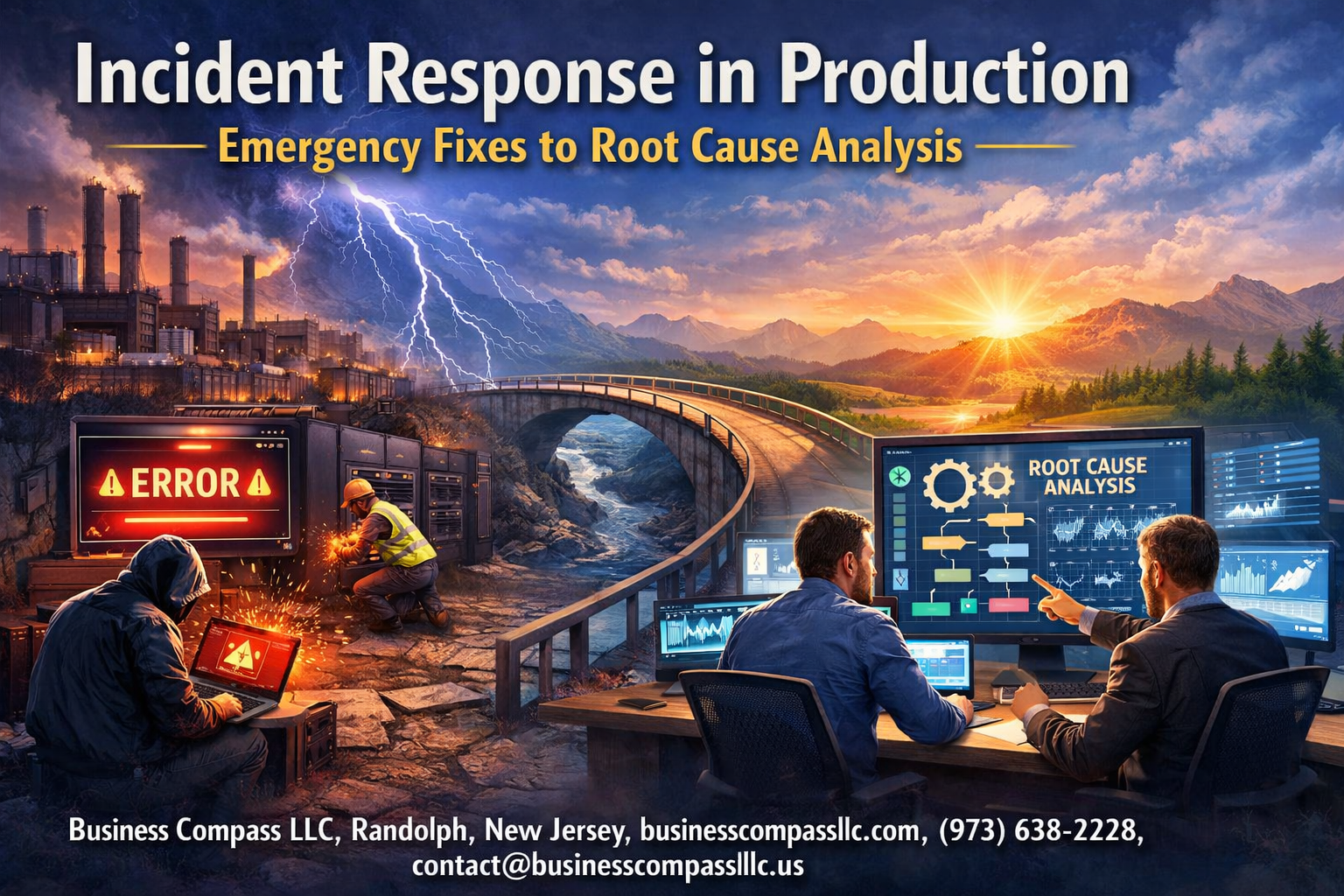
When production systems fail, every second counts. This guide covers incident response in production strategies for DevOps engineers, site reliability engineers, and technical leaders who need to handle critical outages while building stronger systems for the future.
Production incidents can cripple business operations, damage customer trust, and cost companies thousands of dollars per minute. The difference between teams that recover quickly and those that struggle comes down to having solid production incident response processes and the ability to turn crisis into opportunity through effective root cause analysis.
We’ll walk you through building rapid response teams that can jump into action when things go wrong, covering how to set up the right people and processes before disaster strikes. You’ll learn proven immediate containment strategies that stop the bleeding while preserving evidence for investigation. Finally, we’ll dive into systematic investigation techniques that help you dig beyond surface-level fixes to understand what really went wrong, so you can prevent similar issues from happening again.
By the end, you’ll have a complete framework for turning chaotic fire-fighting into controlled, learning-focused production outage management that makes your systems more resilient over time.
Establishing Rapid Response Teams for Production Incidents
Building Cross-Functional Emergency Response Teams
Production incident response demands diverse expertise working seamlessly together. Create teams combining developers, operations engineers, security specialists, and product managers who can tackle complex issues from multiple angles. Each member brings unique skills – developers understand code intricacies, operations knows infrastructure patterns, and product teams grasp user impact priorities.
Train these rapid response teams through regular simulations and tabletop exercises. Cross-train team members on adjacent systems to prevent single points of failure. Document each person’s primary and secondary responsibilities clearly, enabling quick decision-making during high-pressure situations.
Defining Clear Escalation Pathways and Communication Channels
Establish predetermined escalation triggers based on incident severity and business impact. Create automated alerting that reaches the right people within defined timeframes – first responders get 5 minutes, team leads receive notifications after 15 minutes, and executives join critical outages affecting major revenue streams.
Set up dedicated communication channels separate from daily operations. Use tools like Slack incident channels, conference bridges, and status pages that automatically update stakeholders. Document who makes final decisions at each escalation level to avoid confusion when systems are down.
Creating Standardized Incident Classification Systems
Implement consistent severity levels that everyone understands: P0 for complete service outages, P1 for major feature failures, P2 for performance degradation, and P3 for minor issues. Define these categories based on user impact, revenue loss, and regulatory compliance risks rather than technical complexity alone.
Build classification workflows that automatically assign priority levels based on affected services and user metrics. Include expected response times for each category – P0 incidents need immediate attention, while P3 issues can wait for business hours. This system helps teams prioritize efforts during multiple simultaneous problems.
Implementing On-Call Rotation Strategies That Prevent Burnout
Design sustainable on-call schedules that balance coverage needs with team wellness. Rotate primary and secondary responders weekly, ensuring no one carries the burden alone. Limit consecutive on-call periods and provide adequate recovery time between rotations to maintain sharp incident response capabilities.
Compensate on-call engineers fairly through time off, bonuses, or schedule flexibility. Track incident frequency and response quality to identify when additional team members are needed. Build handoff procedures that transfer context effectively, reducing the mental load on incoming responders and improving overall production troubleshooting techniques.
Immediate Containment and Damage Control Strategies
Executing Quick Rollback Procedures to Restore Service
Rollback procedures serve as your first line of defense during production incident response. Deploy automated rollback scripts that can revert code changes, database migrations, and configuration updates within minutes. Maintain pre-tested rollback commands in your emergency fixes production toolkit, ensuring teams can execute them without hesitation during critical outages.
Implementing Circuit Breakers and Feature Flags for Instant Mitigation
Circuit breakers automatically isolate failing services, preventing cascade failures across your system. Feature flags provide granular control during incidents, allowing teams to disable problematic features without full deployments. These tools enable instant mitigation strategies that protect core functionality while problematic components are addressed.
Coordinating Customer Communication During Service Disruptions
Transparent customer communication builds trust during production outage management scenarios. Establish automated status page updates and notification systems that provide real-time incident information. Craft clear, honest messaging that acknowledges the issue while outlining expected resolution timelines and workaround steps for affected users.
Systematic Investigation Techniques for Production Issues
Gathering Critical System Logs and Performance Metrics
Production troubleshooting techniques start with collecting comprehensive logs from all affected systems. Focus on application logs, database query logs, network traffic data, and server performance metrics from the time leading up to the incident. Pay special attention to error patterns, unusual CPU spikes, memory consumption, and disk I/O bottlenecks that might reveal the root cause.
Recreating Incident Scenarios in Safe Testing Environments
Set up isolated staging environments that mirror your production configuration to safely reproduce the problem. This approach lets your team test hypotheses without risking additional system downtime recovery issues. Load testing tools can simulate the exact conditions that triggered the original incident, helping you validate potential fixes before deploying them to live systems.
Interviewing Stakeholders to Understand Timeline and Impact
Talk to team members who were on duty during the incident to piece together the complete timeline. Customer support teams often have valuable insights about user-reported issues that occurred before internal monitoring caught the problem. Business stakeholders can provide context about the real impact on operations and revenue, which helps prioritize your incident management process efforts.
Documenting Evidence Trails for Comprehensive Analysis
Create detailed documentation that captures every piece of evidence discovered during your investigation. Include screenshots of monitoring dashboards, relevant code snippets, configuration changes, and deployment logs. This evidence trail becomes invaluable for your post-incident review process and helps establish patterns that can prevent similar production outage management scenarios in the future.
Root Cause Analysis Methods That Prevent Future Incidents
Applying Five Whys Methodology to Uncover Deep System Issues
The Five Whys approach cuts through surface symptoms to expose underlying system weaknesses. When a production incident occurs, teams ask “why” five consecutive times, each answer forming the next question. This simple yet powerful technique reveals hidden dependencies, architectural flaws, and process gaps that traditional troubleshooting might miss.
Using Fishbone Diagrams to Identify Contributing Factors
Fishbone diagrams provide visual clarity for complex production failures by categorizing potential causes across different dimensions. Teams map contributing factors under categories like people, process, technology, and environment, creating a comprehensive view of failure points that led to the incident.
Conducting Blameless Post-Mortems That Encourage Transparency
Blameless post-incident reviews focus on system improvements rather than individual fault-finding. These sessions create psychological safety for team members to share critical information about failures without fear of punishment. Open dialogue reveals process breakdowns and knowledge gaps that blame-focused discussions typically suppress.
Implementing Timeline Analysis to Understand Failure Sequences
Timeline reconstruction maps the exact sequence of events leading to system failure. Teams document each action, decision, and system state change with precise timestamps, revealing cascading failures and missed intervention opportunities. This chronological analysis identifies critical decision points where different actions could have prevented the outage.
Creating Actionable Remediation Plans with Clear Ownership
Effective remediation plans transform root cause analysis insights into concrete preventive measures. Each action item requires specific owners, deadlines, and success metrics. Teams prioritize fixes based on risk impact and implementation complexity, ensuring high-probability failure modes receive immediate attention while building long-term system resilience.
Building Resilient Systems Through Lessons Learned
Strengthening Monitoring and Alerting Based on Incident Patterns
Post-incident review sessions reveal critical blind spots in production systems that traditional monitoring misses. Smart teams analyze incident patterns to identify early warning signals, transforming reactive firefighting into proactive system health management. This data-driven approach helps create targeted alerts that catch problems before they escalate into full outages.
Automating Recovery Processes to Reduce Manual Intervention
Manual intervention during production incidents introduces human error and delays recovery time. Automated rollback mechanisms, circuit breakers, and self-healing processes significantly reduce system downtime recovery periods. Teams can implement automated recovery workflows that trigger based on specific failure patterns identified during root cause analysis, creating resilient systems design that responds faster than any human operator.
Updating Documentation and Runbooks with New Insights
Fresh incident experiences expose gaps in existing runbooks and reveal new troubleshooting techniques that weren’t previously documented. Teams should immediately capture these insights while details remain crisp, updating procedures with actual command sequences, decision trees, and escalation paths that worked during real emergencies. This creates living documentation that evolves with each production incident response.
Training Teams on Emerging Threats and Response Techniques
Production environments constantly evolve, bringing new failure modes and attack vectors that existing teams may not recognize. Regular training sessions should cover recent incident case studies, new production troubleshooting techniques, and emerging patterns from the incident management process. Hands-on simulation exercises help teams practice rapid response procedures in controlled environments, building muscle memory for when real emergencies strike.
Production incidents will happen—that’s just the reality of running software systems. The difference between teams that thrive and those that struggle comes down to how well they respond when things go wrong. Having rapid response teams ready to jump into action, knowing how to contain damage quickly, and following systematic investigation methods can turn a potential disaster into a manageable situation. But the real value lies in taking those painful moments and turning them into opportunities to build stronger, more resilient systems.
Don’t just fix the immediate problem and move on. Dig deep into what really caused the issue, document everything you learn, and use those insights to prevent similar problems down the road. Your future self—and your users—will thank you for the time you invest in proper root cause analysis and system improvements today. Remember, every incident is a chance to make your system better than it was before.