

Build an End-to-End Fine-Tuned AI Model Training and Serving Pipeline on AWS
You’ve got a powerful base model. Now you want it to actually understand your data, your domain, and your users. That’s exactly what fine-tuning is for — and AWS gives you the infrastructure to do it at scale without stitching together a dozen different tools.
This guide is for ML engineers, data scientists, and AI practitioners who are ready to move beyond experimentation and ship something real. If you’re comfortable with Python and have a basic grasp of cloud services, you’re in the right place.
Here’s what we’ll walk through together:
- Setting up the core components of an AWS fine-tuning pipeline, from dataset prep to environment configuration
- Running and evaluating a training job on Amazon SageMaker, so your fine-tuned AI model is actually production-ready before it touches real traffic
- Deploying the model for real-time inference on AWS and automating the pipeline so it keeps improving without you babysitting it
By the end, you’ll have a working end-to-end ML pipeline on AWS — not just a notebook that runs once, but a repeatable, automated system built for the long haul. Let’s get into it.
Understanding the Core Components of a Fine-Tuning Pipeline on AWS

What Fine-Tuning Is and Why It Delivers Better Model Performance
Fine-tuning adapts a pretrained model to your specific domain using your own data, dramatically improving accuracy over generic outputs.
Key AWS Services That Power Training and Serving Workflows
- Amazon SageMaker – training jobs, endpoints, pipelines
- S3 – dataset and artifact storage
- ECR – custom container registry
How the End-to-End Pipeline Fits Together
Data flows S3 → SageMaker training → model registry → real-time inference endpoint.
Preparing Your Dataset and Environment for Fine-Tuning

Collecting and Cleaning High-Quality Training Data
- Remove duplicates, fix labels, filter noise
Formatting Data to Meet Model Input Requirements
- Match prompt-response pairs to your base model’s expected schema
Setting Up Your AWS Environment, IAM Roles, and S3 Buckets
- Attach SageMaker execution roles, create versioned S3 buckets for datasets and checkpoints
Choosing the Right Base Model
- Pick based on task, token limits, and licensing
Configuring and Launching Your Training Job on Amazon SageMaker

A. Selecting the Optimal Instance Type
- Use
ml.p3.2xlargefor smaller models; scale toml.p4d.24xlargefor LLMs.
B. Key Hyperparameters
- Learning rate, batch size, epochs.
C. Distributed Training
- Enable SageMaker’s data parallelism.
D. Monitor Metrics
- Track via SageMaker Experiments.
E. Save Artifacts
- Push checkpoints to S3 automatically.
Evaluating Your Model to Ensure Production Readiness

Running Offline Evaluation Against a Held-Out Test Set
Run your fine-tuned model against a reserved test set using SageMaker Processing Jobs, tracking metrics like accuracy, F1, and perplexity.
Identifying and Fixing Overfitting or Underfitting Issues
- High train/val loss gap signals overfitting — add dropout or reduce epochs
Benchmarking Fine-Tuned Performance Against the Base Model
Compare outputs directly; your fine-tuned model should consistently outperform the base on domain-specific prompts.
Deploying the Fine-Tuned Model for Real-Time Serving

Packaging the Model for Efficient SageMaker Endpoint Deployment
- Bundle model artifacts into an S3-compatible
model.tar.gzwith a custom inference script.
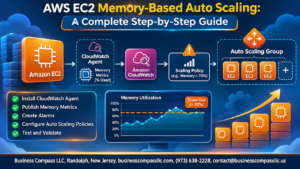
Configuring Auto Scaling to Handle Variable Traffic Loads
- Set
MinCapacityandMaxCapacityon your SageMaker endpoint variant to scale onInvocationsPerInstance.
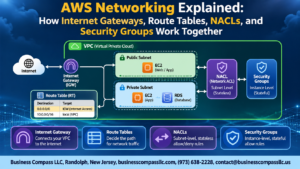
Securing Your Endpoint with VPC and IAM Access Controls
- Restrict real-time model inference AWS traffic using VPC subnets and least-privilege IAM execution roles.
Automating the Pipeline for Continuous Improvement

Orchestrating Retraining Workflows with AWS Step Functions
Triggering Automated Retraining When Data Drift Is Detected
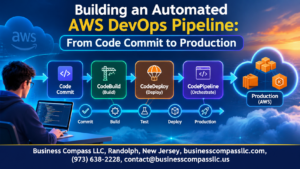
Implementing CI/CD Practices to Push Model Updates Safely
Tracking Costs and Optimizing Resource Utilization Over Time
Your automated ML pipeline on AWS ties everything together — Step Functions chain SageMaker training jobs, drift detection via SageMaker Model Monitor triggers retraining automatically, and CodePipeline handles safe model rollouts. Track spending using AWS Cost Explorer to keep your fine-tuning pipeline lean and efficient.

Fine-tuning an AI model on AWS doesn’t have to feel overwhelming. By breaking it down into clear steps — preparing your data, setting up your environment, training on SageMaker, evaluating performance, and deploying for real-time serving — you can build a solid, production-ready pipeline that actually works for your use case. The key is treating each stage with care rather than rushing to deployment, because a well-evaluated model will always outperform one that was pushed out the door too quickly.
The real game-changer, though, is automation. Once your pipeline runs smoothly from end to end, wiring it up for continuous improvement means your model gets better over time without you having to start from scratch every time. So take what you’ve learned here, start building, and don’t be afraid to iterate — that’s exactly how the best AI systems are made.