Choosing the right AWS Load Balancer can make or break your application’s performance and scalability. This comprehensive ALB vs NLB comparison is designed for cloud engineers, DevOps professionals, and solution architects who need to understand AWS load balancer types and their specific use cases.
AWS offers multiple load balancing solutions, but Application Load Balancer ALB and Network Load Balancer NLB serve different purposes in your cloud architecture. ALB excels at HTTP/HTTPS traffic management with advanced routing capabilities, while NLB delivers ultra-low latency for TCP/UDP traffic at massive scale.
We’ll break down the key technical differences between ALB and NLB, exploring AWS ALB features like content-based routing and SSL termination alongside NLB performance benefits such as static IP addresses and extreme throughput. You’ll also discover real-world load balancer use cases that help you pick the right solution for microservices, gaming applications, IoT workloads, and high-traffic web platforms.
By the end of this AWS load balancing tutorial, you’ll have the knowledge to implement cloud load balancer best practices and confidently choose between ALB and NLB for your specific requirements.
Understanding AWS Load Balancer Fundamentals

Core benefits of load balancing for high availability
AWS Load Balancer delivers critical infrastructure resilience by automatically distributing incoming traffic across multiple targets, eliminating single points of failure that could crash your entire application. When one server goes down, the load balancer instantly redirects traffic to healthy instances, maintaining seamless user experiences while your team fixes issues behind the scenes.
Traffic distribution mechanisms and fault tolerance
Modern AWS load balancing uses sophisticated algorithms to route requests based on server health, response times, and current workloads. The system continuously monitors target health through configurable checks, automatically removing failed instances from rotation and adding them back once they recover. This intelligent traffic management prevents cascading failures and maintains optimal performance even during peak demand periods.
Integration with AWS ecosystem and services
AWS Load Balancer seamlessly connects with Auto Scaling Groups, CloudWatch metrics, and Route 53 DNS services to create a fully automated scaling solution. The deep integration allows you to trigger scaling events based on real-time traffic patterns, automatically provision new instances during spikes, and route users to the closest geographic region for reduced latency and improved global performance.
Application Load Balancer Deep Dive

Layer 7 routing capabilities for intelligent traffic management
Application Load Balancer operates at the application layer, analyzing HTTP and HTTPS requests to make smart routing decisions. Unlike basic load balancers that simply distribute traffic, ALB examines request headers, URLs, and query strings to determine the best destination. This intelligent approach enables microservices architectures where different application components handle specific request types, creating more efficient resource utilization.
Advanced features including SSL termination and WebSocket support
ALB handles SSL/TLS encryption and decryption, removing this computational burden from backend servers while maintaining security. The load balancer supports modern protocols including WebSocket connections for real-time applications like chat systems and live updates. These capabilities reduce server overhead and simplify certificate management across your infrastructure.
Content-based routing rules for enhanced user experience
Routing rules in ALB can direct traffic based on specific content criteria such as:
- Path-based routing –
/api/*requests go to API servers while/images/*routes to media servers - Host-based routing – Different subdomains route to separate application tiers
- Header-based routing – Mobile users get directed to optimized backends
- Query parameter routing – A/B testing scenarios route users based on URL parameters
Performance optimization through connection multiplexing
Connection multiplexing allows ALB to reuse existing connections between the load balancer and backend targets, reducing connection overhead and latency. Instead of opening new connections for each request, ALB efficiently manages connection pools, leading to better resource utilization and faster response times for end users.
Network Load Balancer In-Depth Analysis

Ultra-high performance Layer 4 load balancing benefits
Network Load Balancer operates at the transport layer, delivering exceptional throughput capabilities that can handle millions of requests per second with minimal resource consumption. This AWS Load Balancer type excels in scenarios requiring maximum performance, as it bypasses application-level processing and routes traffic based purely on IP protocol data. The NLB architecture enables seamless scaling without the overhead associated with higher-layer inspection, making it ideal for applications demanding consistent, predictable performance patterns.
Static IP addresses and Elastic IP support advantages
Unlike Application Load Balancer ALB, Network Load Balancer NLB provides static IP addresses for each availability zone, offering significant advantages for enterprise environments with strict networking requirements. Organizations can attach Elastic IP addresses to maintain consistent endpoint configurations across deployments, simplifying firewall rules and DNS management. This capability proves particularly valuable when integrating with on-premises systems or third-party services that require IP whitelisting, as the NLB performance benefits include maintaining stable network identities regardless of scaling activities.
Low latency processing for time-sensitive applications
The streamlined architecture of NLB delivers microsecond-level latency improvements compared to application-layer alternatives, making it perfect for real-time applications like gaming, financial trading, or IoT data streaming. Cloud load balancer best practices emphasize choosing NLB when connection preservation and minimal processing overhead are critical success factors. The load balancer maintains existing connections during scaling events, ensuring uninterrupted service delivery for applications where even brief delays can impact user experience or business operations.
Key Technical Differences Between ALB and NLB

Protocol support variations and their impact on applications
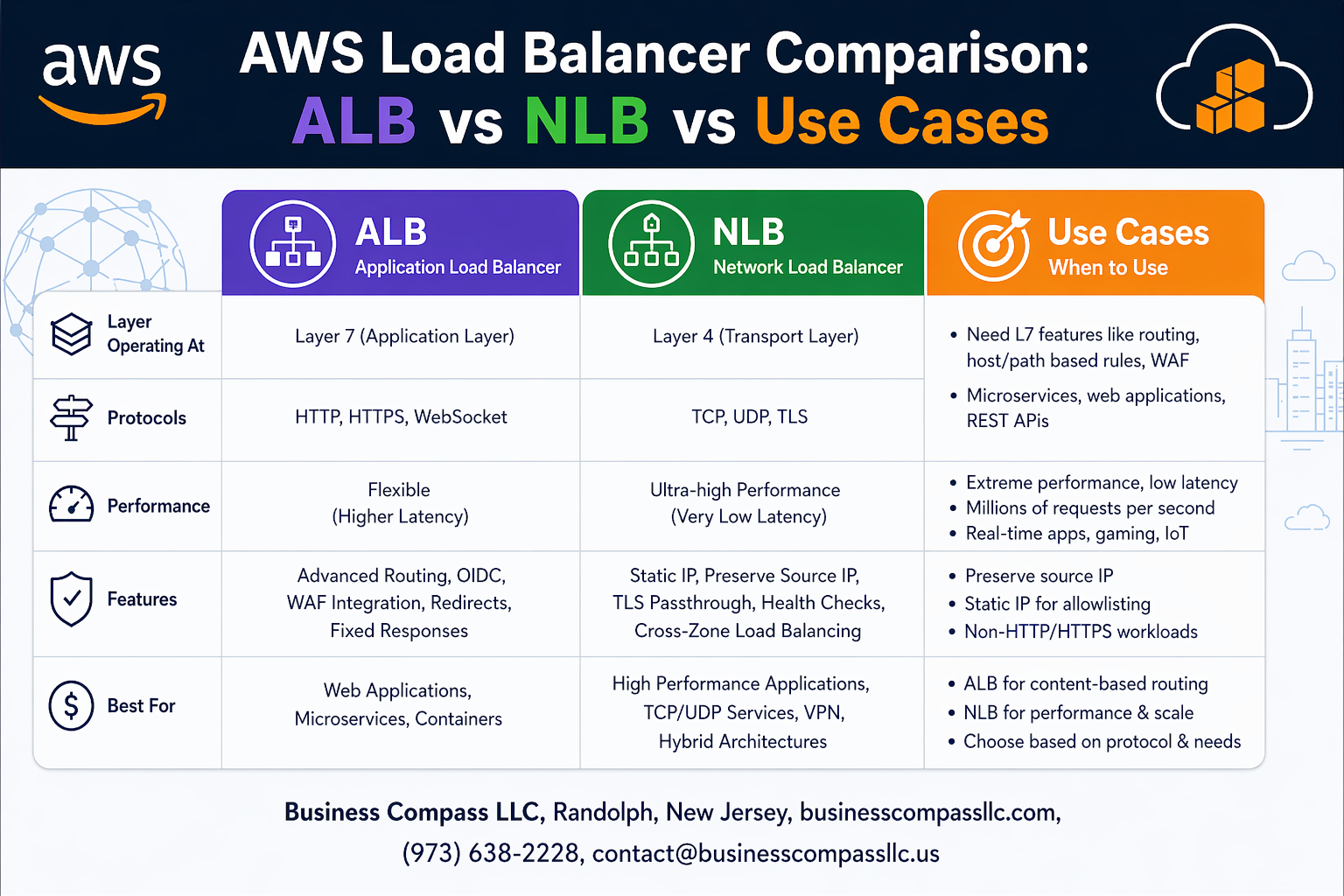
Application Load Balancer operates at Layer 7, handling HTTP and HTTPS traffic with advanced routing capabilities based on URL paths, headers, and hostnames. Network Load Balancer functions at Layer 4, supporting TCP, UDP, and TLS protocols while preserving source IP addresses. This fundamental difference shapes how each AWS load balancer type processes requests and determines which applications can leverage their specific features.
Performance benchmarks and throughput capabilities
Network Load Balancer delivers ultra-low latency performance, handling millions of requests per second with consistent microsecond response times. ALB provides excellent throughput for web applications but introduces slightly higher latency due to Layer 7 processing overhead. NLB excels in high-performance scenarios requiring maximum speed, while ALB offers better flexibility for complex routing decisions in modern web architectures.
Pricing models and cost optimization strategies
Both ALB and NLB use hourly pricing plus data processing charges, but their cost structures differ significantly. ALB charges per Load Balancer Capacity Unit (LCU), considering new connections, active connections, bandwidth, and rule evaluations. NLB pricing focuses on Network Load Balancer Capacity Units (NLCU), emphasizing throughput and connection metrics. Organizations can optimize costs by matching workload characteristics to the appropriate load balancer type and monitoring capacity unit consumption patterns.
Health check mechanisms and monitoring differences
ALB performs sophisticated health checks using HTTP/HTTPS requests with customizable response codes, paths, and intervals. NLB conducts simpler TCP or HTTP health checks, focusing on connection establishment rather than application-level responses. ALB provides detailed CloudWatch metrics for request-level monitoring, while NLB offers connection and flow-level insights. These monitoring differences impact troubleshooting capabilities and operational visibility across different application architectures.
Real-World Use Cases for Application Load Balancer

Web applications requiring content-based routing
Application Load Balancer excels at directing traffic based on specific request characteristics. Modern web applications benefit from ALB’s ability to route requests using URL paths, HTTP headers, and query parameters. E-commerce platforms can direct product searches to specialized backend services while routing user authentication requests to dedicated security services.
Content-based routing enables sophisticated traffic management strategies. ALB supports host-based routing for multi-tenant applications, allowing different domains to reach appropriate backend targets. This flexibility makes ALB ideal for complex web applications requiring intelligent request distribution beyond simple round-robin methods.
Microservices architectures with container deployments
Container-based microservices architectures pair perfectly with ALB’s advanced routing capabilities. ALB integrates seamlessly with Amazon ECS and EKS, providing automatic service discovery and health checking for containerized applications. Dynamic port mapping allows containers to register automatically without manual configuration changes.
ALB’s target group flexibility supports diverse microservices deployment patterns. Development teams can route requests to specific service versions for blue-green deployments or canary releases. The load balancer handles SSL termination and HTTP/2 support, reducing complexity for individual microservices while maintaining optimal performance across distributed architectures.
API gateway implementations for RESTful services
ALB serves as an effective API gateway for RESTful service architectures. Path-based routing directs API calls to appropriate backend services based on resource endpoints. ALB handles authentication integration with AWS Cognito and supports custom request/response modifications through Lambda functions.
RESTful API implementations benefit from ALB’s HTTP-specific features. Built-in support for sticky sessions, WebSocket connections, and HTTP/2 protocol optimization enhances API performance. ALB’s integration with AWS WAF provides essential security features for public-facing APIs, including rate limiting and request filtering capabilities.
Optimal Network Load Balancer Scenarios

Gaming applications demanding ultra-low latency
Real-time gaming demands Network Load Balancer’s microsecond-level latency performance. NLB operates at the transport layer, eliminating application-layer processing delays that could impact competitive gaming experiences. Gaming platforms like multiplayer shooters and racing simulators benefit from NLB’s ability to maintain consistent connection speeds across global player bases, ensuring fair gameplay without lag-induced advantages.
IoT device communications requiring static IP addresses
IoT ecosystems often require static IP addresses for device authentication and firewall configurations. Network Load Balancer provides dedicated IP addresses that remain constant, enabling seamless device-to-cloud communications. Manufacturing sensors, smart city infrastructure, and medical devices rely on NLB’s IP stability for continuous data transmission without connection disruptions.
Financial trading systems with high-frequency transactions
High-frequency trading platforms demand NLB’s ultra-low latency capabilities for millisecond-sensitive transactions. AWS Load Balancer choice becomes critical when processing thousands of trades per second. NLB’s layer-4 routing eliminates application inspection overhead, making it ideal for algorithmic trading systems where every microsecond impacts profitability and competitive advantage.
Legacy applications using TCP/UDP protocols
Existing enterprise applications built on TCP/UDP protocols integrate seamlessly with Network Load Balancer without code modifications. Legacy database clusters, custom networking applications, and proprietary communication systems benefit from NLB’s protocol flexibility. Organizations can modernize infrastructure while preserving existing application architectures, avoiding costly rewrites for cloud load balancer migration projects.

Choosing between AWS Application Load Balancer and Network Load Balancer doesn’t have to be complicated once you understand their core strengths. ALB shines when you need intelligent routing, SSL termination, and application-layer features for web applications and microservices. NLB delivers raw performance and handles millions of requests with ultra-low latency, making it perfect for gaming applications, IoT devices, and any scenario where speed trumps smart routing features.
The decision ultimately comes down to your specific needs and traffic patterns. If you’re building modern web applications with complex routing requirements, ALB will serve you well. For high-performance applications that need to handle massive traffic loads with minimal delay, NLB is your best bet. Take time to evaluate your current infrastructure, expected traffic patterns, and performance requirements before making the switch. Both load balancers can transform your application’s reliability and performance when used in the right context.