AWS Agentic AI Explained: AgentCore vs Strands Agents vs Amazon Bedrock Agents
AWS just gave developers three different ways to build agentic AI — and picking the wrong one can cost you serious time and money.
If you’re a developer, solutions architect, or AI engineer trying to figure out which AWS AI agent framework actually fits your use case, this breakdown is for you. No fluff, no vendor speak — just a straight comparison of what each tool does and when to reach for it.
Here’s what we’re covering:
- What agentic AI on AWS actually means and why AWS suddenly has multiple frameworks competing for the same problem
- How AgentCore, Strands Agents, and Amazon Bedrock Agents each work — their strengths, limitations, and the kind of projects they’re built for
- A side-by-side comparison so you can walk away knowing exactly which framework matches your team, your stack, and your production goals
By the end, the AgentCore vs Bedrock Agents debate won’t feel like alphabet soup anymore. You’ll have a clear answer for your situation.
Let’s get into it.
Understanding the Rise of Agentic AI on AWS

What Agentic AI Is and Why It Matters for Modern Businesses
Agentic AI lets software autonomously plan, decide, and act — not just respond. Businesses gain AI that completes multi-step workflows without constant human input.
How AWS Positions Itself in the Agentic AI Landscape
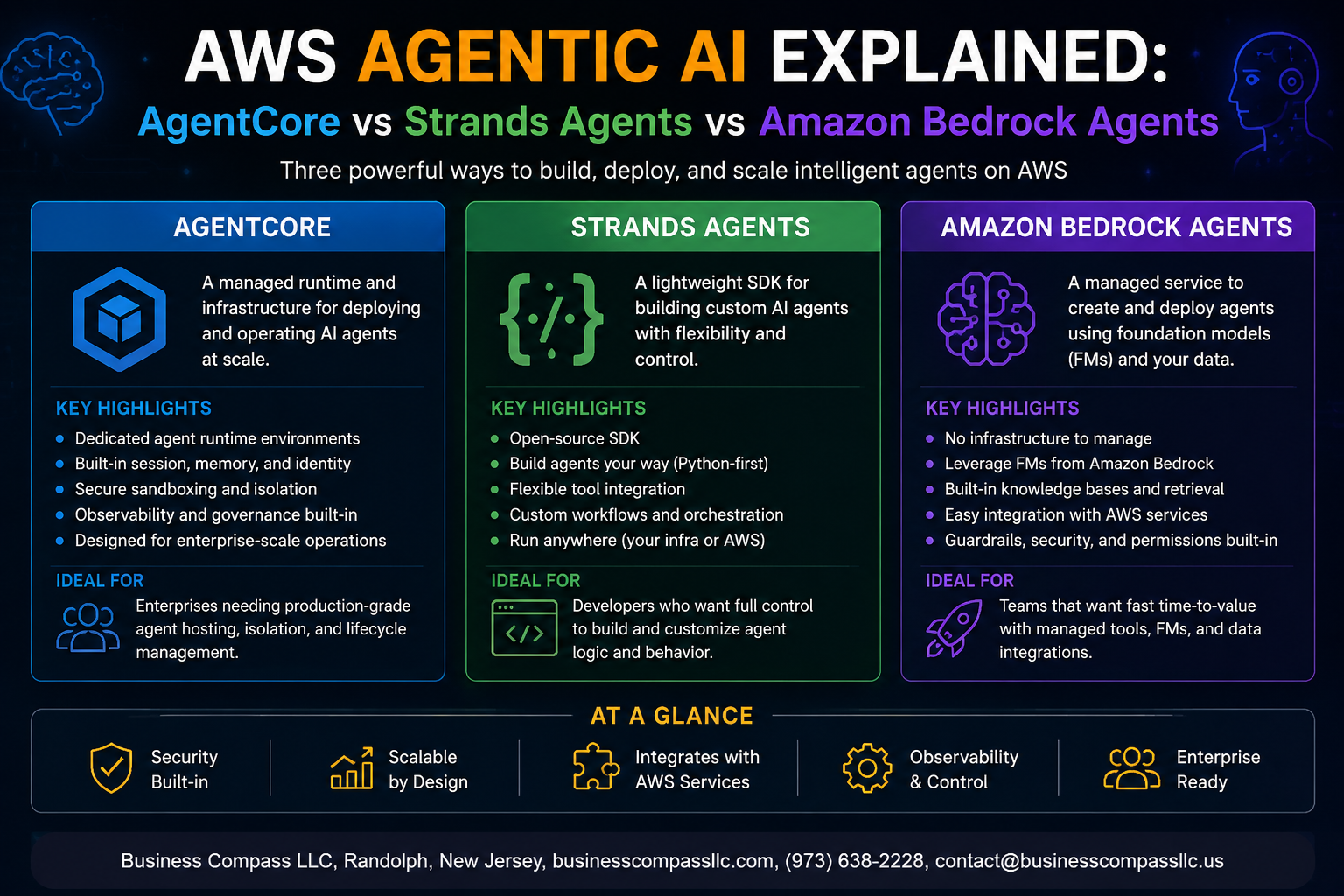
AWS offers three frameworks — AgentCore, Strands Agents, and Amazon Bedrock Agents — covering every skill level.
Key Problems These Frameworks Solve
- Reducing manual orchestration
- Simplifying tool integration
- Scaling production-grade agents reliably
AWS AgentCore Unpacked

What AgentCore Is and the Core Problems It Addresses
AWS AgentCore is a managed runtime for deploying AI agents at scale, solving key pain points like session memory, secure tool execution, and multi-agent orchestration — without building infrastructure from scratch.
- Handles agent lifecycle management
- Simplifies authentication and observability
- Reduces operational overhead significantly
Strands Agents Explained

What Strands Agents Is and How It Came to Be
AWS open-sourced Strands Agents in 2025 as a lightweight Python SDK, letting developers build AI agents with minimal boilerplate.
How the Model-Driven Approach Simplifies Agent Development
The model handles reasoning and tool-calling decisions automatically, so you skip complex orchestration logic.
Best Scenarios Where Strands Agents Delivers Maximum Value
- Rapid prototyping
- Custom tool integration
- Multi-agent workflows
Amazon Bedrock Agents Demystified

What Amazon Bedrock Agents Offers and How It Works
Amazon Bedrock Agents is AWS’s fully managed, no-code-heavy solution for building AI agents. It connects foundation models to tools, APIs, and knowledge bases automatically, handling orchestration behind the scenes — perfect for teams wanting fast deployment without deep ML engineering overhead.
Side-by-Side Comparison of All Three Frameworks
Architecture and Design Philosophy Differences
- AgentCore: Runtime infrastructure layer
- Strands Agents: Code-first, open-source SDK
- Bedrock Agents: Fully managed, low-code
Developer Experience and Ease of Setup
Bedrock Agents wins for speed; Strands gives Python devs control; AgentCore handles the messy runtime plumbing underneath both.
Scalability and Enterprise Readiness
All three scale on AWS infrastructure.
Choosing the Right AWS Agentic AI Framework for Your Needs

A. Decision Criteria to Evaluate Before Committing to a Framework
- Control level needed – AgentCore for infrastructure, Strands for code-first flexibility, Bedrock Agents for managed simplicity.
- Team skills – Python developers love Strands; low-code teams prefer Bedrock Agents.
B. How to Match Your Use Case to the Right Solution
Pick Bedrock Agents for quick deployment, Strands for custom logic.
C. Combining Frameworks for Maximum Flexibility and Power
Run Strands agents on AgentCore infrastructure while connecting Bedrock Agents as specialized sub-agents.

AWS has clearly made a strong bet on agentic AI, and for good reason. AgentCore, Strands Agents, and Amazon Bedrock Agents each bring something different to the table — from low-level infrastructure control to open-source flexibility to fully managed, no-fuss deployment. The right choice really comes down to what your team needs most: speed, control, customization, or simplicity.
Take a step back and think about where your project actually stands. Are you building something quick and production-ready with minimal setup? Bedrock Agents might be your best bet. Need more flexibility and want to work in an open-source environment? Strands Agents could be the way to go. Running complex, multi-agent systems at scale with tight infrastructure requirements? AgentCore is worth a serious look. Start small, test the framework that fits your use case best, and scale from there — that’s the smartest way to get the most out of what AWS agentic AI has to offer.