Modern data teams are drowning in complex ETL pipelines that require constant maintenance and scaling headaches. Serverless ETL on AWS with Apache Iceberg offers a game-changing approach that eliminates infrastructure management while delivering enterprise-grade performance for your data lake modernization needs.
This comprehensive guide is designed for data engineers, cloud architects, and analytics teams who want to build robust, cost-effective data pipelines without the operational overhead of traditional ETL systems.
We’ll walk you through the complete serverless analytics architecture, showing you how to combine AWS Lambda ETL functions, AWS Glue, and other managed services with the powerful Iceberg table format. You’ll discover how to design and implement a serverless data processing pipeline that scales automatically and handles schema evolution seamlessly. We’ll also cover performance optimization strategies that maximize throughput while minimizing costs, plus security best practices that keep your data protected.
By the end of this guide, you’ll have everything you need to build a production-ready AWS serverless data pipeline that leverages Apache Iceberg’s advanced capabilities for modern analytics workloads.
Understanding Serverless ETL Fundamentals and Benefits

Cost-effective data processing without infrastructure management
Serverless ETL AWS solutions eliminate the heavy lifting of server provisioning, patching, and capacity planning. Organizations pay only for actual compute time used, dramatically reducing costs compared to traditional always-on infrastructure. AWS Lambda ETL functions automatically handle resource allocation, while services like AWS Glue provide managed environments for complex data transformations. This pay-per-use model makes serverless data processing especially attractive for variable workloads where traditional servers would sit idle during low-demand periods.
Automatic scaling based on workload demands
AWS serverless data pipeline components scale seamlessly from zero to thousands of concurrent executions without manual intervention. Lambda functions can process sudden spikes in data volume by spinning up multiple instances instantly, while AWS Glue jobs automatically adjust worker capacity based on data size. This elasticity ensures consistent performance during peak loads and prevents over-provisioning during quiet periods. The scaling happens transparently, maintaining data processing SLAs without requiring dedicated DevOps resources to monitor and adjust capacity.
Reduced operational overhead and maintenance requirements
Serverless analytics architecture shifts operational responsibility from your team to AWS, freeing up valuable engineering resources. Platform updates, security patches, and infrastructure monitoring become AWS’s responsibility, allowing teams to focus on business logic and data insights. Monitoring and logging integrate natively with CloudWatch, providing comprehensive observability without additional setup. Error handling and retry mechanisms work automatically, reducing the need for complex failure recovery systems and minimizing the operational burden of maintaining robust data pipelines.
Apache Iceberg Architecture and Core Advantages

Time Travel Capabilities for Historical Data Analysis
Apache Iceberg’s time travel functionality lets you query data as it existed at any specific point in time, making historical analysis and data debugging incredibly straightforward. This serverless data processing capability allows teams to examine data states across different timestamps without complex versioning systems. When building AWS serverless data pipeline solutions, you can easily compare current data against previous snapshots, track changes over time, and recover from accidental data modifications. The feature works seamlessly with AWS analytics services, enabling powerful temporal queries that would traditionally require expensive data warehouse operations.
Schema Evolution Without Breaking Existing Queries
Iceberg table format handles schema changes gracefully, allowing you to add, remove, or modify columns without disrupting existing applications or queries. This flexibility proves essential in serverless ETL AWS environments where data requirements evolve rapidly. Unlike traditional table formats, Iceberg maintains backward compatibility automatically, so legacy queries continue working even after schema updates. Teams can confidently modify data structures in response to business needs without worrying about breaking downstream analytics or reporting systems that depend on stable table schemas.
ACID Transaction Support for Reliable Data Operations
Apache Iceberg architecture provides full ACID transaction guarantees, ensuring data consistency even in distributed serverless environments. This reliability becomes crucial when multiple AWS Lambda ETL functions process data simultaneously, preventing data corruption and ensuring atomic operations. Writers can commit changes safely while readers get consistent views of data, eliminating the race conditions common in traditional data lake implementations. The transaction support works particularly well with AWS services, allowing complex ETL workflows to maintain data integrity across multiple processing stages.
Efficient Metadata Management for Large Datasets
Iceberg’s advanced metadata handling dramatically improves query performance and data lake modernization efforts by storing statistics and partition information efficiently. The metadata layer tracks file-level statistics, enabling query engines to skip irrelevant data files and reduce scan times significantly. This optimization becomes especially valuable in serverless analytics architecture where compute costs directly correlate with processing time. AWS Glue Iceberg integration leverages this metadata to provide faster catalog operations and more efficient job planning, resulting in both performance improvements and cost savings for large-scale data operations.
Essential AWS Services for Serverless ETL Implementation

AWS Lambda for Event-Driven Data Transformations
AWS Lambda serves as the cornerstone of serverless ETL AWS implementations, executing data transformations automatically when triggered by events like S3 uploads or database changes. This event-driven architecture eliminates infrastructure management while providing millisecond response times for real-time data processing. Lambda functions can handle Apache Iceberg table operations, schema evolution, and data quality checks without provisioning servers. The pay-per-execution model ensures cost-effective serverless data processing, especially for sporadic workloads. Integration with other AWS services creates seamless serverless data pipelines that scale automatically based on demand.
Amazon S3 for Scalable Data Lake Storage
Amazon S3 provides the foundation for modern data lake storage in serverless analytics architecture, offering virtually unlimited capacity and 99.999999999% durability. S3’s integration with Apache Iceberg enables efficient data organization through partitioning and clustering strategies that optimize query performance. The service supports multiple storage classes for cost optimization, automatically transitioning older data to cheaper tiers. S3 event notifications trigger downstream Lambda functions for immediate data processing, creating reactive serverless data pipelines. Cross-region replication and versioning capabilities ensure data availability and disaster recovery for critical analytics workloads.
AWS Glue for Managed ETL Workflows and Data Cataloging
AWS Glue delivers fully managed ETL capabilities that eliminate server provisioning and maintenance overhead in serverless ETL AWS environments. The service automatically discovers data schemas and populates the Glue Data Catalog, creating a centralized metadata repository for Apache Iceberg tables. Glue’s visual ETL editor simplifies complex transformation logic while supporting custom Python and Scala code for advanced processing needs. Native Iceberg AWS implementation support includes schema evolution, time travel queries, and ACID transactions. The serverless Glue jobs scale automatically based on data volume, ensuring optimal performance without manual intervention.
Amazon Athena for Serverless Query Processing
Amazon Athena enables instant SQL queries against data stored in S3 without managing infrastructure, making it perfect for ad-hoc analysis in serverless analytics architecture. The service natively supports Apache Iceberg table format, providing access to advanced features like schema evolution and snapshot isolation. Athena’s integration with the Glue Data Catalog automatically recognizes Iceberg tables and their partitioning schemes for optimized query execution. Pay-per-query pricing model aligns costs with actual usage, eliminating idle resource expenses. ACID transaction support ensures data consistency while concurrent users access the same Iceberg tables through standard SQL interfaces.
Designing the Complete Serverless ETL Architecture
Data ingestion layer with event-driven triggers
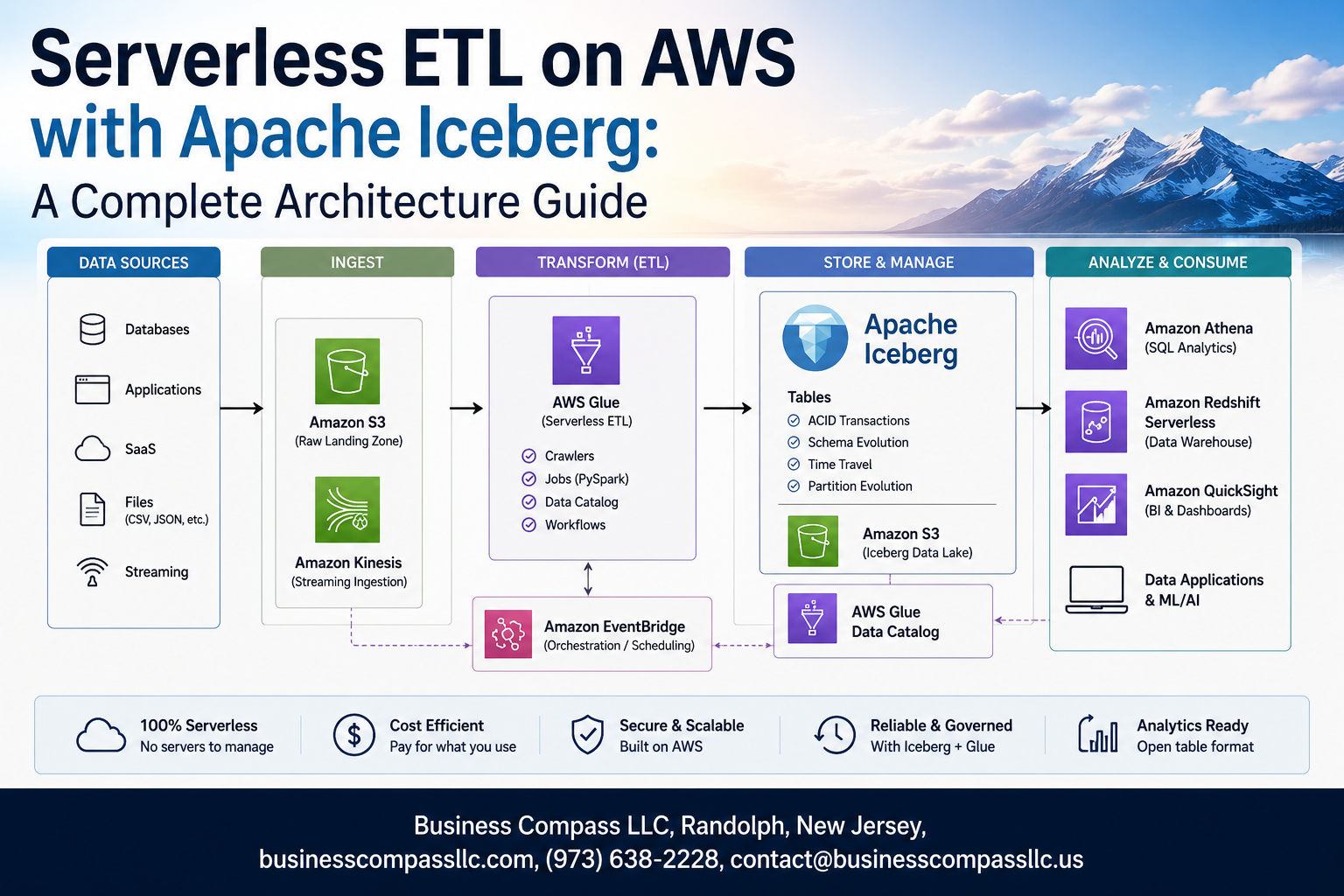
Building an effective serverless ETL AWS architecture starts with establishing robust data ingestion patterns that automatically respond to incoming data events. Amazon S3 event notifications serve as the primary trigger mechanism, instantly activating downstream processing when new files arrive in designated buckets. These events integrate seamlessly with Amazon EventBridge for sophisticated routing rules, enabling different processing workflows based on file types, source systems, or business logic requirements. AWS Lambda functions act as lightweight orchestrators, validating incoming data formats and initiating appropriate ETL pipelines. Amazon Kinesis Data Streams handle real-time data ingestion for streaming scenarios, while AWS Database Migration Service (DMS) captures change data from operational databases. The event-driven approach eliminates polling overhead and ensures immediate processing, making your serverless data pipeline highly responsive to business needs.
Processing layer with Lambda and Glue integration
The processing layer combines AWS Lambda’s event-driven compute with AWS Glue’s managed Apache Spark environment to create a powerful serverless analytics architecture. Lambda functions handle lightweight transformations, data validation, and workflow orchestration, while Glue jobs tackle compute-intensive operations like complex aggregations and large-scale data transformations. This hybrid approach optimizes costs by using Lambda for quick tasks under 15 minutes and Glue for longer-running processes. AWS Step Functions coordinate multi-step workflows, managing error handling and retry logic across the processing pipeline. Glue’s native support for the Iceberg table format enables schema evolution and ACID transactions without requiring additional infrastructure management. The integration allows automatic scaling based on workload demands, processing terabytes of data without manual intervention while maintaining optimal performance and cost efficiency.
Storage layer optimized for Iceberg table format
Amazon S3 serves as the foundational storage layer, optimized specifically for Apache Iceberg’s advanced table format capabilities. Iceberg’s metadata management system stores table schemas, partition specifications, and file manifests separately from actual data files, enabling efficient query planning and execution. The storage architecture implements intelligent partitioning strategies based on time, geography, or business dimensions to minimize scan costs and improve query performance. S3’s lifecycle policies automatically transition older data to cheaper storage classes while maintaining immediate accessibility for recent analytics workloads. Iceberg’s snapshot isolation allows multiple concurrent readers and writers without conflicts, supporting both batch and streaming data updates. The format’s hidden partitioning feature automatically organizes data without exposing partition columns to end users, simplifying query development while maintaining optimal performance across diverse access patterns and data volumes.
Query and analytics layer for business intelligence
The analytics layer leverages Amazon Athena and Amazon Redshift Spectrum for interactive querying of Iceberg tables stored in S3, providing business users with familiar SQL interfaces for data exploration. Athena’s serverless query engine automatically recognizes Iceberg metadata, enabling time travel queries and incremental reads that significantly reduce processing costs. AWS QuickSight connects directly to both Athena and Redshift, delivering self-service analytics capabilities with automatic data refresh triggered by ETL pipeline completion events. The architecture supports concurrent analytical workloads through Iceberg’s multi-version concurrency control, allowing business intelligence tools to query tables while ETL processes continue updating data. Amazon EMR provides additional processing power for complex analytical workloads requiring custom libraries or specialized frameworks. Integration with AWS Lake Formation ensures consistent security policies across all query engines while maintaining fine-grained access controls for sensitive business data.
Step-by-Step Implementation Guide

Setting up S3 buckets and Iceberg table structures
Creating your serverless ETL AWS foundation starts with configuring S3 buckets for data storage and metadata. Set up separate buckets for raw data ingestion, processed outputs, and Iceberg metadata catalogs. Configure bucket policies with proper versioning and lifecycle rules to optimize costs. Create your Iceberg table format schema using AWS Glue Data Catalog, defining partition strategies that align with your query patterns. Use column-level statistics and schema evolution features to maintain performance as your data grows. Structure your bucket hierarchy with clear naming conventions like /raw-data/year/month/day/ for efficient data organization. Enable S3 event notifications to trigger downstream processing automatically. Configure cross-region replication for disaster recovery if needed. Set up proper IAM roles that allow Lambda and Glue services to read from source buckets and write to target locations without overly permissive access.
Configuring Lambda functions for data transformation
Design your AWS Lambda ETL functions with specific transformation logic for lightweight data processing tasks. Create separate functions for data validation, format conversion, and basic aggregations to maintain modularity. Use environment variables to store configuration parameters like database connections and S3 bucket names. Implement proper error handling with dead letter queues to capture failed processing attempts. Configure memory allocation based on your data volume – typically 512MB to 3GB for most ETL workloads. Set timeout values appropriately, keeping functions under 15 minutes to avoid Lambda limits. Use layers to package common libraries and reduce deployment package sizes. Implement retry logic with exponential backoff for external API calls. Create event-driven triggers using S3 notifications or CloudWatch Events to process data as it arrives. Package your code efficiently using deployment packages or container images depending on your dependencies and runtime requirements.
Creating Glue jobs for complex ETL operations
Build AWS Glue Iceberg jobs for heavy-duty data transformations that exceed Lambda’s processing capabilities. Design Spark-based ETL scripts that can handle large datasets with complex joins and aggregations. Configure job parameters to dynamically adjust worker counts based on data volume. Use Glue’s built-in Iceberg AWS implementation connectors to read and write data efficiently. Implement bookmark functionality to track processed data and avoid reprocessing. Create custom transformations using Glue’s DynamicFrame API for schema flexibility. Set up job scheduling using Glue workflows or EventBridge for automated execution. Configure worker types (Standard, G.1X, G.2X) based on your memory and compute requirements. Use Glue DataBrew for visual data preparation when business users need to define transformation rules. Implement data quality checks within your jobs to catch issues early. Create reusable job templates for common transformation patterns across your serverless data processing pipeline.
Establishing monitoring and error handling mechanisms
Implement comprehensive monitoring using CloudWatch metrics to track your serverless analytics architecture performance. Set up custom metrics for data processing latency, error rates, and throughput across all pipeline components. Create CloudWatch alarms with SNS notifications for immediate alerting on failures or performance degradation. Use AWS X-Ray for distributed tracing to identify bottlenecks in your data flow. Implement structured logging with correlation IDs to track data lineage through your pipeline. Set up dead letter queues for Lambda functions and configure retry policies for transient failures. Create automated recovery mechanisms using Step Functions to orchestrate complex error handling workflows. Monitor Iceberg table health using Glue Data Quality rules to catch schema drift and data anomalies. Use CloudTrail for auditing API calls and data access patterns. Establish dashboards in CloudWatch or QuickSight to visualize pipeline health and data processing metrics. Configure budget alerts to monitor costs and prevent unexpected charges from runaway processes.
Performance Optimization Strategies

Partitioning Schemes for Improved Query Performance
Effective partitioning strategies dramatically enhance query performance in serverless ETL AWS implementations using Apache Iceberg. Time-based partitioning works best for event data, splitting tables by year, month, or day depending on query patterns. Geographic partitioning suits location-aware datasets, while categorical partitioning organizes data by business units or product lines. Iceberg’s hidden partitioning feature automatically handles partition evolution, eliminating manual partition management overhead that plagues traditional data lake architectures.
Compaction Schedules for Storage Efficiency
Small file proliferation kills query performance and increases storage costs in serverless data processing environments. Iceberg’s built-in compaction automatically merges small files into optimally-sized chunks, typically 128-512MB depending on your workload. Schedule compaction jobs during low-traffic windows using AWS Lambda or AWS Glue scheduled triggers. Configure compaction based on file count thresholds rather than fixed schedules – trigger when directories contain more than 10-20 small files to maintain optimal read performance.
Memory and Compute Resource Tuning
Right-sizing compute resources prevents both performance bottlenecks and cost overruns in AWS serverless data pipeline architectures. AWS Glue jobs benefit from increased DPU allocations for large datasets – start with 10 DPUs and scale based on processing time metrics. Lambda functions handling Iceberg operations need sufficient memory allocation (1GB minimum) to handle metadata operations efficiently. Monitor CloudWatch metrics to identify memory pressure and adjust accordingly, especially for complex transformations involving multiple table scans.
Parallel Processing Configurations
Maximize throughput by configuring parallel processing across multiple AWS services in your Iceberg AWS implementation. Set Glue job parallelism based on input data size – use one worker per 100MB of source data as a starting point. Configure Lambda concurrency limits to prevent overwhelming downstream services while maintaining processing speed. Implement SQS queues between processing stages to decouple components and enable elastic scaling. Use Iceberg’s snapshot isolation to allow concurrent reads during writes, eliminating processing bottlenecks common in traditional data lake modernization projects.
Security and Compliance Best Practices

IAM Roles and Policies for Least Privilege Access
Securing your serverless ETL AWS implementation starts with granular IAM controls that restrict access to only what each service needs. Create dedicated IAM roles for Lambda functions with specific permissions for reading source data and writing to Iceberg tables. Your AWS Glue crawlers should have separate roles limited to metadata discovery and catalog updates. Grant S3 access at the bucket and prefix level, not account-wide. Use policy conditions to restrict access by IP ranges, time windows, or MFA requirements. Enable CloudTrail logging for all IAM activities and regularly audit permissions to identify unused access patterns.
Data Encryption in Transit and at Rest
Encryption protects your Apache Iceberg data pipeline at every touchpoint. Enable S3 server-side encryption with KMS keys for your data lake storage, ensuring Iceberg table files remain encrypted at rest. Configure SSL/TLS certificates for all API communications between Lambda functions, Glue jobs, and data sources. Use AWS KMS customer-managed keys instead of default service keys for better control over encryption policies and key rotation. Enable encryption for CloudWatch logs, SNS topics, and SQS queues in your serverless data processing workflow. Set up envelope encryption for sensitive data fields within your Iceberg tables using client-side encryption libraries.
VPC Configurations for Network Isolation
Network isolation strengthens your AWS serverless data pipeline security by controlling traffic flow between components. Deploy Lambda functions within private subnets that route internet traffic through NAT gateways for outbound connections. Configure VPC endpoints for S3, Glue, and other AWS services to keep traffic within the AWS network backbone. Set up security groups that allow communication only between necessary services – restrict inbound access to specific ports and protocols. Create separate subnets for different data processing tiers with network ACLs as an additional security layer. Use VPC Flow Logs to monitor network traffic patterns and detect anomalous connections in your Iceberg AWS implementation.
Cost Management and Resource Optimization

Lambda Pricing Optimization Techniques
- Memory allocation rightsizing: Start with minimal memory (512MB) and monitor CloudWatch metrics to identify optimal settings. Lambda charges based on allocated memory and execution time, so finding the sweet spot reduces costs significantly.
- Provisioned concurrency management: Reserve capacity only for critical, time-sensitive workloads. Most serverless ETL AWS operations can tolerate cold starts without impacting business requirements.
- Function duration optimization: Break large ETL jobs into smaller chunks to avoid timeout charges. Use Step Functions to orchestrate multiple Lambda invocations instead of running single long-duration functions.
- Architecture patterns: Implement fan-out patterns using SQS/SNS to process data in parallel, reducing individual function execution time while maintaining throughput.
S3 Storage Class Selection Strategies
- Intelligent Tiering for Iceberg tables: Enable S3 Intelligent-Tiering on your Apache Iceberg data lake to automatically move infrequently accessed data to cheaper storage classes without operational overhead.
- Lifecycle policies by data temperature: Configure policies that move raw ingestion data to IA after 30 days and Glacier after 90 days. Keep current Iceberg table partitions in Standard class for query performance.
- Cross-region replication costs: Evaluate whether disaster recovery requirements justify cross-region replication expenses. Consider single-region deployments with automated backup strategies for cost-sensitive workloads.
- Request patterns analysis: Monitor GET/PUT request patterns through CloudWatch to identify opportunities for storage class optimization based on actual access frequency.
Glue Job Scheduling for Cost Efficiency
- Dynamic scaling with job bookmarks: Enable Glue job bookmarks to process only new data, preventing unnecessary reprocessing of existing datasets. This dramatically reduces compute costs for incremental ETL patterns.
- Time-based scheduling optimization: Schedule non-critical Glue jobs during off-peak hours when AWS offers lower spot pricing for underlying EC2 instances supporting Glue workers.
- Worker type selection: Use G.1X workers for small datasets and G.2X for memory-intensive operations. Avoid over-provisioning workers since Glue charges per DPU-hour consumed.
- Job triggering strategies: Implement event-driven triggers using S3 notifications instead of time-based schedules to process data only when available, reducing idle compute costs.
Monitoring and Alerting for Budget Control
- AWS Budgets integration: Set up cost budgets with alerts at 50%, 80%, and 100% thresholds for your serverless data pipeline resources. Include forecasted spending alerts to prevent month-end surprises.
- CloudWatch cost metrics: Create custom dashboards tracking Lambda invocations, Glue DPU consumption, and S3 request patterns. Establish baseline metrics to identify cost anomalies quickly.
- Resource tagging strategy: Implement consistent tagging across all AWS services to enable detailed cost allocation reporting. Tag resources by environment, team, and project for granular cost tracking.
- Automated cost optimization: Deploy Lambda functions that automatically pause or scale down non-production resources based on schedules or usage patterns, ensuring development environments don’t inflate production costs.

Building a serverless ETL pipeline with Apache Iceberg on AWS opens up powerful possibilities for modern data processing. You’ve learned how to leverage key AWS services, design a robust architecture, and implement the complete solution step-by-step. The combination of serverless computing and Iceberg’s advanced table format gives you the flexibility to handle massive datasets while keeping costs under control and maintaining top-notch performance.
The real magic happens when you apply the optimization strategies and security practices we’ve covered. Your data pipeline can now scale automatically, process data faster, and stay secure without the headache of managing infrastructure. Start with a simple use case, implement the core architecture, and gradually add the advanced features as your needs grow. This approach will help you build a data platform that’s both powerful today and ready for whatever comes next.