
Amazon S3 static website hosting works great for simple sites, but it comes with some serious blind spots that can hurt your website’s performance and security. If you’re a developer, DevOps engineer, or website owner using S3 to host static sites, you’ve probably run into these issues without realizing better solutions exist.
S3 hosting limitations can slow down your site for global users and leave your content exposed to security risks. CloudFront CDN fixes these problems by sitting between your S3 bucket and your visitors, dramatically improving speed and adding layers of protection that basic S3 simply can’t provide.
We’ll explore the specific S3 website performance bottlenecks that affect user experience, dive into the S3 security vulnerabilities that put your site at risk, and show you exactly how CloudFront vs S3 direct hosting delivers faster load times and better protection. You’ll also discover the cost benefits of S3 CloudFront integration and why this combo often saves money compared to S3 alone.
Common S3 Hosting Limitations That Impact Your Website Performance
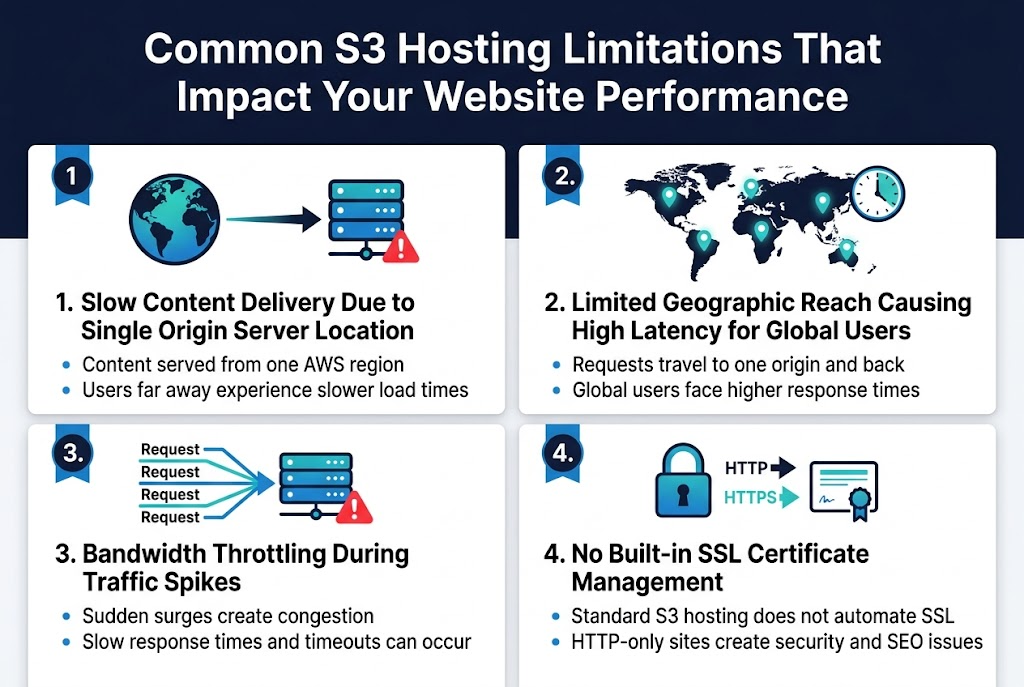
Slow Content Delivery Due to Single Origin Server Location
When you host static websites on S3, your content gets served from a single AWS data center region. This creates a bottleneck where users far from your chosen region experience significantly slower load times. For example, if your S3 bucket sits in US-East but serves users in Asia, those visitors face delays as data travels thousands of miles. This geographic limitation directly impacts user experience and can hurt your website’s performance metrics.
Limited Geographic Reach Causing High Latency for Global Users
S3 hosting limitations become apparent when serving a global audience. Users accessing your site from different continents encounter high latency because requests must travel to your single origin server location and back. A website hosted in Virginia might load quickly for East Coast users but struggle with 500ms+ response times for visitors in Australia or Europe. This latency gap creates an uneven user experience that varies dramatically based on geographic location.
Bandwidth Throttling During Traffic Spikes
S3 static website hosting can experience performance degradation during sudden traffic surges. While AWS provides substantial bandwidth, the single-origin architecture means all requests funnel through one location, creating potential congestion points. During viral content moments or marketing campaigns, users may encounter slower response times or timeouts as the origin server handles increased load without the benefit of distributed traffic management.
No Built-in SSL Certificate Management
Standard S3 website hosting doesn’t include automated SSL certificate management, leaving many sites running on HTTP instead of the secure HTTPS protocol. This creates both security vulnerabilities and SEO disadvantages, as search engines favor HTTPS sites. Manual certificate installation and renewal processes add complexity that many developers want to avoid, often resulting in websites that don’t meet modern security standards expected by users and browsers.
Security Vulnerabilities in Standard S3 Static Website Hosting
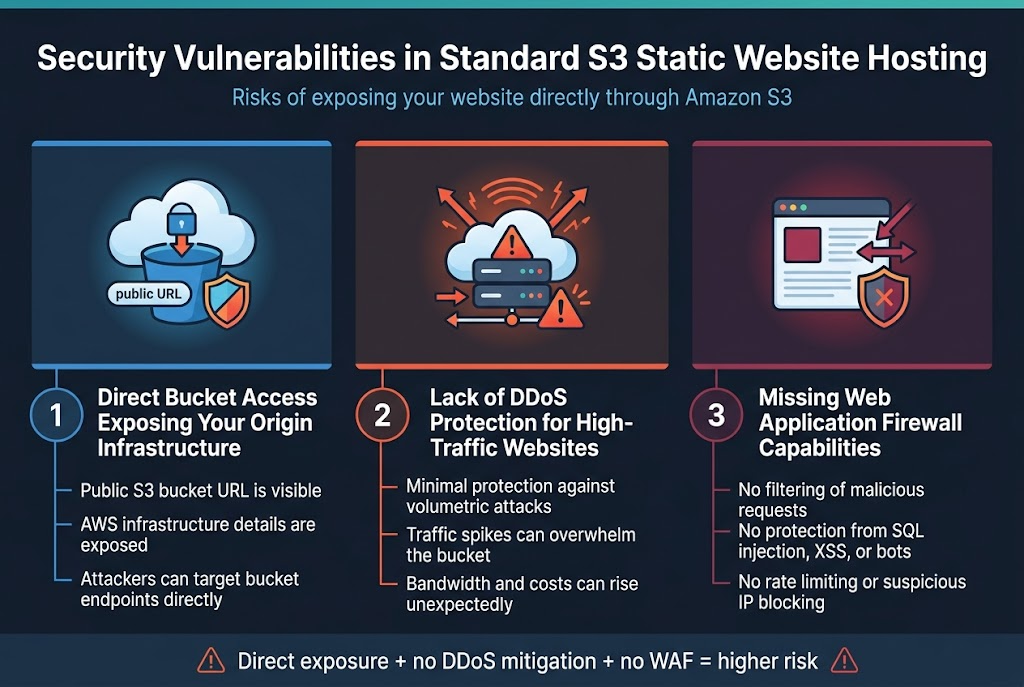
Direct Bucket Access Exposing Your Origin Infrastructure
When you host a static website directly on S3, your bucket URL becomes publicly visible to users and potential attackers. This exposure reveals your AWS infrastructure details, making it easier for malicious actors to identify your hosting setup. Direct bucket access also bypasses any protective layers you might want to implement, creating a clear path to your origin server. S3 security vulnerabilities become apparent when attackers can directly target your bucket endpoints, potentially overwhelming your resources or exploiting misconfigurations in your bucket policies.
Lack of DDoS Protection for High-Traffic Websites
Standard S3 static website hosting offers minimal protection against distributed denial-of-service attacks. When traffic spikes hit your S3 bucket directly, you’re relying solely on AWS’s basic infrastructure protection without any specialized DDoS mitigation services. High-traffic websites become vulnerable to volumetric attacks that can consume your bandwidth allocation and drive up costs unexpectedly. Without proper DDoS protection, even legitimate traffic surges during viral content moments or marketing campaigns can overwhelm your S3 hosting setup.
Missing Web Application Firewall Capabilities
S3 hosting limitations include the absence of web application firewall functionality that could filter malicious requests before they reach your content. Your static website lacks protection against common web attacks like SQL injection attempts, cross-site scripting, and bot traffic that could skew your analytics or consume resources. Basic S3 configurations can’t inspect request headers, block suspicious IP addresses, or implement rate limiting rules that modern websites need for security. This gap leaves your S3 static website hosting vulnerable to automated attacks and malicious crawlers.
How CloudFront Distribution Networks Accelerate Your S3 Content
Global Edge Locations Reducing Load Times by Up to 80%
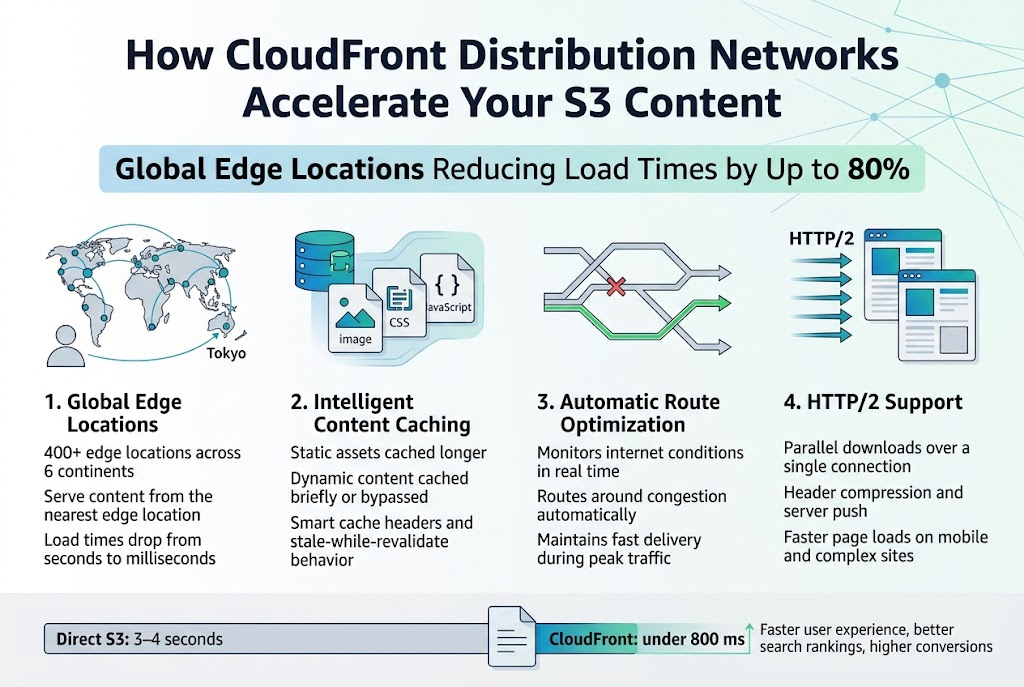
CloudFront’s global network spans over 400 edge locations across six continents, bringing your S3 content closer to users worldwide. When someone requests your website from Tokyo while your S3 bucket sits in Virginia, CloudFront serves that content from the nearest Asian edge location instead of forcing a cross-continental journey. This geographic proximity can slash load times from several seconds to mere milliseconds.
The performance boost becomes dramatic for global audiences. A user downloading a 2MB image from a distant S3 bucket might wait 3-4 seconds, but the same file served through CloudFront’s edge cache typically loads in under 800 milliseconds. This speed improvement directly impacts user experience, search rankings, and conversion rates.
Intelligent Content Caching Strategies
CloudFront doesn’t just cache everything blindly—it uses smart algorithms to determine what content should live at edge locations and for how long. Static assets like images, CSS files, and JavaScript get cached for extended periods, while dynamic content receives shorter cache lifespans or bypasses caching entirely when needed.
The system automatically analyzes request patterns and popular content, prioritizing frequently accessed files for edge storage. Cache headers from your S3 bucket guide these decisions, but CloudFront adds its own intelligence layer. When cache expires, CloudFront can serve stale content while fetching fresh versions in the background, preventing users from experiencing delays during content updates.
Automatic Route Optimization Based on Network Conditions
CloudFront continuously monitors internet conditions across its network, automatically routing requests through the fastest available paths. If the direct route between an edge location and your S3 bucket experiences congestion, CloudFront can bounce traffic through alternative backbone connections to maintain optimal speeds.
Real-time network analysis means your content delivery adapts to changing conditions without any manual intervention. During peak traffic hours or network outages, CloudFront’s routing intelligence ensures users still receive fast responses. This dynamic optimization often outperforms direct S3 connections, especially during high-traffic periods when AWS regions experience increased load.
HTTP/2 Support for Faster Parallel Downloads
Standard S3 website hosting relies on older HTTP/1.1 protocol, which forces browsers to download files sequentially and limits concurrent connections. CloudFront supports HTTP/2 by default, enabling browsers to download multiple resources simultaneously over a single connection. This parallel processing significantly speeds up complex pages with numerous assets.
HTTP/2 also includes header compression and server push capabilities, reducing overhead and allowing CloudFront to proactively send critical resources before browsers request them. Pages that previously required multiple round trips now load much faster, especially on mobile networks where connection establishment takes longer.
Enhanced Security Features CloudFront Provides Over Basic S3 Hosting
Origin Access Control Preventing Direct Bucket Access
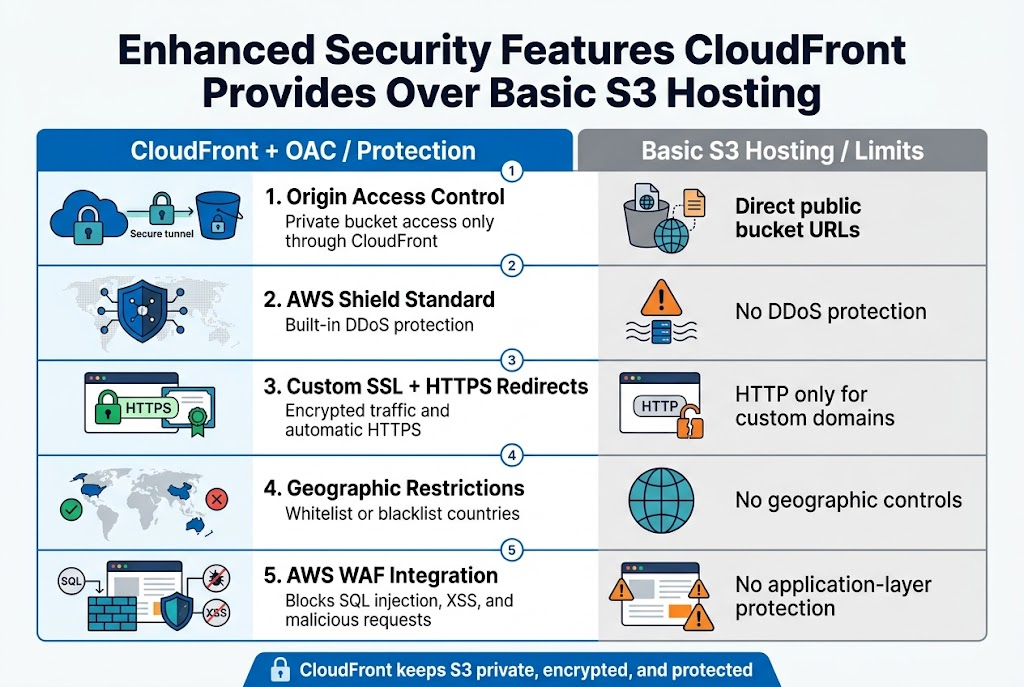
Origin Access Control (OAC) creates a secure tunnel between CloudFront and your S3 bucket, completely blocking public access to your files. Unlike basic S3 static website hosting where anyone can access your content directly through bucket URLs, OAC ensures visitors can only reach your files through CloudFront’s distribution network. This prevents unauthorized bandwidth usage and protects your content from hotlinking.
The security advantage becomes crystal clear when you realize that standard S3 hosting requires making your entire bucket publicly readable. With CloudFront’s OAC, your S3 bucket stays private while still serving content globally, giving you complete control over who accesses what.
AWS Shield Standard DDoS Protection Included by Default
CloudFront automatically includes AWS Shield Standard, providing robust DDoS protection that S3 static website hosting simply can’t match. This service monitors traffic patterns and automatically mitigates common network and transport layer attacks, keeping your website online even during malicious traffic spikes.
While S3 static hosting leaves you vulnerable to volumetric attacks that can overwhelm your site, CloudFront’s distributed infrastructure absorbs and filters malicious traffic across multiple edge locations before it reaches your origin.
Custom SSL Certificates and Automatic HTTPS Redirects
CloudFront supports custom SSL certificates through AWS Certificate Manager, enabling you to secure your domain with HTTPS at no additional cost. The service automatically handles certificate renewal and can enforce HTTPS redirects, ensuring all traffic stays encrypted. S3 static website hosting only supports HTTP connections when using custom domains, creating significant security gaps.
Your visitors get the green padlock in their browser, search engines boost your SEO rankings, and sensitive data stays protected during transmission—benefits that basic S3 hosting simply cannot provide.
Geographic Restrictions for Content Access Control
CloudFront’s geographic restriction feature lets you whitelist or blacklist entire countries from accessing your content, perfect for compliance requirements or content licensing agreements. You can configure these restrictions directly in the CloudFront distribution settings, giving you granular control over your global audience.
S3 static website hosting offers no geographic controls, meaning your content remains accessible worldwide regardless of legal or business restrictions you might need to enforce.
Integration with AWS WAF for Advanced Threat Protection
AWS Web Application Firewall (WAF) integrates seamlessly with CloudFront, providing sophisticated protection against SQL injection, cross-site scripting, and other application-layer attacks. You can create custom rules based on IP addresses, HTTP headers, request patterns, and geographic locations to block malicious traffic before it reaches your S3 origin.
This level of security integration is impossible with standard S3 static website hosting, which lacks any application-layer protection mechanisms and leaves your site exposed to common web vulnerabilities.
Cost Optimization Benefits When Combining S3 with CloudFront
Reduced Data Transfer Costs Through Edge Caching
When you combine S3 static website hosting with CloudFront CDN, your data transfer costs drop significantly. CloudFront’s edge caching stores your content across global locations, meaning visitors download files from nearby servers instead of your origin S3 bucket. This reduces bandwidth charges from your primary S3 region while delivering faster load times.
Lower S3 Request Charges Due to Origin Shielding
CloudFront’s origin shielding feature consolidates requests to your S3 bucket, dramatically cutting down on individual file requests. Instead of hundreds of direct S3 requests from users worldwide, CloudFront batches and optimizes these calls. This AWS hosting optimization can slash your S3 request costs by up to 80% on high-traffic websites.
Free Tier Benefits for New AWS Users
New AWS users get substantial free tier allowances for both S3 and CloudFront services. You receive 50GB of data transfer and 2 million HTTP requests monthly with CloudFront, plus 5GB of S3 storage. This S3 CloudFront integration lets you run small to medium websites virtually free for your first year while testing performance improvements.
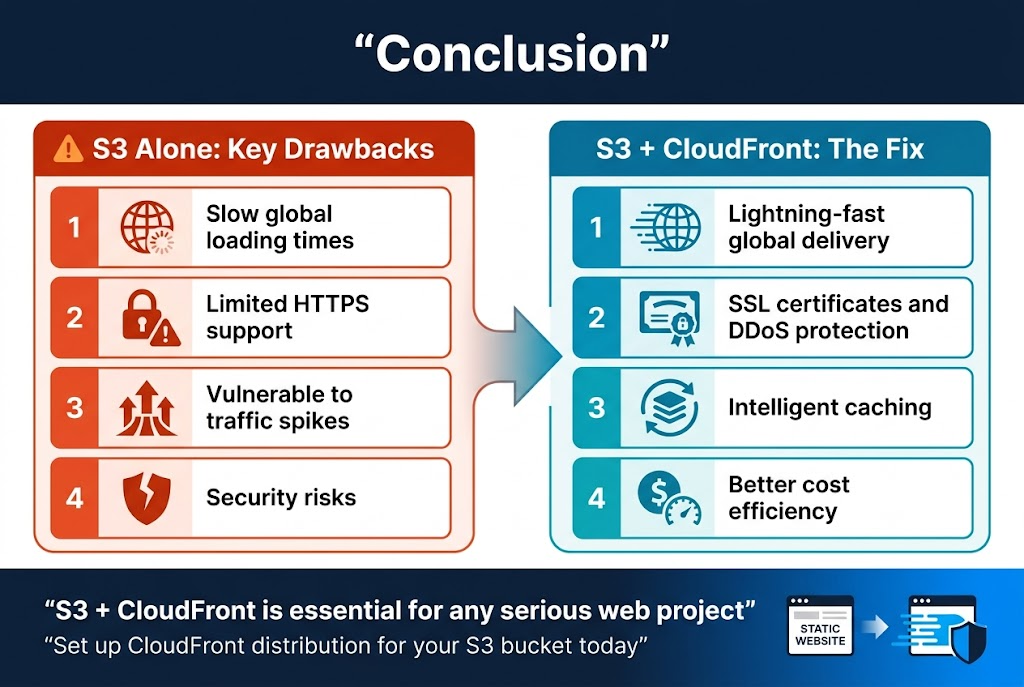
S3 hosting might seem like the perfect solution for static websites, but it comes with some serious drawbacks that can hurt your site’s performance and security. From slow global loading times to limited HTTPS support and vulnerability to traffic spikes, relying on S3 alone leaves your website exposed to multiple risks that could damage user experience and your bottom line.
CloudFront changes the game completely by addressing every single one of these limitations. You get lightning-fast content delivery through a global network, rock-solid security with SSL certificates and DDoS protection, and surprisingly better cost efficiency through intelligent caching. The combination of S3 and CloudFront isn’t just a nice-to-have upgrade—it’s essential for any serious web project. Set up CloudFront distribution for your S3 bucket today and watch your website transform from a basic static host into a high-performance, secure, and cost-effective solution that your users will actually enjoy visiting.