AWS Lambda lets you run code without managing servers, but getting the setup right can make or break your serverless function deployment. This AWS Lambda tutorial is designed for developers and DevOps engineers who want to move beyond basic Lambda creation and build production-ready functions.
Setting up Lambda correctly involves more than just uploading code. You need to understand Lambda function configuration, nail down AWS IAM roles permissions, and implement proper monitoring to avoid costly mistakes and performance issues.
We’ll walk through creating your first Lambda function from scratch, then dive into configuring function settings that actually impact performance. You’ll also learn how to set up IAM roles and permissions management the right way, plus implement monitoring and logging solutions that help you catch problems before they hit production. Finally, we’ll cover AWS Lambda best practices for cost optimization and performance tuning that can save you money and headaches down the road.
Create and Deploy Your First Lambda Function

Set up AWS account and access Lambda console
Getting started with AWS Lambda requires an active AWS account and proper access to the Lambda service. Navigate to the AWS Management Console and search for “Lambda” in the services menu. The Lambda dashboard provides a clean interface where you can create, manage, and monitor your serverless functions. Make sure your account has the necessary permissions to create Lambda functions and associated resources.
Choose the right runtime for your use case
AWS Lambda supports multiple programming languages including Python, Node.js, Java, Go, .NET, and Ruby. Python 3.9+ is excellent for data processing and automation tasks, while Node.js works great for web APIs and real-time applications. Consider factors like execution speed, library availability, and team expertise when selecting your runtime. Each runtime has specific performance characteristics and cold start times that impact your serverless function deployment strategy.
Write and test your function code locally
Before deploying to AWS, develop and test your Lambda function code locally using tools like AWS SAM CLI or the Serverless Framework. Create a simple function that handles the event parameter and returns a properly formatted response. Local testing helps catch errors early and speeds up development cycles. Use mock events that match your expected input format to validate your function logic works correctly before moving to the cloud environment.
Deploy using AWS CLI or console interface
Deploy your AWS Lambda tutorial code through either the web console or AWS CLI for production-ready serverless architecture AWS solutions. The console offers a user-friendly approach with inline code editing, while the CLI provides automation capabilities for continuous deployment pipelines. Package your code and dependencies into a ZIP file, configure environment variables, and set appropriate timeout values. Both deployment methods support versioning and alias management for better release control.
Configure Lambda Function Settings for Optimal Performance

Allocate Memory and Timeout Values Effectively
Memory allocation directly impacts Lambda performance optimization and cost. Start with 512 MB for most functions, then monitor CloudWatch metrics to identify optimal settings. Higher memory increases CPU power proportionally, often reducing execution time and overall costs. Set timeout values based on actual function requirements – web APIs need 30 seconds maximum, while data processing might require up to 15 minutes.
Set Up Environment Variables for Flexible Configuration
Environment variables enable flexible Lambda function configuration without code changes. Store database connection strings, API keys, and feature flags as encrypted variables using AWS KMS. This approach supports different environments (dev, staging, production) with identical code deployments. Keep sensitive data encrypted and use parameter store for complex configurations requiring hierarchical organization.
Configure VPC Settings for Secure Network Access
VPC configuration provides secure network access to private resources like RDS databases and internal APIs. Assign Lambda functions to private subnets with NAT gateways for internet access when needed. Configure security groups to allow only necessary traffic patterns. Remember that VPC-enabled functions experience cold start delays, so evaluate whether private network access justifies the performance trade-off for your specific use case.
Master IAM Roles and Permissions Management

Create execution roles with minimal required permissions
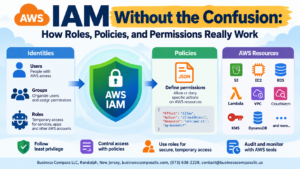
AWS Lambda functions require properly configured IAM roles to access AWS services securely. The principle of least privilege should guide your Lambda function permissions setup. Start by creating an execution role that includes only the basic Lambda execution permissions – this typically means attaching the AWSLambdaBasicExecutionRole managed policy, which provides CloudWatch Logs access for monitoring and debugging your serverless functions.
Attach policies for accessing other AWS services
When your Lambda function needs to interact with other AWS services like S3, DynamoDB, or SQS, attach specific service policies to your execution role. Create custom policies that grant access only to the exact resources your function needs. For example, instead of granting full S3 access, specify particular bucket ARNs and actions like GetObject or PutObject. This targeted approach reduces security risks while maintaining functionality for your serverless architecture AWS deployment.
Implement resource-based policies for cross-account access
Resource-based policies enable Lambda functions to receive invocations from external AWS accounts or services. Configure these policies directly on your Lambda function to control which principals can invoke your function. Use the AWS CLI or console to add resource-based policies that specify source accounts, services, or specific ARNs. This approach is essential for multi-account architectures and third-party integrations while maintaining security boundaries.
Use AWS managed policies vs custom policies strategically
AWS managed policies provide pre-configured permissions for common use cases and receive automatic updates for new service features. Use managed policies like AWSLambdaVPCAccessExecutionRole for VPC-connected functions or AWSXRayDaemonWriteAccess for distributed tracing. However, create custom policies when you need granular control over permissions or when managed policies grant excessive access. Combine both approaches strategically – use managed policies for standard functionality and custom policies for specific business logic requirements in your AWS Lambda setup.
Implement Monitoring and Logging Solutions

Enable CloudWatch Logs for comprehensive debugging
CloudWatch Logs automatically captures your Lambda function’s console output, error messages, and custom log statements. Enable logging by ensuring your Lambda execution role includes the CloudWatchLogsFullAccess policy or create a custom policy with logs:CreateLogGroup, logs:CreateLogStream, and logs:PutLogEvents permissions. Configure log retention periods to manage costs effectively – set shorter retention for development environments and longer periods for production workloads.
Set up CloudWatch metrics and custom alarms
AWS Lambda monitoring becomes powerful when you combine built-in CloudWatch metrics with custom alarms. Track key performance indicators like duration, error rate, throttles, and concurrent executions. Create alarms for error thresholds exceeding 5%, duration spikes beyond expected baselines, or throttling events that indicate capacity issues. Custom metrics can be published using the CloudWatch SDK to monitor business-specific KPIs within your serverless functions.
Configure X-Ray tracing for performance analysis
X-Ray tracing provides deep insights into your Lambda function’s execution path and performance bottlenecks. Enable tracing in your function configuration and add the AWSXRayDaemonWriteAccess policy to your execution role. X-Ray automatically traces AWS service calls and reveals slow database queries, API Gateway latency, and external service dependencies. Use sampling rules to control tracing costs while maintaining visibility into critical performance patterns across your serverless architecture.
Optimize Cost and Performance Through Best Practices

Right-size memory allocation to reduce costs
Lambda billing directly correlates with memory allocation and execution time. Start with the default 128MB setting and gradually increase memory based on actual performance metrics. Monitor CloudWatch logs to identify memory usage patterns and optimize accordingly. Higher memory allocation provides more CPU power, potentially reducing execution time and overall costs despite the higher per-millisecond rate.
Implement connection pooling for database connections
Database connections consume significant resources in serverless environments. Establish connection pools outside the Lambda handler function to reuse connections across invocations within the same execution context. Consider using AWS RDS Proxy for automatic connection pooling and management, which handles connection scaling and reduces the overhead of establishing new database connections for each function execution.
Use Lambda layers for shared dependencies
Layers separate common code and dependencies from your function package, reducing deployment size and improving cold start performance. Create layers for frequently used libraries, custom runtime components, or shared utility functions across multiple Lambda functions. This approach enables better code reuse, faster deployments, and simplified dependency management while staying within the 50MB deployment package limit.
Apply cold start optimization techniques
Cold starts occur when Lambda initializes new execution environments. Minimize package size by removing unnecessary dependencies and using tree-shaking for JavaScript applications. Keep initialization code outside the handler function and leverage provisioned concurrency for critical functions with predictable traffic patterns. Consider using languages like Python or Node.js for faster initialization compared to Java or .NET.
Schedule functions efficiently to minimize idle time
EventBridge (CloudWatch Events) enables precise scheduling for periodic Lambda executions. Use cron expressions to run functions only when needed, avoiding unnecessary invocations during low-traffic periods. For batch processing workloads, combine multiple operations into single function executions rather than triggering separate functions for each task. This reduces total execution time and minimizes the number of billable requests.
AWS Lambda doesn’t have to be intimidating once you break it down into manageable steps. You’ve learned how to create your first function, fine-tune performance settings, set up proper IAM roles, and implement solid monitoring practices. These building blocks give you everything you need to deploy serverless applications that actually work well in production.
The real magic happens when you combine smart configuration choices with ongoing optimization. Keep an eye on your CloudWatch metrics, regularly review your IAM permissions, and don’t forget to clean up unused resources. Start small with a simple function, get comfortable with the basics, then gradually add more complexity as your confidence grows. Your serverless journey is just getting started, and these foundations will serve you well as you build more sophisticated applications.