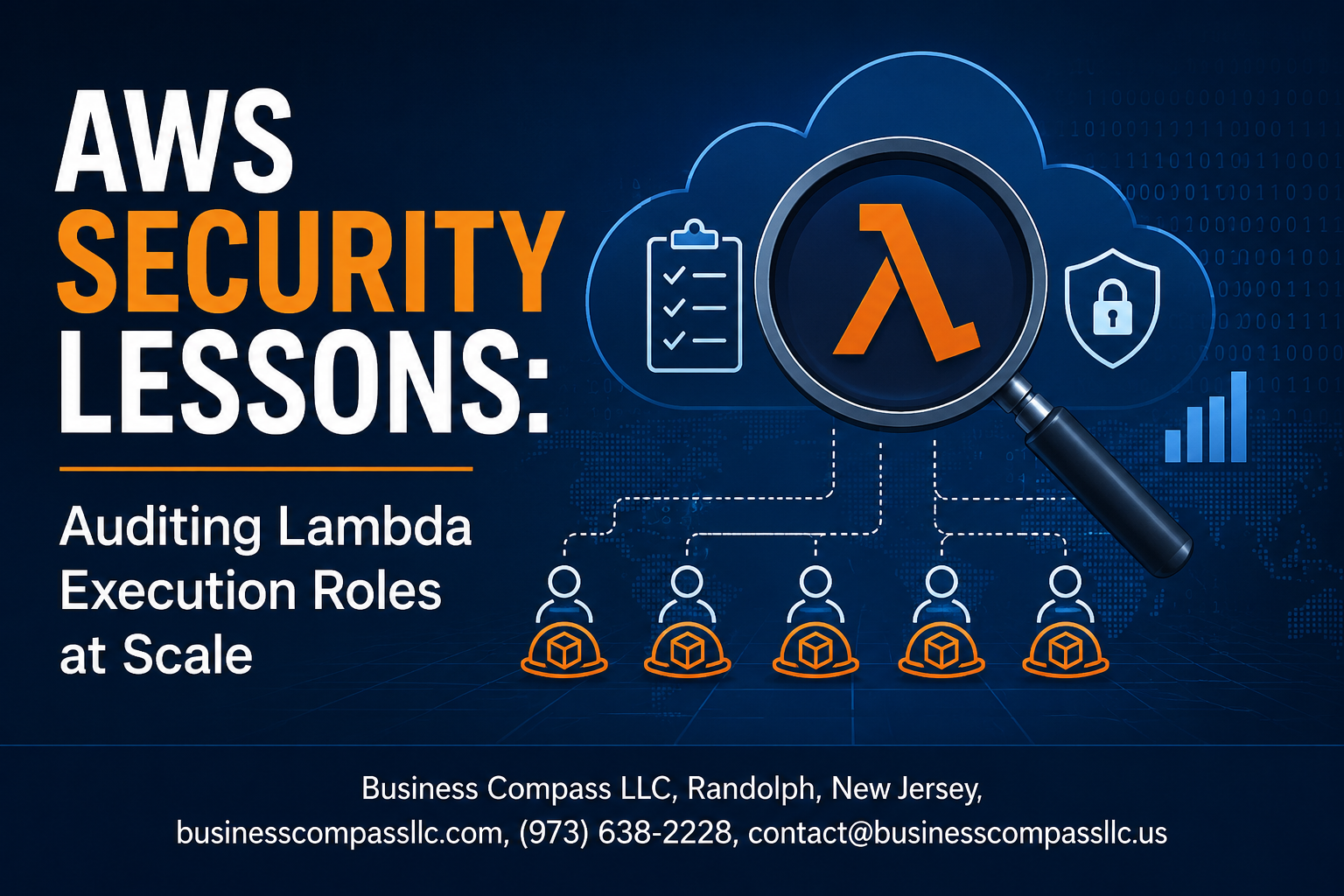
AWS Security Lessons: Auditing Lambda Execution Roles at Scale
If your AWS environment runs dozens or hundreds of Lambda functions, there’s a good chance some of those functions have way more permissions than they actually need. That’s a real problem. Overpermissioned Lambda roles are one of the most common and quietly dangerous security gaps in cloud environments — and most teams don’t catch them until something goes wrong.
This guide is for cloud security engineers, DevOps teams, and AWS architects who want to get serious about AWS Lambda security without spending weeks doing it manually. You don’t need to be a security specialist to follow along, but you should be comfortable working with IAM and Lambda basics.
Here’s what we’re going to dig into:
- Why Lambda execution roles matter and how a single overpermissioned function can become a serious blast radius in the wrong hands
- How to build a scalable inventory of your Lambda execution roles so you actually know what you’re dealing with across accounts and regions
- How to automate the audit process so you’re not stuck repeating this work every quarter — because continuous Lambda security monitoring beats a one-time snapshot every time
By the end, you’ll have a clear, repeatable approach to AWS IAM role auditing at scale and a practical path toward enforcing least privilege across your Lambda environment.
Understanding Lambda Execution Roles and Why They Matter

How Lambda Execution Roles Grant Permissions to Your Functions
When a Lambda function runs, AWS needs to know what it’s allowed to do — read from S3, write to DynamoDB, publish to SNS, and so on. That’s exactly what an execution role handles. It’s an IAM role that your Lambda function assumes at runtime, giving it a specific set of permissions through attached policies.
Here’s what typically makes up an execution role:
- Trust policy — tells AWS that the Lambda service is allowed to assume this role
- Permission policies — define what AWS resources and actions the function can actually access
- Boundaries (optional) — permission boundaries that cap the maximum effective permissions, even if broader policies are attached
The Hidden Risks of Overly Permissive Roles in Production Environments
Overpermissioned Lambda roles are a serious problem that’s easy to overlook. A function that only needs to read a single S3 bucket might have s3:* attached — or worse, *:* on everything. When that function gets compromised through code injection or dependency vulnerabilities, an attacker inherits every permission that role carries.
Common dangerous patterns include:
- Attaching
AdministratorAccessmanaged policies to Lambda roles for convenience - Copying IAM roles across functions without reviewing what each function actually needs
- Granting broad DynamoDB or RDS access when a function only reads one table
Why Execution Role Sprawl Grows Silently Across Large AWS Accounts
In fast-moving engineering teams, Lambda functions get created constantly — for automation scripts, event-driven workflows, microservices, and one-off tasks. Each deployment often brings a new execution role, sometimes cloned from a previous one without any cleanup. Over months, you end up with hundreds of roles, many attached to functions that no longer exist or haven’t been invoked in over a year.
This AWS IAM role auditing at scale challenge is real. Teams rarely delete roles they’re unsure about, so old, overpermissioned roles just sit there — quietly attached to dormant functions, still valid, still exploitable.
The Real-World Cost of Unaudited Lambda Permissions
Skipping regular Lambda execution roles audits has tangible consequences beyond theoretical risk:
- Blast radius expansion — a single compromised function can pivot across your entire AWS environment if its role has broad permissions
- Compliance failures — auditors expect least privilege enforcement; unreviewed roles are a direct finding in SOC 2, PCI-DSS, and ISO 27001 assessments
- Shadow access — developers may not realize a Lambda role grants access to sensitive data stores like Secrets Manager or KMS keys
- Incident response complexity — when something goes wrong, tracing what a role could access slows down your investigation significantly
Building Your Inventory of Lambda Execution Roles at Scale

Using AWS CLI and SDKs to Enumerate All Lambda Functions and Their Roles
Getting a full picture of your Lambda execution roles starts with pulling data programmatically. The AWS CLI makes this straightforward:
- Run
aws lambda list-functions --region us-east-1to grab every function in a region - Extract the
RoleARN from each function’s configuration - Use
aws iam get-roleandaws iam list-attached-role-policiesto pull the full permission set for each role
For teams managing dozens of functions, Python with boto3 is the way to go. You can paginate through list_functions(), collect role ARNs, then batch-call IAM APIs to build a structured dataset. Pair this with list-role-policies to catch inline policies that often get missed in manual reviews — these are a common blind spot in Lambda IAM role auditing at scale.
Leveraging AWS Config to Maintain a Continuously Updated Role Inventory
AWS Config tracks resource configurations over time, making it a solid backbone for continuous Lambda security monitoring. The AWS::Lambda::Function resource type records each function’s role assignment automatically. You can query this data using AWS Config Advanced Queries with SQL-like syntax to find functions sharing roles, spot recently changed role attachments, or flag functions missing role tags.
Set up a Config rule like lambda-function-public-access-prohibited alongside custom rules that check role naming conventions or policy boundaries — this keeps your inventory living and breathing rather than a one-time snapshot.
Organizing Role Data Across Multiple Accounts and Regions Efficiently
Multi-account environments need a centralized approach. AWS Organizations combined with CloudFormation StackSets lets you deploy inventory collection scripts across every account and region from a single control plane. Feed all that data into a central S3 bucket or a DynamoDB table, then use Athena to run cross-account queries.
A practical tagging strategy also helps enormously here:
- Tag Lambda functions with
team,environment, anddata-sensitivitylabels - Use these tags to group roles during your AWS Lambda permissions management review
- Build dashboards in AWS Security Hub or a third-party SIEM to surface accounts lagging on least privilege Lambda IAM standards
Identifying Overpermissioned and High-Risk Roles

Spotting Dangerous Patterns Like Wildcard Actions and Broad Resource Scopes
When auditing overpermissioned Lambda roles, the biggest red flags are wildcard actions ("Action": "*") and overly broad resource scopes ("Resource": "*"). These patterns grant far more access than any Lambda function realistically needs. Look for policies that combine both — that’s where your highest-risk exposure lives.
Common dangerous patterns to watch for:
s3:*onarn:aws:s3:::*— full S3 access across every bucketiam:*— allowing Lambda to create or modify IAM rolesec2:*— unnecessary compute-level permissionsdynamodb:*on*instead of a specific table ARN
Using IAM Access Analyzer to Flag Roles With Excessive Privileges
IAM Access Analyzer takes a lot of the guesswork out of AWS IAM role auditing at scale. It checks your policies against actual usage data and surfaces unused permissions that can be safely removed. Run it regularly and pay close attention to findings marked as “unused access” — those are your quick wins for tightening least privilege Lambda IAM policies.
Detecting Shared Roles Assigned to Multiple Unrelated Lambda Functions
Shared roles are sneaky. One role powering both a payment processor Lambda and a logging function means a vulnerability in one creates a blast radius that hits the other. Pull your Lambda inventory and group functions by execution role — any role attached to three or more unrelated functions deserves immediate scrutiny.
Prioritizing Which Risky Roles to Remediate First Based on Function Sensitivity
Not every risky role needs to be fixed today. Rank your remediation queue using these factors:
- Data sensitivity — does the function touch PII, financial records, or credentials?
- Internet-facing exposure — is the Lambda triggered by API Gateway or public events?
- Blast radius — how many services can the role access if compromised?
- Permission severity — roles with
iam:*orsts:AssumeRolego straight to the top
Automating the Audit Process for Continuous Security

Writing Custom AWS Config Rules to Enforce Least Privilege Policies
AWS Config lets you write custom rules that flag Lambda execution roles the moment they drift from your defined least privilege baseline, giving you real-time visibility instead of waiting for a quarterly review to catch overpermissioned Lambda roles sitting quietly in production.
- Use
AWS::IAM::Roleresource type in your custom Config rule to evaluate attached policies against a known-safe permission set - Trigger evaluations on configuration changes, not just periodic checks, so new role attachments get caught immediately
- Return
NON_COMPLIANTfor any role carrying wildcards like*in theActionorResourcefields of inline or managed policies - Store remediation runbooks alongside your Config rules so the on-call engineer knows exactly what to do when a rule fires
Building Lambda Audit Pipelines Using AWS Security Hub and EventBridge
Security Hub acts as your central scoreboard for AWS Lambda security findings, and when you wire it up to EventBridge, you get an event-driven audit pipeline that reacts to problems rather than polling for them.
- Route Security Hub findings tagged with
Software and Configuration Checks/Industry and Regulatory Standardsdirectly to an EventBridge rule - Trigger a downstream Lambda function that cross-references flagged roles against your approved permission inventory
- Push enriched findings to a Slack channel or PagerDuty for immediate human triage
- Tag every finding with the owning team using resource tags so accountability is clear from the start
Scheduling Regular Permission Reviews With Automated Reporting Tools
Automated reporting closes the gap between real-time alerts and the broader pattern recognition that only comes from reviewing trends over time across your entire Lambda IAM role auditing footprint.
- Use AWS Lambda + Amazon Athena to query CloudTrail logs weekly and surface roles where granted permissions far exceed what was actually called
- Generate a CSV or HTML report sorted by permission gap score — the delta between granted actions and invoked actions
- Email reports directly to team leads using Amazon SES, so the people closest to the code are reviewing their own roles
- Archive reports in S3 with lifecycle policies to maintain a 12-month audit trail without ballooning storage costs
Integrating Role Auditing Into Your CI/CD Deployment Workflows
Catching overpermissioned roles before they ever reach production is far cheaper than remediating them after the fact, and your CI/CD pipeline is the perfect place to enforce continuous Lambda security monitoring as a hard gate.
- Add an IAM policy linting step using tools like Parliament or cfn-python-lint directly in your GitHub Actions or CodePipeline stages
- Fail the build automatically if a proposed execution role contains wildcard actions or broad resource ARNs
- Compare new role definitions against a golden template stored in a version-controlled policy library
- Keep a deployment log that records which role was attached to which function at each release, making rollbacks and forensic reviews straightforward
Using Third-Party Tools to Enhance Audit Coverage and Accuracy
Native AWS tools cover a lot of ground, but third-party solutions bring additional context, smarter analysis, and cross-account visibility that makes AWS Lambda permissions management at scale genuinely manageable.
- Ermetic / Sonrai Security — maps effective permissions across assume-role chains, revealing privilege escalation paths that raw policy analysis misses
- Prowler — open-source CLI tool with pre-built checks specifically targeting Lambda execution roles and IAM misconfigurations
- Steampipe — lets you write SQL queries against live AWS IAM data, making ad-hoc role audits as fast as running a SELECT statement
- Orca Security / Wiz — provide agentless cloud-wide scans that correlate overpermissioned roles with actual workload exposure, prioritizing the highest-risk findings first
Enforcing Least Privilege Across Your Lambda Environment

Applying Permission Boundaries to Limit the Maximum Scope of Any Role
Permission boundaries act like a hard ceiling on what any Lambda execution role can ever do, even if someone accidentally attaches a wildcard policy later. You define the boundary once, attach it to the role, and AWS enforces it automatically — no matter what other policies get added.
- Set permission boundaries at the organizational level using AWS Organizations SCPs combined with IAM permission boundaries
- Define boundaries that explicitly block high-risk actions like
iam:*,organizations:*, ands3:DeleteBucket - Apply boundaries programmatically during role creation using AWS CloudFormation or Terraform so no role ever gets created without them
Replacing Shared Roles With Dedicated Per-Function Execution Roles
Shared execution roles are one of the biggest mistakes teams make when scaling Lambda. One compromised function can pivot to every other function sharing that role.
- Create a unique IAM role per Lambda function — yes, even if you have hundreds of functions
- Automate role creation in your CI/CD pipeline so developers never skip this step
- Name roles consistently, like
lambda-{service}-{function}-role, to make auditing Lambda execution roles faster and cleaner
Using IAM Policy Conditions to Restrict Access by Context and Resource
Raw Allow statements are too broad on their own. IAM conditions let you tighten policies so permissions only work in the exact context you expect.
- Use
aws:SourceVpcto restrict API calls to traffic coming from your VPC - Apply
s3:prefixconditions so a Lambda can only read specific S3 prefixes, not entire buckets - Add
aws:RequestedRegionto prevent functions from accidentally — or maliciously — operating outside approved regions - Combine
lambda:FunctionArnwith resource-level conditions to scope cross-function invocations tightly
Tracking Permission Changes Over Time With AWS CloudTrail
You can’t protect what you can’t see. CloudTrail gives you a full timeline of every IAM change touching your Lambda permissions.
- Enable CloudTrail in every region and route logs to a centralized, tamper-resistant S3 bucket
- Set up EventBridge rules to alert on high-sensitivity API calls like
AttachRolePolicy,PutRolePolicy, orCreateRole - Use Athena to query CloudTrail logs and spot unexpected permission escalation patterns across your AWS Lambda permissions management setup
- Review permission drift weekly by comparing current role policies against your approved baseline stored in version control
Measuring and Sustaining Long-Term Security Improvements

Defining Key Metrics to Track the Health of Your Lambda Role Posture
Tracking the right numbers keeps your AWS Lambda security from slipping quietly into chaos. Focus on metrics that actually signal risk:
- Percentage of Lambda functions using unique execution roles vs. shared roles
- Number of roles with wildcard permissions (
*on actions or resources) - Average number of IAM policies per execution role
- Count of unused permissions identified via IAM Access Analyzer findings
- Time-to-remediation for flagged overpermissioned Lambda roles
- Drift rate — how often new deployments introduce broader permissions than the approved baseline
These numbers tell a real story. If your wildcard permission count is climbing week over week, something in your deployment pipeline is off.
Creating Dashboards That Give Visibility to Security and Engineering Teams
A metric nobody sees is a metric nobody acts on. Build dashboards in AWS Security Hub or a tool like Grafana pulling from CloudWatch and Config data, and make sure both security and engineering teams have access — not just the security folks.
Good dashboards for continuous Lambda security monitoring should show:
- Real-time count of high-risk roles flagged by IAM Access Analyzer
- Trend lines showing permission scope over time per team or service
- Compliance percentage against your least privilege Lambda IAM baseline
- Open findings by severity with aging indicators so stale issues stand out
Color-code by risk level. Engineers respond faster when red is genuinely alarming and not just decorative.
Establishing Governance Policies to Prevent Permission Drift From Recurring
Auditing once and calling it done is how permission sprawl quietly returns. Governance is what makes AWS IAM role auditing at scale stick over time. Bake these practices in:
- Define approved permission templates for common Lambda use cases — DynamoDB read-only, S3 write-specific-bucket, SNS publish — and require engineers to pick from the list
- Gate deployments with CI/CD pipeline checks that reject roles exceeding a defined permission scope
- Run quarterly access reviews tied to team ownership, not just function names
- Enforce SCPs (Service Control Policies) at the AWS Organizations level to block wildcard IAM actions from being attached to Lambda roles entirely
- Assign role ownership so every execution role has a named team accountable for it
Drift happens when nobody owns the outcome. Tying roles to owners and automating policy checks removes the gap where overpermissioned Lambda roles silently accumulate.

Keeping Lambda execution roles secure isn’t a one-time task — it’s an ongoing practice that pays off the more consistently you apply it. From building a complete inventory of your roles to spotting overpermissioned functions and automating your audit workflows, each step builds on the last to create a stronger, more resilient AWS environment. The goal is simple: every Lambda function should have exactly the permissions it needs, nothing more.
Start small if you have to. Pick a handful of high-risk roles, run through the audit process, and tighten those up first. Once you see how much cleaner your security posture looks, it gets a lot easier to roll that process out across the rest of your environment. The teams that stay ahead of cloud security risks aren’t doing anything magical — they’re just auditing regularly, automating where they can, and treating least privilege as a habit rather than a checkbox.