Data Engineering for EV Grid Resilience: From Notebooks to Production
Electric vehicles are reshaping our power grid faster than most utilities can adapt. As charging demand surges and renewable energy sources create new variables, grid operators need sophisticated data engineering solutions to keep the lights on and EVs charged.
This guide is designed for data engineers, grid analysts, and infrastructure teams working on electric vehicle grid integration projects. You’ll learn how to transform raw grid and charging data into actionable insights that prevent blackouts and optimize energy distribution.
We’ll walk through building robust data pipelines for real-time processing that can handle millions of charging events across diverse infrastructure. You’ll discover advanced analytics models for predictive grid management that forecast EV charging loads before they impact system stability. Finally, we’ll cover production deployment strategies that scale from proof-of-concept notebooks to enterprise-grade systems managing entire regional grids.
The shift from experimental data science to production-ready electric vehicle grid resilience systems requires specific technical approaches and architectural decisions that we’ll explore in practical detail.
Understanding EV Grid Integration Challenges
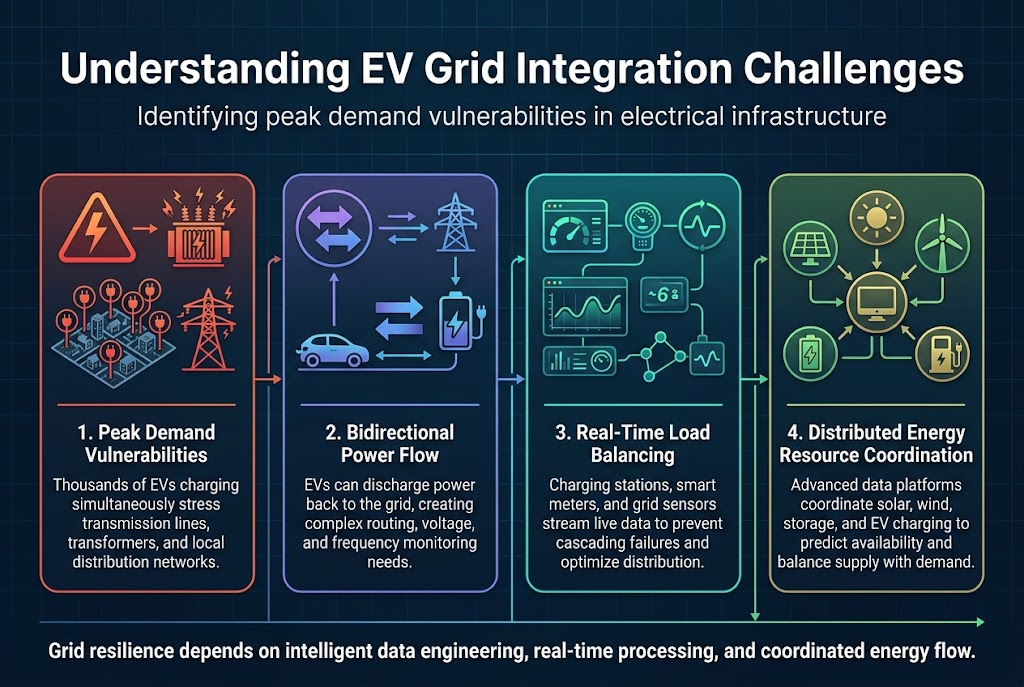
Identifying peak demand vulnerabilities in electrical infrastructure
Electric grids face unprecedented stress when thousands of EVs charge simultaneously during peak hours. Traditional infrastructure wasn’t designed for this concentrated power draw, creating potential failure points that threaten grid stability. Data engineering for electric vehicles becomes critical in mapping these vulnerabilities across transmission lines, transformers, and local distribution networks.
Analyzing bidirectional power flow complexities
EV grid integration introduces bidirectional energy flows as vehicles discharge power back to the grid during peak demand. This creates complex routing scenarios that require sophisticated monitoring systems to track energy direction, voltage levels, and frequency fluctuations in real-time across multiple grid segments.
Assessing real-time load balancing requirements
Grid operators need instant visibility into charging patterns and power consumption to maintain system equilibrium. Real-time grid data processing systems must handle massive data streams from charging stations, smart meters, and grid sensors to prevent cascading failures and optimize energy distribution across interconnected networks.
Managing distributed energy resource coordination
Modern grids integrate solar panels, wind farms, battery storage, and EV charging infrastructure as distributed resources. Electric vehicle grid resilience depends on coordinating these diverse energy sources through advanced data platforms that can predict availability, manage capacity allocation, and automatically balance supply with dynamic charging demands.
Essential Data Sources for Grid Resilience Analysis
Smart meter consumption patterns and anomaly detection
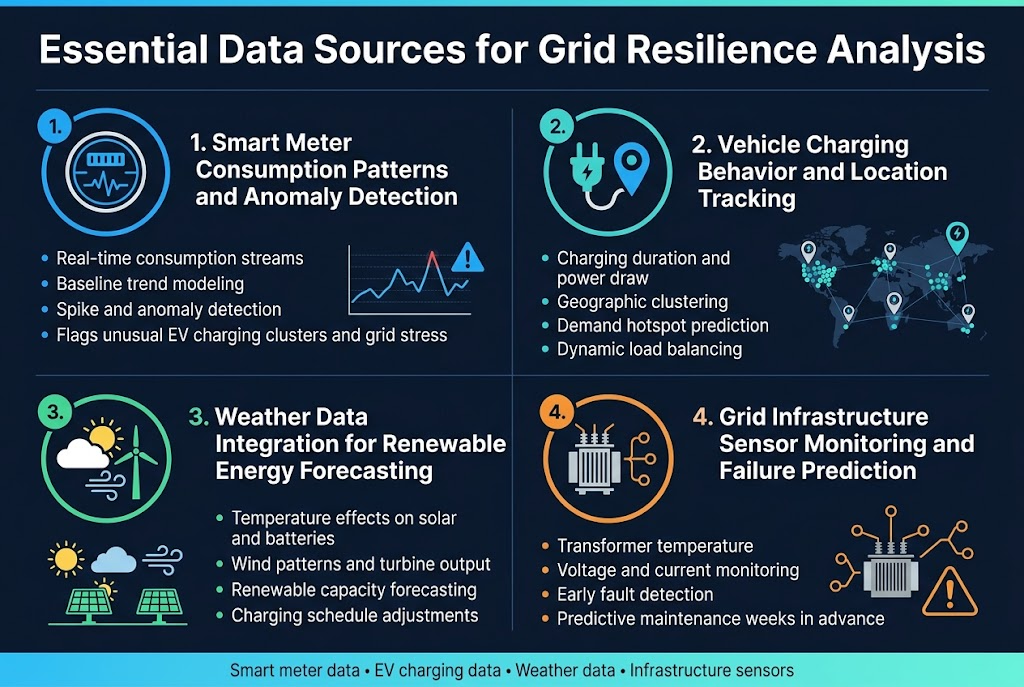
Smart meters generate massive datasets capturing energy consumption patterns across residential, commercial, and industrial sectors. These real-time data streams enable data engineering for electric vehicles by identifying baseline consumption trends and detecting anomalies that could signal grid stress or equipment failure. Advanced pattern recognition algorithms process millions of meter readings to establish normal consumption baselines and flag unusual spikes that might indicate unauthorized EV charging clusters or grid infrastructure issues.
Vehicle charging behavior and location tracking
EV charging infrastructure data provides critical insights into load distribution patterns across charging networks. Location tracking systems monitor charging session duration, power draw rates, and geographic clustering to predict future demand hotspots. This data engineering for smart grid applications helps utilities anticipate peak loading scenarios and optimize charging schedules. Real-time processing of charging behavior data enables dynamic load balancing and prevents grid overload situations.
Weather data integration for renewable energy forecasting
Weather monitoring systems supply essential data for predicting renewable energy generation capacity and EV charging demand fluctuations. Temperature variations directly impact both solar panel efficiency and battery charging requirements, while wind patterns affect turbine output. Integrating meteorological data with EV grid integration models enables accurate forecasting of available renewable capacity. This predictive capability supports automated charging schedule adjustments that maximize clean energy utilization.
Grid infrastructure sensor monitoring and failure prediction
Distributed sensor networks throughout electrical infrastructure continuously monitor transformer temperatures, voltage fluctuations, and current loads. These sensors detect early warning signs of equipment degradation before catastrophic failures occur. Electric vehicle grid resilience depends on proactive maintenance scheduling based on sensor data analytics. Machine learning models process sensor telemetry to predict component failures weeks in advance, enabling preventive repairs that maintain grid stability during peak EV charging periods.
Building Robust Data Pipelines for Real-Time Processing
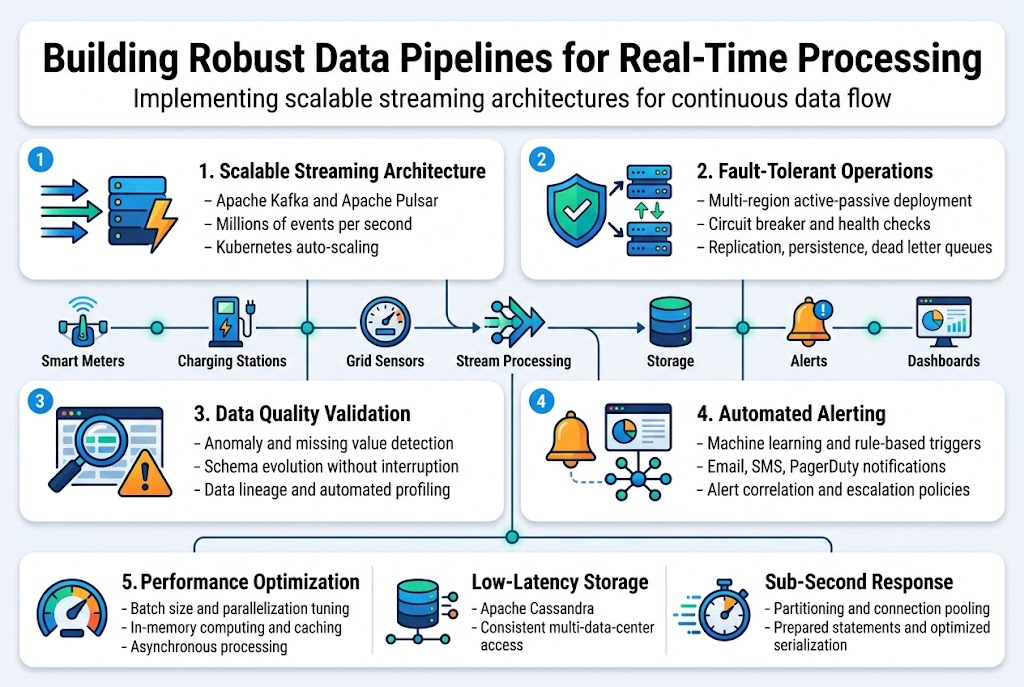
Implementing scalable streaming architectures for continuous data flow
Modern EV grid integration demands real-time data pipelines that handle massive volumes from smart meters, charging stations, and grid sensors. Apache Kafka and Apache Pulsar serve as backbone messaging systems, processing millions of events per second while maintaining message ordering and delivery guarantees. Container orchestration platforms like Kubernetes enable auto-scaling based on traffic patterns, ensuring real-time grid data processing capabilities adapt to peak charging hours.
Stream processing frameworks such as Apache Flink and Kafka Streams transform raw telemetry into actionable insights within milliseconds. These architectures support complex event processing, windowing operations, and stateful computations essential for predictive grid management analytics. Distributed storage solutions like Apache Cassandra provide low-latency data access while maintaining consistency across multiple data centers.
Designing fault-tolerant systems for critical grid operations
Grid stability cannot tolerate system failures, making redundancy and failover mechanisms non-negotiable in data engineering for electric vehicles. Multi-region deployments with active-passive configurations ensure continuous operation even during infrastructure outages. Circuit breaker patterns prevent cascading failures when downstream services experience issues, while health checks and automatic recovery protocols minimize downtime.
Database replication strategies maintain data consistency across geographically distributed nodes, supporting both read and write operations during partial system failures. Message queue persistence guarantees zero data loss during component restarts, while dead letter queues capture and replay failed processing attempts for later analysis.
Establishing data quality validation and cleansing protocols
Smart grid data engineering requires rigorous validation frameworks that detect anomalies, missing values, and data corruption in real-time streams. Schema evolution capabilities allow pipeline adaptations without service interruptions as new data sources come online. Statistical outlier detection algorithms identify faulty sensor readings that could compromise grid stability calculations.
Data lineage tracking provides end-to-end visibility into data transformations, enabling rapid troubleshooting when quality issues arise. Automated data profiling continuously monitors incoming streams for schema violations, duplicate records, and timestamp inconsistencies common in distributed EV charging infrastructure data collection systems.
Creating automated alerting systems for grid anomalies
Intelligent alerting systems combine machine learning models with rule-based triggers to identify critical grid conditions before they escalate. Multi-channel notification strategies ensure operations teams receive alerts through email, SMS, and integration with incident management platforms like PagerDuty. Alert correlation engines reduce noise by grouping related events and preventing alert fatigue during system-wide issues.
Escalation policies automatically route unacknowledged alerts to backup personnel, while severity classification helps prioritize responses based on potential grid impact. Custom dashboards provide visual representations of alert trends, helping teams identify recurring issues and optimize electric vehicle grid resilience monitoring strategies.
Optimizing pipeline performance for sub-second response times
Performance optimization in grid data pipelines requires careful tuning of batch sizes, parallelization strategies, and memory allocation patterns. In-memory computing frameworks like Apache Spark with optimized serialization reduce processing latency for time-critical calculations. Partitioning strategies align data distribution with processing requirements, minimizing cross-node communication overhead.
Connection pooling and prepared statements optimize database interactions, while caching layers store frequently accessed reference data closer to processing engines. Asynchronous processing patterns prevent blocking operations from impacting overall pipeline throughput, enabling consistent sub-second response times even under heavy electric vehicle load forecasting workloads.
Advanced Analytics Models for Predictive Grid Management
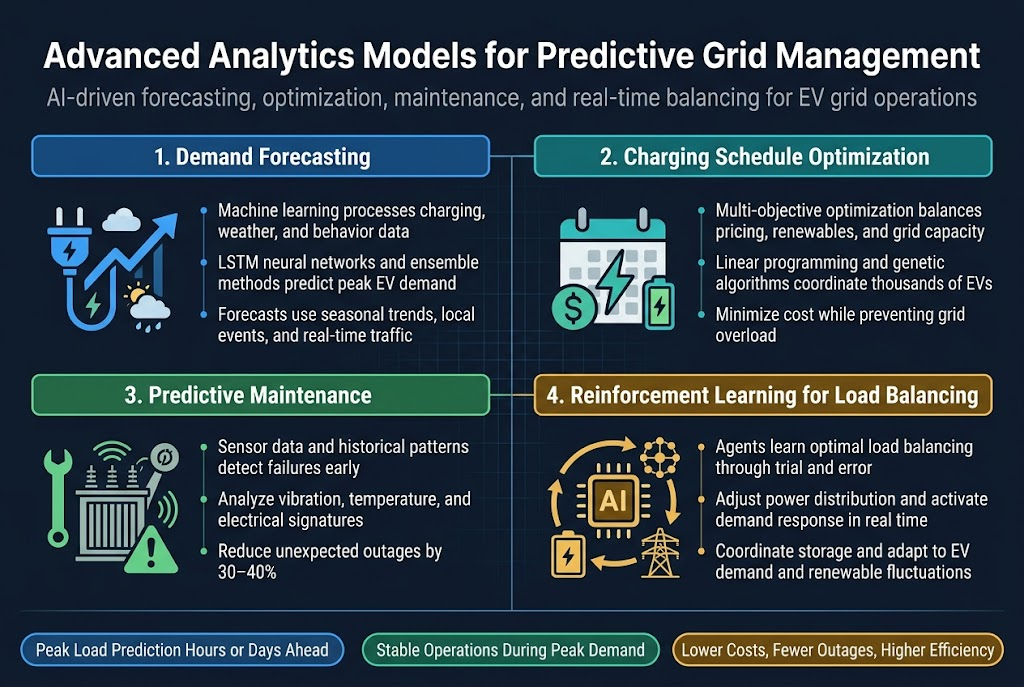
Developing machine learning algorithms for demand forecasting
Machine learning transforms electric vehicle load forecasting by processing massive datasets from charging stations, weather patterns, and consumer behavior. Advanced algorithms like LSTM neural networks and ensemble methods predict EV charging demand with remarkable accuracy, enabling grid operators to anticipate peak loads hours or days ahead. These predictive models analyze seasonal trends, local events, and real-time traffic data to create comprehensive demand forecasts that support proactive grid management and resource allocation.
Creating optimization models for charging schedule coordination
Smart charging coordination relies on sophisticated optimization algorithms that balance grid stability with customer convenience. Multi-objective optimization models consider electricity pricing, renewable energy availability, and grid capacity constraints to determine optimal charging schedules across thousands of EVs simultaneously. These systems use linear programming and genetic algorithms to minimize costs while preventing grid overload, creating win-win scenarios where customers save money and utilities maintain stable operations during peak demand periods.
Building predictive maintenance models for grid equipment
Predictive maintenance models leverage sensor data and historical performance patterns to identify grid equipment failures before they occur. Machine learning algorithms analyze vibration patterns, temperature fluctuations, and electrical signatures from transformers and substations to predict maintenance needs. These models reduce unexpected outages by 30-40% while optimizing maintenance schedules, ensuring critical infrastructure remains operational as EV adoption increases grid stress and complexity across distribution networks.
Implementing reinforcement learning for dynamic load balancing
Reinforcement learning agents excel at real-time grid management by continuously learning optimal load balancing strategies through trial and error. These AI systems adjust power distribution, activate demand response programs, and coordinate energy storage systems based on current grid conditions and predicted outcomes. Deep reinforcement learning models adapt to changing EV charging patterns and renewable energy fluctuations, making split-second decisions that maintain grid stability while maximizing efficiency and minimizing operational costs.
Production Infrastructure and Deployment Strategies
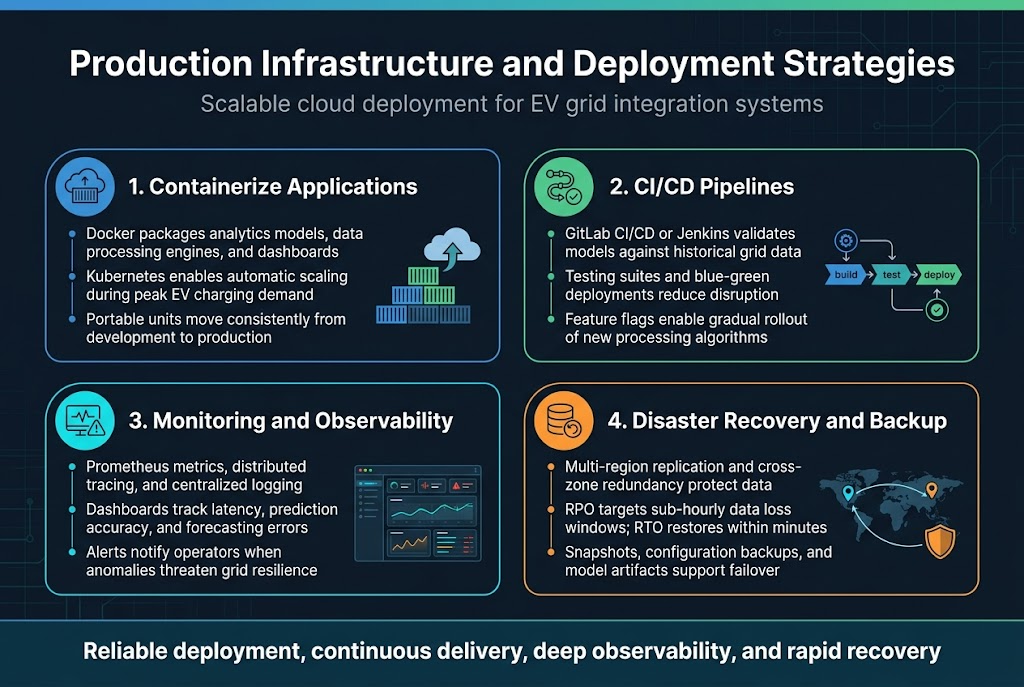
Containerizing Applications for Scalable Cloud Deployment
Modern EV grid integration systems demand robust containerization strategies that support dynamic scaling and seamless deployment across cloud environments. Docker containers package grid analytics models, real-time data processing engines, and monitoring dashboards into portable units that maintain consistency from development to production. Kubernetes orchestration enables automatic scaling based on charging demand patterns, ensuring production deployment for grid systems remains responsive during peak EV usage periods.
Implementing CI/CD Pipelines for Reliable Model Updates
Automated deployment pipelines streamline the delivery of updated predictive grid management analytics models without disrupting critical grid operations. GitLab CI/CD or Jenkins workflows validate model performance against historical grid data, execute comprehensive testing suites, and deploy updates through blue-green strategies. Feature flags control rollouts of new EV charging infrastructure data processing algorithms, allowing gradual exposure while monitoring system stability and grid performance metrics.
Establishing Monitoring and Observability Frameworks
Comprehensive observability combines Prometheus metrics, distributed tracing, and centralized logging to provide deep visibility into data engineering for electric vehicles systems. Custom dashboards track key performance indicators like data processing latency, model prediction accuracy, and grid load forecasting errors. Alert systems notify operators when anomalies threaten electric vehicle grid resilience, enabling proactive responses before grid stability issues impact charging infrastructure or energy distribution networks.
Designing Disaster Recovery and Backup Systems
Multi-region backup strategies protect critical smart grid data engineering assets through automated data replication and cross-zone redundancy. Recovery point objectives target sub-hourly data loss windows, while recovery time objectives ensure grid analytics resume within minutes of failures. Database snapshots, configuration backups, and model artifacts synchronize across geographic regions, supporting rapid failover capabilities that maintain real-time grid data processing during infrastructure outages or regional disasters.
Measuring Success and Continuous Optimization
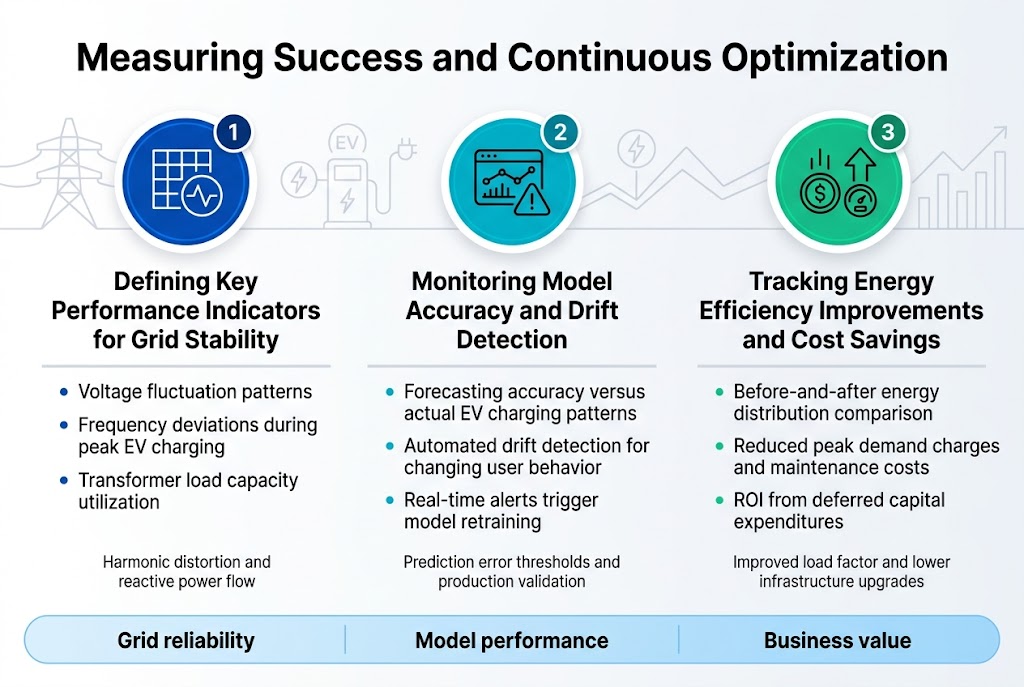
Defining key performance indicators for grid stability
Grid stability metrics require careful tracking across multiple dimensions to ensure electric vehicle integration doesn’t compromise system reliability. Critical KPIs include voltage fluctuation patterns, frequency deviations during peak EV charging periods, and transformer load capacity utilization rates. Power quality indicators like harmonic distortion levels and reactive power flow measurements provide early warning signals for potential grid stress points.
Monitoring model accuracy and drift detection
Predictive grid management analytics demand continuous performance validation through automated monitoring systems that track forecasting accuracy against actual EV charging patterns. Data engineering for electric vehicles requires robust drift detection mechanisms to identify when models lose effectiveness due to changing user behaviors or seasonal variations. Real-time alerting systems trigger model retraining workflows when prediction errors exceed predefined thresholds, ensuring production deployment for grid systems maintains optimal performance levels.
Tracking energy efficiency improvements and cost savings
Smart grid data engineering enables precise measurement of efficiency gains through detailed before-and-after comparisons of energy distribution patterns. Cost tracking systems capture reduced peak demand charges, improved load factor optimization, and decreased infrastructure upgrade requirements resulting from intelligent EV charging infrastructure data management. ROI calculations incorporate operational savings, reduced maintenance costs, and deferred capital expenditures to demonstrate the tangible business value of advanced electric vehicle grid resilience initiatives.
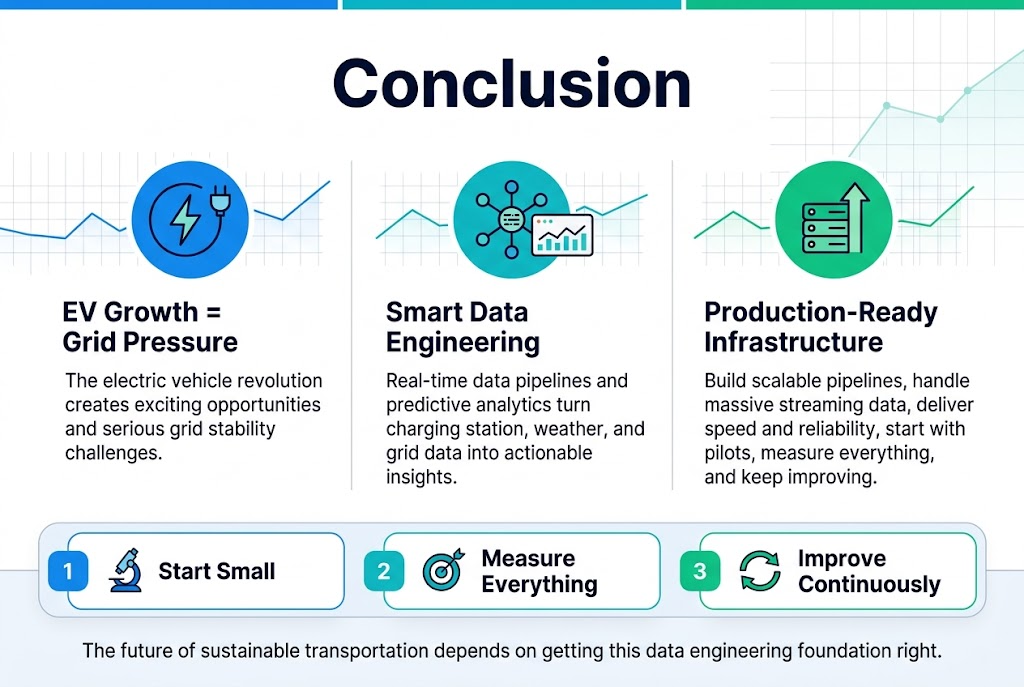
The electric vehicle revolution brings both exciting opportunities and serious grid stability challenges. Smart data engineering makes all the difference between a grid that buckles under pressure and one that adapts seamlessly to changing demands. By combining real-time data pipelines with predictive analytics, engineers can transform raw information from charging stations, weather sensors, and grid infrastructure into actionable insights that keep our power systems running smoothly.
Moving from experimental models to production-ready solutions requires careful planning and the right infrastructure choices. The most successful implementations focus on building scalable data pipelines that can handle massive volumes of streaming information while delivering the speed and reliability that grid operators need. Start small with pilot projects, measure everything that matters, and keep improving your models as you learn more about your specific grid conditions. The future of sustainable transportation depends on getting this data engineering foundation right.