AWS Systems Manager Parameter Store works great within a single region, but what happens when your applications span multiple AWS regions? Setting up AWS CDK SSM Parameter Store across regions can be tricky without the right approach.
This guide is for DevOps engineers, cloud architects, and developers who need to implement cross region SSM parameters in their AWS CDK infrastructure as code projects. You’ll learn how to build reliable parameter synchronization between regions while keeping your deployments secure and maintainable.
We’ll walk through the complete AWS CDK cross region deployment process, starting with setting up your development environment and creating the source parameters. Then we’ll dive into implementing SSM parameter replication AWS strategies that automatically sync your configuration data across regions. Finally, you’ll discover how to manage cross region parameter management AWS securely with proper IAM permissions and monitoring.
By the end of this tutorial, you’ll have a working cross region architecture that keeps your parameters in sync and your applications running smoothly across multiple AWS regions.
Understanding SSM Parameter Store Cross-Region Architecture

Core benefits of cross-region parameter distribution
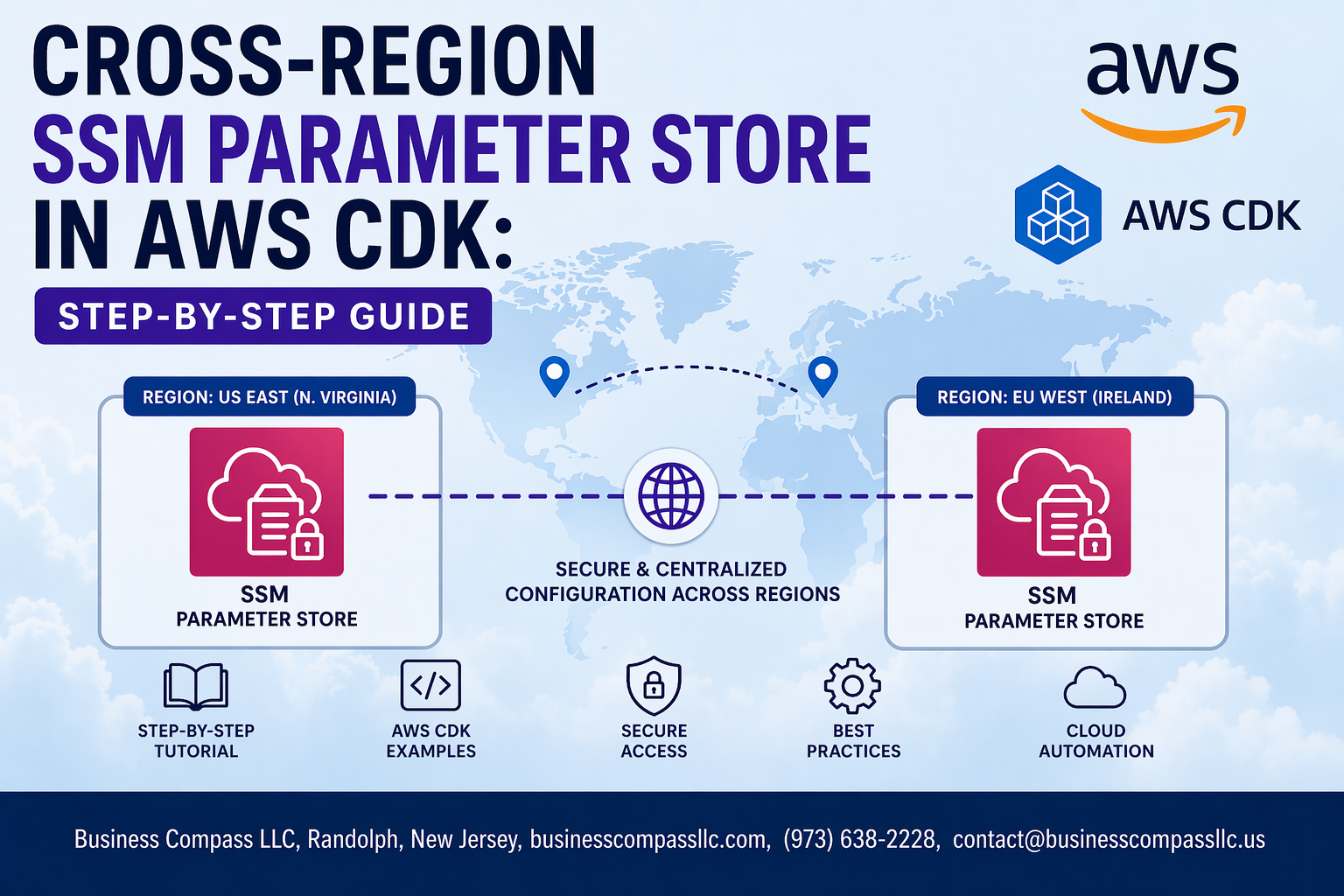
Cross-region SSM parameter distribution transforms how organizations manage configuration data across global AWS infrastructures. This approach enables automatic disaster recovery scenarios where applications seamlessly access configuration parameters even when primary regions experience outages. Teams can maintain consistent application behavior across multiple geographic locations while reducing latency for users in different regions by serving parameters from the nearest AWS region.
AWS regional limitations and challenges
AWS Systems Manager Parameter Store operates within specific regional boundaries, meaning parameters created in us-east-1 aren’t automatically available in eu-west-1. This isolation creates deployment complexities for multi-region applications requiring synchronized configuration data. CDK developers must implement custom replication mechanisms since AWS doesn’t provide native cross-region parameter synchronization. Network latency increases when applications access parameters from distant regions, and API rate limits can impact performance during high-frequency parameter retrieval operations.
Security considerations for multi-region deployments
Multi-region parameter deployments introduce additional security layers requiring careful IAM policy management across regions. KMS encryption keys used for SecureString parameters are region-specific, necessitating separate key management strategies for each deployment region. Cross-region parameter access requires properly scoped IAM roles that balance security with operational flexibility. Organizations must establish consistent encryption standards and access patterns while maintaining audit trails across all regions where parameters are replicated.
Cost implications of cross-region parameter access
Cross-region parameter access generates data transfer charges when applications retrieve parameters from regions outside their deployment zone. AWS charges for both parameter API requests and the underlying data transfer between regions, with costs scaling based on parameter size and frequency of access. Organizations can optimize expenses by implementing intelligent caching strategies and regional parameter stores that minimize cross-region calls. The cost-benefit analysis should consider reduced latency benefits against increased infrastructure expenses when designing cross-region SSM parameter architectures.
Setting Up Your AWS CDK Environment

Installing and configuring AWS CDK prerequisites
Begin by installing Node.js (version 14 or higher) and the AWS CDK CLI globally using npm install -g aws-cdk. Verify your installation with cdk --version to confirm the setup. You’ll also need the AWS CLI configured with appropriate credentials and the TypeScript compiler if you’re using TypeScript for your AWS CDK infrastructure as code project.
Creating a multi-region CDK project structure
Initialize your CDK parameter store tutorial project with cdk init app --language typescript. Structure your project with separate stack files for each region, organizing them in folders like lib/us-east-1 and lib/eu-west-1. This approach helps manage cross region parameter management AWS deployments efficiently while maintaining clean separation between regional resources.
Configuring AWS credentials for multiple regions
Set up AWS profiles for each target region in your ~/.aws/credentials file or use environment variables. Configure region-specific profiles like [profile us-east-1] and [profile eu-west-1] with appropriate access keys. When deploying AWS CDK cross region deployment stacks, specify the profile using --profile flag to ensure resources are created in the correct regions for your cross region SSM parameters setup.
Creating SSM Parameters in the Source Region

Defining Parameter Types and Values in CDK
Creating SSM parameters in your source region starts with choosing the right parameter types for your data. The AWS CDK SSM Parameter Store supports three main types: String for simple text values, StringList for comma-separated values, and SecureString for sensitive data requiring encryption. Define parameters using the aws-ssm.StringParameter construct, specifying the parameter name, value, and type explicitly. Consider data sensitivity and access patterns when selecting types, as SecureString parameters automatically encrypt data while String parameters offer faster retrieval for non-sensitive configuration data.
Implementing Proper Naming Conventions and Hierarchies
AWS CDK cross region deployment success depends heavily on consistent parameter naming strategies. Structure your parameter names using hierarchical paths like /application/environment/component/setting to enable logical grouping and easier management across regions. Implement standardized prefixes for different environments (dev, staging, prod) and maintain consistent naming patterns throughout your infrastructure as code. This approach simplifies cross region parameter management AWS operations and ensures seamless parameter discovery during replication processes.
Setting Up Parameter Encryption with KMS Keys
SecureString parameters require KMS key configuration for proper encryption in your AWS CDK infrastructure as code. Create dedicated KMS keys for parameter encryption using the aws-kms.Key construct, then reference these keys in your parameter definitions. Configure key policies to allow access from both your source region and target regions where parameter replication will occur. Enable automatic key rotation and establish proper key aliases to maintain consistency across your cross region SSM parameters implementation.
Adding Tags and Metadata for Organization
Effective parameter organization relies on comprehensive tagging strategies for your SSM parameter store tutorial implementation. Apply tags consistently across all parameters using the CDK’s tagging capabilities, including environment, application, owner, and cost center tags. Add description metadata to parameters explaining their purpose and usage patterns, which proves invaluable during cross region parameter management. Implement tag-based policies for automated lifecycle management and ensure tags propagate correctly during SSM parameter replication AWS processes.
Implementing Cross-Region Parameter Replication

Building custom constructs for parameter copying
Creating reusable CDK constructs streamlines SSM parameter replication across AWS regions. Custom constructs encapsulate the logic for copying parameters, making your infrastructure code modular and maintainable. Design constructs that accept source region, target regions, and parameter patterns as props. Include error handling and retry mechanisms within your construct to manage network issues or temporary service outages.
Using AWS Lambda functions for automated replication
Lambda functions provide serverless automation for cross-region SSM parameter synchronization. Deploy Lambda functions in both source and target regions to handle parameter copying operations. Configure EventBridge rules to trigger replication when parameters change in the source region. Your Lambda code should validate parameter types, handle encryption keys, and manage IAM permissions across regions. Include comprehensive logging and error notification through SNS topics.
Handling parameter updates and synchronization
Parameter synchronization requires careful consideration of update conflicts and versioning strategies. Implement timestamp-based conflict resolution or use parameter versions to track changes across regions. Create monitoring dashboards to track synchronization status and identify drift between regions. Set up CloudWatch alarms for failed replications and establish rollback procedures for problematic updates.
Managing different parameter types across regions
Different SSM parameter types require specific handling during cross-region replication. String parameters replicate straightforwardly, while SecureString parameters need KMS key management across regions. StringList parameters require validation of formatting consistency. Handle advanced parameters with their higher throughput limits and larger size constraints. Create type-specific replication strategies to ensure data integrity and proper encryption handling across all target regions.
Accessing Cross-Region Parameters in Target Regions

Reading parameters from remote regions using CDK
Cross-region parameter access in AWS CDK requires careful configuration to retrieve SSM parameters from different regions. Use the StringParameter.valueFromLookup() method with explicit region specification to fetch parameters during synthesis time. For runtime parameter access, implement the aws-sdk within Lambda functions or EC2 instances to dynamically retrieve cross-region SSM parameters.
const crossRegionParam = StringParameter.valueFromLookup(this, 'CrossRegionParam', {
  parameterName: '/app/database/endpoint',
  region: 'us-west-2'
});
Implementing caching strategies for performance
Parameter caching dramatically improves application performance when accessing cross-region SSM parameters. Implement client-side caching using AWS Parameter Store’s built-in caching capabilities or create custom caching layers with Redis or DynamoDB. Set appropriate TTL values based on parameter update frequency to balance performance with data freshness.
const parameterClient = new SSMClient({
  region: 'us-west-2',
  maxAttempts: 3,
  retryMode: 'adaptive'
});
Creating cross-region parameter lookup utilities
Build reusable utility functions that abstract cross-region parameter retrieval complexity. Create TypeScript classes that handle region switching, error handling, and parameter validation automatically. These utilities should include retry logic, fallback mechanisms, and standardized error responses for consistent parameter management across your AWS CDK infrastructure.
export class CrossRegionParameterLookup {
  async getParameter(name: string, region: string): Promise<string> {
    // Implementation with error handling and retry logic
  }
}
Handling parameter access permissions and IAM roles
Configure IAM policies that grant cross-region SSM parameter access permissions. Create roles with ssm:GetParameter and ssm:GetParameters permissions for target regions. Use resource-based policies to restrict access to specific parameter paths and implement least-privilege principles. Consider using cross-account parameter sharing when parameters span multiple AWS accounts in your CDK cross region deployment strategy.
{
  "Version": "2012-10-17",
  "Statement": [{
    "Effect": "Allow",
    "Action": ["ssm:GetParameter", "ssm:GetParameters"],
    "Resource": "arn:aws:ssm:*:*:parameter/app/*"
  }]
}
Managing Security and Permissions

Setting up cross-region KMS key policies
KMS encryption plays a crucial role when replicating SSM parameters across regions. Each region requires its own KMS key since these keys are region-specific resources in AWS. Create dedicated KMS keys in both source and target regions, ensuring your key policies grant appropriate permissions to the AWS Systems Manager service and your CDK deployment roles. Configure cross-region access by allowing the source region’s KMS key to decrypt parameters while the target region’s key handles encryption of replicated values.
Configuring IAM roles for parameter access
Your AWS CDK infrastructure needs properly configured IAM roles to manage cross-region parameter operations. Create service roles with permissions for both ssm:GetParameter and ssm:PutParameter actions across multiple regions. Include necessary KMS permissions like kms:Decrypt for the source region and kms:Encrypt for target regions. Attach these roles to your CDK stacks and Lambda functions handling parameter replication, ensuring they can authenticate and perform operations in all required regions.
Implementing least privilege access controls
Design your permission model following least privilege principles for enhanced security. Restrict parameter access to specific paths using resource-based policies with wildcards like /app/production/* rather than granting broad access. Implement time-bound access controls and consider using AWS STS assume role patterns for temporary cross-region operations. Create separate roles for different environments and applications, limiting each role’s scope to only the SSM parameters and KMS keys necessary for its specific function within your cross-region parameter management workflow.
Testing and Validation Strategies

Unit testing cross-region parameter operations
Building robust unit tests for your AWS CDK SSM Parameter Store cross-region setup requires mocking AWS services and validating parameter creation logic. Create test suites that verify parameter definitions, encryption configurations, and cross-region replication policies without actual AWS API calls. Use AWS CDK’s built-in testing utilities to snapshot-test your CloudFormation templates and ensure consistent cross region SSM parameters across different environments.
Integration testing with multiple AWS regions
Set up automated integration tests that deploy your CDK parameter store infrastructure across actual AWS regions. Create test scenarios that validate parameter availability, cross-region synchronization timing, and failover mechanisms. Your test pipeline should verify that parameters remain accessible when primary regions experience issues, ensuring your AWS cross region architecture performs reliably under various conditions.
Validating parameter consistency across regions
Implement automated checks that compare parameter values, metadata, and encryption settings across all target regions. Build validation scripts that query SSM parameter replication AWS endpoints and flag any discrepancies in parameter versions or content. Schedule regular consistency checks to catch synchronization delays or replication failures before they impact your applications.
Performance testing for cross-region access
Measure latency and throughput when accessing cross region parameter management AWS resources from different geographical locations. Create load tests that simulate realistic application traffic patterns and monitor response times for parameter retrieval operations. Track performance metrics during peak usage periods to identify potential bottlenecks in your AWS Systems Manager cross region configuration and optimize accordingly.
Deployment and Monitoring Best Practices

Orchestrating multi-region CDK deployments
Deploying AWS CDK SSM Parameter Store across multiple regions requires careful sequencing to ensure parameter dependencies are met. Start by deploying your primary region stack containing the source parameters, then deploy secondary regions in a specific order that respects cross-region dependencies. Use CDK deployment pipelines with conditional logic to handle region-specific configurations and parameter mappings automatically.
Consider implementing a deployment orchestrator that validates parameter availability before proceeding to dependent regions. This prevents cascade failures when cross region SSM parameters aren’t yet available in target regions.
Setting up CloudWatch monitoring for parameter access
CloudWatch metrics provide visibility into your SSM parameter synchronization performance across regions. Create custom metrics that track parameter access patterns, latency, and success rates for cross-region operations. Set up dashboards showing parameter usage trends, error rates, and regional performance comparisons to identify bottlenecks quickly.
Monitor GetParameter API calls across regions using CloudTrail integration with CloudWatch. This helps track which applications access parameters from specific regions and identifies potential optimization opportunities for cross region parameter management AWS strategies.
Implementing alerting for replication failures
Configure CloudWatch alarms that trigger when parameter replication fails or experiences delays between regions. Set up SNS topics that notify operations teams immediately when AWS CDK cross region deployment encounters synchronization issues. Create escalation policies that automatically attempt remediation steps before alerting human operators.
Build custom Lambda functions that monitor parameter consistency across regions and alert when values diverge unexpectedly. This proactive monitoring prevents applications from using stale or incorrect parameter values during regional failover scenarios.
Creating rollback strategies for failed deployments
Design rollback mechanisms that can quickly restore previous parameter values across all regions when deployments fail. Implement version tagging for parameters that enables automated rollback to known-good configurations. Use CDK stack rollback capabilities combined with parameter versioning to maintain consistency during failed AWS CDK infrastructure as code deployments.
Create pre-deployment snapshots of critical parameters and automate the restoration process through Lambda functions triggered by deployment failures. This ensures minimal downtime when cross region SSM parameters need emergency rollback procedures.

Cross-region SSM Parameter Store setup with AWS CDK gives you the power to share configuration data seamlessly across multiple AWS regions. We’ve walked through the complete process from understanding the architecture to implementing replication, managing security permissions, and establishing robust testing strategies. The key is getting your CDK environment configured properly, creating parameters in your source region, and setting up the replication mechanism that keeps everything in sync.
When you’re ready to deploy this solution, remember that monitoring and validation are just as important as the initial setup. Start small with a few parameters, test thoroughly in non-production environments, and gradually expand your cross-region parameter strategy. This approach will save you headaches down the road and ensure your applications can access the configuration data they need, no matter which region they’re running in.