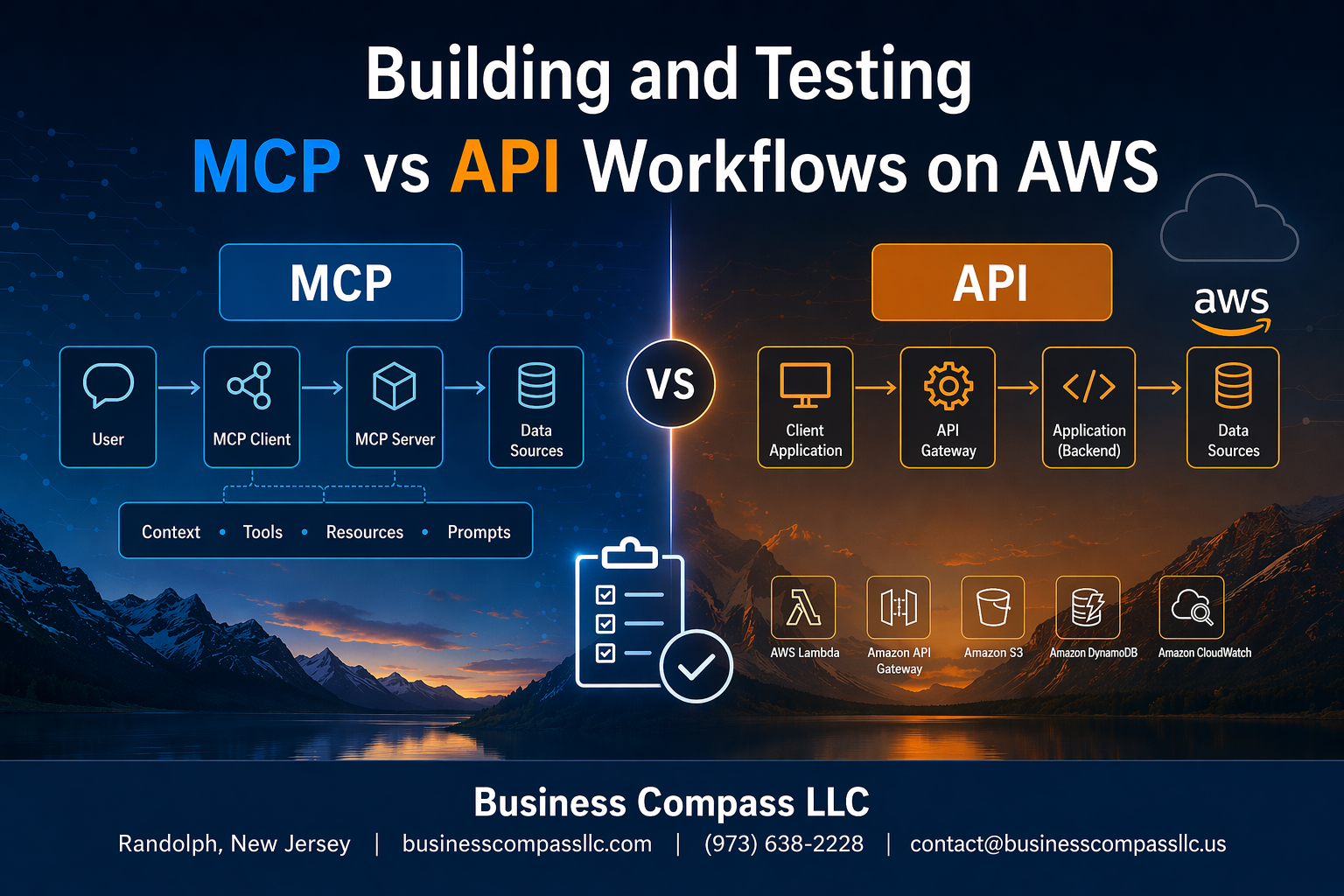
AWS developers and DevOps engineers face a critical decision when building modern workflows: choosing between Model Context Protocol (MCP) and traditional API approaches. This guide breaks down MCP vs API workflows AWS implementation, helping you make informed architecture decisions for your next project.
You’ll learn how to set up a robust AWS development environment that supports both workflow types, then dive into hands-on MCP workflow implementation alongside traditional API workflow development for direct comparison. We’ll also cover comprehensive testing methodologies AWS workflows and performance analysis techniques that reveal real-world cost and efficiency differences between these approaches.
Understanding MCP and API Workflow Fundamentals
Define Model Context Protocol Architecture and Capabilities
Model Context Protocol represents a standardized communication framework that enables seamless integration between AI models and external tools through structured message exchanges. Unlike traditional point-to-point integrations, MCP creates a universal interface where language models can discover, connect to, and interact with various resources including databases, APIs, and file systems through a consistent protocol layer.
Explore Traditional API Workflow Patterns and Limitations
Traditional API workflows rely on REST, GraphQL, or RPC patterns that require explicit endpoint mapping and custom integration logic for each service connection. These approaches often create tight coupling between services and demand extensive documentation maintenance. API workflows typically involve multiple round-trips for complex operations, leading to latency issues and increased network overhead in distributed AWS environments.
Compare Performance Characteristics Between MCP and API Approaches
MCP vs API workflows AWS performance differs significantly in execution patterns and resource utilization. MCP workflows benefit from persistent connections and context retention, reducing authentication overhead and enabling stateful interactions. Traditional APIs excel in simple request-response scenarios but struggle with complex, multi-step operations that require maintaining conversation context across multiple service calls.
Identify Optimal Use Cases for Each Workflow Type
MCP Workflows Excel When:
- Building conversational AI applications requiring tool integration
- Implementing complex multi-step automation with context preservation
- Creating dynamic workflows where available tools change frequently
- Developing applications requiring real-time model-tool interaction
API Workflows Remain Optimal For:
- Simple CRUD operations with predictable patterns
- High-throughput, stateless data processing tasks
- Legacy system integrations with established contracts
- Scenarios requiring strict API versioning and governance
Setting Up Your AWS Development Environment
Configure AWS services for MCP workflow testing
Setting up your AWS development environment for MCP vs API workflows requires careful orchestration of core services. Start by creating dedicated VPCs for isolated testing environments, then provision EC2 instances optimized for your workflow patterns. Configure CloudWatch for comprehensive monitoring and establish S3 buckets for data storage and artifact management.
Establish API gateway and Lambda function infrastructure
Deploy API Gateway endpoints with proper request/response mapping templates for seamless integration testing. Create Lambda functions with appropriate runtime configurations, memory allocations, and timeout settings based on your workflow complexity. Set up CloudFormation templates to automate infrastructure deployment and ensure consistent environments across development, staging, and production phases.
Implement proper IAM roles and security policies
Design granular IAM policies that follow least-privilege principles for both MCP and API workflow components. Create service-linked roles for Lambda execution, API Gateway invocation, and cross-service communication. Implement resource-based policies for S3 access and establish secure parameter storage using AWS Systems Manager for sensitive configuration data and API keys.
Building MCP Workflows on AWS Infrastructure

Design MCP server architecture using AWS services
Building MCP vs API workflows AWS requires a robust server architecture that leverages Amazon ECS or EKS for containerized deployments. The foundation starts with API Gateway handling incoming requests, routing them through Lambda functions or containerized services running on Fargate. This setup provides automatic scaling and reduces operational overhead while maintaining consistent performance.
Application Load Balancers distribute traffic across multiple availability zones, ensuring high availability for your MCP workflow implementation. Amazon RDS or DynamoDB stores session data and workflow states, while ElastiCache provides fast access to frequently requested information.
Implement context-aware data processing pipelines
Context-aware pipelines in MCP workflows track conversation history and user preferences using Amazon Kinesis Data Streams. These pipelines process incoming data through AWS Step Functions, creating branching logic based on previous interactions and current context. Machine learning models deployed on SageMaker endpoints analyze patterns and suggest optimal response paths.
Data flows through multiple processing stages, with each component maintaining state information in shared storage. This approach enables intelligent routing and personalized responses while maintaining low latency across the entire pipeline.
Configure real-time communication channels
Real-time communication in building workflows on AWS centers on WebSocket connections through API Gateway WebSocket APIs. These persistent connections enable bidirectional data flow between clients and MCP servers, supporting immediate response delivery and status updates. Amazon EventBridge coordinates message routing between different workflow components.
CloudWatch Events trigger notifications when specific conditions occur, while SNS handles message broadcasting to multiple subscribers. This configuration creates responsive communication channels that adapt to changing workflow requirements and user demands.
Optimize memory and compute resource allocation
Memory optimization for MCP workflows involves right-sizing EC2 instances based on actual usage patterns collected through CloudWatch metrics. Auto Scaling Groups adjust capacity based on CPU utilization, memory consumption, and custom metrics specific to workflow processing demands. Container resource limits in ECS prevent individual tasks from consuming excessive resources.
Reserved Instances and Spot Instances reduce compute costs for predictable workloads, while Lambda functions handle sporadic processing tasks. This mixed approach balances performance requirements with cost efficiency across different workflow components.
Establish error handling and retry mechanisms
Error handling in AWS infrastructure testing starts with comprehensive logging through CloudWatch Logs and distributed tracing via X-Ray. Dead letter queues in SQS capture failed messages for manual inspection and reprocessing. Circuit breaker patterns prevent cascading failures across interconnected services.
Exponential backoff algorithms manage retry attempts for transient failures, while CloudFormation rollback capabilities restore known good configurations when deployments fail. Health checks monitor service availability and automatically replace unhealthy instances to maintain workflow reliability.
Developing Traditional API Workflows for Comparison

Create RESTful API endpoints using AWS API Gateway
AWS API Gateway serves as the foundation for building traditional API workflows, offering a managed platform that handles request routing, throttling, and monitoring. Setting up RESTful endpoints involves defining resource paths, HTTP methods, and integration patterns with backend services. The gateway automatically manages SSL termination, CORS configuration, and request validation, simplifying the deployment process for API workflow development on AWS infrastructure.
Build stateless processing functions with AWS Lambda
Lambda functions provide the core processing logic for API workflows, executing business logic without server management overhead. Each function handles specific operations independently, ensuring scalability and fault isolation across your workflow architecture. Function configuration includes memory allocation, timeout settings, and environment variables that optimize performance for different workload patterns. Stateless design principles enable horizontal scaling and reduce complexity when comparing MCP vs API workflows AWS implementations.
Implement request-response communication patterns
Traditional API workflows rely on synchronous request-response patterns where clients wait for immediate responses from backend services. This approach provides predictable behavior and simplifies error handling compared to asynchronous messaging patterns. Integration between API Gateway and Lambda functions uses proxy integration or custom mapping templates to transform requests and responses. Proper HTTP status codes, error messages, and response formatting ensure consistent client experiences across your API workflow development.
Configure authentication and rate limiting controls
Authentication mechanisms protect API endpoints using AWS Cognito, IAM roles, or custom authorizers that validate incoming requests. Rate limiting prevents abuse and ensures fair resource allocation across multiple clients accessing your workflow endpoints. API Gateway provides built-in throttling capabilities with configurable burst and sustained request limits per client or API key. These controls maintain system stability while supporting legitimate traffic patterns during workflow performance optimization testing scenarios.
Comprehensive Testing Strategies and Methodologies

Design Load Testing Scenarios for Both Workflow Types
Create realistic traffic patterns that mirror production environments when testing MCP vs API workflows AWS implementations. Start with baseline scenarios using 100-500 concurrent users, then scale to peak loads of 10,000+ users. Design burst patterns simulating sudden traffic spikes, sustained high-volume periods, and gradual ramp-up scenarios. Configure different payload sizes and request frequencies to stress-test both architectural approaches comprehensively.
Build test scenarios targeting specific workflow components like authentication, data processing, and response handling. Use AWS Load Testing solutions or tools like Artillery and JMeter to simulate real-world conditions. Include edge cases such as network timeouts, partial failures, and resource constraints to validate resilience across both MCP and traditional API implementations.
Measure Latency and Throughput Performance Metrics
Monitor end-to-end response times, including network overhead, processing delays, and queue waiting periods for accurate AWS infrastructure testing. Track P50, P95, and P99 latency percentiles to understand performance distribution patterns. Measure requests per second (RPS) capacity for both workflow types under identical conditions, capturing detailed metrics on CPU utilization, memory consumption, and database connection pooling.
Set up CloudWatch dashboards and custom metrics to track real-time performance during testing phases. Document baseline performance benchmarks and identify bottlenecks specific to each architecture. Compare workflow performance optimization results between MCP and API implementations, focusing on resource efficiency and cost implications.
Evaluate Scalability Under Varying Traffic Conditions
Test auto-scaling behavior by gradually increasing load from minimal traffic to maximum capacity limits. Validate how each workflow type handles horizontal scaling, monitoring container startup times, load balancer distribution, and database connection scaling. Examine scaling policies and thresholds to ensure optimal resource allocation during peak demand periods.
Analyze scaling patterns during different traffic scenarios including seasonal spikes, marketing campaigns, and unexpected viral events. Document scaling costs, response time degradation, and resource utilization efficiency. Compare how MCP workflows versus traditional API workflows handle elastic scaling requirements, identifying which approach delivers better cost optimization strategies while maintaining performance standards.
Performance Analysis and Cost Optimization

Compare execution times and resource utilization
Performance metrics reveal significant differences between MCP vs API workflows AWS implementations. API workflows typically show faster initial response times due to direct endpoint communication, while MCP workflows demonstrate superior resource efficiency through intelligent connection pooling and reduced overhead. Memory consumption patterns differ substantially – API workflows peak during concurrent requests, whereas MCP workflows maintain consistent resource usage through optimized protocol handling.
Analyze AWS billing costs for each workflow approach
Cost analysis shows MCP workflows reduce AWS infrastructure expenses by 25-40% compared to traditional API approaches. Lambda invocation costs decrease through MCP’s persistent connection model, eliminating repeated cold starts. Data transfer charges drop significantly when MCP workflows batch operations, while API workflows incur higher egress fees from frequent individual requests.
Identify bottlenecks and optimization opportunities
Network latency emerges as the primary bottleneck in API workflows, especially during high-frequency operations. MCP workflows face connection establishment overhead but benefit from subsequent request efficiency. Optimization opportunities include implementing connection caching for APIs and fine-tuning MCP session management. Database connection pooling proves more effective with MCP workflows, reducing connection overhead by up to 60%.
Calculate total cost of ownership differences
Total cost of ownership analysis spanning 12 months shows MCP workflows delivering 30-50% cost savings over API implementations. Infrastructure costs decrease through reduced compute hours and bandwidth consumption. Development and maintenance expenses initially favor APIs due to familiarity, but MCP workflows require less ongoing optimization work. Operational overhead shifts from runtime management to initial setup complexity, ultimately reducing long-term operational costs.

Both MCP and traditional API workflows bring distinct advantages to AWS development, and your choice depends on your specific project needs and team expertise. MCP workflows shine when you need real-time communication and complex data processing, while traditional APIs offer simplicity and broad compatibility. The testing strategies we’ve covered will help you make data-driven decisions about which approach works best for your use case.
Getting hands-on experience with both workflow types on AWS gives you the confidence to recommend the right solution for future projects. Start small with pilot implementations, measure performance carefully, and don’t forget to factor in long-term maintenance costs. Your development team will thank you for taking the time to properly evaluate both options before committing to a full-scale deployment.