This guide shows experienced DevOps engineers and infrastructure teams how to build sophisticated Terraform configurations using loops and conditional logic. You’ll learn to create dynamic, maintainable infrastructure that scales with your organization’s needs.
Who this is for: DevOps professionals and infrastructure engineers working on complex, enterprise-scale Terraform deployments who want to move beyond basic resource declarations.
We’ll cover three key areas that will transform your Terraform skills:
Dynamic Resource Creation with For-Each and Count – Master the difference between Terraform for each loop and count constructs. Learn when to use each approach for creating multiple resources and how to handle complex data structures effectively.
Smart Conditional Logic Implementation – Build intelligent infrastructure that adapts based on environment variables, input conditions, and business rules using Terraform conditional expressions and advanced conditional logic patterns.
Enterprise-Scale Configuration Patterns – Combine loops with local values and variables to create reusable, maintainable configurations that handle real-world complexity while optimizing performance across large deployments.
Master For and For-Each Loop Constructs for Dynamic Resource Creation
Build scalable infrastructure with count meta-argument
The count meta-argument enables Terraform dynamic resource creation by generating multiple instances of a resource based on a numeric value. This approach works perfectly when you need identical resources that differ only by index. You can reference each instance using count.index to create unique names or configurations. However, be careful with resource deletion – removing items from the middle of a count list causes Terraform to destroy and recreate subsequent resources, potentially disrupting your infrastructure.
Create flexible configurations using for_each with maps
Terraform for each loop functionality provides superior flexibility compared to count by accepting maps or sets as input. This pattern allows you to create resources with meaningful keys rather than numeric indices, making your configuration more maintainable. When using maps, each resource instance gets a unique key that remains stable even when you add or remove other resources. The each.key and each.value references give you access to both the map key and its corresponding value for dynamic configuration.
Generate multiple similar resources efficiently
Combining Terraform loops tutorial concepts with data structures creates powerful patterns for enterprise environments. You can define complex maps containing resource specifications and iterate through them using for_each. This approach scales beautifully when managing multiple environments, regions, or similar resources that share common configurations but require specific customizations. The key advantage lies in maintaining DRY principles while keeping your code readable and maintainable.
Avoid common pitfalls in loop implementation
Terraform count vs for each decision impacts long-term maintainability significantly. Avoid using count with lists that might change order, as this triggers unnecessary resource recreation. When using for_each, ensure your keys remain stable across runs – changing keys forces resource replacement. Always validate that your input data structures are properly formatted before applying, and consider using local values to transform complex data into the exact format needed for your loops.
Leverage Advanced Conditional Logic for Smart Resource Management
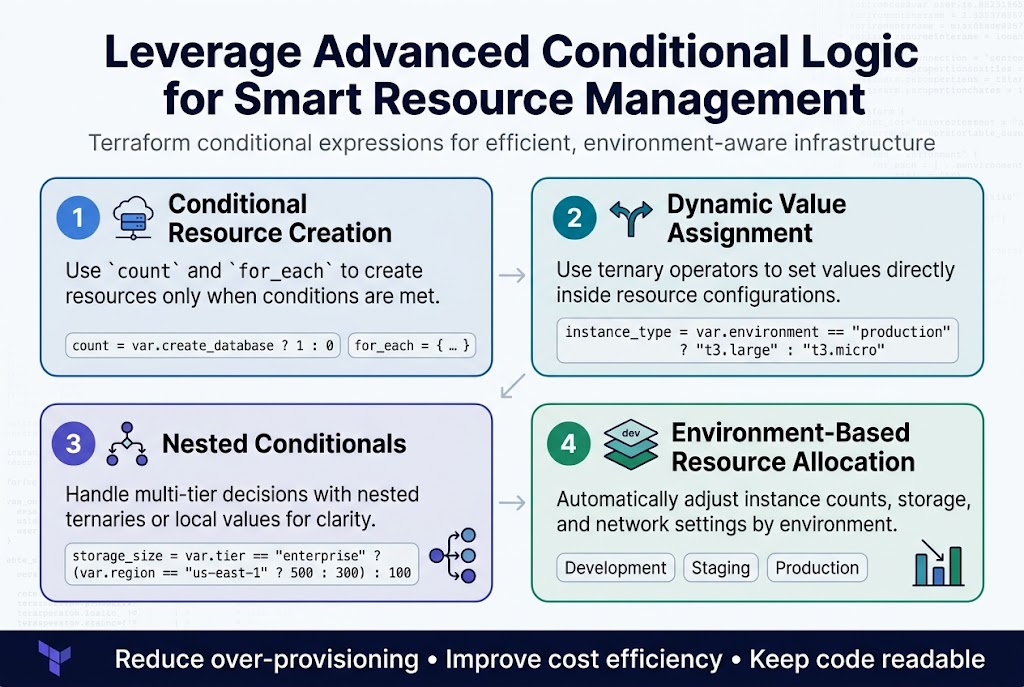
Implement conditional resource creation with count and for_each
Terraform conditional expressions with count and for_each enable smart resource provisioning based on specific criteria. The count parameter accepts boolean expressions or numeric values, creating resources only when conditions evaluate to true. Using for_each with conditional maps provides more granular control, allowing dynamic resource creation based on complex filtering logic across data structures.
Use ternary operators for dynamic value assignment
Ternary operators (condition ? true_value : false_value) streamline dynamic value assignment in Terraform configurations. These expressions replace verbose conditional blocks with concise inline logic for environment-specific settings, resource sizing, and feature toggles. Combine multiple ternary operators to create sophisticated decision trees that adapt configurations based on workspace variables, tags, or external data sources.
Apply nested conditionals for complex decision making
Nested Terraform conditional expressions handle multi-layered decision scenarios common in enterprise deployments. Stack multiple conditions using logical operators (&&, ||) within ternary expressions to evaluate environment types, compliance requirements, and resource dependencies simultaneously. This approach enables sophisticated resource allocation patterns where different combinations of variables trigger unique configuration paths.
Optimize resource allocation based on environment variables
Environment-driven conditional logic automates resource scaling and feature activation across development, staging, and production environments. Use terraform.workspace and custom variables within conditional expressions to adjust instance types, enable monitoring tools, and configure security policies. This pattern reduces configuration drift while maintaining consistency across deployment pipelines through centralized decision logic.
Combine Loops with Complex Data Structures for Enterprise-Scale Deployments
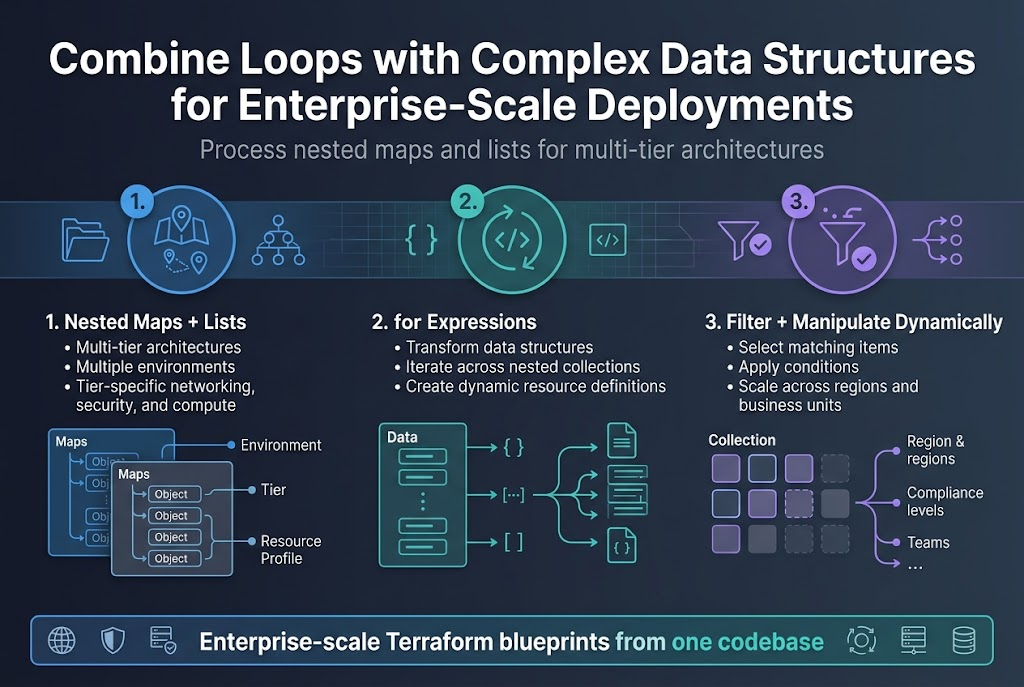
Process nested maps and lists for multi-tier architectures
Enterprise Terraform deployments often require sophisticated data structures to manage complex infrastructure patterns. When working with Terraform for each loop constructs across nested maps, you can efficiently provision multi-tier architectures where each tier contains varying resource configurations. Consider a scenario where your infrastructure spans multiple environments, each containing different application tiers with unique networking, security, and compute requirements. Your Terraform configuration can leverage deeply nested data structures to define these relationships, enabling dynamic resource creation based on hierarchical dependencies.
Multi-dimensional data structures become particularly powerful when combined with Terraform complex data structures for enterprise-scale deployments. You can structure your variables as maps containing lists of objects, where each object represents a specific configuration profile. This approach allows you to define infrastructure blueprints that scale horizontally and vertically, accommodating different business units, geographic regions, and compliance requirements within a single codebase.
Transform data structures using for expressions
Filter and manipulate collections dynamically
Implement Dynamic Configuration Patterns Using Local Values and Variables
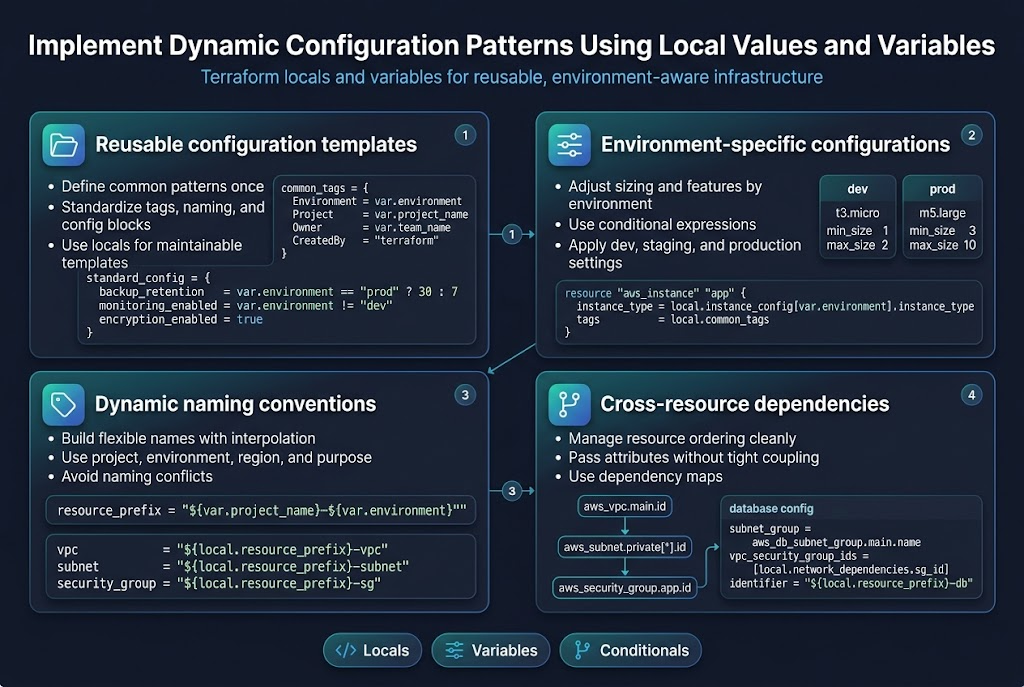
Create reusable configuration templates with locals
Terraform local values transform complex configurations into clean, maintainable templates. Define common patterns once and reference them throughout your infrastructure code. Use locals to standardize resource tagging, naming schemes, and configuration blocks that repeat across multiple resources.
locals {
  common_tags = {
    Environment = var.environment
    Project     = var.project_name
    Owner       = var.team_name
    CreatedBy   = "terraform"
  }

  standard_config = {
    backup_retention = var.environment == "prod" ? 30 : 7
    monitoring_enabled = var.environment != "dev"
    encryption_enabled = true
  }
}
Build environment-specific resource configurations
Terraform conditional expressions enable dynamic resource sizing and feature toggles based on environment variables. Combine locals with conditional logic to automatically adjust instance types, storage sizes, and security settings across development, staging, and production environments.
locals {
  instance_config = {
    dev = {
      instance_type = "t3.micro"
      min_size      = 1
      max_size      = 2
    }
    prod = {
      instance_type = "m5.large"
      min_size      = 3
      max_size      = 10
    }
  }
}

resource "aws_instance" "app" {
  instance_type = local.instance_config[var.environment].instance_type
  tags          = local.common_tags
}
Establish naming conventions with dynamic interpolation
Terraform dynamic resource creation relies heavily on consistent naming patterns. Build flexible naming schemes using string interpolation and local values that automatically generate resource names based on environment, region, and purpose. This approach eliminates naming conflicts and improves resource organization.
locals {
  resource_prefix = "${var.project_name}-${var.environment}"

  naming_convention = {
    vpc        = "${local.resource_prefix}-vpc"
    subnet     = "${local.resource_prefix}-subnet"
    security_group = "${local.resource_prefix}-sg"
  }
}
Manage cross-resource dependencies effectively
Terraform local values excel at managing complex dependencies between resources while maintaining clean separation of concerns. Create dependency maps and reference patterns that automatically handle resource ordering and attribute passing without tight coupling between resource definitions.
locals {
  network_dependencies = {
    vpc_id     = aws_vpc.main.id
    subnet_ids = aws_subnet.private[*].id
    sg_id      = aws_security_group.app.id
  }

  database_config = {
    subnet_group = aws_db_subnet_group.main.name
    vpc_security_group_ids = [local.network_dependencies.sg_id]
    identifier = "${local.resource_prefix}-db"
  }
}
Optimize Performance and Maintainability in Complex Terraform Configurations
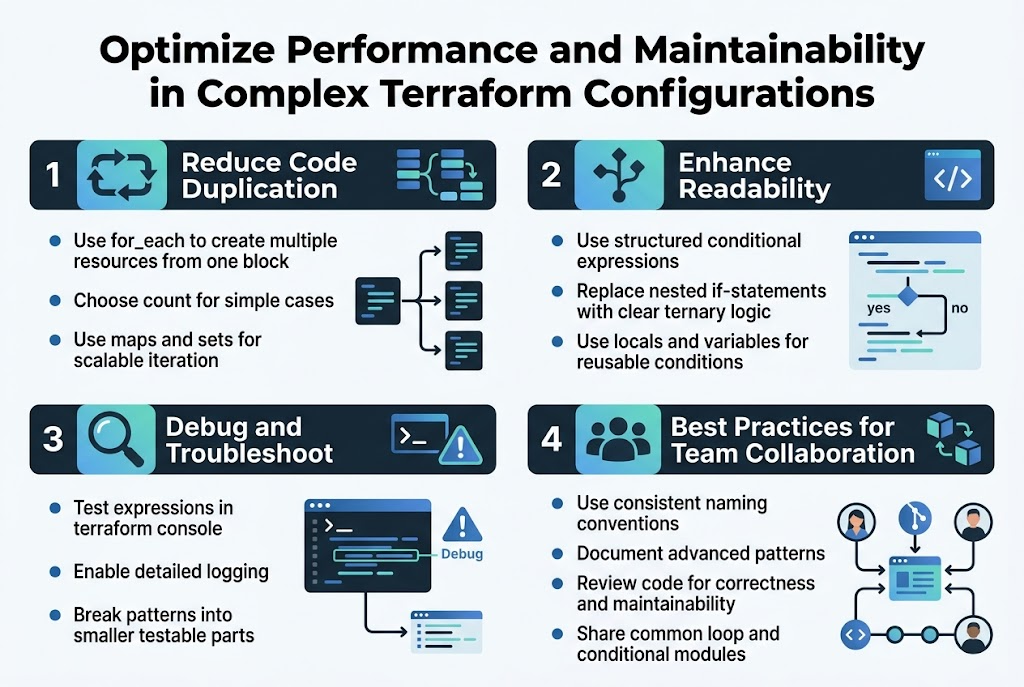
Reduce code duplication through intelligent looping
Terraform for each loop patterns eliminate repetitive resource definitions by creating multiple instances from a single configuration block. Instead of copying the same resource declaration dozens of times, you can define it once and let the loop handle the multiplication. This approach dramatically reduces your codebase size while making updates incredibly simple – change one resource definition and all instances automatically inherit the modification.
The count vs for each decision impacts maintainability significantly. While count works great for simple scenarios, for_each excels when working with complex data structures like maps or sets. You can iterate through environment configurations, user lists, or infrastructure components without hardcoding each variation. This intelligent looping strategy transforms unwieldy configurations into clean, maintainable code that scales effortlessly with your infrastructure needs.
Enhance readability with structured conditional expressions
Terraform conditional expressions bring clarity to complex logic by replacing nested if-statements with readable ternary operations. Structure your conditionals using consistent formatting and descriptive variable names that immediately communicate the decision being made. Group related conditions together and break complex expressions into multiple lines for better comprehension.
Advanced conditional patterns shine when combined with local values and variables. Create reusable condition blocks that can be referenced throughout your configuration, making your intent crystal clear. This approach helps team members quickly understand the logic flow without deciphering cryptic boolean expressions scattered across multiple files.
Debug and troubleshoot advanced pattern implementations
Debugging advanced Terraform patterns requires systematic approaches to isolate issues within loops and conditionals. Use terraform console to test expressions interactively and validate data transformations before applying them to resources. Enable detailed logging to trace how your loops process different inputs and where conditional logic branches.
Break down complex patterns into smaller, testable components. Create separate local values for intermediate calculations and use descriptive names that reveal the transformation steps. This granular approach makes it easier to identify exactly where problems occur and speeds up troubleshooting when working with Terraform complex data structures.
Establish best practices for team collaboration
Team collaboration on Terraform enterprise configuration demands consistent coding standards and clear documentation of advanced patterns. Establish naming conventions for loop variables and conditional expressions that team members can easily understand. Document the purpose and expected inputs for each complex pattern, especially when using intricate data transformations.
Version control strategies become critical when multiple developers work with sophisticated Terraform configurations. Use meaningful commit messages that explain pattern changes and their impact. Implement code review processes focused on pattern correctness and maintainability. Create shared modules for common loop and conditional patterns to ensure consistency across projects while reducing the learning curve for new team members.
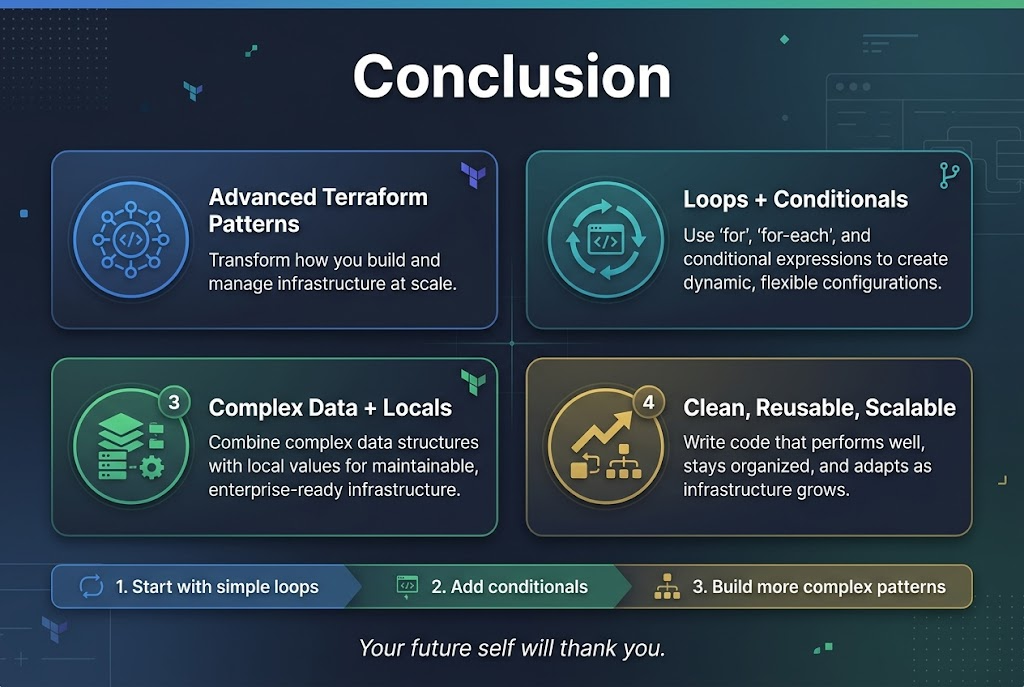
Mastering advanced Terraform patterns transforms how you build and manage infrastructure at scale. The combination of for and for-each loops with conditional expressions gives you the power to create dynamic, flexible configurations that adapt to changing requirements. When you pair these patterns with complex data structures and local values, you’re building infrastructure that’s both maintainable and enterprise-ready.
The real magic happens when you start thinking beyond static configurations. These advanced patterns let you write Terraform code that’s clean, reusable, and performs well even as your infrastructure grows. Start experimenting with these techniques in your next project – begin with simple loops and conditionals, then gradually work your way up to more complex patterns. Your future self will thank you for building infrastructure that scales effortlessly and stays organized as your team and requirements evolve.