Managing sensitive data in AWS doesn’t have to be complicated. For DevOps engineers, cloud architects, and development teams working with AWS infrastructure, choosing between AWS Secrets Manager and SSM Parameter Store for AWS secrets management can make or break your security strategy and budget.
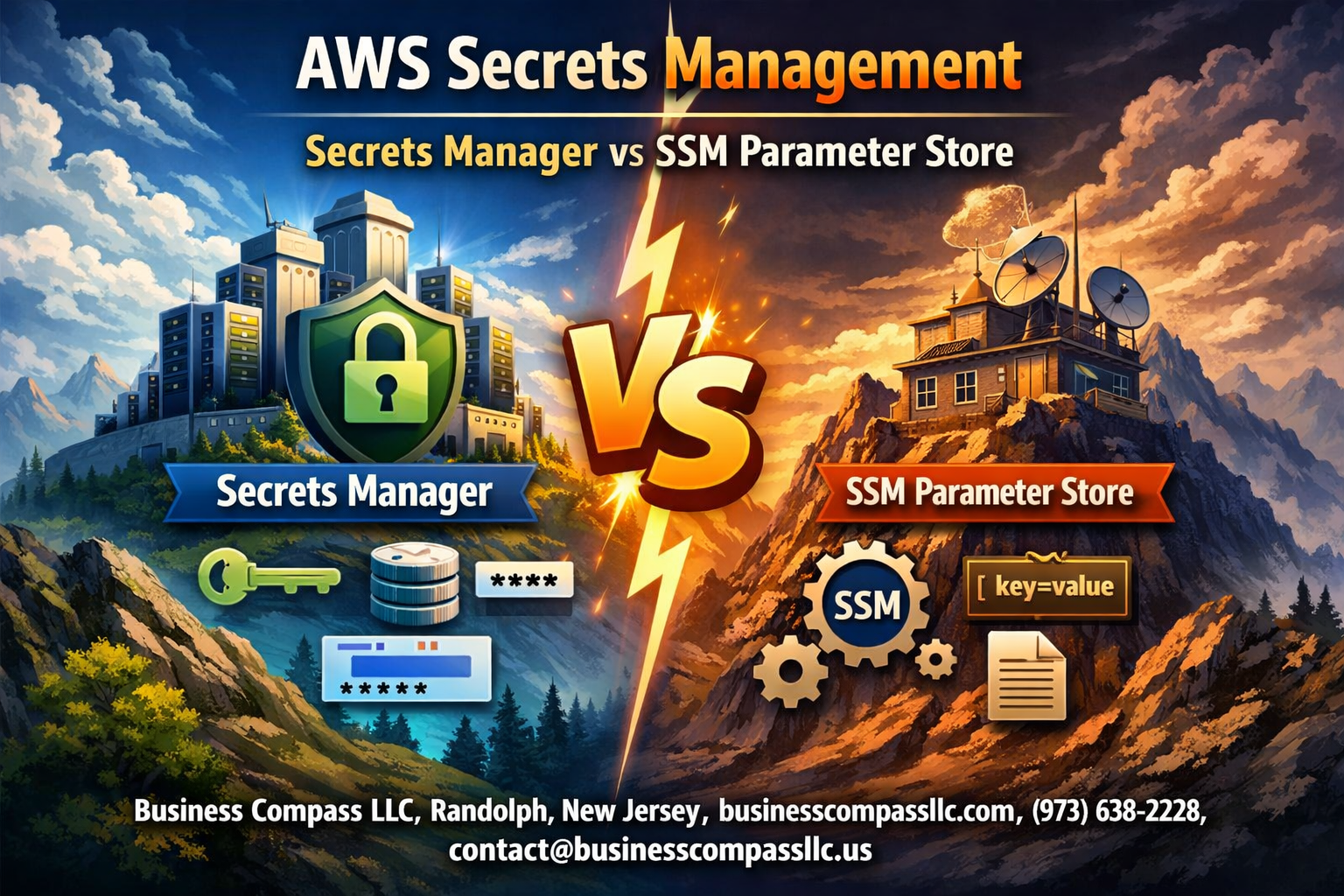
Both services handle AWS secrets storage, but they serve different purposes and come with distinct advantages. AWS Secrets Manager excels at automatic rotation and database credential management, while SSM Parameter Store offers a cost-effective solution for configuration data and simple secrets.
In this guide, we’ll break down the AWS Secrets Manager vs SSM Parameter Store debate by comparing their core features and capabilities. You’ll discover the pricing differences that could impact your AWS bill, and learn practical use cases that will help you pick the right service for your specific needs. By the end, you’ll know exactly which AWS secrets management solution fits your team’s requirements and budget.
Understanding AWS Secrets Management Fundamentals

Core security challenges in cloud infrastructure
Modern cloud environments face complex security challenges when managing sensitive information like database passwords, API keys, and certificates. Organizations often struggle with hardcoded credentials scattered across applications, configuration files, and deployment scripts. This fragmented approach creates security vulnerabilities where secrets become difficult to rotate, monitor, and audit effectively.
Benefits of centralized secret storage
Centralized AWS secrets storage transforms how teams handle sensitive data by providing a single source of truth for all credentials. This approach enables automated secret rotation, granular access controls, and comprehensive audit trails. Teams can programmatically retrieve secrets through secure APIs, eliminating the need for hardcoded values while maintaining encryption both in transit and at rest.
Compliance requirements for sensitive data
Regulatory frameworks like SOC 2, PCI DSS, and GDPR mandate strict controls over sensitive data handling and storage. AWS secrets management solutions help organizations meet these compliance requirements by providing detailed audit logs, encryption standards, and access controls. These features support compliance audits and demonstrate proper security governance to regulators and stakeholders.
Cost implications of poor secret management
Poor secret management practices can lead to significant financial consequences including data breaches, compliance penalties, and operational downtime. Security incidents resulting from exposed credentials often cost organizations millions in remediation, legal fees, and reputation damage. Investing in proper AWS secrets management infrastructure prevents these costly scenarios while reducing manual overhead for secret rotation and access management.
AWS Secrets Manager Deep Dive

Advanced Encryption and Automatic Rotation Capabilities
AWS Secrets Manager takes security seriously with AES-256 encryption for all stored secrets, using AWS KMS keys that you can fully control. The automatic rotation feature stands out as a game-changer, seamlessly updating database passwords, API keys, and other credentials on a schedule you define without breaking your applications.
Seamless Integration with RDS and Other AWS Services
The tight integration between Secrets Manager and RDS databases makes credential management effortless. When you enable automatic rotation for RDS instances, Secrets Manager handles the entire process – creating new passwords, updating database users, and ensuring zero downtime. This native integration extends to services like Redshift, DocumentDB, and third-party applications through Lambda functions.
Cross-Region Replication for Disaster Recovery
Cross-region replication ensures your secrets remain available during regional outages by automatically synchronizing encrypted copies across multiple AWS regions. You can configure replication policies to maintain compliance requirements while keeping your disaster recovery strategy robust and your applications running smoothly.
SSM Parameter Store Comprehensive Analysis

Hierarchical Parameter Organization Structure
SSM Parameter Store excels at organizing configuration data through its path-based hierarchy system. You can structure parameters like /production/database/password or /dev/api/keys/stripe, making it incredibly easy to manage hundreds or thousands of parameters across different environments. This tree-like structure allows for bulk operations, precise access controls, and intuitive navigation that mirrors your application architecture.
Built-in Change Notifications and Tracking
Every parameter modification in SSM Parameter Store gets automatically tracked with version history, timestamps, and user information. The service integrates seamlessly with CloudWatch Events and SNS, so your applications can react instantly when configuration values change. This built-in versioning means you can roll back problematic changes quickly and maintain detailed audit trails without additional setup.
Cost-Effective Storage for Configuration Data
Standard parameters in SSM Parameter Store are completely free for up to 10,000 parameters, making it perfect for storing configuration data, connection strings, and feature flags. Even advanced parameters with higher throughput and larger size limits cost just $0.05 per 10,000 API interactions. This pricing model makes Parameter Store the go-to choice for high-volume, low-sensitivity configuration management.
Integration with AWS Systems Manager Ecosystem
Parameter Store sits at the heart of the AWS Systems Manager suite, connecting seamlessly with EC2 Run Command, State Manager, and Patch Manager. Your EC2 instances can automatically retrieve parameters during bootstrapping, while Systems Manager automations can dynamically update configurations across your entire fleet. This deep integration eliminates the need for custom configuration management solutions.
Head-to-Head Feature Comparison

Security features and encryption methods
Both AWS Secrets Manager and SSM Parameter Store leverage AWS KMS for encryption, but they differ in their security approaches. Secrets Manager automatically encrypts all data using AWS KMS keys and supports cross-account access with granular IAM policies. It also provides built-in versioning and detailed audit logging through CloudTrail. SSM Parameter Store offers encryption for SecureString parameters using KMS, but standard parameters remain unencrypted by default.
Scalability limits and performance metrics
SSM Parameter Store handles up to 10,000 parameters per AWS account and region, with standard parameters limited to 4KB and advanced parameters supporting up to 8KB. API throughput reaches 1,000 requests per second. AWS Secrets Manager doesn’t impose hard limits on secret count but charges per secret stored. Both services deliver sub-100ms response times for retrieval operations, though Parameter Store’s higher throughput makes it better suited for high-frequency configuration access patterns.
Automation and rotation capabilities
Secrets Manager excels in automatic credential rotation with built-in Lambda functions for RDS, Redshift, and DocumentDB. Custom rotation functions can handle other services, with configurable rotation schedules and automatic rollback on failure. SSM Parameter Store lacks native rotation capabilities, requiring custom automation through Lambda functions or Systems Manager documents. Parameter Store compensates with superior integration into EC2 instance configurations and patch management workflows through Systems Manager.
Pricing Models and Cost Optimization

Secrets Manager pricing structure and hidden costs
AWS Secrets Manager charges $0.40 per secret per month plus $0.05 per 10,000 API calls. While this seems straightforward, costs can spike with automatic rotation features that trigger additional API calls. Database credentials rotating every 30 days might generate unexpected charges through Lambda functions and API requests.
Parameter Store free tier and paid features
SSM Parameter Store offers 10,000 standard parameters free monthly, with advanced parameters costing $0.05 each. Advanced features like parameter policies, increased throughput, and larger storage sizes push you into paid tiers. The free tier covers most basic configuration needs effectively.
Real-world cost scenarios and breakeven analysis
For storing 100 database passwords with rotation, Secrets Manager costs roughly $40 monthly versus Parameter Store’s potential $5 for advanced parameters. The breakeven point typically occurs around 20-30 secrets when factoring in operational overhead. High-frequency applications accessing secrets thousands of times daily see API costs escalate quickly.
Strategies for minimizing expenses
Cache secrets locally to reduce API calls, batch parameter retrievals when possible, and audit unused secrets regularly. Consider Parameter Store for configuration data and reserve Secrets Manager for truly sensitive credentials requiring rotation. Implement proper secret lifecycle management to avoid paying for orphaned resources.
Use Case Scenarios and Best Practices

When to choose Secrets Manager for enterprise applications
Enterprise applications handling sensitive data like database credentials, API keys, and third-party service tokens benefit from AWS Secrets Manager‘s automatic rotation capabilities. Financial services, healthcare, and e-commerce platforms requiring strict compliance standards should prioritize Secrets Manager for its built-in encryption, fine-grained IAM policies, and audit trails. The service excels in multi-region deployments where cross-region secret replication ensures high availability and disaster recovery.
Organizations with complex microservices architectures appreciate Secrets Manager’s programmatic access through SDKs and seamless integration with RDS, Redshift, and DocumentDB. The automatic rotation feature reduces security risks by eliminating manual credential updates across distributed systems.
Optimal Parameter Store implementations for startups
Startups and cost-conscious organizations find SSM Parameter Store perfect for storing application configuration data, feature flags, and non-sensitive parameters. The service’s free tier supports up to 10,000 standard parameters, making it ideal for early-stage companies managing environment variables and application settings. Parameter Store’s hierarchical structure allows teams to organize configurations by application, environment, or team boundaries.
Small development teams benefit from Parameter Store’s simple API and quick setup process. The service works well for storing database connection strings (non-sensitive portions), application URLs, and configuration templates that don’t require automatic rotation.
Hybrid approaches for complex architectures
Modern cloud architectures often combine both services to optimize costs and functionality. AWS secrets management best practices suggest using Secrets Manager for rotating credentials while leveraging Parameter Store for static configuration data. This hybrid approach allows organizations to benefit from Secrets Manager’s security features where needed while keeping operational costs low.
Large-scale applications typically store database passwords and API keys in Secrets Manager, while application configurations, environment variables, and feature toggles live in Parameter Store. This strategy provides the right balance between security, functionality, and cost efficiency for complex multi-tier applications.

When it comes to managing secrets on AWS, both Secrets Manager and SSM Parameter Store bring unique strengths to the table. Secrets Manager shines with its automatic rotation capabilities, native database integration, and enterprise-grade security features, making it perfect for complex applications that need hands-off secret management. SSM Parameter Store wins on simplicity and cost-effectiveness, especially for basic configuration data and smaller-scale operations where you don’t mind handling rotation manually.
The choice between these two really depends on your specific needs and budget. If you’re running production applications with databases that require frequent password rotations and you want AWS to handle the heavy lifting, Secrets Manager is worth the extra cost. For simpler use cases, development environments, or when you’re watching every penny, SSM Parameter Store delivers solid security without breaking the bank. Take a close look at your current setup, consider your long-term scaling plans, and pick the tool that matches both your technical requirements and your team’s comfort level with managing secrets.