

AWS Agentic AI Architecture Explained: Automating Application Modernization at Scale
If your team is still manually managing legacy application migrations, you already know how slow and expensive that gets. AWS Agentic AI changes that equation by letting AI agents plan, decide, and act autonomously — without someone babysitting every step.
This guide is for cloud architects, engineering leads, and enterprise IT teams who want a clear, practical breakdown of how agentic AI architecture on AWS actually works — and how to put it to work for application modernization at scale.
Here’s what we’ll walk through:
- The core AWS services that make agentic AI tick — think Amazon Bedrock, AWS Lambda, and the orchestration layer that ties it all together
- How agentic AI automates application modernization by handling code analysis, refactoring decisions, and deployment workflows without constant human input
- Real-world agentic AI use cases showing how enterprises are already cutting modernization timelines from months to weeks
No fluff, no theory for theory’s sake — just a straight look at how scalable AI architecture on AWS is reshaping the way enterprises modernize their software stacks.
What Is AWS Agentic AI and Why It Matters for Modern Enterprises
Defining Agentic AI in the Context of AWS Services
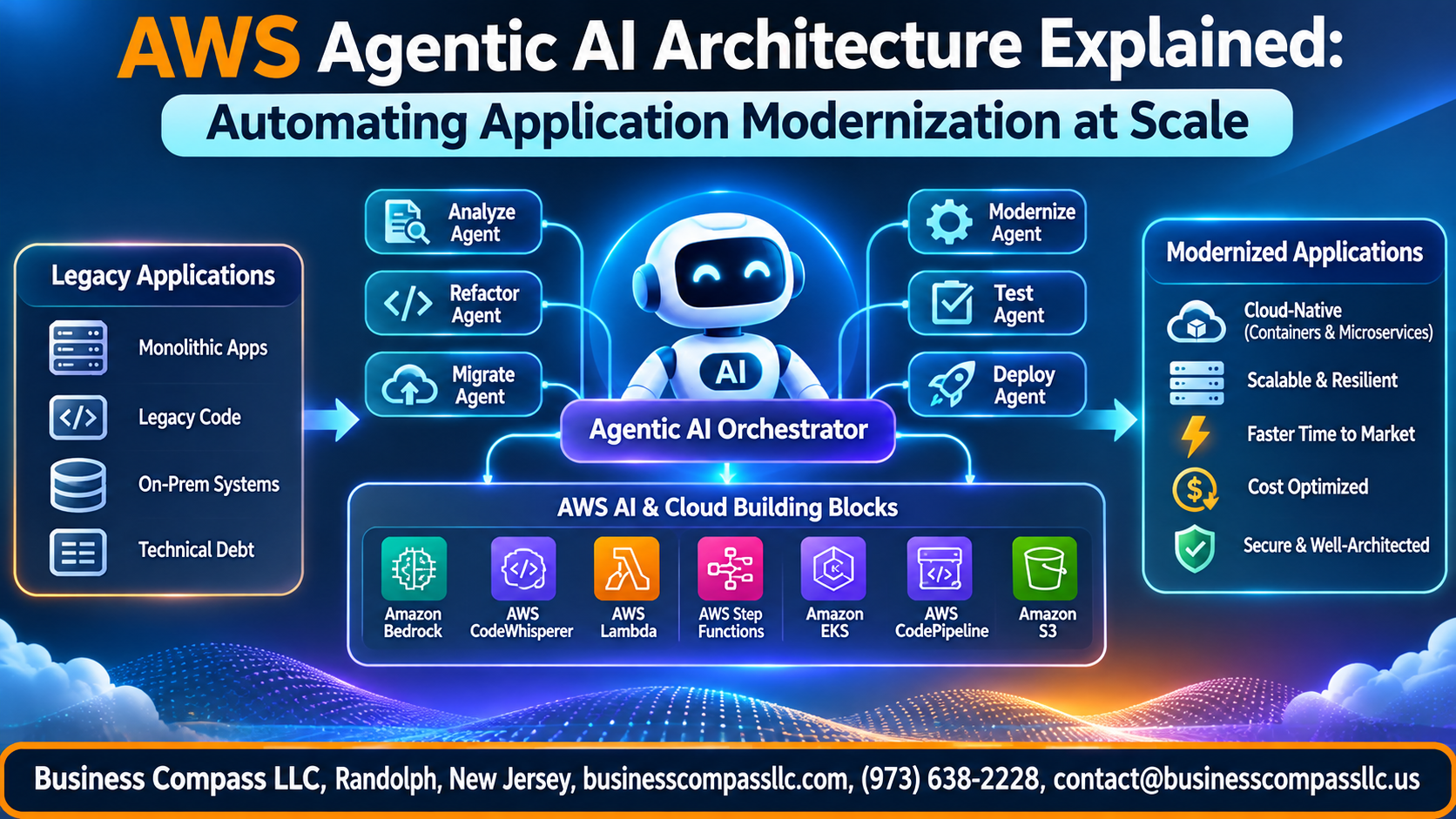
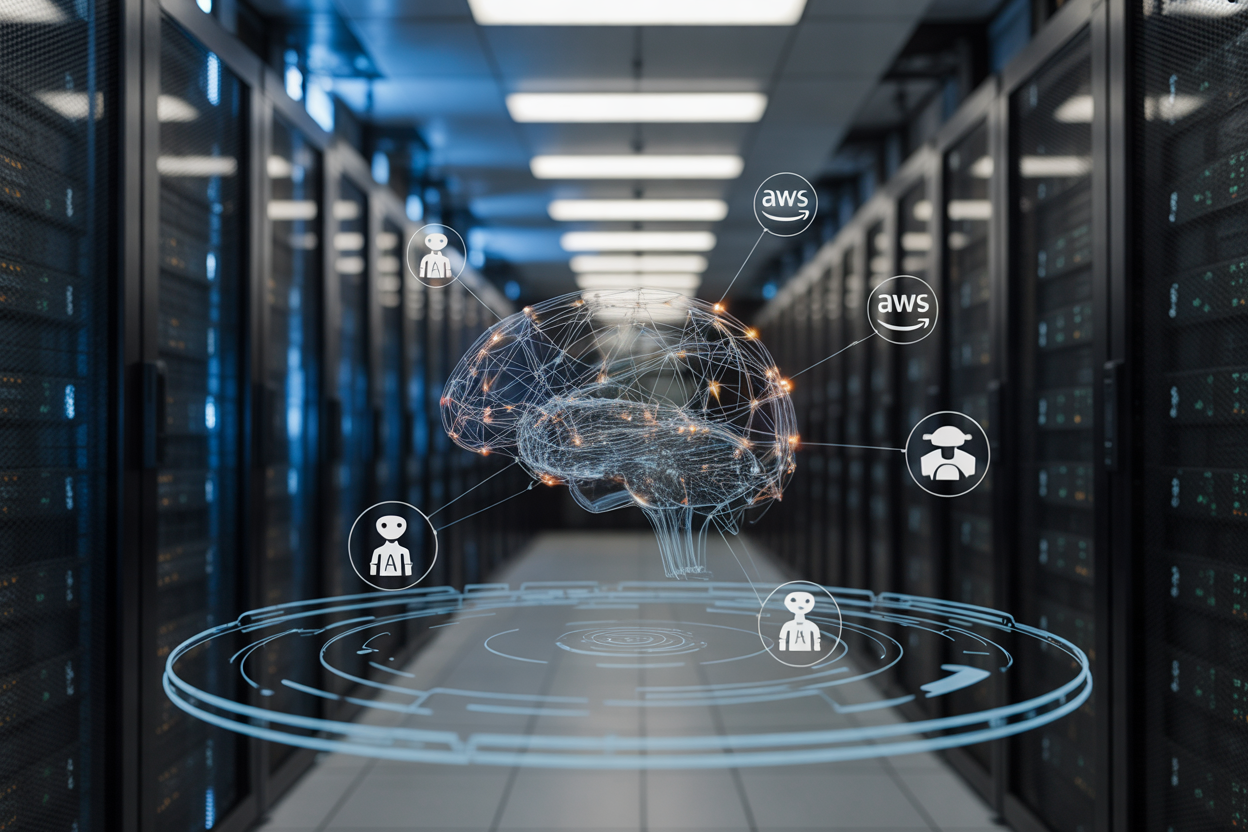
AWS Agentic AI combines Amazon Bedrock, Lambda, and Step Functions to build autonomous AI agents that plan, reason, and act — without constant human input. Unlike basic chatbots, these agents execute multi-step workflows, making AWS application modernization faster and smarter at enterprise scale.
Core AWS Services That Power Agentic AI Architectures

Amazon Bedrock as the Foundation for Intelligent Agents
AWS Agentic AI runs on Amazon Bedrock, giving agents access to powerful foundation models. Paired with AWS Lambda and Step Functions for workflow orchestration, Amazon CodeWhisperer for code generation, and Amazon Q for modernization guidance, these services together build a truly scalable agentic AI architecture on AWS.
How Agentic AI Automates Application Modernization at Scale

Automated Code Analysis and Legacy System Discovery
AWS Agentic AI scans legacy codebases, flags dependencies, and maps technical debt automatically — cutting discovery time from weeks to hours.
Intelligent Refactoring and Cloud-Native Migration Planning
AI agents generate refactoring roadmaps, prioritizing workloads for containerization or serverless migration based on complexity and business impact.
Continuous Testing and Quality Assurance Through AI Agents
Agents run automated regression tests, catch breaking changes instantly.
Self-Healing Pipelines That Reduce Human Intervention
Pipelines detect failures and auto-remediate without tickets.
Designing a Scalable Agentic AI Architecture on AWS

Multi-Agent Collaboration Patterns for Complex Modernization Tasks
Scalable AWS Agentic AI works best when specialized agents handle distinct tasks—one refactors code, another runs tests, another manages deployments—coordinating through Amazon Bedrock’s multi-agent framework, keeping workflows clean and parallel execution fast across large enterprise modernization projects.
Overcoming Key Challenges in Agentic AI Deployments

A. Managing Hallucinations and Ensuring Reliable Agent Outputs
Ground agents in verified data sources using RAG pipelines.
B. Securing Agentic Workflows With IAM and Least-Privilege Access
Assign scoped IAM roles per agent task.
C. Controlling Costs as Agent Usage Scales
Set token budgets and monitor API call frequency.
D. Building Human-in-the-Loop Checkpoints
Flag high-risk decisions for human review before execution.
E. Monitoring With Amazon CloudWatch
Track agent latency, errors, and retry rates in real time.
Real-World Use Cases Proving the Value of AWS Agentic AI

Modernizing Monolithic Applications Into Microservices Automatically
Accelerating Database Migration With Intelligent Schema Conversion
Streamlining DevOps Pipelines Through Autonomous Agent Collaboration
AWS Agentic AI use cases deliver measurable results across enterprises:
- Legacy decomposition: AI agents analyze codebases and split monoliths into microservices autonomously
- Schema conversion: Agents map, convert, and validate database schemas during migration
- DevOps automation: Collaborative agents handle testing, deployment, and rollback without human intervention

AWS Agentic AI is changing how enterprises think about application modernization. Instead of relying on manual processes and fragmented workflows, businesses can now build intelligent systems that reason, plan, and act autonomously across complex environments. From the core AWS services that power these architectures to the real-world use cases proving their value, one thing is clear — agentic AI is not just a buzzword. It is a practical path to scaling modernization efforts faster and with far less friction.
If your organization is still modernizing applications the old-fashioned way, now is a great time to explore what AWS Agentic AI can do for you. Start small, pick a high-impact use case, and build from there. The architecture is flexible enough to grow with your needs, and the payoff — faster delivery, smarter automation, and reduced technical debt — is well worth the investment. The enterprises already using this approach are not waiting around, and neither should you.