Building Reliable AI Agents: From LLM Reasoning to Real-World Actions
AI agents are moving fast — from research demos to systems that actually get work done. But building reliable AI agents that hold up in production? That’s where most teams hit a wall.
This guide is for developers, ML engineers, and technical product builders who want to move beyond basic chatbot setups and build autonomous AI agents that reason, act, and scale. If you’re already comfortable with large language models and want to understand how to string them into something that works in the real world, you’re in the right place.
Here’s what we’ll walk through:
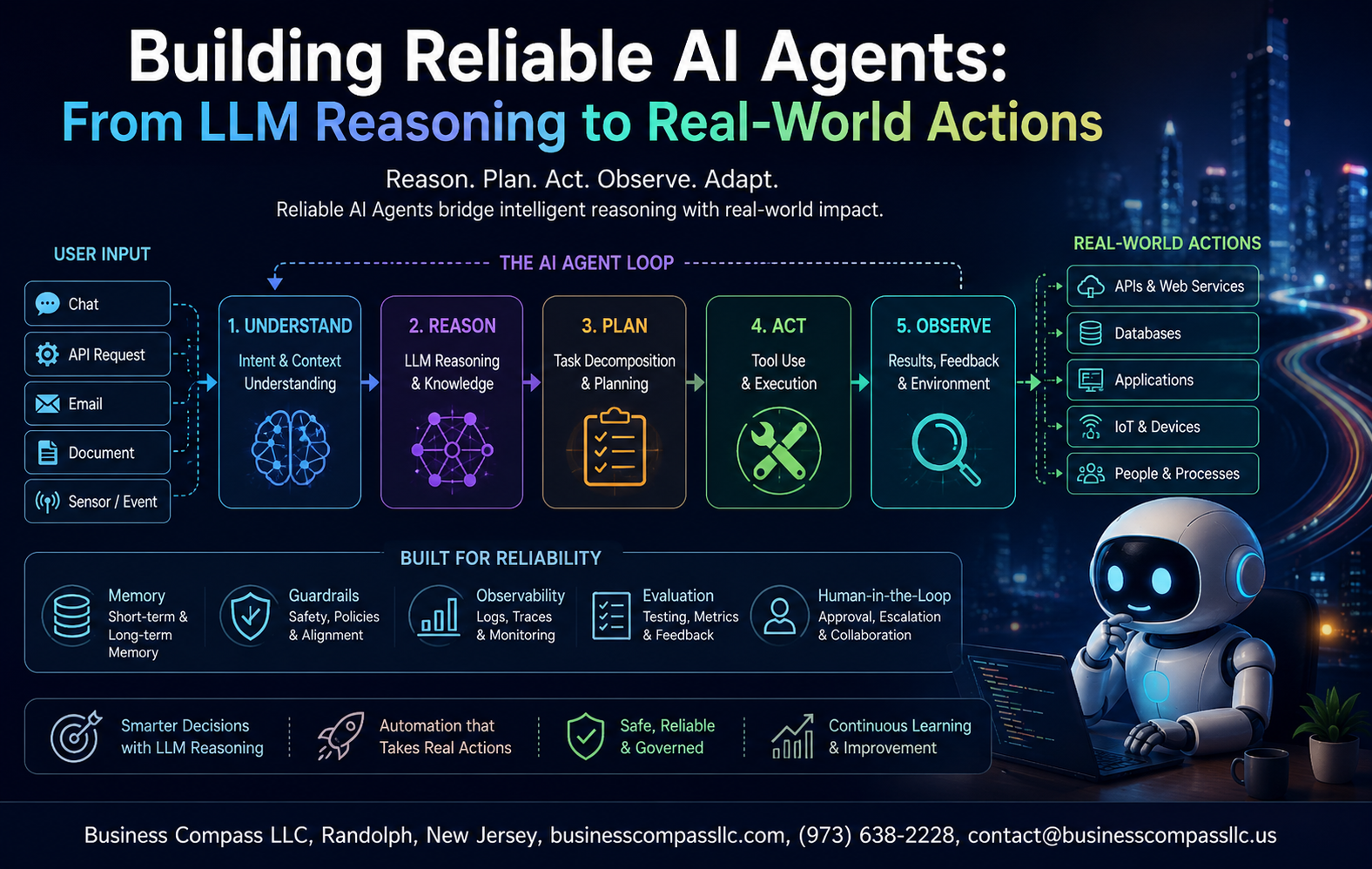
- How AI agent architecture actually works — the core components that make an agent tick, including memory, tools, and the LLM reasoning pipeline that connects them
- Connecting agents to real-world tools and systems — because an agent that can’t take action is just a fancy chatbot
- Scaling AI agents from prototype to production — where reliability, trust, and performance under pressure become the real challenges
No fluff, no hand-waving. Just a clear breakdown of what it takes to build production AI systems that do what you actually need them to do.
Understanding the Core Components of AI Agents

How LLMs Serve as the Reasoning Engine Behind Agent Behavior
LLMs don’t just generate text—they decide what to do next, making them the brain of any AI agent.
Key Differences Between Simple LLM Calls and Full Agent Systems
- Single LLM calls: one input, one output
- Agents: multi-step reasoning, tool use, memory
Essential Building Blocks Every Reliable AI Agent Needs
- Reasoning engine (LLM)
- Tools for real-world actions
- Memory for context retention
Designing Effective Reasoning Pipelines for AI Agents

Choosing the Right Reasoning Framework
Pick ReAct for tool-heavy tasks, Chain-of-Thought for complex logic.
Chain-of-Thought Prompting
Breaking problems into steps cuts errors dramatically in your LLM reasoning pipeline.
Speed vs. Accuracy
- Cache repeated reasoning steps
- Route simple queries to faster models
Avoiding Reasoning Failures
Validate outputs; hallucinations silently break autonomous AI agents.
Connecting AI Agents to Real-World Tools and Systems

How Tool Use Expands What AI Agents Can Actually Accomplish
Real-world AI automation only clicks when agents can act beyond text generation—browsing the web, running code, querying databases.
Best Practices for Integrating APIs and External Data Sources
- Validate inputs before every call
- Handle failures gracefully with retries
Keeping Tool Calls Safe, Scoped, and Auditable
Log everything. Restrict permissions tightly.
Managing Memory and Context for Smarter Agent Performance

Short-Term vs Long-Term Memory and When to Use Each
Effective AI agent memory management separates great agents from frustrating ones. Short-term memory handles active conversation context; long-term memory stores persistent knowledge across sessions. Use retrieval-augmented generation to surface relevant facts without overwhelming your LLM reasoning pipeline, keeping multi-turn task completion accurate and scalable AI agent development practical.
Building Trust and Reliability Into Agent Behavior

Why Human-in-the-Loop Checkpoints Reduce Costly Agent Errors
Catching mistakes before they spiral saves time and money. Pause points let humans review high-stakes decisions.
Implementing Guardrails That Prevent Harmful or Unintended Actions
- Block unauthorized actions
- Filter dangerous outputs
How to Test and Benchmark Agent Reliability Before Deployment
Simulate edge cases early using real-world scenarios to stress-test your building reliable AI agents pipeline before going live.
Scaling AI Agents From Prototype to Production

Infrastructure Choices That Determine Long-Term Agent Stability
Scalable AI agents need containerized deployments, async task queues, and redundant API connections.
Monitoring Agent Performance and Catching Failures Early
- Track token usage, latency, and tool-call failure rates.
Strategies for Handling Edge Cases
Graceful fallbacks prevent cascading failures in production AI systems.
Iterating Based on Real-World Feedback
Log everything; user behavior reveals gaps fast.

Building reliable AI agents isn’t just about picking the right model or writing clever prompts. It’s about thoughtfully combining reasoning pipelines, memory systems, real-world tool connections, and trust mechanisms into something that actually holds up when it matters. Each layer — from how your agent thinks through a problem to how it remembers past interactions — plays a direct role in whether your agent delivers consistent, dependable results or falls apart under real-world pressure.
The jump from prototype to production is where most teams hit unexpected walls, but it’s also where all the foundational work pays off. If you’ve built with reliability in mind from the start — clear reasoning flows, solid memory management, and guardrails that keep agent behavior predictable — scaling becomes a much smoother ride. Start small, test hard, and keep refining. The best AI agents aren’t built overnight, but with the right approach, they’re absolutely within reach.