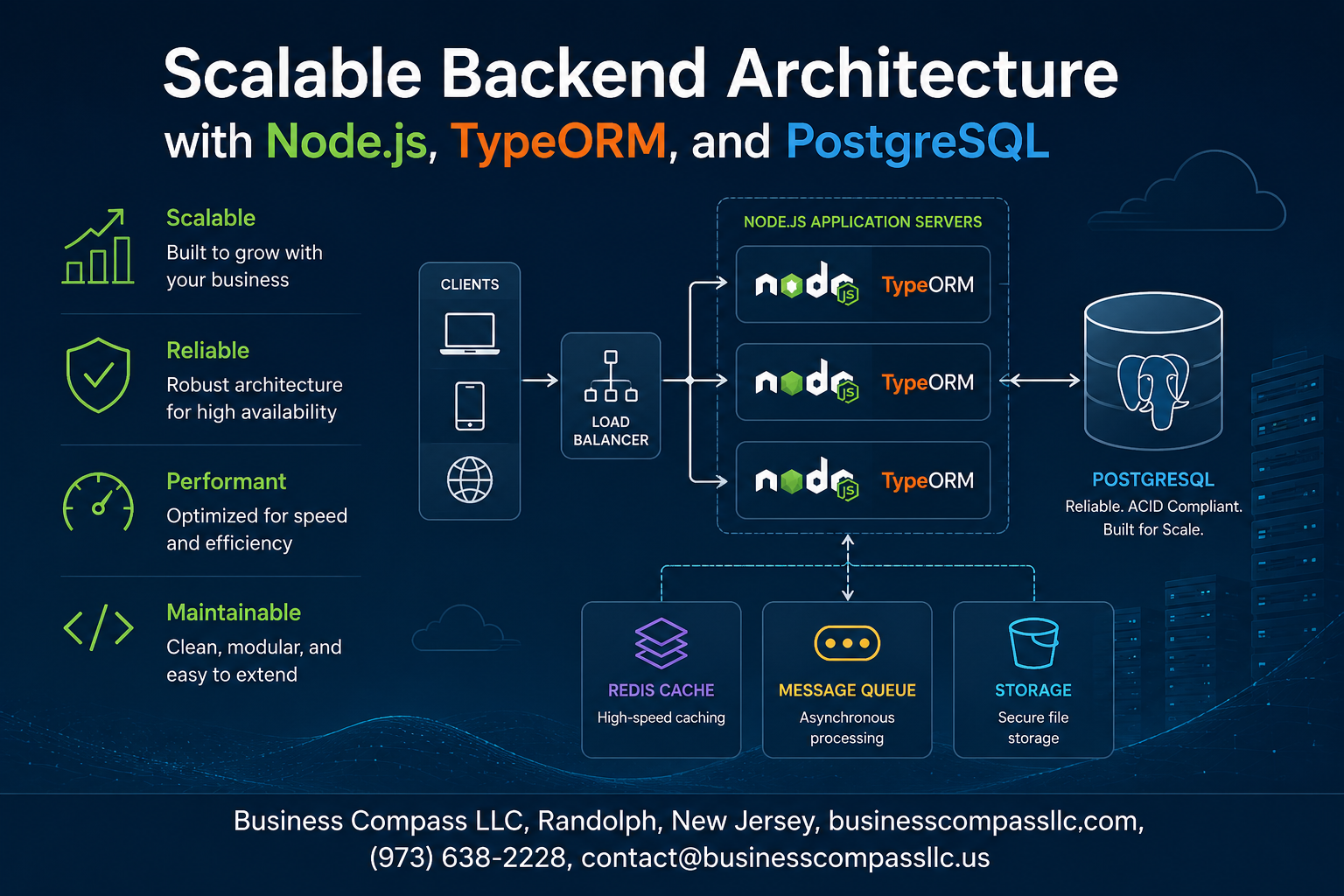
Building scalable backend architecture with Node.js, TypeORM, and PostgreSQL is essential for developers creating high-performance web applications that need to handle growing user loads without breaking. This comprehensive guide targets backend developers, full-stack engineers, and engineering teams who want to build robust systems that scale smoothly from startup to enterprise levels.
You’ll learn how to set up a solid foundation for maximum performance using TypeScript backend development practices that prevent common pitfalls. We’ll explore database architecture patterns that grow with your business, showing you how to design PostgreSQL schemas and TypeORM relationships that handle millions of records efficiently.
The guide covers building robust API layers for seamless integration, including RESTful API development techniques and Node.js microservices patterns that keep your codebase maintainable. We’ll dive deep into advanced query optimization methods that boost PostgreSQL performance and teach you deployment strategies that ensure zero downtime when pushing updates to production.
By the end, you’ll have a complete blueprint for creating backend scalability patterns that support real-world traffic while maintaining code quality and system reliability.
Foundation Setup for Maximum Performance

Configure Node.js environment for enterprise-grade scalability
Building a scalable Node.js backend architecture starts with proper environment configuration. Set up Node.js with the latest LTS version and configure clustering to maximize CPU utilization across multiple cores. Use PM2 for process management and implement environment-specific configurations through dotenv files. Configure memory limits, garbage collection settings, and enable worker threads for CPU-intensive operations to handle enterprise-level traffic efficiently.
Install and optimize TypeORM for seamless database operations
TypeORM database integration requires careful setup for optimal performance. Install TypeORM with PostgreSQL driver and configure connection pooling with appropriate pool sizes based on your expected load. Set up entity decorators with proper indexing strategies and enable query logging in development. Configure migrations for database schema management and implement repository patterns for clean data access layers that support complex business logic.
Set up PostgreSQL with performance-tuned configurations
PostgreSQL performance optimization begins with proper configuration tuning. Adjust shared_buffers to 25% of available RAM, set work_mem appropriately for your query complexity, and configure effective_cache_size. Enable query planning optimizations through proper statistics collection and implement connection pooling with pgBouncer. Create appropriate indexes on frequently queried columns and set up read replicas for scaling read operations across your scalable web applications.
Establish development workflow for rapid deployment
Development workflow optimization accelerates deployment cycles significantly. Set up automated testing with Jest and implement continuous integration pipelines using GitHub Actions or Jenkins. Configure Docker containers for consistent development environments and implement database seeding scripts for quick local setup. Use TypeScript backend development practices with strict type checking and establish code review processes that maintain code quality while enabling rapid iteration cycles.
Database Architecture That Grows With Your Business

Design normalized schemas that eliminate bottlenecks
A well-structured PostgreSQL schema forms the backbone of any scalable Node.js backend architecture. Start by implementing third normal form (3NF) to eliminate redundant data while maintaining referential integrity through foreign key relationships. Create separate entities for users, orders, products, and categories with clear one-to-many and many-to-many relationships. Use TypeORM entities to map these relationships directly in your TypeScript code, enabling type safety and automated migrations. Consider denormalization only for read-heavy operations where query performance significantly outweighs storage costs. Design your schema with future growth in mind by avoiding overly complex nested JSON fields that become difficult to query efficiently as data volumes increase.
Implement efficient indexing strategies for lightning-fast queries
Strategic indexing transforms your PostgreSQL performance from sluggish to lightning-fast. Create composite indexes on frequently queried column combinations, especially for WHERE clauses that filter on multiple fields simultaneously. Index foreign keys to accelerate JOIN operations between related tables. Use partial indexes for conditional queries that target specific subsets of data, reducing index size and maintenance overhead. Monitor query execution plans using EXPLAIN ANALYZE to identify missing indexes and remove unused ones that slow down INSERT and UPDATE operations. TypeORM’s synchronize feature automatically creates basic indexes, but custom indexes require manual configuration in your migration files for optimal database query optimization.
Configure connection pooling for optimal resource management
Connection pooling prevents your Node.js application from overwhelming PostgreSQL with excessive connections while maintaining responsive performance. Configure TypeORM’s connection pool with minimum and maximum connection limits based on your server’s CPU cores and expected concurrent users. Set appropriate idle timeouts to close unused connections and prevent connection leaks. Use separate connection pools for read-heavy operations versus write operations to distribute load effectively. Monitor connection pool metrics through your application logs to identify bottlenecks before they impact user experience. A properly configured pool typically maintains 2-4 connections per CPU core, with higher limits for applications handling many concurrent requests in your scalable web applications infrastructure.
Building Robust API Layers for Seamless Integration

Structure modular controllers that enhance maintainability
Breaking down your Node.js backend architecture into modular controllers transforms complex applications into manageable components. Each controller handles specific business logic, making debugging and feature additions straightforward. TypeScript interfaces define clear contracts between controllers, while dependency injection patterns enable seamless testing and code reuse across your scalable web applications.
Implement middleware for security and error handling
Security middleware acts as your application’s first line of defense, validating authentication tokens and sanitizing incoming requests before they reach your controllers. Error handling middleware catches exceptions gracefully, returning consistent API responses while logging critical issues for monitoring. Rate limiting and CORS middleware protect against common attacks, ensuring your RESTful API development remains secure at scale.
Design RESTful endpoints that scale effortlessly
Well-designed REST endpoints follow consistent naming conventions and HTTP methods that developers intuitively understand. Resource-based URLs with proper status codes create predictable interfaces that frontend teams can rely on. Implementing pagination, filtering, and sorting parameters early prevents performance bottlenecks as your user base grows, while versioning strategies protect existing integrations during API evolution.
Add input validation that prevents costly errors
Input validation middleware intercepts malformed requests before they corrupt your database or crash your application. Schema validation using libraries like Joi or class-validator ensures data integrity while providing clear error messages to API consumers. Type-safe validation with TypeScript backend development catches errors during compilation, reducing runtime failures and improving overall application reliability in production environments.
Advanced Query Optimization Techniques

Master TypeORM query builder for complex data operations
TypeORM’s query builder transforms complex database operations into maintainable code that scales with your Node.js backend architecture. Instead of wrestling with raw SQL, you can chain methods like .leftJoinAndSelect() and .where() to build sophisticated queries while maintaining TypeScript safety. The real power emerges when handling dynamic filtering, pagination, and aggregate functions across multiple table relationships. Smart developers leverage .subQuery() for complex conditional logic and .getRawAndEntities() when you need both computed values and entity objects. This approach keeps your PostgreSQL performance optimization goals aligned with clean, readable code that junior developers can understand and maintain.
Implement caching strategies that reduce database load
Redis integration with TypeORM creates a bulletproof caching layer that dramatically reduces database hits in scalable web applications. Start with query result caching using .cache(true, 60000) on frequently accessed data, then graduate to application-level caching for user sessions and computed results. The magic happens when you implement cache invalidation strategies—use Redis pub/sub to broadcast changes across microservices, ensuring data consistency. Smart cache keys based on entity versions prevent stale data while TTL settings handle automatic cleanup. Memory-efficient JSON serialization combined with compression reduces bandwidth costs and improves response times for your TypeScript backend development workflow.
Optimize N+1 query problems for superior performance
N+1 problems silently destroy database query optimization efforts, turning simple data fetches into performance nightmares. TypeORM’s eager loading with .relations() or query builder’s .leftJoinAndSelect() eliminates redundant database calls by fetching related data in single queries. DataLoader pattern implementation creates batching mechanisms that collect multiple requests and execute them together, perfect for GraphQL endpoints. The key lies in profiling your queries using PostgreSQL’s EXPLAIN ANALYZE and TypeORM’s logging to identify problematic patterns. Selective field loading with .select() reduces memory usage while strategic use of .lazy() relations handles rarely accessed data without performance penalties.
Deployment Strategies That Ensure Zero Downtime

Configure Docker containers for consistent environments
Docker containers transform your Node.js backend architecture by packaging your application with all dependencies into lightweight, portable units. Create a multi-stage Dockerfile that separates build and runtime environments, reducing image size and security vulnerabilities. Use docker-compose to orchestrate PostgreSQL databases, TypeORM connections, and Node.js services across development, staging, and production environments. Environment-specific configuration files ensure consistent behavior while allowing customization for different deployment targets. Container registries like Docker Hub or AWS ECR store versioned images, enabling rollbacks and deployment consistency across your infrastructure.
Implement load balancing for high availability
Load balancers distribute incoming requests across multiple Node.js instances, preventing single points of failure and maximizing resource utilization. NGINX or HAProxy can route traffic based on various algorithms like round-robin, least connections, or weighted distribution. Configure health checks that automatically remove unhealthy instances from the pool, ensuring requests only reach responsive servers. Session affinity or stateless design patterns work with TypeORM connection pooling to maintain database performance. Auto-scaling groups behind load balancers dynamically adjust capacity based on traffic patterns, handling sudden spikes in user demand without manual intervention.
Set up monitoring and logging for proactive maintenance
Comprehensive monitoring catches performance issues before they impact users, using tools like Prometheus, Grafana, and New Relic to track Node.js metrics, PostgreSQL query performance, and TypeORM connection health. Structured logging with Winston or Bunyan captures request traces, error stack traces, and business logic events in JSON format. Centralized log aggregation through ELK stack or CloudWatch enables powerful search and alerting capabilities. Database monitoring tracks slow queries, connection pool usage, and replication lag. Real-time alerts notify teams about memory leaks, high CPU usage, database deadlocks, or API response time degradation.
Establish backup and recovery procedures for data protection
PostgreSQL backup strategies include automated daily dumps, continuous archiving with WAL-E or Barman, and point-in-time recovery capabilities. Multi-region replication protects against datacenter failures while read replicas distribute query load away from primary databases. Test restoration procedures regularly using isolated environments to verify backup integrity and recovery time objectives. Database schema migrations through TypeORM should be reversible and tested in staging environments. File-based backups complement database backups by preserving uploaded assets, configuration files, and application logs in versioned storage systems like AWS S3.
Deploy with CI/CD pipelines for automated releases
CI/CD pipelines automate the entire deployment process from code commit to production release, using tools like GitHub Actions, GitLab CI, or Jenkins to build, test, and deploy Node.js applications. Pipeline stages include TypeScript compilation, unit tests, integration tests against PostgreSQL, Docker image building, and security scanning. Blue-green deployments eliminate downtime by maintaining parallel production environments, switching traffic only after successful health checks. Rolling deployments gradually replace instances while monitoring application metrics and database connections. Feature flags allow safe deployment of incomplete features, while automated rollback triggers protect against deployment failures or performance regressions.

Building a scalable backend doesn’t have to be overwhelming when you break it down into these core components. The combination of Node.js, TypeORM, and PostgreSQL gives you a solid foundation that can handle growth from day one. Setting up your database architecture correctly, creating well-structured API layers, and optimizing your queries early will save you countless headaches down the road.
The real game-changer comes when you implement smart deployment strategies that keep your application running smoothly even during updates. Start with these fundamentals, test your setup under load, and gradually add complexity as your user base grows. Your future self will thank you for taking the time to build it right from the beginning.