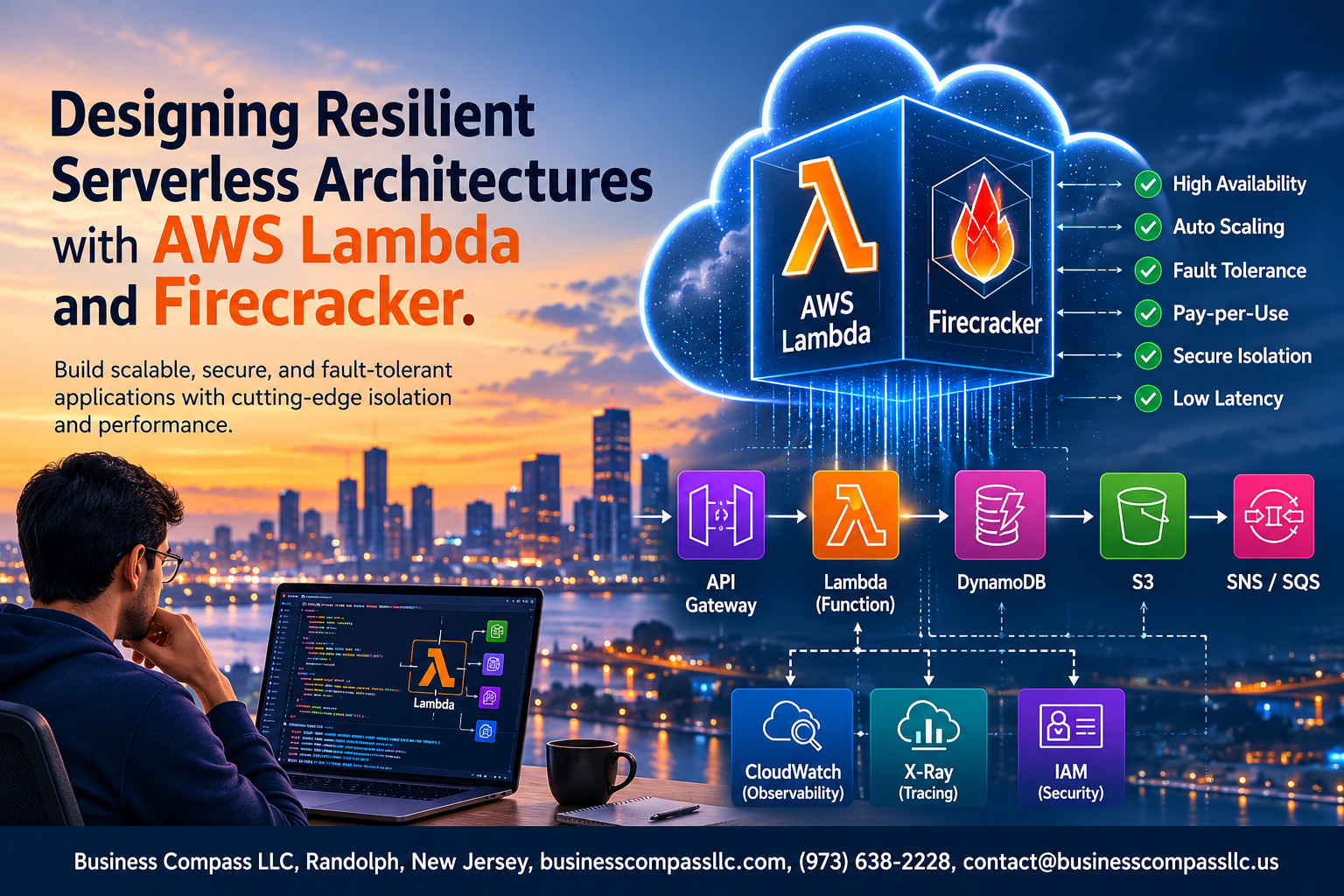
Designing Resilient Serverless Architectures with AWS Lambda and Firecracker
Serverless sounds simple until something breaks in production at 2 AM. If you’re a cloud architect, backend engineer, or DevOps engineer building serious workloads on AWS, you already know that dropping functions into Lambda doesn’t automatically make your system resilient, secure, or observable.
This guide is for teams who’ve moved past the “hello world” stage and want to build serverless architecture best practices into everything — from how AWS Lambda handles failures to how Firecracker MicroVM isolation keeps your workloads lean and secure.
Here’s what we’re covering:
- How Firecracker Lambda isolation actually works and why it matters for performance and security
- Building fault-tolerant serverless functions that recover gracefully instead of silently failing
- Serverless observability and monitoring strategies that give you real visibility into what’s happening inside your architecture
No fluff — just the patterns and decisions that separate a shaky serverless setup from a resilient cloud architecture design that holds up under real pressure.
Understanding the Foundation of Serverless Resilience

Why Traditional Architectures Fall Short in Serverless Environments
Monolithic and even microservice-based systems were built around the assumption that servers are always running, always warm, and always predictable. When you drop that model and move to serverless, those assumptions collapse fast. Cold starts, stateless execution, shared infrastructure, and unpredictable traffic spikes expose weaknesses that traditional resilience patterns simply weren’t designed to handle. A load balancer and a few redundant EC2 instances won’t save you when your Lambda function times out under a sudden burst of concurrent requests or when noisy neighbors on shared infrastructure quietly degrade your performance.
Key Resilience Principles Every Serverless Architect Must Know
AWS Lambda resilience starts with a mindset shift — you’re not managing servers, but you are absolutely responsible for what happens inside each function invocation. Design every function to be stateless and idempotent, so retries don’t create duplicate side effects. Lean on dead-letter queues and destinations to catch failed invocations before they disappear silently. Set concurrency limits deliberately to protect downstream services from getting hammered. Implement retry logic with exponential backoff and jitter at every integration point. These aren’t optional nice-to-haves; they’re the baseline for any resilient cloud architecture design in a serverless world.
How AWS Lambda and Firecracker Work Together to Boost Reliability
Firecracker MicroVM performance is the quiet engine behind Lambda’s ability to run thousands of concurrent workloads safely. Each function runs inside its own lightweight MicroVM, which boots in under 125 milliseconds and provides hardware-level isolation without the overhead of traditional VMs. This Firecracker Lambda isolation means one tenant’s runaway process can’t bleed into another’s execution environment, dramatically reducing the blast radius of failures. The combination of Lambda’s managed scaling with Firecracker’s strong security boundaries gives you a foundation where fault-tolerant serverless functions can run at scale without sacrificing speed or safety.
Leveraging Firecracker MicroVMs for Stronger Isolation and Performance

What Makes Firecracker MicroVMs Superior to Traditional Containers
Firecracker MicroVMs sit in a sweet spot between full virtual machines and traditional containers. Unlike containers that share a host kernel — creating potential security gaps — Firecracker spins up a dedicated, minimal kernel per workload in under 125 milliseconds. This kernel-level separation means one noisy or compromised function can’t bleed into another tenant’s environment, which is exactly what you want in multi-tenant serverless infrastructure. AWS built Firecracker specifically for Lambda and Fargate, stripping away everything a VM doesn’t need — no BIOS emulation, no legacy device drivers, no unnecessary overhead — leaving a lean virtualization layer that’s faster and safer than anything a standard container runtime offers. The result is Firecracker Lambda isolation that punches well above its weight class without the bloat.
Achieving Faster Cold Starts Without Sacrificing Security
Cold starts are the classic serverless headache, and Firecracker attacks this problem directly by keeping the MicroVM boot process brutally simple. The VMM (Virtual Machine Monitor) is written in Rust, which means memory safety is baked in at the language level — no garbage collector pausing execution, no runtime surprises. Firecracker boots a MicroVM in roughly 125ms with a memory footprint as small as 5MB, meaning AWS Lambda can pre-warm pools of these tiny VMs and snap a function into one almost instantly. You get Firecracker MicroVM performance that feels like a container but carries the security posture of a full VM. Snapshotting is another trick here — Firecracker can save a MicroVM’s memory state mid-initialization and restore it later, dramatically cutting the time a function spends getting ready to handle traffic.
Reducing Blast Radius Through Lightweight Virtualization
When something goes wrong in a serverless environment — and it will — the question isn’t just what broke, it’s how much broke. Firecracker shrinks that answer significantly. Each Lambda function execution runs inside its own isolated MicroVM, which acts as a hard boundary. A memory corruption bug, an infinite loop, or even a supply-chain attack embedded in a dependency stays trapped inside that single MicroVM. It can’t touch adjacent workloads, escalate privileges across tenant boundaries, or persist beyond the function’s lifecycle. This is resilient cloud architecture design in practice — engineering the system so that individual failures stay local rather than cascading. The isolation model also means AWS can pack thousands of MicroVMs onto a single host without one function’s bad behavior tanking everyone else’s performance.
Optimizing Resource Utilization Across High-Traffic Workloads
Firecracker’s design is genuinely clever when it comes to resource efficiency. Because each MicroVM is so lightweight, AWS can run thousands of them on the same physical host without the overhead you’d normally see with traditional hypervisors. Memory is allocated only for what the function actually needs, and unused memory gets reclaimed fast. For AWS Lambda scalability under heavy traffic, this matters a lot — the platform can spin up hundreds of concurrent MicroVMs across a fleet almost instantly, giving your functions the headroom to scale without the provisioning delays you’d hit with heavier virtualization. Firecracker also supports memory ballooning, letting the host dynamically reclaim unused guest memory and redistribute it to other workloads in real time. That kind of tight resource control is what lets serverless platforms stay cost-efficient even when traffic patterns are spiky and unpredictable.
Building Fault-Tolerant AWS Lambda Functions

Designing Stateless Functions That Recover Gracefully from Failure
Keeping your Lambda functions stateless is one of the smartest moves you can make for AWS Lambda resilience. When a function holds no memory of past executions, any new invocation starts clean, meaning a crashed instance never poisons the next run. Store session data in DynamoDB or ElastiCache instead, and your fault-tolerant serverless functions bounce back without missing a beat.
Implementing Retry Logic and Dead-Letter Queues for Error Handling
AWS Lambda automatically retries asynchronous invocations twice on failure, but pairing that with a Dead-Letter Queue (DLQ) backed by SQS or SNS gives failed events a safe landing spot rather than silent data loss. Tuning your retry intervals and maximum attempts lets you handle transient errors gracefully while keeping downstream services from getting hammered, a core serverless architecture best practice worth building in from day one.
Using AWS Lambda Destinations to Manage Asynchronous Failures
Lambda Destinations take error handling a step further by routing both successful and failed invocation results to targets like SQS, SNS, EventBridge, or another Lambda function automatically. Unlike DLQs that only catch failures, Destinations give you full visibility into both outcomes, making it far easier to trigger compensating workflows, alert on failures, and build truly resilient cloud architecture design without bolting on extra glue code.
Architecting for High Availability and Scalability

Distributing Workloads Across Multiple Availability Zones
Spreading your AWS Lambda functions across multiple Availability Zones is one of the smartest moves you can make for high availability. AWS handles a lot of this automatically, but you still need to think carefully about your downstream dependencies — databases, queues, and APIs — making sure they’re equally distributed so no single zone becomes a chokepoint.
Applying Concurrency Controls to Prevent Cascading Failures
Unchecked concurrency is a silent killer in serverless systems. When one noisy function hogs all available concurrency, every other function in your account suffers. Setting reserved concurrency limits on critical Lambda functions acts like a dedicated lane on a highway — your most important workloads keep moving even when traffic spikes unexpectedly elsewhere.
Implementing Circuit Breaker Patterns in Serverless Workflows
Serverless doesn’t mean failure-proof. When a downstream service starts misbehaving, Lambda functions will keep hammering it unless you teach them to stop. Implementing a circuit breaker — through tools like AWS Step Functions or custom logic backed by DynamoDB state tracking — gives your architecture the ability to detect trouble early and route around it gracefully before failures snowball.
Auto-Scaling Strategies That Keep Costs in Check
AWS Lambda scales automatically, but “automatic” doesn’t mean “free.” Pairing Lambda with SQS queues and event source mapping lets you control the rate at which messages are processed, smoothing out traffic spikes without surprise bills. Setting smart concurrency limits alongside provisioned concurrency for latency-sensitive paths gives you both AWS Lambda scalability and predictable spending.
Securing Your Serverless Architecture at Every Layer

Enforcing Least Privilege with IAM Roles and Policies
Every Lambda function should carry only the permissions it actually needs — nothing more. Scoping IAM roles tightly to specific resources and actions cuts the blast radius when something goes wrong, keeping your serverless security layers solid and your exposure minimal across the entire architecture.
Protecting Function Invocations with API Gateway and WAF
Pairing API Gateway with AWS WAF gives you a real defensive perimeter around your functions. You can block malicious traffic, throttle abusive callers, and enforce authentication before a single request ever reaches your Lambda code, which is a straightforward win for resilient cloud architecture design.
Detecting and Responding to Threats in Real Time
AWS GuardDuty, CloudTrail, and Security Hub work together to flag suspicious activity the moment it surfaces. Automating responses through EventBridge rules means threats get contained fast, without waiting on manual intervention, keeping your serverless architecture best practices sharp and your runtime environment genuinely trustworthy around the clock.
Monitoring, Observability, and Continuous Improvement

Gaining Full Visibility with AWS CloudWatch and X-Ray
Plugging AWS CloudWatch and X-Ray into your serverless observability stack gives you a real-time window into how your Lambda functions and Firecracker MicroVMs are actually behaving under load, catching latency spikes, cold start patterns, and error clusters before they snowball into outages that hurt your users.
Setting Up Intelligent Alerts to Catch Issues Before They Escalate
Dumb threshold alerts that fire at 90% CPU are yesterday’s approach — smart alerting means building anomaly detection rules in CloudWatch that learn your traffic baselines and ping your team when something drifts unexpectedly, cutting mean-time-to-detection dramatically across your serverless architecture.
Using Performance Metrics to Drive Ongoing Architecture Refinements
Raw metrics like invocation duration, concurrent executions, and throttle counts are your roadmap for tuning memory allocation, adjusting reserved concurrency, and deciding when a monolithic Lambda function needs breaking apart — continuously feeding those insights back into your design keeps your AWS Lambda scalability story healthy long-term.
Conducting Chaos Engineering Tests to Validate Resilience
Running controlled chaos experiments — randomly killing functions, injecting artificial latency into downstream dependencies, or simulating Firecracker MicroVM isolation failures — is the only honest way to know your fault-tolerant serverless architecture holds up when something genuinely breaks in production rather than just hoping it does.

Resilient serverless architectures don’t happen by accident. They’re built through smart decisions at every layer — from how Firecracker MicroVMs keep your functions isolated and performant, to how your Lambda functions handle failures gracefully, to how your security posture holds up under real-world pressure. Pair all of that with solid high availability design and meaningful observability practices, and you’ve got a system that can actually hold its own when things go sideways.
The good news is that AWS gives you the building blocks — you just need to put them together thoughtfully. Start by revisiting your current Lambda setup and asking where the weak points are. Are your functions fault-tolerant? Do you have the right monitoring in place to catch problems before they become outages? Small, deliberate improvements in each of these areas add up fast. Take what you’ve learned here and start hardening your architecture one layer at a time.