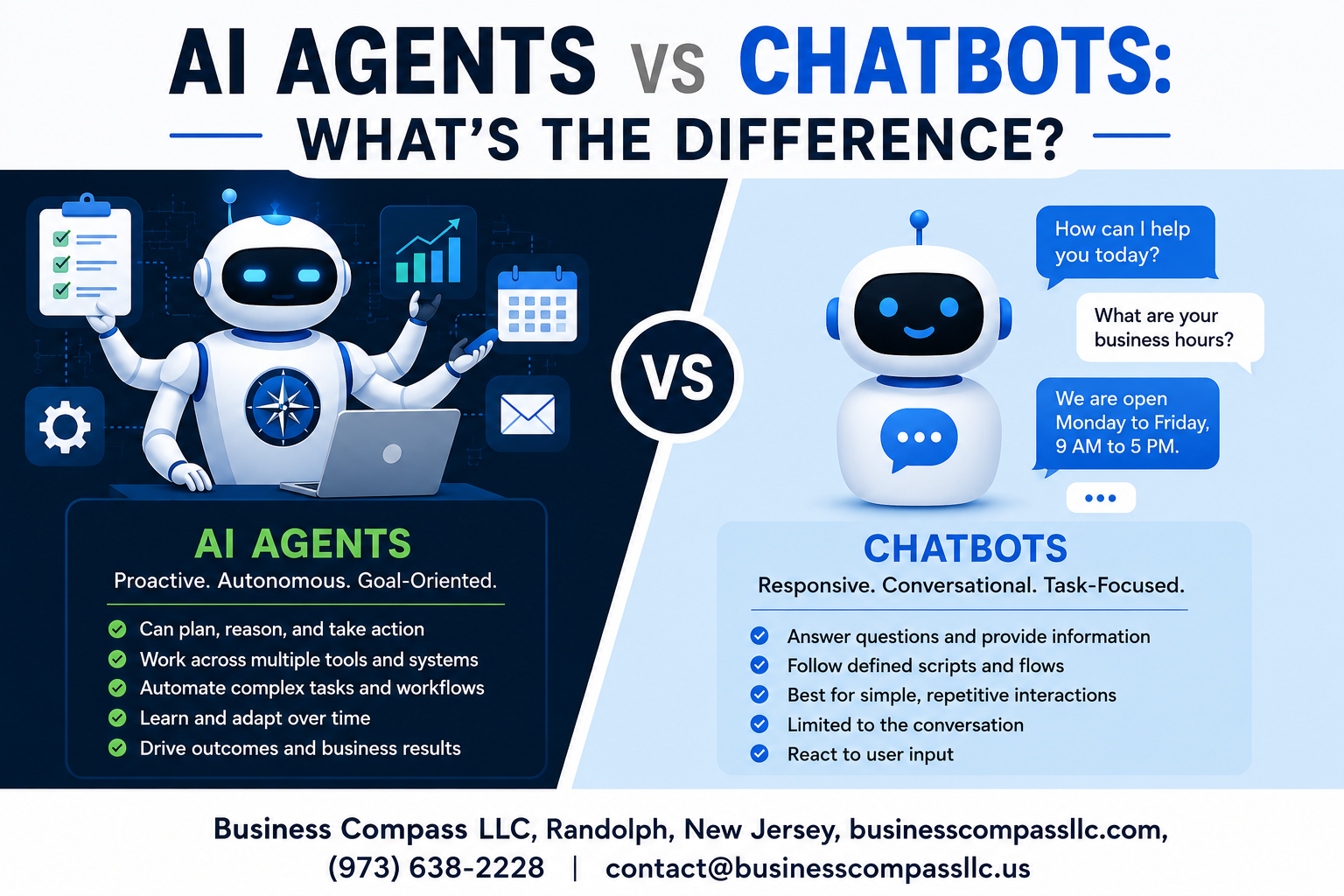
You’re probably hearing a lot about AI agents vs chatbots these days, but many business owners, IT managers, and customer service teams can’t tell the difference between AI agents and chatbots. While both use conversational AI technology, they work in completely different ways and solve different problems.
This guide is for anyone trying to decide between chatbot vs AI agent solutions for their company. We’ll break down what makes artificial intelligence agents different from basic chatbots, explore their real-world applications across industries, and help you figure out which automated customer service solution fits your budget and business goals.
We’ll cover the core functions that separate simple chatbots from intelligent virtual assistants, examine key technical differences that affect how well they perform, and walk through a practical cost-benefit analysis so you can make the right choice for your team.
Understanding Chatbots and Their Core Functions
Traditional Rule-Based Chatbot Capabilities
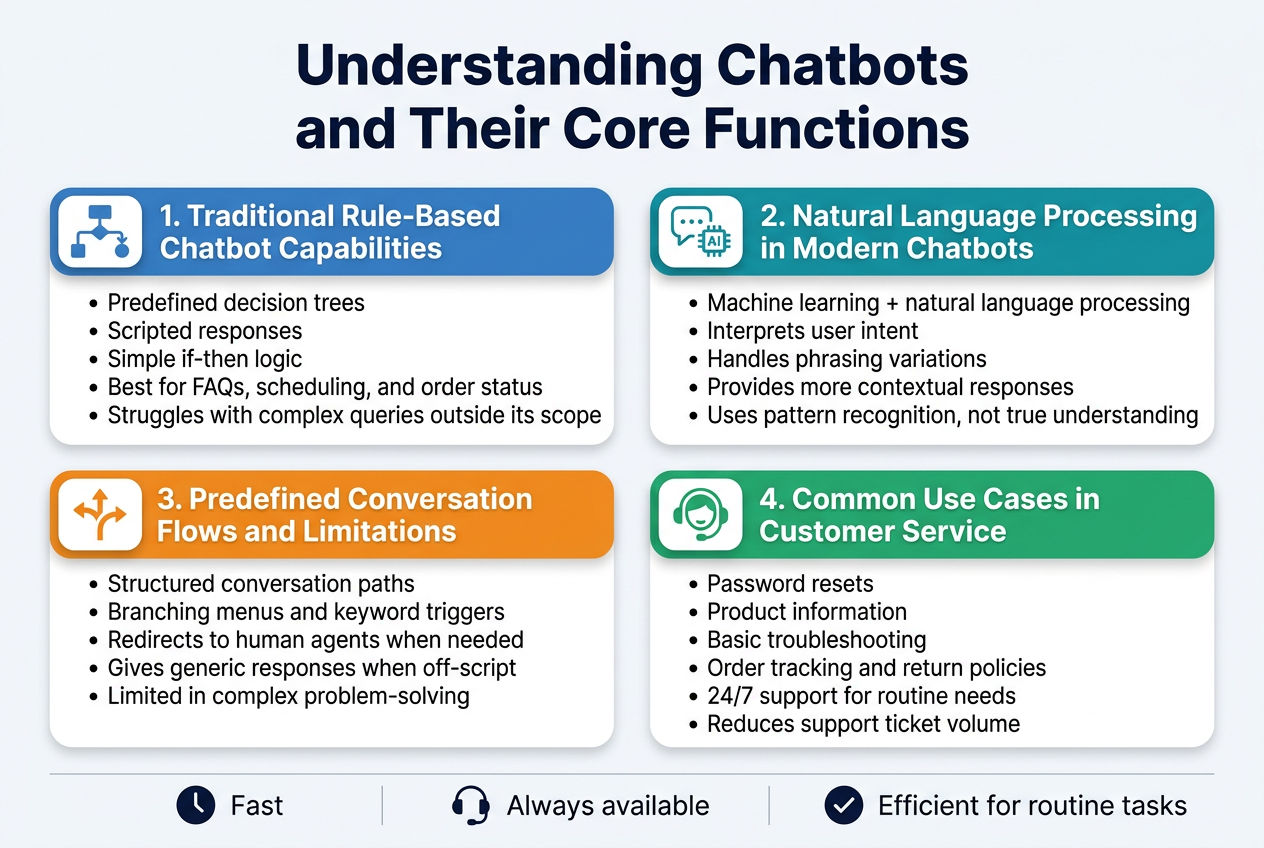
Traditional chatbots operate on predefined decision trees and scripted responses. These systems follow simple if-then logic, matching user inputs to predetermined answers. They excel at handling basic FAQs and straightforward tasks like appointment scheduling or order status inquiries. However, they struggle with complex queries outside their programmed scope.
Natural Language Processing in Modern Chatbots
Modern conversational AI technology incorporates machine learning chatbots with natural language processing capabilities. These systems can interpret user intent, handle variations in phrasing, and provide more contextual responses. While more sophisticated than rule-based systems, they still rely on pattern recognition rather than true understanding of complex business scenarios.
Predefined Conversation Flows and Limitations
Most chatbots follow structured conversation paths designed by developers. Users navigate through branching menus or keyword-triggered responses. When conversations deviate from these paths, chatbots often redirect users to human agents or provide generic responses. This limitation becomes apparent in complex problem-solving scenarios requiring creative thinking.
Common Use Cases in Customer Service
Automated customer service solutions using chatbots handle routine inquiries like password resets, product information, and basic troubleshooting. They’re particularly effective for e-commerce sites managing order tracking, return policies, and store hours. These AI chatbot implementations reduce support ticket volume and provide 24/7 availability for standard customer needs.
Exploring AI Agents and Their Advanced Capabilities
Autonomous decision-making and problem-solving
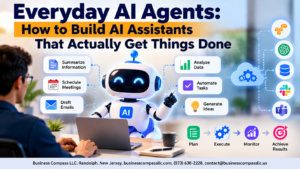
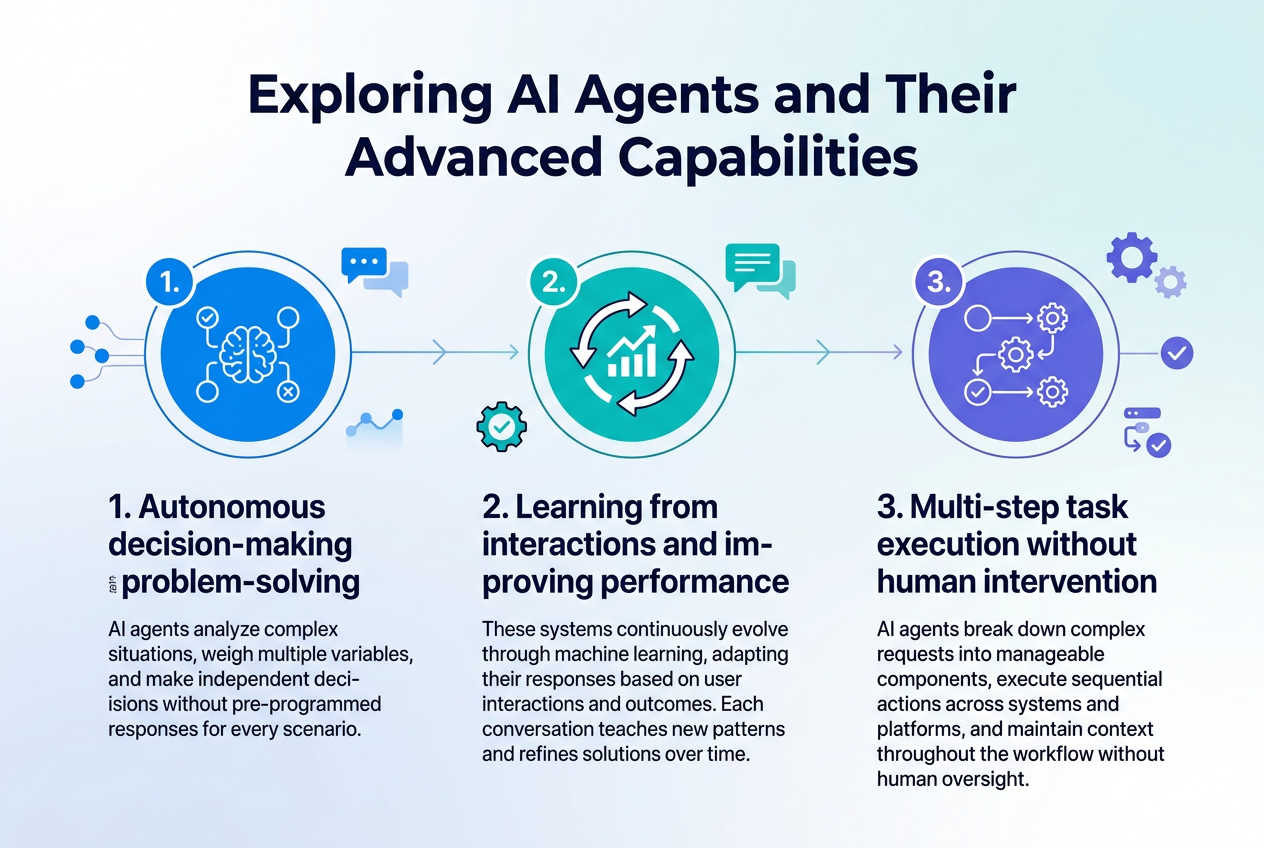
Artificial intelligence agents operate with sophisticated reasoning capabilities that set them apart from basic chatbots. Unlike their simpler counterparts, AI agents can analyze complex situations, weigh multiple variables, and make independent decisions without requiring pre-programmed responses for every scenario.
Learning from interactions and improving performance
These intelligent systems continuously evolve through machine learning algorithms, adapting their responses based on user interactions and outcomes. Each conversation teaches the AI agent new patterns, allowing it to refine its understanding and deliver increasingly accurate solutions over time.
Multi-step task execution without human intervention
AI agents excel at breaking down complex requests into manageable components, executing sequential actions across different systems and platforms. They can coordinate multiple processes, from gathering information to implementing solutions, while maintaining context throughout the entire workflow without human oversight.
Key Technical Differences That Impact Performance
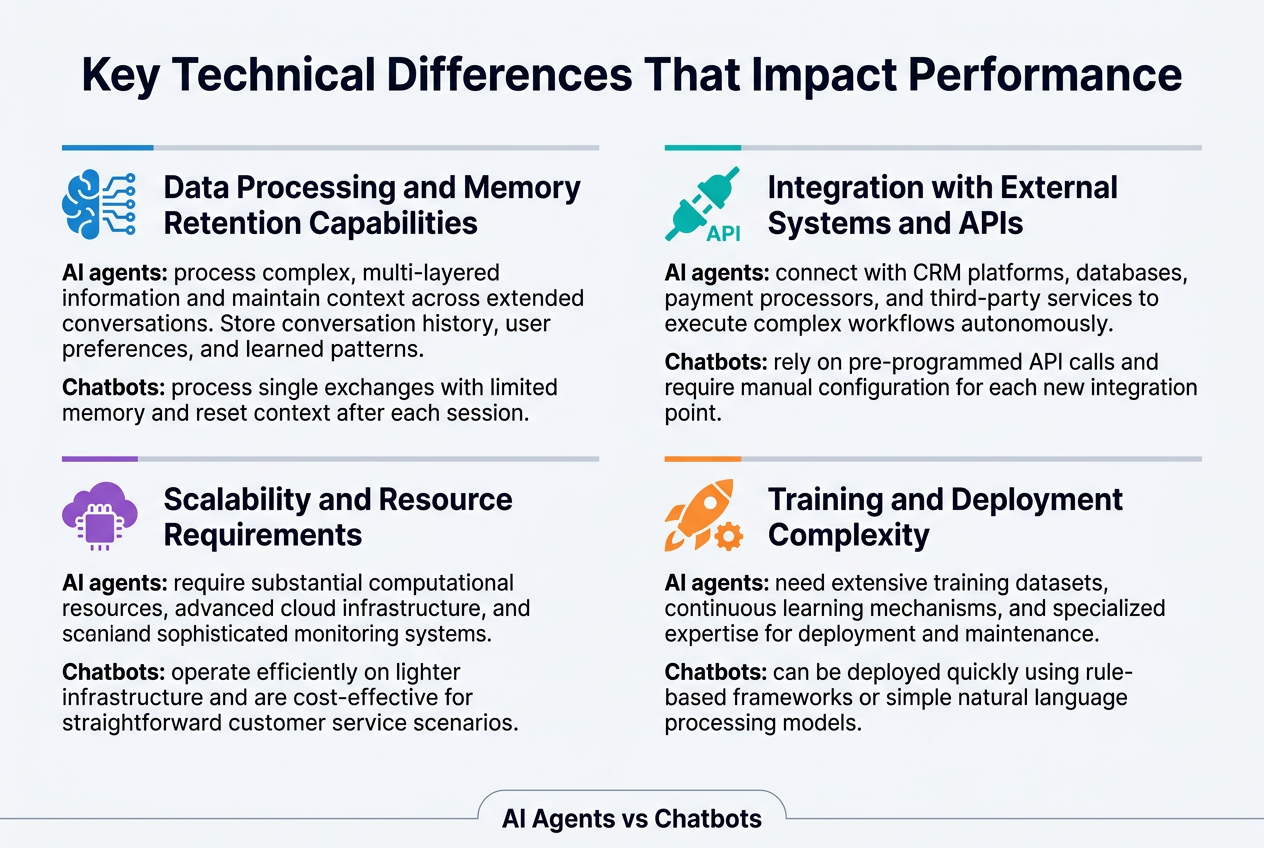
Data Processing and Memory Retention Capabilities
AI agents excel at processing complex, multi-layered information while maintaining context across extended conversations. They store conversation history, user preferences, and learned patterns to deliver increasingly personalized interactions. Chatbots typically process single exchanges with limited memory, resetting context after each session or maintaining only basic conversation flow within short interactions.
Integration with External Systems and APIs
The difference between AI agents and chatbots becomes stark when examining system integration capabilities. AI agents seamlessly connect with CRM platforms, databases, payment processors, and third-party services to execute complex workflows autonomously. Traditional chatbots rely on pre-programmed API calls for specific functions, requiring extensive manual configuration for each new integration point.
Scalability and Resource Requirements
Conversational AI technology demands vary significantly between these solutions. AI agents require substantial computational resources, advanced cloud infrastructure, and sophisticated monitoring systems to handle dynamic decision-making processes. Chatbots operate efficiently on lighter infrastructure, making them cost-effective for straightforward customer service scenarios where complex reasoning isn’t required.
Training and Deployment Complexity
AI chatbot implementation complexity differs dramatically based on the chosen technology. AI agents need extensive training datasets, continuous learning mechanisms, and specialized expertise for deployment and maintenance. Basic chatbots can be deployed quickly using rule-based frameworks or simple natural language processing models, requiring minimal technical expertise and shorter development cycles for standard use cases.
Real-World Applications and Use Case Scenarios
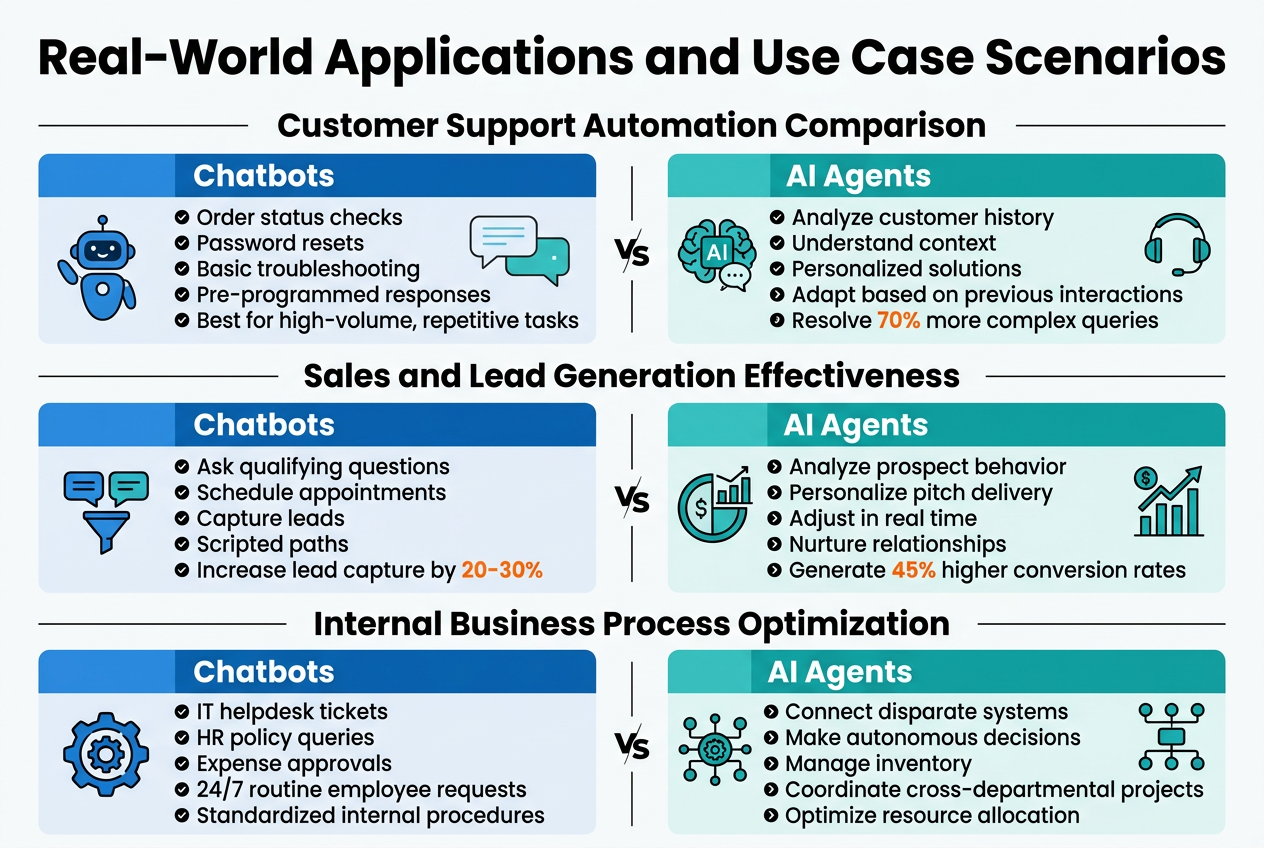
Customer Support Automation Comparison
Chatbots excel at handling routine customer inquiries like order status checks, password resets, and basic troubleshooting through pre-programmed responses. They work best for high-volume, repetitive tasks where consistency matters more than complexity. AI agents vs chatbots becomes clear when dealing with escalated issues – AI agents can analyze customer history, understand context, and provide personalized solutions that adapt based on previous interactions.
AI agents transform customer support by learning from each interaction and making decisions without human intervention. They can process complex requests, understand emotional context, and even predict customer needs before issues arise. This difference between AI agents and chatbots means AI agents can resolve 70% more complex queries independently compared to traditional chatbot implementations.
Sales and Lead Generation Effectiveness
Conversational AI technology through basic chatbots captures leads by asking qualifying questions and scheduling appointments, but their impact stops at data collection. They follow scripted paths that may miss subtle buying signals or fail to address unique prospect concerns. Chatbot vs AI agent comparison shows that while chatbots increase lead capture by 20-30%, they often struggle with lead quality and personalization.
Intelligent virtual assistants powered by AI agents revolutionize sales processes by analyzing prospect behavior, personalizing pitch delivery, and adjusting strategies in real-time. They can identify warm leads, nurture relationships through multiple touchpoints, and even negotiate basic terms. Artificial intelligence agents in sales generate 45% higher conversion rates by understanding buyer intent and timing their engagement perfectly.
Internal Business Process Optimization
Business automation tools using chatbots streamline internal workflows like IT helpdesk tickets, HR policy queries, and expense approvals through simple command-response interactions. They reduce administrative burden by handling routine employee requests 24/7, but require constant updates when processes change. Machine learning chatbots work well for standardized internal procedures where consistency trumps creativity.
AI chatbot implementation at the agent level transforms how businesses operate internally by connecting disparate systems and making autonomous decisions. AI agents can manage inventory based on demand patterns, coordinate cross-departmental projects, and optimize resource allocation without human oversight. Automated customer service solutions extend beyond external customers to create intelligent internal ecosystems that adapt and improve continuously.
Cost-Benefit Analysis for Business Implementation
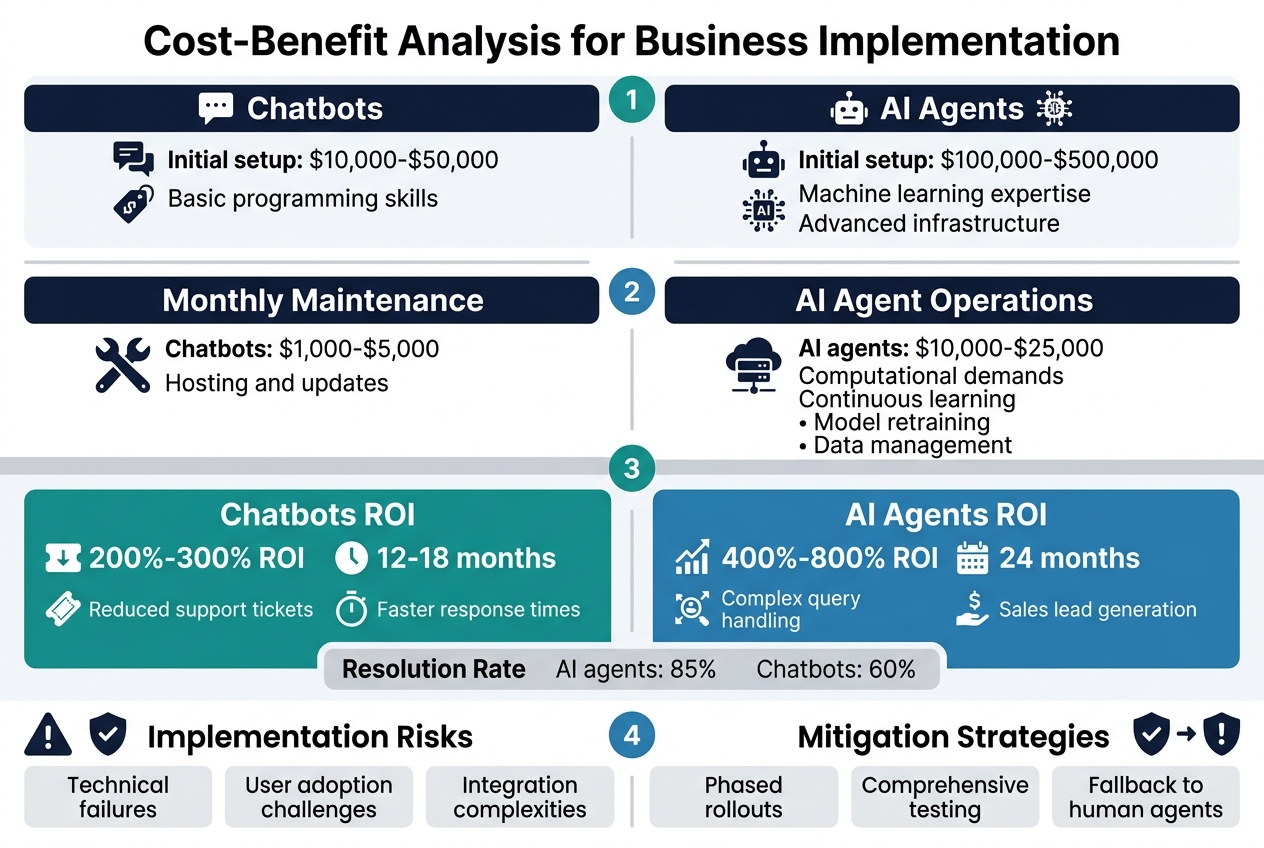
Initial Setup and Development Investments
Chatbot implementation typically requires $10,000-$50,000 in upfront costs, while AI agents demand $100,000-$500,000 for comprehensive development. The difference between AI agents and chatbots becomes clear when comparing resource requirements – chatbots need basic programming skills, whereas AI agents require machine learning expertise and advanced infrastructure.
Ongoing Maintenance and Operational Expenses
Monthly operational costs vary dramatically between these automated customer service solutions. Chatbots average $1,000-$5,000 monthly for hosting and updates, while AI agents consume $10,000-$25,000 due to computational demands and continuous learning requirements. AI chatbot implementation also involves regular model retraining and data management expenses.
ROI Potential and Performance Metrics
Chatbots deliver 200-300% ROI within 12-18 months through reduced support tickets and faster response times. AI agents achieve 400-800% ROI over 24 months by handling complex queries and generating sales leads. Performance metrics show AI agents resolve 85% of customer issues compared to chatbots’ 60% resolution rate.
Risk Assessment and Mitigation Strategies
Implementation risks include technical failures, user adoption challenges, and integration complexities. Chatbots present lower risk profiles with simpler troubleshooting, while AI agents carry higher stakes due to their complexity. Successful business automation tools require phased rollouts, comprehensive testing, and fallback protocols to human agents when systems encounter unexpected scenarios.
Choosing the Right Solution for Your Business Needs
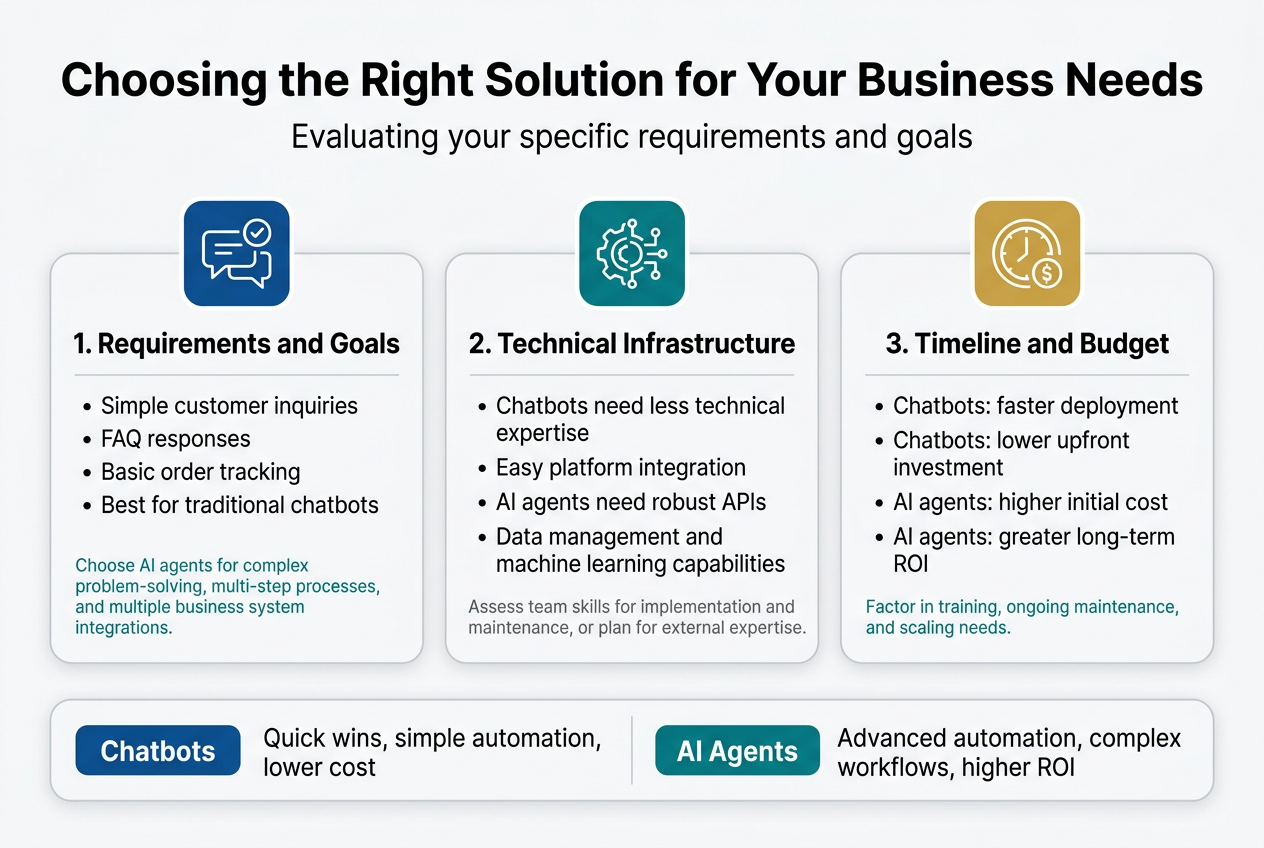
Evaluating your specific requirements and goals
Start by mapping out exactly what you want your automated system to accomplish. Simple customer inquiries, FAQ responses, and basic order tracking work perfectly with traditional chatbots. However, if you need complex problem-solving, multi-step processes, or integration with multiple business systems, AI agents become essential. Consider whether you’re looking for basic conversational AI technology or need intelligent virtual assistants that can handle dynamic, unpredictable scenarios.
Technical infrastructure and team capabilities assessment
Your existing tech stack plays a huge role in determining the best automated customer service solutions for your business. Chatbots typically require less technical expertise and can often integrate with existing platforms easily. AI agents demand more sophisticated infrastructure, including robust APIs, data management systems, and often machine learning capabilities. Assess whether your team can handle the implementation and ongoing maintenance, or if you’ll need external expertise for your AI chatbot implementation.
Timeline and budget considerations
Budget constraints often drive the initial choice between AI agents vs chatbots, but don’t overlook long-term costs. Chatbots offer faster deployment and lower upfront investment, making them attractive for quick wins. AI agents require more substantial initial investment but can deliver greater ROI through advanced automation capabilities. Factor in training costs, ongoing maintenance, and potential scaling needs when comparing business automation tools options.
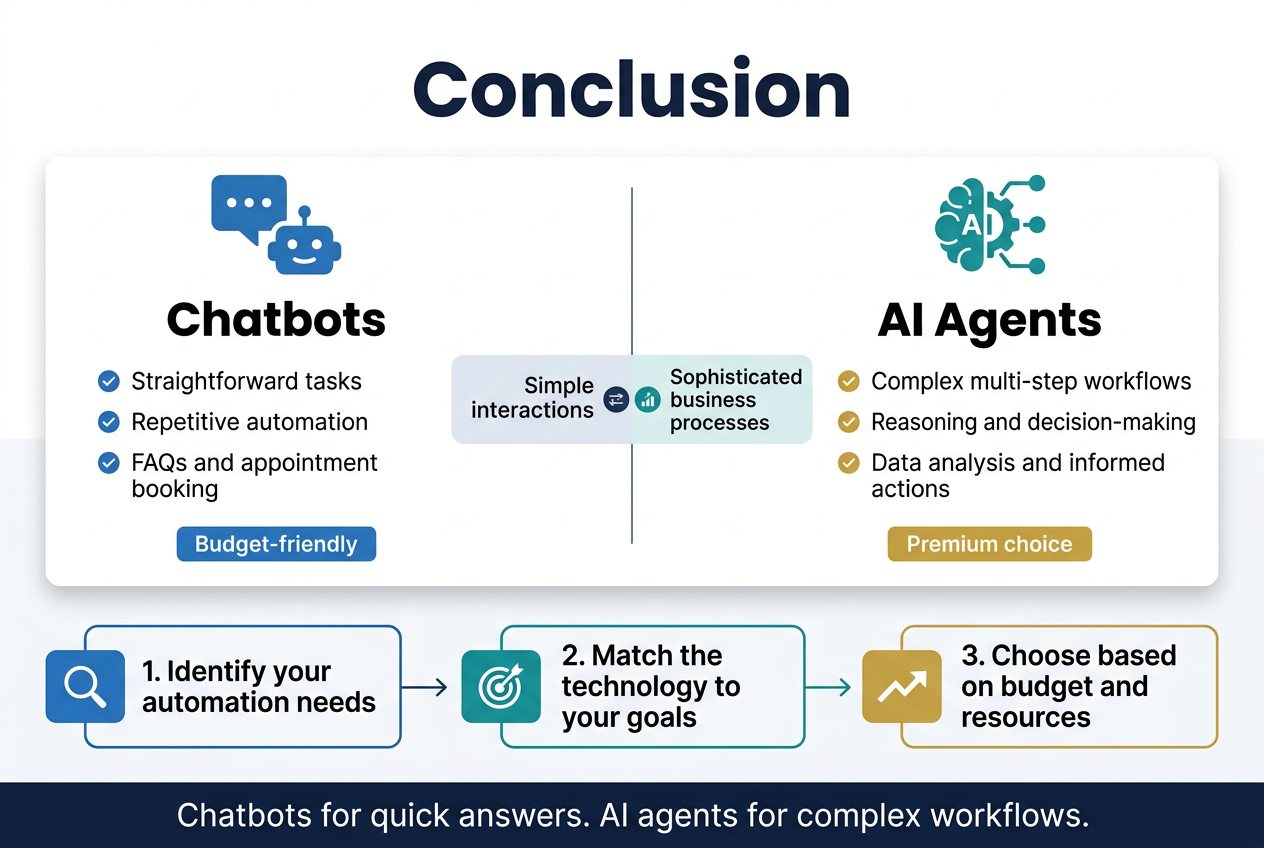
Understanding the differences between chatbots and AI agents comes down to complexity and capability. Chatbots excel at handling straightforward, repetitive tasks like answering FAQs or booking appointments, while AI agents can tackle complex, multi-step processes that require reasoning and decision-making. The technical differences affect everything from development costs to maintenance requirements, making chatbots the budget-friendly option for simple interactions and AI agents the premium choice for sophisticated business processes.
The right choice for your business depends on your specific needs and budget. If you’re looking to automate basic customer service or provide quick answers to common questions, a well-designed chatbot will serve you perfectly. But if your business requires intelligent automation that can handle complex workflows, analyze data, and make informed decisions, investing in AI agents will pay off in the long run. Start by identifying your most pressing automation needs, then choose the technology that best matches your goals and resources.