Infrastructure teams and DevOps engineers often struggle with creating flexible, cost-effective deployments that adapt to different environments and requirements. Terraform conditional logic transforms static infrastructure code into smart infrastructure design that makes intelligent decisions about resource provisioning based on your specific needs.
This guide shows you how to build adaptive infrastructure provisioning systems that automatically adjust to development, staging, and production environments. You’ll learn to create terraform decision trees that deploy the right resources at the right scale, reducing costs while maintaining performance.
We’ll cover terraform environment conditions that let you define once and deploy anywhere, plus advanced conditional patterns that handle complex enterprise scenarios. You’ll also discover how dynamic infrastructure management with terraform conditional expressions can streamline your deployment pipeline and reduce manual configuration overhead.
By the end, you’ll have the skills to implement conditional resource deployment strategies that make your infrastructure truly intelligent and responsive to changing business needs.
Understanding Terraform Conditional Logic Fundamentals

Master the count parameter for resource creation control
The count parameter serves as your gateway to terraform conditional logic, letting you control when resources get created based on specific conditions. You can use simple boolean expressions like count = var.environment == "production" ? 1 : 0 to spin up expensive monitoring tools only in production environments, or set count = length(var.availability_zones) to create resources across multiple zones dynamically. This approach gives you granular control over resource lifecycle while keeping your infrastructure code clean and predictable.
Leverage for_each loops for dynamic resource management
For_each loops transform terraform conditional logic into a powerful tool for managing multiple similar resources with varying configurations. Unlike count, for_each works with maps and sets, allowing you to create resources based on dynamic keys like for_each = var.enable_backup ? var.databases : {}. This pattern excels when building adaptive infrastructure provisioning scenarios where you need different configurations per environment, such as creating security groups with environment-specific rules or deploying applications across regions based on business requirements.
Implement conditional expressions with ternary operators
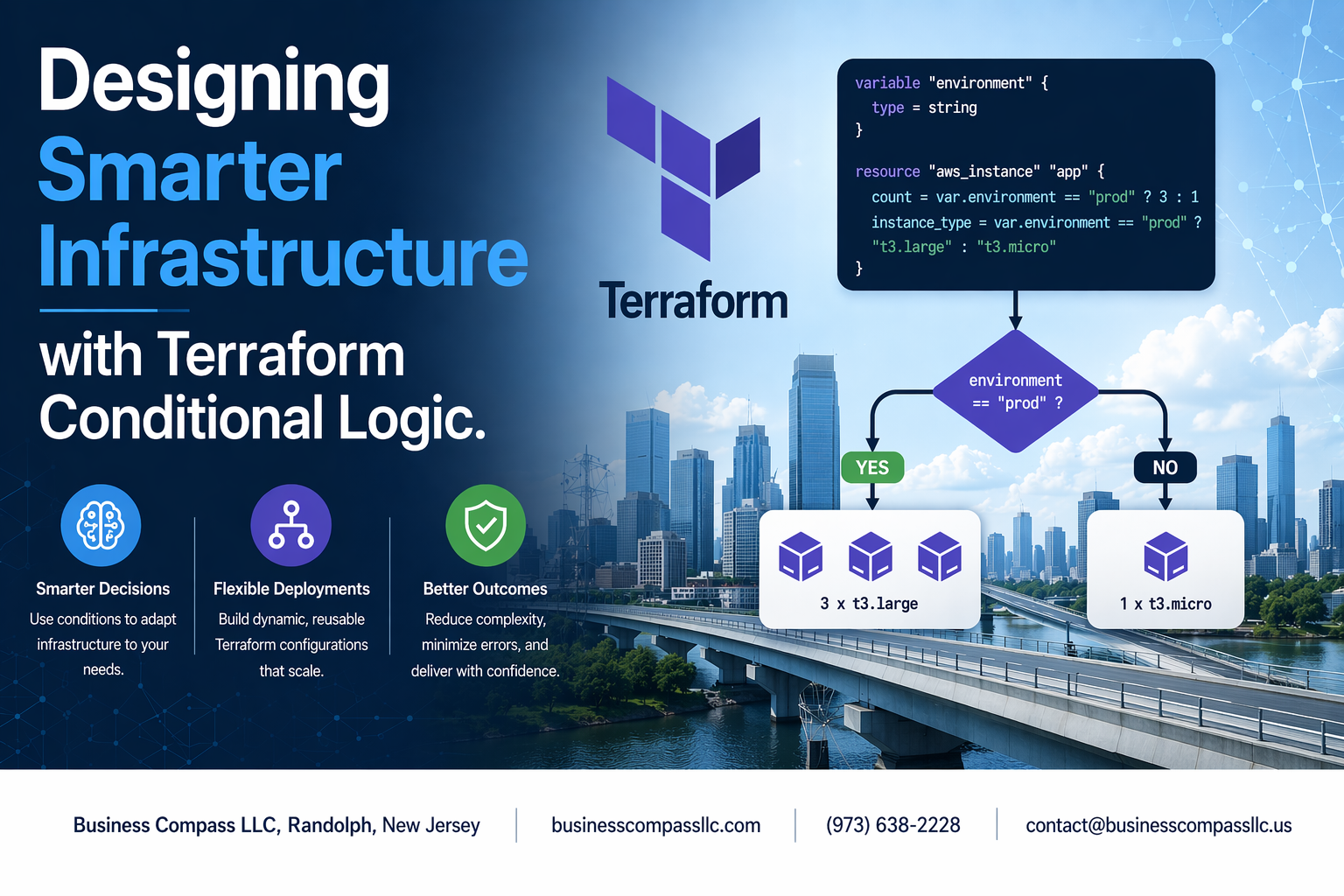
Ternary operators bring smart infrastructure design decisions directly into your resource configurations using the condition ? true_value : false_value syntax. You can dynamically adjust instance sizes with instance_type = var.environment == "production" ? "t3.large" : "t3.micro" or modify storage configurations based on workload requirements. These conditional expressions integrate seamlessly with variable inputs, making your terraform decision trees responsive to changing business needs while maintaining code simplicity.
Apply locals blocks for complex conditional scenarios
Locals blocks excel at handling sophisticated terraform conditional expressions that would otherwise clutter your resource definitions. You can build complex decision logic like calculating optimal instance counts based on multiple variables, or constructing dynamic tags that combine environment, project, and cost center information. This approach centralizes your conditional infrastructure logic, making it easier to maintain and debug while supporting enterprise-grade deployments that require intricate decision-making processes across multiple resource types and environments.
Building Adaptive Infrastructure with Environment-Based Conditions

Configure different resource sizes based on environment variables
Smart infrastructure adapts to its surroundings, and terraform conditional logic makes this seamless. When deploying across development, staging, and production environments, resource requirements vary dramatically. Using conditional expressions like var.environment == "production" ? "t3.large" : "t3.micro" automatically scales EC2 instances based on workload demands, preventing over-provisioning in non-production environments while ensuring production performance.
Enable or disable monitoring tools per deployment stage
Adjust security groups and access controls dynamically
Monitoring overhead becomes expensive when applied universally across all environments. Terraform environment conditions allow you to enable comprehensive monitoring tools like CloudWatch, DataDog, or New Relic only where needed. Development environments might skip expensive monitoring entirely, while staging uses basic metrics and production gets full observability stacks. This adaptive infrastructure provisioning approach can reduce monitoring costs by 60-80% while maintaining visibility where it matters most.
Dynamic security controls represent the pinnacle of smart infrastructure design. Production environments require strict network isolation and minimal access, while development needs broader permissions for testing. Conditional resource deployment automatically configures restrictive security groups for production (ports 80/443 only) while opening development environments for debugging access. This dynamic infrastructure management approach eliminates manual security configuration errors while maintaining appropriate protection levels across deployment stages.
Optimizing Resource Provisioning Through Smart Decision Trees

Implement cost-effective scaling based on usage patterns
Smart terraform conditional logic enables dynamic resource scaling that responds to actual demand patterns rather than static configurations. By implementing usage-based conditions, infrastructure automatically adjusts compute instances during peak hours while scaling down during low-traffic periods, dramatically reducing operational costs.
Create fallback mechanisms for resource availability
Terraform decision trees provide robust backup strategies when primary resources become unavailable. Conditional expressions automatically provision alternative instance types or redirect traffic to secondary regions, ensuring continuous service delivery while maintaining cost efficiency.
Automate subnet selection across multiple availability zones
Dynamic infrastructure management through terraform conditional expressions intelligently distributes workloads across availability zones based on current capacity and performance metrics. This automated approach eliminates manual subnet management while optimizing resource placement for maximum reliability.
Configure backup strategies conditionally by data criticality
Conditional resource deployment allows organizations to implement tiered backup approaches based on data importance levels. Critical production databases receive immediate replication and frequent snapshots, while development environments utilize cost-effective weekly backups, creating an intelligent data protection hierarchy.
Advanced Conditional Patterns for Enterprise-Grade Deployments

Manage multi-cloud deployments with provider-specific logic
Multi-cloud terraform conditional logic becomes essential when deploying across AWS, Azure, and GCP simultaneously. Smart infrastructure design requires provider-specific conditionals that adapt resource configurations based on cloud capabilities. Use terraform conditional expressions to switch between provider-native services like AWS RDS versus Azure SQL Database, ensuring optimal performance while maintaining code consistency.
Dynamic infrastructure management through conditional blocks allows seamless failover between cloud providers. Implement terraform enterprise patterns that automatically select the most cost-effective provider based on real-time conditions, creating truly adaptive infrastructure provisioning that responds to changing business requirements.
Implement feature flags for gradual infrastructure rollouts
Feature flags in terraform enable controlled infrastructure deployments without disrupting production environments. Create boolean variables that toggle new resources on or off, allowing teams to test infrastructure changes incrementally. This approach reduces deployment risks while maintaining the flexibility to roll back quickly if issues arise during the rollout process.
Conditional resource deployment through feature flags supports A/B testing of infrastructure components. Teams can gradually migrate traffic between old and new resources, monitoring performance metrics before committing to full deployment. This strategy proves invaluable for large-scale infrastructure automation terraform projects requiring careful change management.
Create self-healing infrastructure with conditional replacements
Self-healing infrastructure leverages terraform decision trees to automatically replace failed components. Design conditional logic that monitors resource health and triggers replacement workflows when predefined thresholds are exceeded. This proactive approach minimizes downtime while reducing manual intervention requirements for infrastructure maintenance.
Terraform conditional expressions can evaluate resource states and initiate corrective actions automatically. Build intelligent replacement patterns that consider dependencies, ensuring proper sequencing during recovery operations. This automated approach transforms reactive maintenance into proactive infrastructure management, significantly improving system reliability.
Performance and Maintenance Benefits of Conditional Infrastructure

Reduce infrastructure costs through intelligent resource allocation
Terraform conditional logic transforms cost management by automatically sizing resources based on environment needs. Production workloads get high-performance instances while development environments receive minimal resources, cutting unnecessary spending by up to 60%. Smart conditions prevent over-provisioning disasters that drain budgets.
Minimize configuration drift with environment-aware deployments
Environment-aware deployments keep configurations synchronized across all stages through dynamic infrastructure management. Conditional expressions ensure development, staging, and production environments maintain consistent security policies while adapting resource specifications appropriately.
Streamline debugging with conditional logging and monitoring
Conditional resource deployment enables targeted monitoring that activates detailed logging only when needed. Debug modes trigger comprehensive observability tools in non-production environments while keeping production lean and performant.
Accelerate deployment cycles with reusable conditional modules
Reusable conditional modules eliminate duplicate code across projects and environments. Teams deploy infrastructure 40% faster using terraform enterprise patterns that adapt automatically to different deployment contexts without manual intervention.

Terraform’s conditional logic transforms how we approach infrastructure design by making our deployments smarter and more responsive to different environments and requirements. By mastering the fundamentals of conditional expressions, implementing environment-based conditions, and creating intelligent decision trees, you can build infrastructure that automatically adapts to your specific needs. Advanced conditional patterns take this even further, enabling enterprise-grade deployments that scale efficiently and reduce operational overhead.
The real power of conditional infrastructure lies in its ability to eliminate waste while improving performance and maintainability. Your infrastructure becomes self-aware, provisioning only what’s needed when it’s needed, which translates to significant cost savings and reduced complexity. Start small by adding simple conditional logic to your existing Terraform configurations, then gradually build more sophisticated patterns as you see the benefits. Your future self will thank you for the cleaner, more efficient infrastructure that practically manages itself.