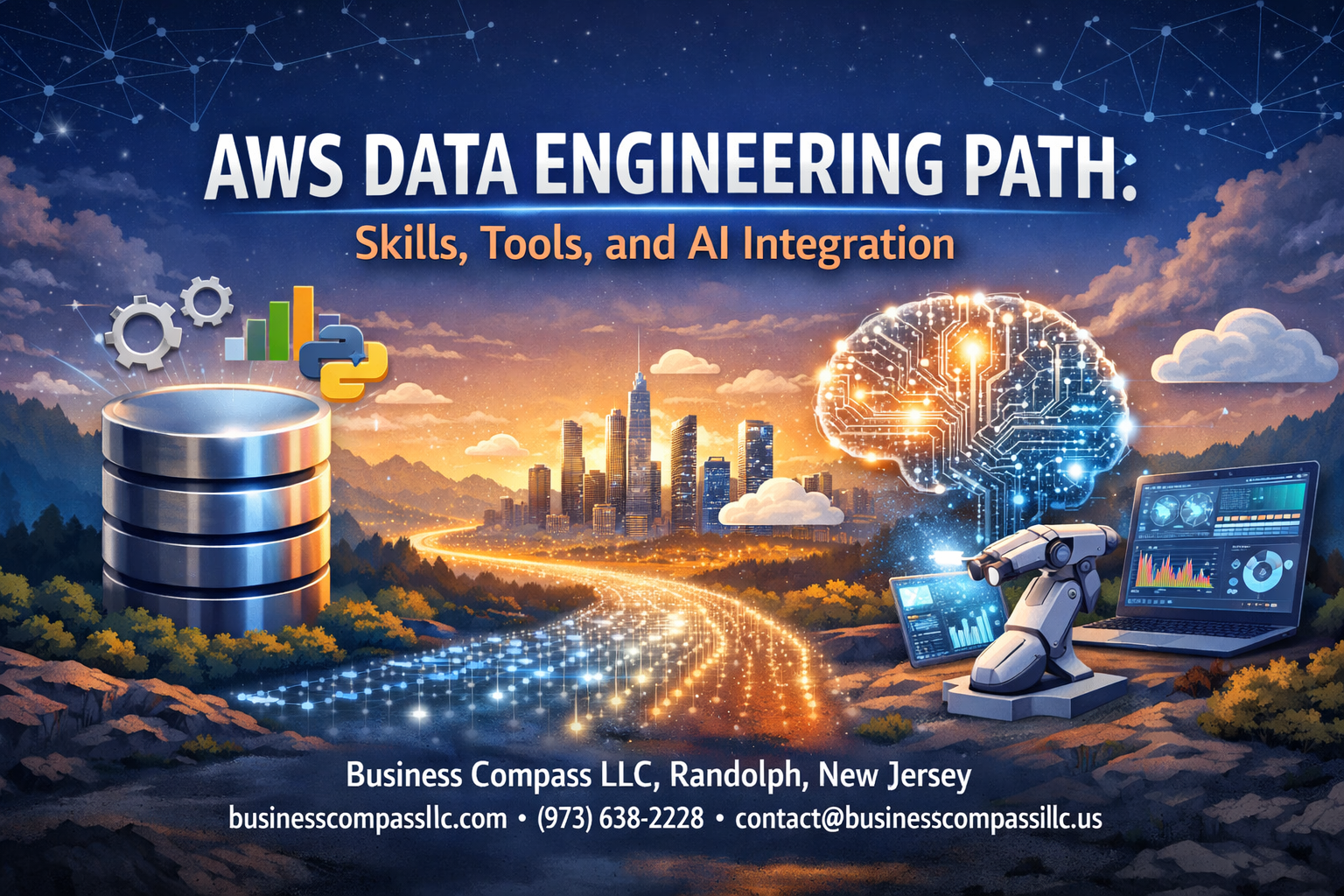
The AWS data engineering landscape is booming, and companies are scrambling to find skilled professionals who can build robust data pipelines and integrate AI solutions. This comprehensive guide is designed for aspiring data engineers, current IT professionals looking to specialize, and experienced engineers wanting to master AWS data services.
AWS data engineers need a specific skill set that goes beyond basic cloud knowledge. You’ll need to understand how Amazon data engineering tools work together, from simple data collection to complex machine learning workflows. The AWS data engineer career path offers excellent opportunities, but success requires strategic planning and the right technical foundation.
We’ll explore the essential technical skills that separate successful AWS data engineers from the competition, including hands-on experience with core services like S3, Redshift, and Glue. You’ll discover the advanced AWS ETL tools and data pipeline architectures that handle enterprise-scale workloads. Finally, we’ll cover practical AI and machine learning integration strategies that are reshaping modern data engineering, plus actionable insights for building your AWS data engineering roadmap and pursuing relevant certifications.
Essential Technical Skills for AWS Data Engineering Success

Master Python and SQL for Data Manipulation
Python stands as the cornerstone programming language for AWS data engineers, offering unmatched versatility in data processing and analysis. Your journey starts with mastering core libraries like Pandas for data manipulation, NumPy for numerical computing, and Boto3 for AWS service integration. These tools become your daily companions when working with Amazon S3, RDS, and other AWS data services.
SQL proficiency goes beyond basic queries – you need advanced skills in window functions, common table expressions, and query optimization. Amazon Redshift, Aurora, and Athena each have unique SQL dialects and performance characteristics that require hands-on experience. Practice complex joins, subqueries, and analytical functions regularly.
Key Python skills to develop:
- Data cleaning and transformation with Pandas
- API integration using requests library
- Error handling and logging best practices
- Object-oriented programming for scalable code
- Working with JSON, CSV, and Parquet formats
SQL mastery areas:
- Performance tuning for large datasets
- Stored procedures and functions
- Data warehouse design patterns
- Cross-platform compatibility
- Integration with BI tools
Develop Cloud Computing Fundamentals
Understanding cloud architecture principles forms the foundation of successful AWS data engineering. You need solid grasp of distributed computing concepts, including horizontal scaling, load balancing, and fault tolerance. These principles directly impact how you design data pipelines and choose appropriate AWS data services.
Security becomes paramount when handling sensitive data in the cloud. Identity and Access Management (IAM) policies, encryption at rest and in transit, and compliance frameworks like GDPR require constant attention. AWS provides multiple security layers, but implementing them correctly demands deep understanding.
Core cloud concepts to master:
- Virtual Private Clouds (VPC) and networking
- Auto-scaling and resource optimization
- Disaster recovery and backup strategies
- Cost management and resource monitoring
- Multi-region deployments
Security essentials:
- IAM roles and policies configuration
- Encryption key management with KMS
- Network security groups and NACLs
- Audit trails with CloudTrail
- Data classification and governance
Build ETL Pipeline Design Expertise
ETL pipeline architecture on AWS requires understanding both traditional batch processing and modern streaming approaches. AWS Glue serves as the primary ETL service, but you’ll also work with Lambda functions for lightweight transformations and Step Functions for complex orchestration workflows.
Data quality and monitoring become critical when pipelines process millions of records daily. Implementing data validation, error handling, and alerting systems prevents downstream issues that could impact business decisions. AWS CloudWatch and custom metrics help track pipeline health and performance.
Pipeline design principles:
- Modular and reusable component architecture
- Incremental processing strategies
- Schema evolution handling
- Parallel processing optimization
- Resource cost optimization
Monitoring and quality control:
- Data lineage tracking
- Automated testing frameworks
- Performance benchmarking
- Error recovery mechanisms
- SLA monitoring and alerting
Strengthen Data Modeling and Architecture Skills
Dimensional modeling remains relevant for AWS data warehousing solutions, but modern approaches also include data vault modeling and data lake architectures. Understanding when to use star schemas versus denormalized structures impacts query performance and storage costs significantly.
The AWS data engineering roadmap includes mastering both relational and NoSQL data models. DynamoDB requires different thinking patterns compared to traditional RDBMS systems, while S3 data lakes need careful partitioning strategies for optimal performance with services like Athena and EMR.
Data modeling expertise areas:
- Kimball dimensional modeling techniques
- Data vault methodology for enterprise environments
- NoSQL design patterns for DynamoDB
- Graph database modeling with Neptune
- Time-series data optimization
Architecture decision points:
- Lambda vs. Kappa architecture patterns
- Batch vs. real-time processing trade-offs
- Data lake vs. data warehouse selection
- Microservices vs. monolithic pipeline design
- Multi-tenant data isolation strategies
Core AWS Services Every Data Engineer Must Know

Leverage Amazon S3 for Scalable Data Storage
Amazon S3 stands as the backbone of AWS data engineering workflows, offering virtually unlimited storage capacity with 99.999999999% durability. Data engineers rely on S3’s flexibility to store structured, semi-structured, and unstructured data in multiple formats including CSV, JSON, Parquet, and ORC files.
S3’s storage classes optimize costs based on access patterns. Frequently accessed data sits in Standard storage, while Infrequent Access (IA) and Glacier classes handle archive scenarios. Smart Tiering automatically moves objects between access tiers, reducing storage costs by up to 68% without performance impact.
The service integrates seamlessly with AWS data services through native connectors. Data lakes built on S3 support analytics engines like Amazon Athena, EMR, and Redshift Spectrum without data movement. Cross-region replication ensures data availability across geographic locations, while versioning protects against accidental deletions or modifications.
Security features include server-side encryption, access control lists, and bucket policies that define granular permissions. S3 Event Notifications trigger downstream AWS data pipeline processes when objects are created, modified, or deleted, enabling real-time data processing workflows.
Harness AWS Glue for Automated Data Processing
AWS Glue eliminates the complexity of building and maintaining ETL infrastructure through its fully managed, serverless architecture. The service automatically discovers data schemas across S3, RDS, and Redshift sources, creating a unified data catalog that serves as a central metadata repository for AWS data engineering projects.
Glue’s visual ETL jobs allow data engineers to design transformations using drag-and-drop interfaces, while Python and Scala developers can write custom transformation logic. The service handles resource provisioning, scaling, and infrastructure management automatically, charging only for actual compute time used during job execution.
Data quality rules within Glue validate incoming data against predefined criteria, flagging anomalies and ensuring downstream analytics accuracy. The service supports both batch and streaming ETL patterns, processing data from Kinesis streams in near real-time or handling large batch jobs during off-peak hours.
Glue crawlers automatically update schema definitions when source data structures change, maintaining catalog accuracy without manual intervention. Job bookmarking tracks processed data to prevent duplicate processing in incremental loads, while built-in retry mechanisms handle transient failures gracefully.
Use Amazon Redshift for Data Warehousing
Amazon Redshift powers enterprise data warehousing with columnar storage and massively parallel processing capabilities. The service handles petabyte-scale datasets while maintaining sub-second query performance through advanced query optimization and result caching.
Redshift’s architecture separates compute and storage, allowing independent scaling of each component. Concurrency Scaling automatically adds cluster capacity during peak query periods, ensuring consistent performance for business-critical analytics. Reserved instances reduce costs by up to 75% for predictable workloads.
The AQUA acceleration layer boosts query performance by up to 10x through intelligent caching and advanced compression algorithms. Redshift Spectrum extends queries directly to S3 data lakes without ETL processes, joining warehouse data with external datasets seamlessly.
Automatic workload management prioritizes queries based on user-defined rules, preventing resource contention. Machine learning-powered ANALYZE commands optimize table statistics, while automatic vacuum operations maintain query performance by reclaiming space and sorting data.
Implement AWS Lambda for Serverless Computing
AWS Lambda transforms data engineering workflows through event-driven, serverless computing that scales from zero to thousands of concurrent executions. Lambda functions respond to S3 uploads, DynamoDB changes, or API calls without managing underlying infrastructure.
The service excels in real-time data transformation scenarios, processing streaming data from Kinesis or triggering data quality checks after file uploads. Lambda’s 15-minute execution limit suits micro-batch processing, data validation, and alerting functions perfectly.
Cost efficiency comes from paying only for actual compute time, measured in milliseconds. Lambda automatically scales based on incoming event volume, handling traffic spikes without pre-provisioning resources. Memory allocation from 128MB to 10GB accommodates various processing requirements.
Integration with AWS data services happens through native triggers and destinations. Lambda can enrich data before loading into Redshift, validate schemas before Glue processing, or send alerts to SNS when data quality issues arise. Environment variables and AWS Systems Manager Parameter Store manage configuration without hardcoding values.
Deploy Amazon EMR for Big Data Analytics
Amazon EMR simplifies big data processing by managing Hadoop, Spark, and other open-source frameworks on EC2 instances. The service handles cluster provisioning, configuration, and scaling while providing access to familiar tools like Hive, Pig, and Presto.
Spot instances reduce EMR costs by up to 90% compared to On-Demand pricing, making large-scale data processing economically feasible. Auto Scaling policies adjust cluster size based on pending tasks or custom metrics, optimizing both performance and costs.
EMR Notebooks provide collaborative development environments for data scientists and engineers working with Spark and PySpark. Built-in integration with S3, DynamoDB, and RDS enables direct data access without complex connector configurations.
The service supports multiple deployment options including persistent clusters for ongoing analytics workloads and transient clusters for specific jobs. EMR on EKS runs Spark jobs on existing Kubernetes clusters, while EMR Serverless eliminates cluster management entirely for certain use cases.
Security features include encryption at rest and in transit, integration with AWS IAM for fine-grained permissions, and support for Kerberos authentication in enterprise environments.
Advanced AWS Tools for Complex Data Workflows

Orchestrate Pipelines with AWS Step Functions
AWS Step Functions serves as the command center for your AWS data pipeline orchestration, allowing you to build sophisticated workflows that handle complex data processing scenarios. Think of it as a visual workflow engine that connects different AWS services into a seamless data processing chain.
Step Functions excels at managing long-running processes where multiple services need to work together. You can create state machines that automatically retry failed steps, handle parallel processing, and make decisions based on data conditions. For data engineers working with AWS ETL tools, this means you can coordinate Lambda functions, Glue jobs, and EMR clusters without writing complex orchestration code.
The service supports both Standard and Express workflows, giving you flexibility based on your performance requirements. Standard workflows work perfectly for batch processing jobs that run daily or weekly, while Express workflows handle high-volume, short-duration tasks with microsecond billing.
Visual workflow design makes debugging and monitoring straightforward. You can see exactly where your pipeline fails and understand the execution flow at a glance. This transparency proves invaluable when managing multiple AWS data engineering workflows across different teams and environments.
Stream Real-time Data with Amazon Kinesis
Amazon Kinesis transforms how you handle streaming data, providing three specialized services for different real-time processing needs. Kinesis Data Streams captures and stores streaming data, Kinesis Data Firehose delivers data to destinations like S3 and Redshift, and Kinesis Data Analytics processes streams in real-time using SQL or Apache Flink.
Data Streams works as your high-throughput data highway, capable of ingesting millions of records per second from sources like web applications, mobile apps, and IoT devices. You configure shards based on your throughput requirements, and Kinesis automatically manages data distribution and replication across multiple availability zones.
For Amazon data engineering tools implementation, Kinesis Firehose simplifies data delivery without requiring custom consumer applications. It automatically scales to match your data volume, handles data transformation through Lambda functions, and delivers compressed, encrypted data to your chosen destinations.
Real-time analytics becomes possible through Kinesis Data Analytics, where you can write SQL queries against streaming data or deploy Apache Flink applications for complex event processing. This capability opens doors for fraud detection, recommendation engines, and live dashboards that respond to data changes within seconds.
Monitor and Optimize with AWS CloudWatch
CloudWatch acts as your AWS data engineering monitoring nerve center, providing comprehensive observability across all your data workflows. Custom metrics help you track pipeline performance, data quality issues, and resource utilization patterns that standard AWS metrics might miss.
Dashboard creation becomes essential for team collaboration and system health monitoring. You can build dashboards that show data processing rates, error frequencies, and cost trends across different pipeline components. These visual representations help stakeholders understand system performance without diving into technical details.
Alarm configuration enables proactive issue management before problems impact your data workflows. Set up alarms for failed Glue jobs, Lambda function timeouts, or unusual data volume patterns. CloudWatch can automatically trigger remediation actions through SNS notifications or Lambda functions, reducing manual intervention requirements.
Log aggregation through CloudWatch Logs centralizes troubleshooting across distributed data processing components. You can search across Lambda logs, Glue job outputs, and custom application logs from a single interface. Log insights queries help identify patterns and root causes quickly, especially during incident response situations.
Performance optimization opportunities become clear through CloudWatch metrics analysis. You can identify underutilized resources, spot bottlenecks in your data pipeline, and make informed decisions about scaling strategies that align with your AWS data engineer career path goals.
AI and Machine Learning Integration Strategies

Connect AWS SageMaker with Data Pipelines
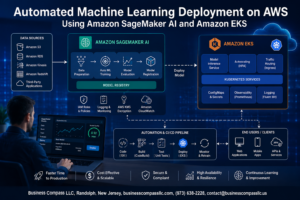
Building seamless connections between AWS SageMaker and your data pipelines transforms raw data into actionable machine learning insights. The key lies in creating automated workflows that feed clean, processed data directly into your ML models without manual intervention.
Start by integrating SageMaker Processing jobs with your existing AWS data pipeline workflows. These processing jobs can handle data preprocessing, feature extraction, and model training preparation right within your pipeline architecture. Use AWS Step Functions to orchestrate complex workflows that combine data ingestion from S3, transformation with AWS Glue, and direct feeding into SageMaker training jobs.
Setting up SageMaker Pipelines provides end-to-end automation for your machine learning workflows. These pipelines can automatically trigger when new data arrives in your data lake, creating a continuous learning system. Connect your ETL processes to SageMaker Feature Store to maintain consistent feature engineering across training and inference environments.
Real-time integration becomes powerful when you combine Amazon Kinesis with SageMaker endpoints. Stream processing applications can send data directly to deployed models for instant predictions, creating responsive ML-powered applications. This approach works exceptionally well for fraud detection, recommendation systems, and real-time analytics scenarios.
Implement AI-Powered Data Quality Checks
Traditional data quality monitoring gets a major upgrade when you integrate AI-powered validation systems. AWS offers several services that can automatically detect anomalies, identify data drift, and flag quality issues before they impact downstream processes.
Amazon SageMaker Data Wrangler includes built-in data quality insights that automatically generate quality reports and suggest remediation steps. These insights use machine learning algorithms to detect outliers, missing values, and inconsistent data patterns across your datasets. The visual interface makes it easy to spot issues that manual inspection might miss.
AWS Glue DataBrew takes data quality monitoring further by applying machine learning to understand your data patterns over time. It can automatically detect when new data doesn’t match historical patterns, alerting you to potential upstream issues. Create automated quality gates that stop pipeline execution when data quality scores drop below acceptable thresholds.
Combine Amazon Lookout for Metrics with your data pipelines to monitor key data quality metrics continuously. This service learns normal patterns in your data metrics and alerts you when anomalies occur. Set up automated responses that can quarantine bad data, trigger data refresh processes, or send notifications to data engineering teams.
Custom quality checks using Amazon Comprehend can analyze text data for sentiment shifts, language changes, or content quality issues. This proves invaluable for social media data, customer feedback processing, and document management systems.
Automate Feature Engineering with ML Services
Feature engineering automation saves countless hours while improving model performance and consistency. AWS provides several services that can automatically generate, select, and optimize features for your machine learning models.
SageMaker Feature Store acts as a centralized repository for feature engineering logic. Store feature transformation code alongside the features themselves, ensuring consistent feature generation across training and inference. The feature store automatically handles versioning, lineage tracking, and feature sharing across teams.
Amazon SageMaker Autopilot automatically handles feature engineering tasks like encoding categorical variables, scaling numerical features, and creating interaction terms. While primarily designed for automated machine learning, you can extract and reuse the feature engineering logic Autopilot generates in your custom pipelines.
AWS Glue Studio provides visual tools for creating complex feature engineering workflows. Drag-and-drop transformations handle common tasks like aggregations, joins, and calculations. The generated code can be customized and integrated into larger pipeline workflows.
For time-series data, Amazon Forecast automatically generates relevant features like seasonality indicators, trend components, and lag features. Even if you’re not using Forecast for predictions, you can leverage its feature engineering capabilities for your custom models.
Real-time feature engineering becomes manageable with Amazon Kinesis Analytics. Process streaming data to create features on-the-fly, maintaining consistent feature generation between batch and streaming scenarios. This approach works well for recommendation systems and fraud detection applications.
Build Intelligent Data Classification Systems
Automated data classification systems help organizations understand their data landscape while ensuring compliance and security. AWS machine learning services can automatically identify sensitive information, classify content types, and organize data based on business rules.
Amazon Macie uses machine learning to automatically discover and classify sensitive data like personally identifiable information (PII), financial data, and healthcare records. Integrate Macie findings with your data catalog systems to automatically tag and classify datasets based on their sensitivity levels. This automation ensures consistent data handling policies across your organization.
Amazon Comprehend provides natural language processing capabilities for text classification tasks. Build custom classifiers that can automatically categorize documents, emails, or social media content based on your specific business needs. The service handles multiple languages and can process both real-time streams and batch datasets.
Amazon Rekognition brings image and video classification to your data workflows. Automatically tag and organize visual content based on objects, scenes, activities, and even custom labels trained on your specific use cases. This proves valuable for media companies, retail organizations, and any business dealing with large image collections.
Create intelligent routing systems using Amazon Textract combined with classification models. Automatically extract text from documents and classify them for appropriate processing workflows. Insurance claims, legal documents, and customer correspondence can be automatically routed to the right teams or systems.
AWS Lambda functions can orchestrate these classification services into comprehensive workflows. Build serverless applications that automatically process new data, apply multiple classification models, and update metadata systems with the results. This approach scales automatically and keeps costs low for variable workloads.
Career Development and Certification Pathways

Pursue AWS Certified Data Analytics Specialty
The AWS Certified Data Analytics – Specialty certification stands as the gold standard for validating your AWS data engineering expertise. This advanced certification demands deep knowledge across the entire data lifecycle, from ingestion and storage to processing and visualization. You’ll need hands-on experience with services like Amazon Kinesis, AWS Glue, Amazon Redshift, and Amazon QuickSight.
The exam covers five key domains: collection, storage and data management, processing, analysis and visualization, and security. Each domain requires practical understanding of real-world scenarios you’ll encounter as an AWS data engineer. Preparation typically takes 3-6 months of dedicated study, combining hands-on labs, practice exams, and diving deep into AWS documentation.
Beyond the technical validation, this certification significantly boosts your AWS data engineer career path prospects. Certified professionals often see salary increases of 15-25% and gain access to senior-level positions that require proven expertise. The certification also demonstrates your commitment to staying current with AWS data engineering tools and best practices.
Study strategies that work best include building actual data pipelines using various AWS services, participating in AWS workshops, and leveraging the AWS Skill Builder platform for structured learning paths.
Build Portfolio Projects Showcasing Skills
Your portfolio serves as tangible proof of your AWS data engineering skills and separates you from candidates who only have theoretical knowledge. Strong portfolio projects should demonstrate end-to-end data solutions that solve real business problems using core AWS data services.
Consider building a real-time analytics dashboard that ingests streaming data through Amazon Kinesis, processes it with AWS Lambda or AWS Glue, stores results in Amazon S3, and visualizes insights using Amazon QuickSight. Another powerful project involves creating a complete ETL pipeline that handles batch processing from multiple data sources, implements data quality checks, and maintains proper data lineage.
Machine learning integration projects particularly impress employers. Build a recommendation engine using Amazon SageMaker that processes customer behavior data stored in Amazon Redshift, or create an automated data classification system using AWS Comprehend and Amazon Textract.
Document your projects thoroughly on platforms like GitHub, including architecture diagrams, code samples, and explanations of design decisions. Include performance metrics, cost optimizations you implemented, and how you handled challenges like data quality issues or scaling requirements.
Your portfolio should also demonstrate knowledge of AWS ETL tools beyond basic implementations. Show how you’ve optimized Apache Spark jobs on Amazon EMR, implemented incremental data loading strategies, and built monitoring solutions using Amazon CloudWatch.
Navigate Salary Expectations and Job Market Trends
AWS data engineering professionals command competitive salaries that vary significantly based on experience, location, and specific skill sets. Entry-level AWS data engineers typically earn $85,000-$110,000 annually, while experienced professionals with specialized skills can expect $140,000-$200,000 or more in major tech hubs.
Factors that drive higher compensation include expertise in advanced AWS machine learning integration, experience with large-scale data processing frameworks, and proven ability to architect cost-effective solutions. Companies particularly value professionals who can bridge the gap between traditional data engineering and modern AI/ML workflows.
The job market shows strong demand for AWS data engineering expertise, with growth outpacing supply. Remote opportunities have expanded significantly, allowing access to higher-paying positions regardless of geographic location. Companies increasingly seek professionals who understand both technical implementation and business impact of data solutions.
Negotiation strategies should highlight your unique combination of AWS certifications, practical experience, and ability to deliver measurable business outcomes. Emphasize your knowledge of the complete AWS data engineering roadmap and how you’ve applied it to solve complex data challenges.
Stay competitive by continuously updating your skills with emerging AWS services and maintaining active engagement in the AWS community through user groups, conferences, and online forums. The field evolves rapidly, and professionals who demonstrate continuous learning command premium compensation.

AWS data engineering offers incredible opportunities for tech professionals ready to dive into cloud-based data solutions. The combination of mastering essential technical skills, understanding core AWS services like S3, Lambda, and Redshift, and getting comfortable with advanced tools for complex workflows creates a solid foundation for success. When you add AI and machine learning capabilities to your toolkit, you’re not just keeping up with current trends—you’re positioning yourself at the forefront of data innovation.
Your journey doesn’t end with technical knowledge though. Getting those AWS certifications and continuously learning new tools will set you apart in a competitive job market. Start with the fundamentals, get hands-on experience with real projects, and gradually work your way up to more complex AI integrations. The demand for skilled AWS data engineers keeps growing, and with the right combination of skills and certifications, you’ll be ready to tackle exciting challenges and build the data-driven solutions that companies desperately need.