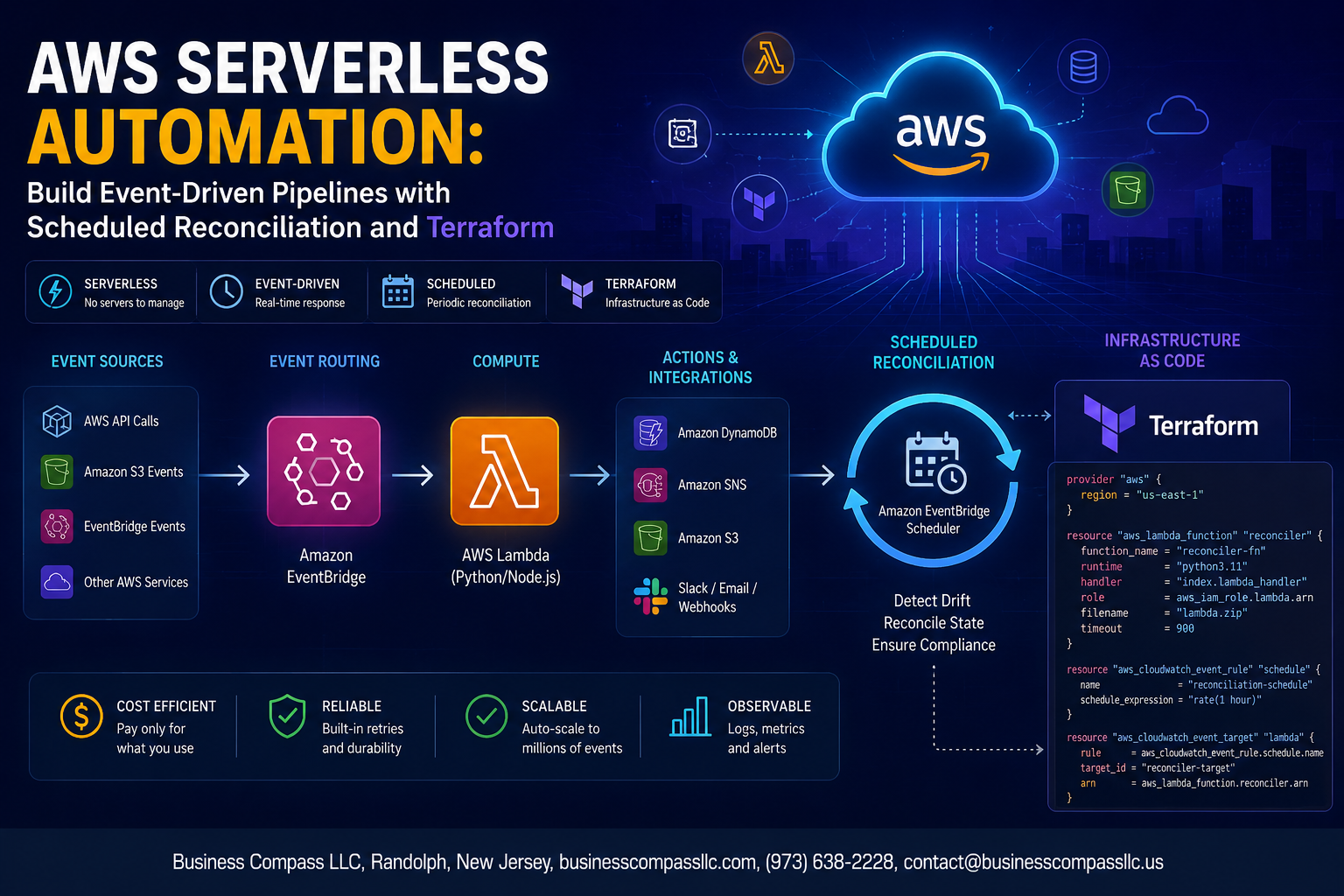
AWS Serverless Automation: Build Event-Driven Pipelines with Scheduled Reconciliation and Terraform
Running data pipelines that break at 2 AM gets old fast. If you’re a cloud engineer, DevOps practitioner, or backend developer tired of babysitting brittle workflows, AWS serverless automation gives you a smarter way to build systems that trigger, recover, and scale on their own — without a server humming in the background waiting for something to do.
This guide is built for teams already comfortable with AWS basics who want to level up their serverless pipeline architecture. No hand-wavy theory here — just a practical walkthrough you can actually use.
Here’s what we’re covering:
- How event-driven pipelines on AWS actually work — the core mechanics behind AWS Lambda event-driven execution and how events replace the need for constant polling
- Building and deploying your pipeline with Terraform — using Terraform infrastructure automation to spin up consistent, repeatable AWS environments without clicking through the console
- Keeping everything in sync with scheduled reconciliation — how scheduled reconciliation on AWS catches missed events, fixes drift, and keeps your pipeline honest over time
By the end, you’ll have a clear picture of how scalable serverless architecture comes together — from the first event trigger all the way through AWS pipeline monitoring and production-ready deployment.
Let’s get into it.
Understanding Event-Driven Pipelines on AWS

What Makes Event-Driven Architecture Ideal for Automation
AWS serverless automation shines when systems react to events instantly—no idle servers, no wasted costs. Event-driven pipelines AWS teams build trigger actions only when needed, keeping workflows lean and responsive.
Key AWS Services That Power Serverless Pipelines
- AWS Lambda handles compute
- EventBridge routes events
- SQS buffers messages
How Scheduled Reconciliation Strengthens Data Consistency
Scheduled reconciliation AWS catches missed events, fixing gaps automatically.
Designing Your Serverless Pipeline Architecture

Mapping Out Event Sources and Triggers
- S3 uploads, API Gateway calls, and DynamoDB streams kick off your pipeline
Structuring Lambda Functions for Maximum Efficiency
- Keep functions single-purpose; chain them loosely
Connecting Services with EventBridge
- Route events cleanly between services
Planning Reconciliation Windows
- Schedule periodic checks to catch dropped events
Implementing Scheduled Reconciliation with AWS

Using EventBridge Scheduler to Trigger Reconciliation Jobs
Schedule reconciliation jobs using EventBridge Scheduler with cron expressions targeting Lambda functions.
Building Idempotent Lambda Functions to Avoid Duplicate Processing
Use idempotency keys stored in DynamoDB to skip already-processed events.
Storing and Comparing State with DynamoDB for Accurate Reconciliation
- Track event states
- Compare snapshots to catch drift
Automating Infrastructure Deployment with Terraform

Setting Up Your Terraform Project Structure for AWS Serverless
Organize your Terraform AWS deployment into modules — one each for Lambda, EventBridge, and IAM. This keeps your serverless pipeline architecture clean and reusable across environments.
modules/lambdamodules/eventbridgemodules/iamenvs/dev,envs/prod
Monitoring and Optimizing Your Event-Driven Pipeline

Gaining Full Visibility with CloudWatch Logs and Metrics
Use CloudWatch to track Lambda invocations, errors, and duration across your AWS serverless automation pipeline.
Setting Up Alerts to Catch Pipeline Failures Early
- Create alarms on error rates and throttling
- Trigger SNS notifications instantly
Reducing Costs by Right-Sizing Lambda Configurations
Use Lambda Power Tuning to match memory to actual workload needs.
Scaling and Securing Your Serverless Automation

Applying Least-Privilege IAM Policies to Protect Resources
Grant Lambda only the exact permissions it needs—nothing more.
Handling High Event Volumes Without Performance Degradation
- Use SQS batching and reserved concurrency to stay stable under load.
Encrypting Data in Transit and at Rest
Use KMS keys across S3, SQS, and DynamoDB.
Auditing with AWS CloudTrail
Track every API call automatically.

Building event-driven pipelines on AWS doesn’t have to be overwhelming. By breaking it down into manageable pieces — designing a solid serverless architecture, setting up scheduled reconciliation, automating deployments with Terraform, and keeping a close eye on performance — you can create a system that runs efficiently without constant babysitting. The combination of AWS serverless tools and Terraform gives you the flexibility to scale fast while keeping your infrastructure consistent and repeatable.
Now it’s time to put this into action. Start small, maybe with a single pipeline, and layer in the monitoring, security, and scaling practices as you grow more comfortable. The beauty of this approach is that each piece builds on the last, so you’re never starting from scratch. If you haven’t already, spin up a test environment, experiment with the patterns covered here, and see how quickly your automation game levels up.