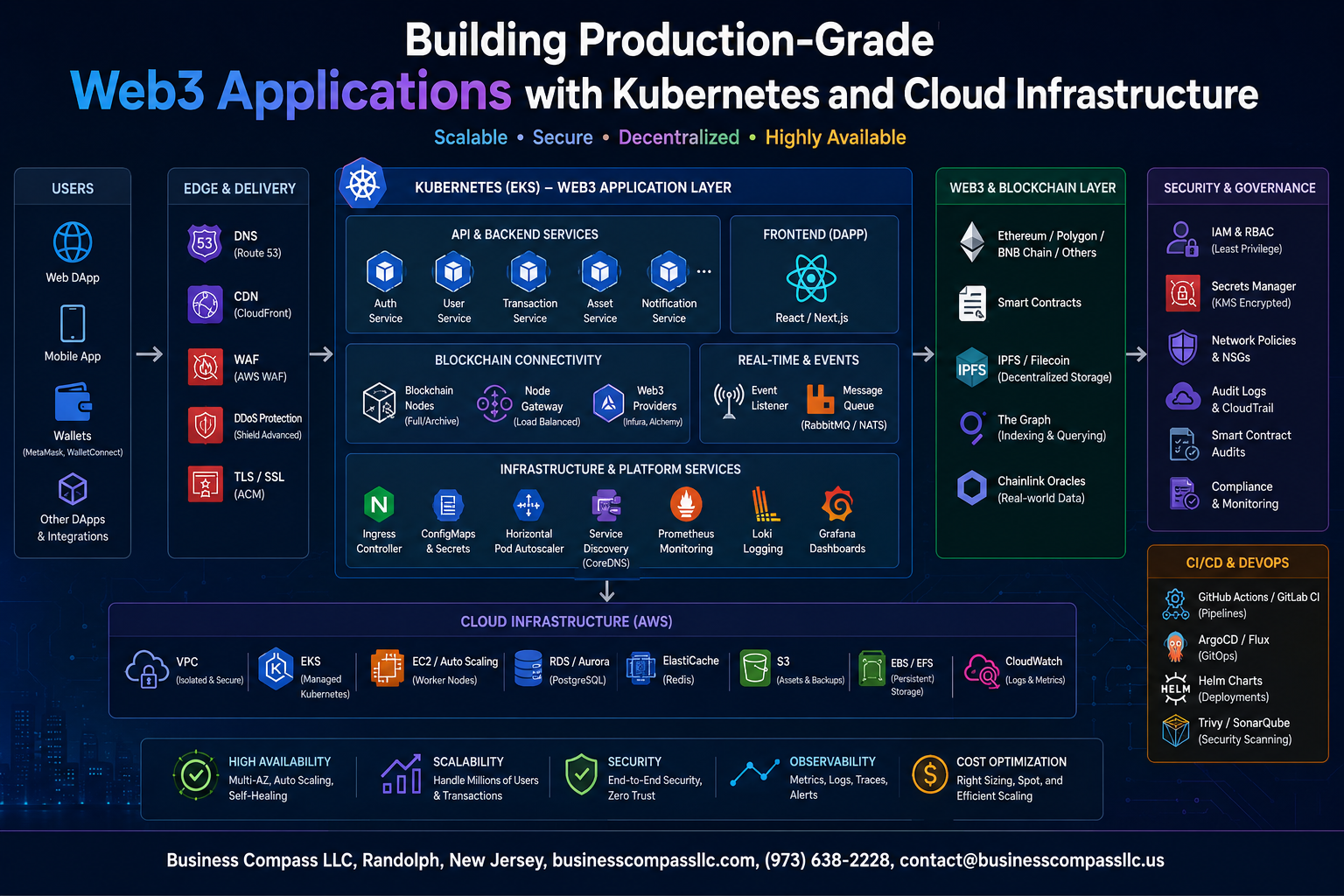
Stop Guessing, Start Shipping: Building Production-Grade Web3 Applications with Kubernetes and Cloud Infrastructure
Running a Web3 app in a local dev environment is one thing. Getting it to hold up under real traffic, chain reorganizations, and security pressure in production is a completely different game.
This guide is for blockchain engineers, DevOps teams, and full-stack developers who are done with fragile deployments and want a setup that actually scales. If you’re managing smart contract infrastructure, running blockchain nodes, or shipping decentralized apps to real users, this is written for you.
Here’s what we’ll walk through together:
- Kubernetes foundations for Web3 workloads — how to structure your cluster so it handles the quirky, stateful demands of blockchain node management on Kubernetes without falling apart
- Cloud infrastructure and resilience — the specific design decisions that keep your Web3 cloud infrastructure reliable when nodes go down, forks happen, or traffic spikes
- Security and observability — how to lock down your Kubernetes Web3 security posture end to end, and set up Web3 observability monitoring alongside a CI/CD pipeline that ships fast without breaking things
No fluff, no theory-only content. Just practical steps you can apply to a real production-grade Web3 application stack.
Understanding the Core Requirements of Production-Grade Web3 Applications

Key Differences Between Web3 and Traditional Web Application Architecture
Web3 applications aren’t just regular apps with a blockchain bolted on — they’re architecturally different from the ground up. Traditional web apps rely on centralized servers, databases, and authentication systems you fully control. Web3 apps split that trust across:
- Decentralized nodes that must stay synchronized with chain state
- Smart contracts that act as immutable backend logic
- Wallet-based authentication instead of username/password flows
- On-chain and off-chain data layers that need constant reconciliation
When you’re planning a production-grade Web3 application, you can’t treat blockchain nodes as simple microservices — they carry heavy storage requirements, unique networking needs, and strict uptime demands that most Kubernetes operators aren’t used to dealing with.
Critical Performance and Reliability Standards for Decentralized Apps
Decentralized app deployment on cloud infrastructure has to meet tighter reliability bars than most teams expect going in. A few numbers to keep in mind:
- Block propagation latency needs to stay under 500ms for smooth user-facing transaction feedback
- Node sync drift of even a few blocks can cause stale reads and failed transactions
- RPC endpoint availability should target 99.9%+ uptime — users don’t tolerate “blockchain unavailable” errors
- Multi-region redundancy isn’t optional for production; it’s the baseline
You should build your Kubernetes clusters with pod disruption budgets, liveness probes tuned to blockchain-specific health metrics, and horizontal pod autoscalers that account for sudden spikes during on-chain events like NFT drops or DeFi liquidations.
Security Considerations Unique to Blockchain-Based Systems
Kubernetes Web3 security goes beyond standard container hardening. The stakes are fundamentally different — a misconfigured secret or exposed private key doesn’t just leak data, it drains wallets and destroys trust instantly. Key areas to lock down:
- Private key management: Never store signing keys as Kubernetes secrets in plaintext. Use HSMs or dedicated vaults like HashiCorp Vault with strict access policies
- RPC endpoint exposure: Public or poorly authenticated RPC nodes are a direct attack surface — rate limiting and API gateway protection are non-negotiable
- Smart contract interaction: Validate all inputs at the infrastructure layer before they ever reach a contract call
- Node-to-node communication: Enforce mTLS between services that interact with blockchain nodes
- Supply chain risks: Blockchain client images (Geth, Nethermind, etc.) need regular patching and image signature verification
Scalability Challenges You Must Address Before Deployment
Kubernetes blockchain scalability isn’t just about adding more pods. The bottlenecks in Web3 infrastructure are different from typical web workloads:
- Storage I/O: Full Ethereum nodes can exceed 1TB and require high-throughput SSDs — standard cloud persistent volumes often fall short
- Stateful scaling: Blockchain nodes are stateful by nature, so horizontal scaling requires careful StatefulSet design with proper volume claim templates
- Chain reorganizations (reorgs): Your app layer needs to handle reorgs gracefully without surfacing errors to end users
- Gas price volatility: Transaction queuing systems need dynamic priority logic to avoid stuck transactions during network congestion
- Event indexing load: Real-time indexing of on-chain events (via tools like The Graph or custom indexers) can spike unpredictably and needs autoscaling headroom built in ahead of time
Getting these foundations right before your first production deployment saves enormous pain later — reengineering stateful Kubernetes workloads under live traffic is a nightmare nobody wants.
Setting Up a Robust Kubernetes Foundation for Web3 Workloads

Choosing the Right Kubernetes Distribution for Blockchain Node Management
Picking the right Kubernetes distribution for your Web3 Kubernetes deployment can make or break your blockchain infrastructure. Here’s what actually matters when comparing options:
- EKS (Amazon) – Great managed control plane, deep AWS integration, solid for teams already on AWS
- GKE (Google) – Best-in-class auto-scaling, Autopilot mode reduces ops overhead significantly
- AKS (Azure) – Strong Active Directory integration, good for enterprise Web3 teams
- Self-managed (kubeadm/k3s) – Maximum control, ideal when regulatory requirements demand on-prem blockchain node management on Kubernetes
- Rancher RKE2 – Security-hardened by default, popular in regulated industries running decentralized app deployment on cloud
For most production teams, a managed distribution wins because you skip fighting the control plane and focus on actual blockchain workloads.
Configuring Namespaces and Resource Quotas for Stable Operations
Namespaces are your first line of defense against noisy-neighbor problems across blockchain services. Structure them around workload type, not team names.
Recommended namespace layout:
blockchain-nodes– Ethereum, Solana, or other chain nodesindexers– The Graph nodes, custom indexersapi-services– RPC endpoints, REST APIsmonitoring– Prometheus, Grafana stack
Resource quota example for blockchain-nodes:
apiVersion: v1
kind: ResourceQuota
metadata:
  name: blockchain-nodes-quota
  namespace: blockchain-nodes
spec:
  hard:
    requests.cpu: "32"
    requests.memory: 128Gi
    limits.cpu: "64"
    limits.memory: 256Gi
    persistentvolumeclaims: "20"
Set LimitRange objects alongside quotas so individual pods can’t gobble up resources silently. Blockchain nodes — especially archive nodes — are notorious for memory spikes during sync, so leave headroom in your limits.
Implementing Persistent Storage Solutions for On-Chain Data
On-chain data storage is where most Web3 DevOps best practices get ignored until something breaks. Blockchain nodes need fast, durable, and often massive storage. Here’s how to approach it:
Storage class recommendations by node type:
| Node Type | Storage Class | Minimum IOPS | Size Range |
|---|---|---|---|
| Ethereum Full Node | SSD-backed (gp3/premium) | 3,000+ | 1–2 TB |
| Ethereum Archive Node | High-throughput HDD or NVMe | 5,000+ | 12–16 TB |
| Solana Validator | NVMe local SSD | 50,000+ | 2–4 TB |
| Light/RPC Node | Standard SSD | 1,000+ | 500 GB |
Key storage patterns that actually work in production:
- StatefulSets over Deployments – Always run blockchain nodes as StatefulSets; they get stable network identities and predictable PVC bindings
- Retain reclaim policy – Set
persistentVolumeReclaimPolicy: Retainso a pod crash doesn’t nuke your chain data - Volume snapshots – Schedule regular snapshots using
VolumeSnapshotresources; restoring from a snapshot beats resyncing from genesis - ReadWriteOnce access mode – Most blockchain clients don’t support concurrent writes, so
RWOis the right call
apiVersion: storage.k8s.io/v1
kind: StorageClass
metadata:
  name: blockchain-ssd
provisioner: ebs.csi.aws.com
parameters:
  type: gp3
  iops: "6000"
  throughput: "250"
reclaimPolicy: Retain
volumeBindingMode: WaitForFirstConsumer
allowVolumeExpansion: true
Enabling allowVolumeExpansion: true saves you from the painful exercise of migrating data when your node outgrows its original disk allocation — and it will outgrow it.
Deploying and Managing Blockchain Nodes on Kubernetes

Containerizing Ethereum and Other Blockchain Clients Efficiently
Packaging blockchain clients like Geth, Erigon, or Lighthouse into Docker containers is straightforward when you treat each client as a stateless process wrapper around persistent data. Use minimal base images — Alpine or distroless variants — to shrink attack surfaces and pull times. Pin exact client versions in your Dockerfile to avoid surprise breaking changes during automated builds.
- Always separate the client binary from chain data using mounted volumes
- Use multi-stage builds to keep image sizes lean and predictable
- Store images in a private registry with vulnerability scanning enabled (Harbor or ECR work well)
- Define resource requests and limits explicitly — blockchain clients are notoriously hungry for CPU and memory during sync
Using StatefulSets to Maintain Node Identity and Data Integrity
Blockchain nodes are not interchangeable replicas — each one holds a specific chain state and peer identity, which makes StatefulSets the right Kubernetes primitive for the job. Unlike Deployments, StatefulSets give each pod a stable network identity and a dedicated PersistentVolumeClaim that survives pod restarts and rescheduling.
- Name pods predictably (e.g.,
eth-node-0,eth-node-1) so peer discovery configs stay consistent - Use
volumeClaimTemplatesto provision high-IOPS storage (SSD-backed StorageClasses likepd-ssdon GKE orgp3on EKS) per node - Set
podManagementPolicy: Parallelonly when nodes are independent — for validator clients, keep the default ordered startup - Back up PVCs regularly using tools like Velero or cloud-native snapshot APIs
Automating Node Synchronization and Health Monitoring
Blockchain node synchronization is a long-running, resource-intensive process, and without proper automation it becomes a manual bottleneck. Kubernetes readiness and liveness probes are your first line of defense, but blockchain clients expose JSON-RPC endpoints that give you much richer health signals.
- Configure readiness probes to check sync status via
eth_syncing— reject traffic until the node is fully synced - Use liveness probes sparingly; a restarting syncing node wastes hours of work
- Deploy a sidecar container (like
eth-monitoror a custom script) to continuously pollnet_peerCountandeth_blockNumber, pushing metrics to Prometheus - Set up alerting rules for peer count drops below a threshold and block height lag compared to chain tip
- Tools like Ethereum Node Metrics Exporter plug directly into Grafana dashboards for real-time visibility — a must-have for production-grade Web3 applications
Optimizing Pod Scheduling for High-Availability Node Clusters
Running multiple blockchain nodes on the same underlying host defeats the purpose of redundancy. Kubernetes scheduling controls let you spread nodes across failure domains without manual placement decisions.
- Use
podAntiAffinityrules withtopologyKey: kubernetes.io/hostnameto ensure no two node pods land on the same machine - Apply
topologySpreadConstraintsacross availability zones for cross-AZ resilience in cloud infrastructure Web3 setups - Use dedicated node pools with taints and tolerations to isolate blockchain workloads from application pods — this prevents noisy-neighbor resource contention
- Label nodes by their role (
blockchain-node,validator,rpc-endpoint) and usenodeSelectorto match workloads precisely - Request guaranteed QoS class by setting equal resource requests and limits on node pods — this protects them from eviction during cluster pressure
Managing Node Upgrades Without Disrupting Live Applications
Upgrading a blockchain client in production is genuinely risky — a bad release can cause missed attestations, stalled RPC responses, or worse, database corruption. A structured rollout process inside Kubernetes removes most of that risk.
- Use rolling updates on StatefulSets with
maxUnavailable: 1so at least one healthy node always serves traffic - Keep a standby node fully synced before triggering any upgrade — this gives you an instant fallback
- Gate upgrades behind a feature flag or a manual approval step in your CI/CD pipeline (Argo CD’s sync waves work well here)
- Test new client images against a staging cluster that mirrors mainnet data before touching production
- Maintain a rollback-ready image tag in your Helm values file — one
helm rollbackcommand should restore the previous working state within minutes
Building a Resilient Cloud Infrastructure for Web3 Services

Selecting the Best Cloud Provider for Decentralized Workloads
Picking the right cloud provider for your cloud infrastructure Web3 setup isn’t just about price — it’s about which platform gives your decentralized workloads the most breathing room. Here’s what actually matters when comparing providers:
- AWS offers the widest global region coverage and battle-tested managed services like EKS, making it a go-to for teams already deep in the AWS ecosystem
- Google Cloud (GKE) shines with its networking performance and tight Kubernetes integration — GKE Autopilot is genuinely impressive for reducing node management headaches
- Azure (AKS) works best if your org has existing Microsoft licensing or enterprise agreements
- Multi-cloud setups using providers like Equinix Metal or Bare Metal servers give you the raw performance blockchain nodes often demand, without noisy-neighbor issues on shared hypervisors
For decentralized app deployment on cloud, prioritize providers with:
- Low-latency networking between regions
- Strong compliance posture (SOC 2, ISO 27001)
- Native support for persistent, high-IOPS storage (critical for chain data)
Designing Multi-Region Architectures to Eliminate Single Points of Failure
A single-region deployment is a ticking clock for production Web3 apps. When a region goes down — and it will — your nodes go dark, transactions fail, and users lose trust fast. Multi-region design fixes this.
Core patterns to follow:
- Active-Active setup: Run blockchain nodes and API services across at least two regions simultaneously. Traffic gets load-balanced and either region can handle the full load independently
- Active-Passive failover: A simpler option where a standby region takes over if the primary fails — lower cost, but with some recovery lag
- Global load balancing: Tools like AWS Global Accelerator, Cloudflare, or GCP’s Global Load Balancer route users to the nearest healthy endpoint automatically
Key components to replicate across regions:
- Blockchain node clusters (full nodes, archive nodes)
- RPC endpoints and API gateways
- Secret stores and configuration management
- Monitoring stacks
One often-missed detail: blockchain nodes need peer discovery configured correctly across regions. Use static peer lists and private networking (VPC peering or Transit Gateway) so your nodes stay in sync without exposing internal traffic to the public internet.
Leveraging Managed Services to Reduce Operational Overhead
Running everything from scratch sounds like control — but it’s mostly just extra work. Managed services let your team focus on building, not babysitting infrastructure. Here’s where they genuinely pay off in a Web3 Kubernetes deployment:
| Service Type | Managed Option | Why It Helps |
|---|---|---|
| Kubernetes Control Plane | EKS, GKE, AKS | No etcd management, automatic upgrades |
| Databases | AWS RDS, Cloud Spanner | Automated backups, high-availability out of the box |
| Secret Management | AWS Secrets Manager, HashiCorp Vault (managed) | Centralized key rotation without custom tooling |
| Message Queues | Amazon SQS, GCP Pub/Sub | Reliable event delivery for on-chain event processing |
| Observability | Datadog, Grafana Cloud | Prebuilt dashboards, alerting without self-hosted overhead |
For blockchain node management on Kubernetes, consider managed node providers like Chainstack, QuickNode, or Alchemy for non-critical RPC calls. This offloads archive node storage costs (which can run into multiple terabytes) while keeping your own nodes reserved for sensitive or high-frequency operations.
Optimizing Cloud Costs Without Sacrificing Performance
Cloud bills for Web3 infrastructure can spiral quickly — especially with the storage demands of full and archive blockchain nodes. The good news: smart architecture cuts costs without cutting corners on performance.
Compute cost strategies:
- Use Spot/Preemptible instances for stateless workloads like indexers, API replicas, and batch processors — just never for primary blockchain nodes
- Right-size your node groups using Kubernetes Vertical Pod Autoscaler (VPA) to automatically adjust resource requests based on real usage data
- Schedule non-critical workloads during off-peak hours using Kubernetes CronJobs
Storage cost strategies:
- Tier your chain data: keep recent blocks on fast SSD storage, archive older data to cheaper object storage (S3, GCS)
- Use Volume Snapshots instead of full backups — they’re faster and cheaper for large chain datasets
- Set PersistentVolume reclaim policies carefully to avoid paying for orphaned disks
Networking cost strategies:
- Keep inter-service traffic within the same availability zone where possible — cross-AZ data transfer fees add up fast
- Use VPC endpoints or Private Service Connect to avoid routing traffic through public internet gateways
A healthy habit: run weekly cost reports per namespace using tools like Kubecost or OpenCost. Breaking down spend by team, environment, and workload type makes it obvious where money is being wasted — and gives you clear targets to optimize.
Securing Your Web3 Kubernetes Deployment End to End

Managing Private Keys and Secrets Safely with Vault and Kubernetes Secrets
Keeping private keys safe in a Web3 Kubernetes deployment is non-negotiable. A leaked signing key can drain wallets, compromise smart contracts, and destroy user trust overnight. Here’s how to handle secrets the right way:
- HashiCorp Vault is the go-to solution for dynamic secret generation, key rotation, and audit logging. Deploy it as a sidecar or use the Vault Agent Injector to deliver secrets directly into pods without ever writing them to disk.
- Kubernetes Secrets work fine for low-sensitivity configs but should always be encrypted at rest using a KMS provider like AWS KMS, GCP Cloud KMS, or Azure Key Vault.
- Never bake private keys into Docker images or environment variables in plain YAML. Use
secretKeyRefand mount secrets as in-memorytmpfsvolumes. - Enable envelope encryption in your Kubernetes API server so secrets stored in etcd are protected by an external encryption key.
- Rotate keys regularly and use Vault’s dynamic secrets feature to generate short-lived credentials for RPC endpoints, databases, and signing services.
Enforcing Network Policies to Isolate Sensitive Blockchain Components
Blockchain nodes handle high-value transactions, so open internal network access is a serious risk. Kubernetes NetworkPolicy resources let you define exactly which pods can talk to each other.
- Isolate validator nodes from public-facing services. Only allow inbound connections from designated relayer or sequencer pods.
- Use namespace-level segmentation to separate your blockchain node layer, application layer, and monitoring stack. Cross-namespace traffic should be explicitly whitelisted.
- Block all egress by default and only open outbound traffic to known peer nodes, RPC providers, and oracle endpoints.
- Consider a service mesh like Istio or Cilium for Layer 7 network policies. Cilium especially shines in cloud infrastructure Web3 setups because it can enforce policies based on Ethereum addresses and transaction types.
- Regularly audit your NetworkPolicy rules — gaps here are a common attack vector in production-grade Web3 applications.
Implementing Role-Based Access Control for Cluster and Smart Contract Operations
RBAC is your first line of defense against insider threats and accidental misconfigurations in your Web3 DevOps workflow.
- Define least-privilege roles for every team member. Developers shouldn’t have cluster-admin access in production — ever.
- Create separate
ClusterRolesfor:- Node operators managing blockchain node management on Kubernetes
- Smart contract deployers with access only to deployment namespaces
- Monitoring teams with read-only access to logs and metrics
- Use ServiceAccounts for all workloads. Avoid sharing service accounts across namespaces or assigning default accounts elevated permissions.
- Tie Kubernetes RBAC to your identity provider (Okta, Azure AD, Google Workspace) using OIDC so access is tied to real identities and automatically revoked when team members leave.
- For smart contract operations, layer on on-chain governance controls — multisig wallets, timelocks, and proposal-based upgrade patterns — so no single key or operator can push changes unilaterally.
Conducting Regular Security Audits and Vulnerability Scans
Security in Kubernetes Web3 security isn’t a one-time setup — it’s an ongoing practice. Here’s what a solid audit rhythm looks like:
- Container image scanning: Use tools like Trivy, Snyk, or Anchore in your CI/CD pipeline to catch vulnerable dependencies before they reach production. This fits naturally into a CI/CD pipeline Web3 Kubernetes workflow.
- CIS Kubernetes Benchmark: Run
kube-benchregularly to check your cluster configuration against industry best practices. Fix critical findings before they become incidents. - Penetration testing: Schedule external pen tests at least quarterly, focusing on RPC endpoints, wallet signing services, and bridge contracts — the highest-value targets in any decentralized app deployment on cloud.
- Runtime security: Deploy Falco to detect anomalous behavior at runtime — unexpected shell access inside a node pod, unusual network calls, or privilege escalation attempts.
- Smart contract audits: Get third-party auditors to review contract code before major deployments. Tools like Slither and MythX can automate a first pass but don’t replace human review.
- Keep a security runbook that documents your response steps for common incidents like key compromise, node takeover, or DDoS on RPC endpoints.
Achieving Observability and Continuous Delivery in Web3 Environments

Setting Up Monitoring and Alerting for Blockchain Node Performance
Running blockchain nodes without solid monitoring is like driving blindfolded. You need real-time visibility into peer counts, block sync lag, transaction pool sizes, and RPC response times. Tools like Prometheus and Grafana pair naturally with Kubernetes, scraping node metrics via exporters.
Key metrics to track per node:
- Block height lag — how far behind the node is from the chain tip
- Peer connection count — drops here often signal networking or firewall issues
- Transaction pool depth — sudden spikes can indicate mempool congestion or spam attacks
- RPC latency percentiles (p95, p99) — critical for dApp responsiveness
Set up AlertManager rules that page your on-call team when sync falls behind by more than 10 blocks, or when peer count drops below a healthy threshold. Kubernetes liveness and readiness probes should also reflect actual node health, not just process uptime.
Tracking On-Chain and Off-Chain Metrics with Unified Dashboards
Web3 observability means watching two worlds at once — what’s happening on the blockchain and what’s happening inside your infrastructure. Grafana dashboards work great here because you can pull data from multiple sources into one place.
On-chain metrics to capture:
- Gas prices and base fee trends
- Smart contract event emission rates
- Wallet interaction volumes
- Failed transaction ratios
Off-chain infrastructure metrics:
- Kubernetes pod CPU and memory usage per node type
- Persistent volume I/O latency (especially critical for archive nodes)
- API gateway request rates and error budgets
- Cache hit/miss ratios for RPC response caching layers
Tools like The Graph or custom indexers can surface contract-level activity and feed it directly into dashboards alongside your Kubernetes cluster metrics. This unified view is what separates teams that react to problems from teams that catch them before users ever notice. Web3 observability monitoring done right means your on-call engineer sees the full picture — not just half of it.
Building CI/CD Pipelines Tailored for Smart Contract and App Deployments
A CI/CD pipeline for Web3 is a bit different from standard software delivery. Smart contracts are immutable once deployed, so your pipeline needs extra checkpoints that traditional app pipelines skip entirely.
A solid CI/CD pipeline for Web3 Kubernetes deployment typically looks like this:
- Code commit triggers pipeline — GitHub Actions, GitLab CI, or Tekton on Kubernetes
- Static analysis and linting — Slither, MythX, or Semgrep for Solidity security scanning
- Unit and integration tests — Hardhat or Foundry test suites run against local fork environments
- Testnet deployment gate — contracts deploy to a staging testnet, smoke tests verify core flows
- Manual approval checkpoint — smart contract upgrades should never auto-deploy to mainnet
- Infrastructure apply via Helm/ArgoCD — Kubernetes workloads update through GitOps workflows
- Post-deploy verification — on-chain state checks confirm the deployment landed correctly
For the application layer, ArgoCD handles GitOps-style delivery cleanly, syncing Helm chart changes to your cluster automatically. Pair it with Kustomize overlays per environment so your staging and production configs stay clean and auditable. This approach covers the full CI/CD pipeline Web3 Kubernetes stack needs for safe, repeatable releases.
Using Chaos Engineering to Validate System Resilience Before Launch
You don’t want to discover that your blockchain node setup falls apart during a network spike when real users are affected. Chaos engineering lets you break things intentionally in a controlled way so you can fix gaps before they become incidents.
Practical chaos experiments for Web3 infrastructure:
- Kill random validator or RPC node pods — does your load balancer route around them cleanly?
- Simulate network partition between nodes — do nodes re-peer gracefully, or do they stall?
- Throttle persistent volume I/O — how does your node handle slow disk during high write loads?
- Inject high CPU load on indexer pods — does your alerting catch degradation before it hits users?
- Drain a full Kubernetes node — do stateful node workloads reschedule and recover data integrity?
Tools like Chaos Mesh or LitmusChaos run directly inside Kubernetes and let you scope experiments to specific namespaces so production isn’t touched. Run these experiments on a staging environment that mirrors production as closely as possible, then document what broke and why. Teams that skip this step almost always regret it during their first high-traffic event on mainnet.

Running Web3 applications in production is no small feat, but Kubernetes and cloud infrastructure give you the tools to do it right. From setting up a solid Kubernetes foundation to deploying blockchain nodes, building resilient cloud infrastructure, locking down security, and getting full visibility into your systems — each piece plays a critical role in keeping your Web3 apps running smoothly at scale.
The good news is that you don’t have to figure it all out at once. Start with the basics, get your infrastructure stable, and layer in security and observability as you grow. The teams that win in Web3 are the ones that treat their infrastructure as seriously as their smart contracts. So take what you’ve learned here, start building, and don’t be afraid to iterate as your needs evolve.