Artificial intelligence and machine learning are reshaping how we work, shop, and live—but the technical jargon can make these technologies feel intimidating and out of reach.
This guide breaks down artificial intelligence basics and machine learning fundamentals for beginners, professionals, and anyone curious about how these systems actually work. You don’t need a computer science degree to understand what artificial intelligence really means or grasp how machine learning impacts your daily routine.
We’ll explore the key differences between AI and machine learning, helping you cut through the confusion and understand what each technology does. You’ll also discover how AI and ML systems learn from data and make decisions, plus see real examples of AI applications already working behind the scenes in your favorite apps and services.
By the end, you’ll have a solid foundation in AI terminology and understand how machine learning explained in simple terms can help you navigate our increasingly automated world.
What Artificial Intelligence Really Means for Your Daily Life

Defining AI in Simple, Practical Terms
Artificial intelligence basics come down to one core concept: creating machines that can think and make decisions like humans. Think of AI as digital brain power that helps computers recognize patterns, solve problems, and learn from experience. Instead of following rigid programming instructions, AI systems adapt and improve based on the information they process.
At its heart, AI mimics human cognitive abilities like learning, reasoning, and decision-making. When you ask Siri a question or get Netflix recommendations tailored to your taste, you’re experiencing AI that processes information, understands context, and provides relevant responses. The technology analyzes massive amounts of data to identify patterns humans might miss, then uses those insights to make predictions or suggestions.
What is artificial intelligence in everyday language? It’s software that gets smarter over time. Unlike traditional programs that only do exactly what they’re programmed to do, AI systems observe, learn, and adjust their behavior. They can handle uncertainty, work with incomplete information, and even surprise their creators with creative solutions.
How AI Already Powers Your Smartphone and Apps
Your smartphone runs on artificial intelligence from the moment you wake up. Voice assistants like Siri, Google Assistant, and Alexa use natural language processing to understand your questions and provide answers. They don’t just match keywords – they grasp context, tone, and intent.
Machine learning in daily life shows up in countless ways through your apps:
- Photo apps automatically organize pictures by recognizing faces, locations, and objects
- Maps predict traffic patterns and suggest faster routes based on real-time data
- Email filters learn to identify spam by analyzing message patterns
- Shopping apps recommend products based on your browsing and purchase history
- Social media platforms curate your feed using algorithms that learn your preferences
- Banking apps detect fraudulent transactions by spotting unusual spending patterns
Your camera app uses AI to enhance photos automatically, adjusting lighting, focus, and color balance in milliseconds. Predictive text learns your writing style and suggests words before you finish typing. Even your phone’s battery management system uses AI to optimize power consumption based on your usage patterns.
Music streaming services analyze your listening habits, time of day, and even your location to create personalized playlists. Dating apps use machine learning algorithms to suggest potential matches based on preferences, behavior patterns, and compatibility metrics.
The Difference Between AI in Movies and Real-World Applications
Hollywood presents AI as either helpful robots or world-ending threats, but real artificial intelligence looks nothing like the movies. Cinema AI typically features human-like consciousness, emotions, and the ability to instantly become superintelligent. These fictional AIs can understand any topic, control all technology simultaneously, and make complex moral decisions.
Real-world AI applications are much more specialized and practical. Current AI systems excel at specific tasks but struggle with general intelligence. A chess-playing AI can’t suddenly start diagnosing diseases or writing poetry. Each AI system is designed for particular problems and trained on relevant data.
Movie AI often displays these unrealistic traits:
- Instant learning across all subjects
- Emotional understanding and human-like consciousness
- Perfect decision-making without errors or bias
- Universal connectivity to all digital systems
- Self-awareness and independent goals
Actual AI systems work more like specialized tools:
- Narrow focus on specific problems or domains
- Data-dependent performance that varies with training quality
- Probabilistic outputs rather than absolute certainty
- Human oversight required for important decisions
- Limited understanding outside their training scope
The gap between expectation and reality often leads to both unrealistic fears and overblown expectations about what AI can accomplish today.
Why Understanding AI Gives You a Competitive Edge
Grasping artificial intelligence fundamentals positions you ahead in almost every industry. As AI becomes more prevalent, professionals who understand its capabilities and limitations make better strategic decisions, identify opportunities others miss, and communicate more effectively with technical teams.
Career advantages multiply when you understand how AI impacts your field. Marketing professionals who grasp machine learning can better interpret campaign analytics and customer behavior predictions. Healthcare workers familiar with AI applications can leverage diagnostic tools more effectively. Financial professionals who understand algorithmic trading and risk assessment systems make more informed investment decisions.
Business leaders with AI knowledge can:
- Identify automation opportunities that reduce costs and improve efficiency
- Ask better questions when evaluating AI vendors and solutions
- Spot emerging trends before competitors recognize them
- Make informed decisions about AI investments and implementations
- Bridge communication gaps between technical and business teams
Understanding AI also helps you protect against its misuse. You’ll recognize when claims about AI capabilities seem exaggerated, understand privacy implications of data collection, and make better personal decisions about which AI-powered services to trust with your information.
The competitive edge extends beyond professional benefits. AI literacy helps you adapt to rapid technological changes, understand news about AI developments, and make informed choices as both a consumer and citizen in an increasingly AI-driven world.
Machine Learning Fundamentals That Anyone Can Grasp

Breaking Down Machine Learning Without Technical Jargon
Think of machine learning as teaching a computer to recognize patterns, just like how you learned to spot your favorite song within the first few notes. When you were a kid, you probably couldn’t identify songs instantly, but after hearing thousands of them, your brain developed the ability to recognize melodies, rhythms, and artists almost immediately.
Machine learning fundamentals work exactly the same way. Instead of cramming rules and instructions into a computer’s memory, we feed it tons of examples and let it figure out the patterns on its own. The computer looks at all this information, finds connections that might not be obvious to humans, and then uses these discoveries to make predictions about new, unseen data.
What makes this approach so powerful is that the machine doesn’t just memorize answers – it actually learns to understand the underlying relationships in the data. This means it can handle situations it has never encountered before, as long as they follow similar patterns to what it learned during training.
The beauty of machine learning explained in simple terms is that you don’t need to understand complex algorithms to grasp the core concept. You already use pattern recognition every day when you decide what to wear based on the weather, choose a restaurant based on past experiences, or recognize a friend’s voice over the phone.
How Machines Actually Learn from Data
Picture a child learning to distinguish between cats and dogs. At first, they might call every four-legged animal a “doggie.” But as parents show them more examples – pointing out the differences in ears, tails, sounds, and behaviors – the child’s brain starts building a mental model of what makes a cat a cat and a dog a dog.
Machine learning works through this same process of exposure and correction. We show the computer thousands of labeled examples: “This is a cat, this is a dog, this is also a cat.” The algorithm analyzes every pixel, every shape, every color combination, looking for patterns that consistently appear in cat photos versus dog photos.
How does machine learning work in practice? The computer creates mathematical representations of these patterns, essentially building its own internal rulebook. When you show it a new photo, it compares what it sees against these learned patterns and makes its best guess.
The learning happens through constant feedback. When the machine gets something wrong, the algorithm adjusts its internal rules slightly. Get enough feedback over enough examples, and these tiny adjustments add up to remarkably accurate predictions. Modern systems can process millions of examples in hours, developing pattern recognition abilities that often surpass human capabilities in specific domains.
What’s fascinating is that machines often discover patterns humans miss entirely. They might notice that cats in photos tend to have a specific pixel intensity ratio in their eyes, or that certain combinations of features predict outcomes better than others.
Common Types of Machine Learning You Encounter Daily
You interact with machine learning in daily life far more than you realize. That morning when you open Netflix and see personalized recommendations, machine learning algorithms are analyzing your viewing history, comparing it to millions of other users, and predicting what you’ll enjoy watching next.
Supervised learning powers most of the obvious applications around you. Email spam filters learn from millions of examples of spam versus legitimate emails. Your phone’s camera recognizes faces because it was trained on countless labeled photos. Voice assistants understand your commands because they learned from massive datasets of spoken words paired with their written transcripts.
Unsupervised learning works behind the scenes in more subtle ways. When you shop online and see “customers who bought this item also bought,” that’s machine learning finding hidden patterns in purchasing behavior without anyone telling it what to look for. Credit card fraud detection uses similar techniques, identifying unusual spending patterns that deviate from your normal behavior.
Reinforcement learning shows up in recommendation systems that get better over time. Music streaming apps notice when you skip songs versus when you replay them, constantly adjusting to improve their suggestions. GPS navigation learns from real-time traffic data and millions of route choices to find optimal paths.
Social media feeds use all three types simultaneously – analyzing your interactions, finding patterns in similar users’ behavior, and continuously adjusting what content to show you based on your engagement. Even your smartphone keyboard learns your typing patterns and suggests words you’re likely to use next.
Key Differences Between AI and Machine Learning Explained
Why These Terms Are Often Confused
The AI vs ML difference gets muddled because these technologies work so closely together that people use them interchangeably. Marketing teams don’t help either – they slap “AI-powered” on everything from coffee makers to spreadsheet software. This creates a fog around what each term actually means.
Most people encounter machine learning through AI applications without realizing there’s a distinction. When Netflix suggests your next binge-watch or your phone recognizes your face, you’re experiencing machine learning at work, but companies brand it as artificial intelligence. The confusion deepens because machine learning is the driving force behind many modern AI breakthroughs, making the lines seem blurry.
Media coverage adds another layer of confusion by treating these terms as synonyms. News articles about self-driving cars might mention “AI technology” and “machine learning algorithms” in the same breath, assuming readers understand they’re talking about related but different concepts.
How Machine Learning Fits Within the AI Umbrella
Think of artificial intelligence basics like this: AI is the big tent, and machine learning is one of the most important sections inside it. Artificial intelligence encompasses any system that can perform tasks requiring human-like intelligence – reasoning, learning, perception, and decision-making.
Machine learning represents a specific approach to achieving AI. Instead of programming every possible rule and response, ML systems learn patterns from data and improve their performance over time. This makes machine learning a subset of AI, not a competing technology.
Other AI approaches exist alongside machine learning:
- Rule-based systems that follow pre-programmed logic
- Expert systems that mimic human expertise in specific domains
- Natural language processing that helps computers understand human language
- Computer vision that interprets visual information
Machine learning fundamentals have become so effective that they now power most modern AI applications. The relationship is symbiotic – AI provides the goal (intelligent behavior), while machine learning provides the method (learning from data).
Real Examples That Show the Distinction Clearly
A chess computer from the 1990s demonstrates classic AI without machine learning. Deep Blue beat world champion Garry Kasparov using brute force calculation and pre-programmed chess knowledge. Engineers coded specific strategies and rules, but the system never learned from games or improved beyond its original programming.
Compare this to modern chess engines like AlphaZero, which uses machine learning. Instead of being taught chess rules and strategies, AlphaZero learned by playing millions of games against itself. It discovered winning patterns through experience, eventually developing strategies that surprised even chess masters.
Smart thermostats show another clear distinction. A basic programmable thermostat follows simple AI – it makes decisions based on time and temperature rules you set. A learning thermostat like Nest uses machine learning to study your habits, preferences, and home patterns, automatically adjusting to optimize comfort and energy usage.
Voice assistants highlight both technologies working together. The ability to understand speech and respond appropriately represents artificial intelligence. The improvement in recognition accuracy as the system encounters more accents and speaking patterns shows machine learning in action.
Which Term to Use in Different Situations
Choose “artificial intelligence” when discussing the broader capability or end result. Say “AI-powered customer service” when describing a chatbot’s ability to help customers, regardless of the underlying technology. Use AI when talking about the vision or goal – creating systems that think and act intelligently.
Pick “machine learning” when the learning process matters. Describe “machine learning algorithms” when explaining how a system improves over time. Use ML when discussing data requirements, training processes, or algorithmic approaches. Say “our machine learning model” when referring to a specific trained system.
In business contexts, AI sounds more strategic and forward-thinking. “Our AI strategy” captures executive attention better than “our machine learning implementation.” For technical discussions, machine learning shows you understand the nuts and bolts of how intelligent systems actually work.
When writing about machine learning explained for beginners, focus on the learning aspect. When covering what is artificial intelligence broadly, emphasize the intelligent behavior and human-like capabilities these systems demonstrate.
How AI and ML Systems Learn and Make Decisions
The Step-by-Step Process of Machine Learning
Machine learning fundamentals follow a predictable pattern that mirrors how humans learn new skills. First, the system receives massive amounts of data – think thousands of images, text documents, or numerical records. This raw information gets preprocessed and cleaned, removing errors and inconsistencies that could confuse the learning process.
Next comes pattern recognition. The algorithm analyzes the data to identify relationships and recurring themes. For example, when learning to recognize cats in photos, the system notices that felines typically have pointed ears, whiskers, and specific eye shapes. These patterns become the foundation for future predictions.
The training phase involves repeatedly exposing the algorithm to examples while providing correct answers. Each iteration refines the system’s understanding, gradually improving accuracy. Finally, the model gets tested on fresh data it hasn’t seen before to verify its performance.
Understanding Training Data and Its Impact on Results
Training data acts as the foundation for how does machine learning work effectively. Quality matters more than quantity – biased or incomplete datasets create AI systems that perpetuate those same limitations.
Consider a hiring algorithm trained primarily on resumes from one demographic group. The system learns to favor similar profiles, inadvertently discriminating against qualified candidates from different backgrounds. This demonstrates how training data directly shapes decision-making patterns.
The diversity of examples also affects performance. An image recognition system trained only on photos taken in daylight might struggle with nighttime scenes. Similarly, language models trained predominantly on formal text may have difficulty understanding casual conversation or regional dialects.
Data labeling accuracy proves equally critical. Incorrectly tagged examples teach the system wrong associations, leading to systematic errors that compound over time.
Why Some AI Systems Make Mistakes
AI errors stem from several predictable sources that help explain artificial intelligence for beginners. Limited training scenarios create blind spots where systems encounter situations they’ve never learned to handle properly.
Correlation versus causation presents another challenge. AI might notice that ice cream sales and drowning incidents both increase during summer, incorrectly linking frozen treats to water accidents rather than recognizing warm weather as the common factor.
Adversarial examples exploit system vulnerabilities through carefully crafted inputs designed to fool algorithms. A few strategically placed stickers on a stop sign might cause an autonomous vehicle to misclassify it as a speed limit sign.
Edge cases – unusual situations that rarely appear in training data – often trigger unexpected behaviors. Real-world complexity exceeds what any training dataset can fully capture.
How Feedback Loops Improve AI Performance Over Time
Machine learning systems become smarter through continuous feedback cycles that mirror natural learning processes. When users correct mistakes or confirm accurate predictions, the system updates its internal parameters to perform better next time.
Reinforcement learning takes this concept further by rewarding good decisions and penalizing poor ones. Gaming AI learns winning strategies by playing millions of matches, gradually discovering effective moves through trial and error.
Online learning enables real-time adaptation as new information becomes available. Search engines constantly refine results based on user clicks and interactions, while recommendation systems adjust suggestions based on viewing patterns.
However, feedback loops can sometimes reinforce problems. If users consistently click on sensationalized content, recommendation algorithms learn to prioritize drama over accuracy. This shows why human oversight remains essential even as systems become more sophisticated.
Regular model retraining with fresh data helps prevent performance degradation and keeps systems current with changing conditions.
Real-World Applications Transforming Industries Today
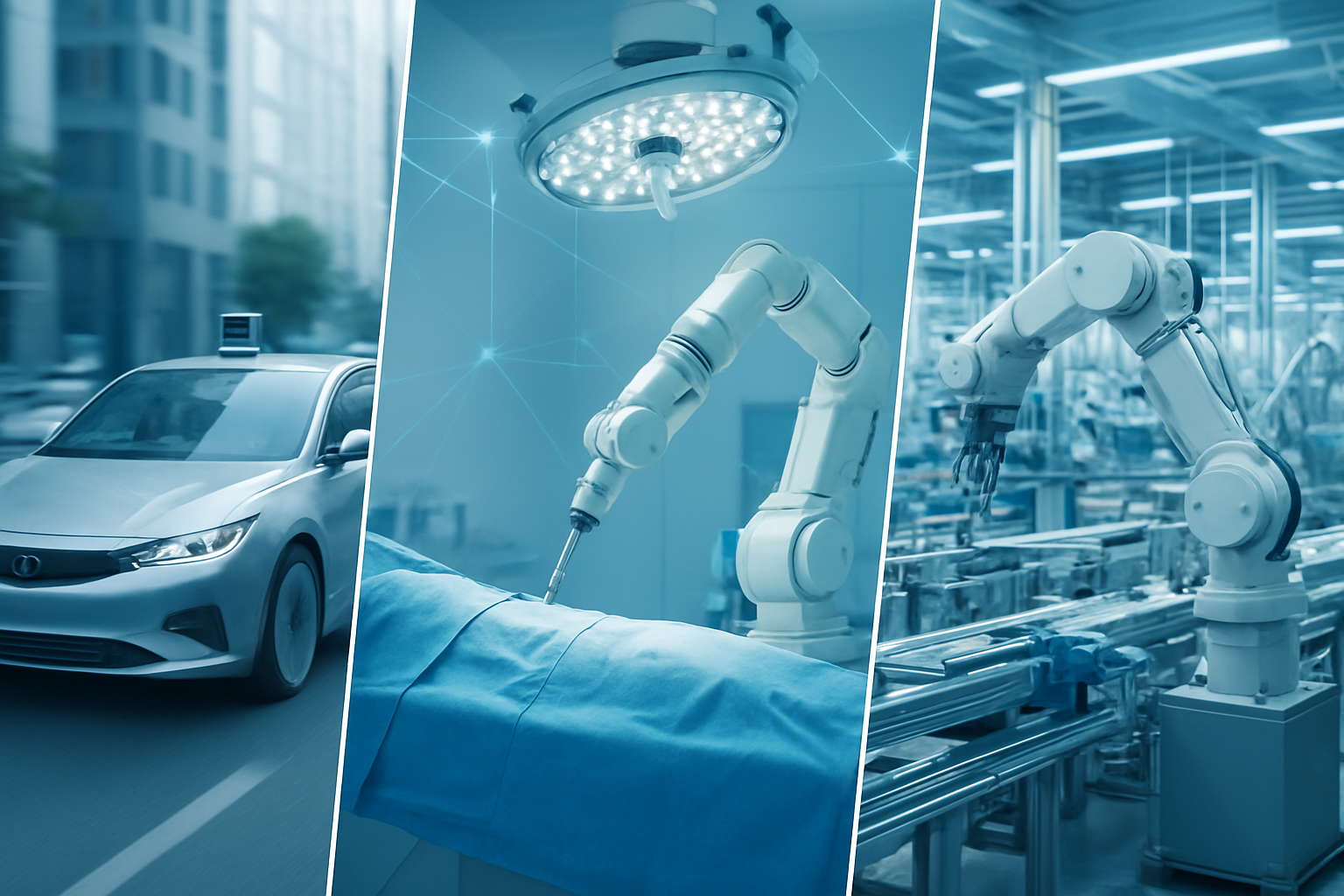
Healthcare Breakthroughs You Can Benefit From
Medical imaging has been completely transformed by artificial intelligence applications, allowing doctors to detect diseases earlier than ever before. AI systems can now spot cancerous tumors in mammograms with accuracy rates exceeding human radiologists, often catching abnormalities that might be missed during routine screenings. These machine learning algorithms analyze thousands of medical images in seconds, comparing patterns against vast databases of previous cases.
Drug discovery, traditionally a process taking 10-15 years, now benefits from AI acceleration that cuts development time significantly. Machine learning models predict how different compounds will interact with target proteins, eliminating countless failed experiments before they begin. This means new treatments reach patients faster and at lower costs.
Virtual health assistants powered by artificial intelligence basics help patients manage chronic conditions like diabetes by monitoring blood sugar levels and providing personalized recommendations. These systems learn individual patterns and can predict potential health crises before symptoms appear, sending alerts to both patients and healthcare providers.
Robotic surgery systems use AI to enhance precision during complex procedures, reducing recovery times and improving outcomes. Surgeons can perform minimally invasive operations with enhanced accuracy, while AI analyzes real-time data to guide surgical decisions.
Financial Services That Use AI to Protect Your Money
Fraud detection systems represent one of the most practical machine learning fundamentals in action today. Every time you swipe your credit card, AI algorithms instantly analyze the transaction against your spending patterns, location data, and thousands of risk factors. These systems can flag suspicious activity within milliseconds, often blocking fraudulent charges before you even notice them.
Algorithmic trading uses machine learning to execute trades at speeds impossible for human traders. These systems analyze market conditions, news sentiment, and historical patterns to make split-second investment decisions that can protect your portfolio during market volatility.
Credit scoring has evolved beyond traditional metrics thanks to AI applications that consider hundreds of data points. Alternative credit scoring models help people with limited credit history access loans by analyzing payment patterns, employment stability, and even social media behavior to assess creditworthiness more fairly.
Robo-advisors democratize investment management by using AI to create personalized portfolios based on your risk tolerance and financial goals. These platforms continuously rebalance investments and adjust strategies as market conditions change, providing professional-level portfolio management at a fraction of traditional costs.
Transportation Innovations Making Travel Safer
Autonomous vehicles represent the most visible example of how AI applications are reshaping transportation. Self-driving cars use multiple AI systems simultaneously – computer vision to identify objects, machine learning to predict pedestrian behavior, and neural networks to make real-time driving decisions. These vehicles process sensor data from cameras, radar, and lidar systems to create a comprehensive understanding of their environment.
Traffic management systems in smart cities use AI to optimize signal timing and reduce congestion. These systems analyze traffic patterns throughout the day, adjusting light sequences to improve flow and reduce emissions from idling vehicles.
Predictive maintenance in aviation uses machine learning to monitor aircraft components and predict mechanical failures before they occur. Airlines can schedule maintenance during planned downtime rather than dealing with unexpected breakdowns that cause flight delays and safety concerns.
Ride-sharing platforms optimize routes and match drivers with passengers using sophisticated algorithms that consider traffic conditions, driver locations, and demand patterns. This reduces wait times and makes transportation more efficient for everyone involved.
Essential AI Terminology Every Professional Should Know

Must-Know Terms for Business Conversations
Algorithm sits at the heart of every AI system – think of it as a recipe that tells computers how to solve problems step by step. When someone mentions their company uses “advanced algorithms,” they’re talking about sophisticated problem-solving instructions.
Neural Networks mimic how our brains process information through interconnected nodes. These artificial intelligence basics form the backbone of deep learning systems that recognize faces, translate languages, and power chatbots.
Training Data refers to the information fed to machine learning systems so they can learn patterns. Just like teaching a child to recognize cats by showing them hundreds of cat pictures, AI systems need examples to understand what they’re looking for.
Predictive Analytics helps businesses forecast future trends based on historical data. Companies use this to anticipate customer behavior, inventory needs, and market changes.
Natural Language Processing (NLP) enables computers to understand human language. When you ask Siri a question or use voice-to-text, you’re experiencing NLP in action.
Technical Concepts Simplified for Non-Experts
Supervised Learning works like having a teacher guide a student. The system learns from labeled examples – showing it thousands of emails marked as “spam” or “not spam” teaches it to identify spam automatically.
Unsupervised Learning lets the AI discover patterns without guidance. Imagine giving someone a box of mixed LEGO pieces and asking them to find similarities – the system groups data based on hidden patterns it discovers.
Deep Learning uses multiple layers of neural networks to process complex information. Think of it as looking at a photograph through multiple filters, each one picking up different details until the full picture emerges.
Computer Vision gives machines the ability to “see” and interpret images. This technology powers everything from medical imaging diagnosis to quality control in manufacturing.
Reinforcement Learning trains AI through trial and error, rewarding good decisions and penalizing bad ones. Game-playing AI systems often use this approach to master complex strategies.
Buzzwords to Avoid and What They Really Mean
“AI-powered” gets slapped onto every product these days. Many times, it just means basic automation or simple rule-based systems. Real AI involves learning and adaptation, not just following pre-programmed responses.
“Intelligent automation” often describes regular workflow automation with a fancy name. True machine learning explained involves systems that improve their performance over time, not just executing predetermined tasks.
“Smart algorithms” frequently refers to standard statistical analysis dressed up with trendy language. Genuine artificial intelligence for beginners starts with understanding that smart means the system can adapt and learn from new information.
“Cognitive computing” sounds impressive but usually describes pattern recognition or data analysis tools that have existed for years. The cognitive aspect implies human-like thinking, which most systems don’t actually possess.
“Machine intelligence” gets thrown around as a synonym for any computer program that makes decisions. Real machine intelligence requires the ability to generalize from limited examples and handle unexpected situations.
Language That Will Make You Sound Informed
Bias and Fairness represents crucial concerns in AI development. Understanding how training data can introduce unfair preferences shows you grasp the ethical dimensions of AI terminology.
Explainable AI addresses the need to understand how AI systems reach their conclusions. When discussing AI applications, mentioning explainability demonstrates awareness of transparency requirements.
Edge Computing brings AI processing closer to where data gets generated, reducing delays and improving privacy. This shows understanding of practical AI implementation challenges.
Transfer Learning allows AI systems trained on one task to apply knowledge to related problems. This concept shows you understand how does machine learning work efficiently across different domains.
Hyperparameter Tuning involves adjusting the settings that control how AI systems learn. Referencing this process demonstrates technical awareness without getting lost in complex details.
Feature Engineering describes selecting and preparing the right data inputs for machine learning models. Understanding this process shows you know that machine learning in daily life depends on choosing relevant information patterns.

Artificial intelligence and machine learning aren’t just tech buzzwords anymore—they’re already reshaping how we work, shop, and interact with the world around us. From the recommendation algorithms that suggest your next Netflix binge to the smart systems helping doctors diagnose diseases faster, these technologies are quietly making our lives easier and more efficient. The key difference is simple: AI is the broader goal of making machines smart, while machine learning is one specific way we’re getting there by teaching computers to learn from data.
Now that you understand the basics, start paying attention to AI and ML in your own daily routine. You’ll be surprised how often you encounter these systems, from your phone’s voice assistant to your bank’s fraud detection. The professionals who take time to learn this essential vocabulary and understand these concepts will be better positioned to adapt as these technologies continue evolving. Don’t wait for AI to transform your industry—start exploring how you can work alongside these powerful tools today.